
China Life(601628)

Search documents
一揽子政策落地显效 中长期资金筑牢稳市根基丨时报经济眼
Zheng Quan Shi Bao· 2025-09-17 00:06
Group 1 - The A-share market has stabilized and become more active since the implementation of a comprehensive financial support package for high-quality economic development on September 24, 2024, leading to improved market expectations and confidence [1][3] - The China Securities Regulatory Commission (CSRC) aims to consolidate the positive momentum in the capital market, enhance its attractiveness and inclusiveness, and promote long-term, value, and rational investment philosophies [1][4] - The combination of regulatory guidance and financial support has transitioned market stabilization efforts from passive responses to proactive management, focusing on consistency in macro policy orientation [4][6] Group 2 - The influx of medium- and long-term funds is crucial for maintaining the long-term stability and health of the market, with various types of funds, including insurance and bank wealth management, increasingly entering the market [6][7] - Data shows that the total investment amount from five major listed insurance companies reached 18,464.29 billion yuan, a 28.71% increase from the beginning of the year, while the total scale of public funds surpassed 35 trillion yuan [6][7] - The establishment of long-term assessment mechanisms has improved the willingness of institutional investors to enter the market, leading to a concentration of funds towards high-quality assets [7][8] Group 3 - To sustain the positive trend in the capital market, it is essential to further improve stabilization mechanisms and continuously stimulate the market's internal growth potential [9] - The CSRC plans to deepen capital market reforms, cultivate long-term capital, and accelerate the entry of medium- and long-term funds into the market [9][10] - Recommendations include enhancing the scale and proportion of medium- and long-term funds entering the market, improving corporate governance, and increasing shareholder returns through dividends and buybacks [9][10]



上市险企渠道变局: 个险承压 银保快速增长
Zhong Guo Zheng Quan Bao· 2025-09-16 22:23
Core Insights - The personal insurance industry is experiencing a rapid channel differentiation, with individual insurance channels showing a slowdown in growth while bancassurance channels are seeing significant increases in both premium scale and new business value [1][2][4] Bancassurance Channel Performance - Several major listed insurance companies reported impressive growth in their bancassurance channels, with some companies seeing new business value growth exceeding 100% year-on-year [2] - For instance, Ping An Life's new business value from bancassurance reached 5.972 billion yuan, a year-on-year increase of 168.6%; China Life's total premium from bancassurance was 72.444 billion yuan, up 45.7%, with new single premium increasing by 111.1% to 35.873 billion yuan [2] - The regulatory environment has changed, with the removal of restrictions on the number of bank branches that can cooperate with insurance companies, leading to an increase in collaboration and performance in the bancassurance sector [2][4] Individual Insurance Channel Challenges - In contrast to the growth in bancassurance, the individual insurance channels of several companies, except for New China Life, have faced pressure, with declines in first-year premiums for long-term insurance [3][4] Future Channel Strategies - Industry experts suggest that insurance companies will adopt a diversified channel strategy, emphasizing both bancassurance and individual insurance channels to ensure stable business development and long-term growth in new business value [5][6] - Companies like China Life and New China Life are focusing on professionalization and innovation in their marketing teams to enhance sales capabilities and optimize recruitment models [5][6]
上市险企渠道变局:个险承压 银保快速增长
Zhong Guo Zheng Quan Bao· 2025-09-16 20:20
Core Insights - The personal insurance industry is experiencing a rapid channel differentiation, with individual insurance channels showing a slowdown in growth while bancassurance channels are seeing significant increases in both premium scale and new business value [1][2][3] Bancassurance Channel Performance - Several major listed insurance companies reported impressive growth in their bancassurance channels, with some companies seeing new business value growth exceeding 100% year-on-year [1] - For instance, Ping An Life's new business value from bancassurance reached 5.972 billion yuan, a year-on-year increase of 168.6%; China Life's total premium from bancassurance was 72.444 billion yuan, up 45.7%, with new single premium increasing by 111.1% to 35.873 billion yuan; New China Life's first-year premium from long-term insurance via bancassurance was 24.939 billion yuan, up 150.3% [1][2] Regulatory Changes and Industry Dynamics - In May 2024, regulatory authorities lifted restrictions on the number of bank branches that can collaborate with insurance companies, leading to an increase in cooperative bank branches [2] - As of June 2025, Taiping Life's number of performance branches reached 13,000, a year-on-year increase of 28.9%, with a monthly average growth of 70.2% [2] Future Channel Strategies - Industry experts suggest that insurance companies will adopt a diversified channel strategy, emphasizing both bancassurance and individual insurance channels to enhance business stability and achieve long-term growth in new business value [3][4] - China Life's management indicated that the individual insurance channel will continue to play a core role, focusing on professionalization and diversification of business [4]

保险行业2025年中报综述:负债端“反内卷”政策成效显著,投资端表现分化
Shenwan Hongyuan Securities· 2025-09-16 09:14
Investment Rating - The report maintains a positive outlook on the insurance industry, recommending several key companies including China Life, China Pacific Insurance, New China Life, Ping An Insurance, China People’s Insurance, China Property Insurance, and Sunshine Insurance [3]. Core Insights - The "anti-involution" policy on the liability side has shown significant effectiveness, leading to notable improvements in NBV and COR performance [3]. - Profit performance among listed insurance companies is differentiated, with a year-on-year increase in net profit of 3.7% to CNY 178.2 billion in the first half of 2025 [3][10]. - The investment performance is varied, with a steady increase in the proportion of equity allocation in the secondary market [3]. Summary by Sections 1. Profit Performance and EV Growth - In the first half of 2025, the net profit of listed insurance companies reached CNY 178.2 billion, with a year-on-year growth of 3.7% [6][10]. - The embedded value (EV) of listed insurance companies increased steadily, with growth rates ranging from 2.6% to 18.4% compared to the end of 2024 [10]. 2. Liability Side: "Anti-Involution" Policy Effectiveness - The net new business value (NBV) for the first half of 2025 reached CNY 75.42 billion, a year-on-year increase of 30.5% [3][26]. - The NBV growth rates for various companies ranged from 14.0% to 58.4% [3]. - The cost of risk (COR) improved, leading to a significant increase in underwriting profits, with a year-on-year growth of 67.9% to CNY 24.87 billion [3]. 3. Asset Side: Investment Performance Variation - The total investment assets of seven listed insurance companies grew by 7.5% to CNY 21.9 trillion, accounting for 60.3% of the industry’s total insurance fund utilization [3]. - The net investment return rate for listed insurance companies ranged from 2.8% to 3.8%, showing a decline compared to the previous year [3]. 4. Investment Analysis Opinion - The report highlights the dual factors of liability costs and long-term interest rates, which have recently shown marginal improvement, suggesting a positive outlook for the insurance sector [3].

保险板块9月16日跌0.94%,中国太保领跌,主力资金净流出15.41亿元
Zheng Xing Xing Ye Ri Bao· 2025-09-16 08:46
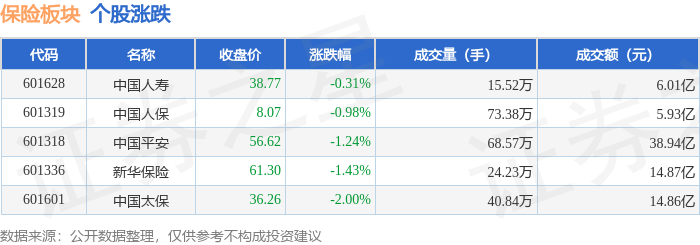
Core Insights - The insurance sector experienced a decline of 0.94% on September 16, with China Pacific Insurance leading the drop [1] - The Shanghai Composite Index closed at 3861.87, up 0.04%, while the Shenzhen Component Index closed at 13063.97, up 0.45% [1] Company Performance - China Life Insurance (601628) closed at 38.77, down 0.31% with a trading volume of 155,200 shares and a turnover of 601 million yuan [1] - China Pacific Insurance (601601) closed at 36.26, down 2.00% with a trading volume of 408,400 shares and a turnover of 1.486 billion yuan [1] - China Ping An (601318) closed at 56.62, down 1.24% with a trading volume of 685,700 shares and a turnover of 3.894 billion yuan [1] - New China Life Insurance (601336) closed at 61.30, down 1.43% with a trading volume of 242,300 shares and a turnover of 1.487 billion yuan [1] - China Reinsurance (601319) closed at 8.07, down 0.98% with a trading volume of 733,800 shares and a turnover of 593 million yuan [1] Fund Flow Analysis - The insurance sector saw a net outflow of 1.541 billion yuan from institutional investors, while retail investors had a net inflow of 978 million yuan [1] - The detailed fund flow for major companies shows that: - China Life Insurance had a net outflow of 69.03 million yuan from institutional investors [2] - China Pacific Insurance had a net outflow of 2.53 billion yuan from institutional investors [2] - China Ping An experienced a net outflow of 761 million yuan from institutional investors [2] - New China Life Insurance had a net outflow of 329 million yuan from institutional investors [2] - China Reinsurance had a net outflow of 1.287 million yuan from institutional investors [2]

险资万亿元“隐秘仓位”曝光
3 6 Ke· 2025-09-16 04:20
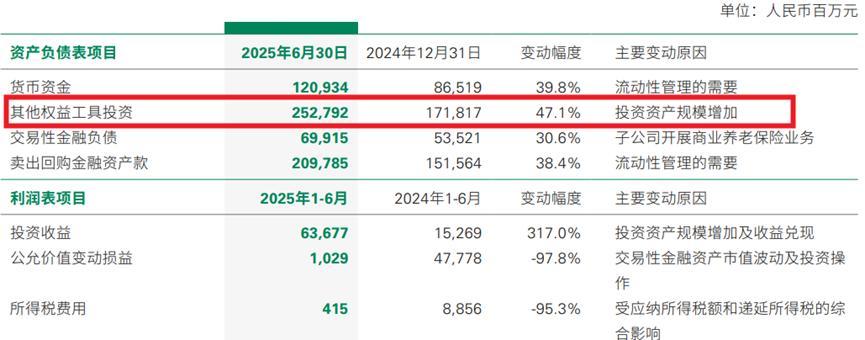
Core Viewpoint - The "Other Equity Instruments Investment" (OCI) has emerged as a significant platform for insurance funds to increase their holdings in A-shares, with a record investment of 1.1 trillion yuan in stocks this year, marking a historical first [1][3]. Group 1: Growth of OCI - The OCI asset scale held by the five major listed insurance companies reached approximately 1.1 trillion yuan by June 2025, a historical high, compared to over 800 billion yuan at the end of 2024, indicating a growth rate exceeding 35% in the first half of the year [3][4]. - The rapid growth of OCI assets is primarily attributed to increased allocations by insurance companies rather than just asset appreciation [3][4]. Group 2: Preference for OCI - Insurance funds are increasingly favoring equity investments and placing significant emphasis on the OCI channel due to its accounting benefits, which allow market value fluctuations and cumulative gains/losses not to enter the profit and loss statement [5][6]. - Major insurance companies such as Ping An, China Life, New China Life, China Pacific Insurance, and China Re are actively utilizing OCI accounts for their investments [5]. Group 3: Individual Company Performance - Ping An has notably utilized the OCI account, with its OCI assets surpassing 500 billion yuan for the first time, reaching 520.5 billion yuan, a 46% increase from 356.5 billion yuan at the end of 2024 [6][7][8]. - China Life's OCI assets increased from 171.8 billion yuan to 252.8 billion yuan, a growth of over 800 billion yuan, reflecting a 47.1% increase [9][10]. - New China Life's OCI assets grew from 30.64 billion yuan to 37.47 billion yuan, while its trading financial assets decreased, indicating a shift towards long-term equity allocations [15][16]. - China Re's OCI assets increased from 115.78 billion yuan to 139.64 billion yuan, marking a 20% growth in just six months [19][20]. Group 4: Investment Strategies - China Life has significantly increased its investments in Hong Kong stocks through OCI, with the amount rising from 36.3 billion yuan to 61.1 billion yuan, a growth of over 68% [12][14]. - The investment strategies of these insurance companies reflect a structural shift towards long-term equity investments, with a focus on high-dividend assets [14][22]. Group 5: Stock Preferences - The investment preferences of insurance funds can be inferred from their major stock holdings, with China Life favoring companies with strong cash flows, such as telecom and coal sectors, while Ping An focuses on high-dividend stocks like Changjiang Power [21]. - New China Life's investment strategy shows a strong individual stock selection, particularly in the pharmaceutical sector, indicating a focus on asset appreciation [22].
保险板块9月15日跌0.87%,新华保险领跌,主力资金净流出11.88亿元
Zheng Xing Xing Ye Ri Bao· 2025-09-15 08:43
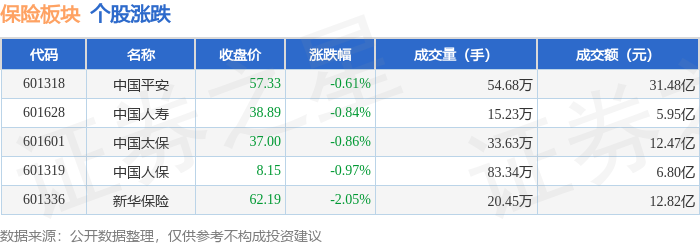
Core Points - The insurance sector experienced a decline of 0.87% on September 15, with New China Life Insurance leading the drop [1] - The Shanghai Composite Index closed at 3860.5, down 0.26%, while the Shenzhen Component Index rose by 0.63% to 13005.77 [1] Insurance Sector Performance - China Ping An (601318) closed at 57.33, down 0.61% with a trading volume of 546,800 shares and a transaction value of 3.148 billion [1] - China Life Insurance (601628) closed at 38.89, down 0.84% with a trading volume of 152,300 shares and a transaction value of 595 million [1] - China Pacific Insurance (601601) closed at 37.00, down 0.86% with a trading volume of 336,300 shares and a transaction value of 1.247 billion [1] - China Property & Casualty Insurance (601319) closed at 8.15, down 0.97% with a trading volume of 833,400 shares and a transaction value of 680 million [1] - New China Life Insurance (601336) closed at 62.19, down 2.05% with a trading volume of 204,500 shares and a transaction value of 1.282 billion [1] Capital Flow Analysis - The insurance sector saw a net outflow of 1.188 billion from institutional investors, while retail investors contributed a net inflow of 875 million [1] - Detailed capital flow for major companies shows: - China Life Insurance had a net outflow of 46.69 million from institutional investors and a net inflow of 55.17 million from retail investors [2] - China Property & Casualty Insurance had a net outflow of 65.68 million from institutional investors and a net inflow of 21.49 million from retail investors [2] - China Pacific Insurance had a net outflow of 1.55 billion from institutional investors and a net inflow of 1.69 billion from retail investors [2] - New China Life Insurance had a significant net outflow of 324 million from institutional investors but a net inflow of 209 million from retail investors [2] - China Ping An experienced a net outflow of 5.96 billion from institutional investors and a net inflow of 420 million from retail investors [2]
金华监管分局同意中国人寿永康市支公司龙山镇桥下营销服务部变更营业场所
Jin Tou Wang· 2025-09-15 08:40
Core Viewpoint - The National Financial Supervision Administration of Jinhua has approved the relocation of China Life Insurance Company's Yongkang Branch's marketing service department to a new address in Jinhua City, Zhejiang Province [1] Group 1 - The new business location for the marketing service department is set to be at No. 90, Ground Floor, Hongxing New District, Longshan Town, Yongkang City, Jinhua, Zhejiang Province [1] - China Life Insurance Company is required to handle the change and obtain the necessary permits in accordance with relevant regulations [1]
锦州金融监管分局同意撤销中国人寿北镇市支公司青堆子镇营销服务部
Jin Tou Wang· 2025-09-15 08:40
Group 1 - The Jinzhou Financial Regulatory Bureau approved the request from China Life Insurance Company Limited Liaoning Branch to revoke the marketing service department in Qingduizi Town, Beizhen City [1] - Following the approval, the marketing service department must cease all business activities immediately and return the license to the Jinzhou Financial Regulatory Bureau within 15 working days [1] - The company is required to handle related procedures in accordance with relevant laws and regulations [1]
中国人寿寿险公司启动2025年金融教育宣传周活动
Huan Qiu Wang· 2025-09-15 08:17
Core Viewpoint - The "Financial Education Promotion Week" launched by regulatory authorities aims to enhance financial literacy among consumers and protect their rights in financial transactions [1][2] Group 1: Event Overview - The event is themed "Protecting Financial Rights, Supporting a Better Life" and lasts for one week, focusing on educating the public about financial products and risks [1] - China Life Insurance Company actively participates by implementing a comprehensive "online + offline" promotional model, including various themed activities to educate consumers about financial risks [1] Group 2: Activities and Initiatives - China Life has established "Consumer Protection Energy Stations" at service centers, offering interactive games to teach financial knowledge and enhance risk awareness [1][2] - The company is expanding its outreach through community engagement, organizing teams to deliver financial knowledge directly to neighborhoods and various sectors [2] - A regular online knowledge Q&A session called "Tuesday Appointment" is part of the promotional strategy, creating a multi-channel approach to financial education [2] Group 3: Goals and Future Plans - The initiative aims to strengthen public trust in the financial system while providing practical services that cater to different demographics, including the elderly and disabled [2] - China Life plans to integrate consumer rights protection with practical services, focusing on creating accessible and memorable financial education content [2]