
China Life(601628)

Search documents
国寿、太保宣布:撤销监事会
Jin Rong Shi Bao· 2025-12-26 02:14
Group 1 - The core point of the article is the significant shift in the governance structure of the insurance industry in China, with multiple companies, including China Life and China Pacific Insurance, announcing the abolition of their supervisory boards [1][2][3] - As of December 25, 2023, a total of 13 insurance companies have announced the dissolution of their supervisory boards, indicating a profound transformation in the long-standing "three meetings and one layer" governance framework [1][2] - The trend of abolishing supervisory boards began with Japan's insurance company in April 2023 and has been rapidly adopted by state-owned insurance groups, expanding from group companies to specialized subsidiaries [1][2] Group 2 - The new policy guidance is driven by the upcoming implementation of the revised Company Law in July 2024, which allows wholly state-owned companies to replace supervisory boards with audit committees [3] - The decision to abolish supervisory boards is motivated by the need to reduce costs and improve efficiency, addressing the weaknesses of traditional supervisory functions [3] - Experts believe that the abolition of supervisory boards represents an exploration of modern financial governance, with a focus on enhancing compliance and risk management capabilities within the insurance industry [3]


“长钱”叙事下的险资
Shang Hai Zheng Quan Bao· 2025-12-26 02:01
Group 1 - The core narrative of insurance capital is shifting towards "long money," characterized by more precise asset-liability matching, diversified investment channels, and extended investment horizons, which are expected to persist for a long time [1] - Regulatory policies are guiding this shift by loosening restrictions on insurance capital investments, encouraging long-term investments in the capital market [2][6] - As of Q3 2025, the balance of stock investments for life and property insurance companies has increased by approximately 50% and 30% respectively compared to the beginning of the year [2] Group 2 - Insurance capital is increasingly focusing on gold investments as a new area of interest, with the wealth storage function of gold regaining importance amid global macro uncertainties [3] - The OCI strategy, which emphasizes long-term dividend returns over short-term price differences, has led to a record number of approximately 40 equity stakes taken by insurance capital this year [4] - The new "National Nine Articles" has transformed dividend requirements from regulatory guidance to rigid constraints, enhancing the market environment for stable dividend targets [4] Group 3 - Long-term investment philosophy is becoming a core criterion for talent selection within insurance institutions, emphasizing the importance of a shared long-term investment vision among team members [5] - The investment strategy is evolving from a generic approach to a more refined asset-liability matching strategy, necessitated by changes in liability characteristics and the development of floating yield products [6][7] - A dynamic asset-liability matching mechanism is being established to adapt to the characteristics of floating yield products and market conditions, ensuring investment returns effectively cover liability costs [7]

养老社区布局从“落子成点”到“经纬成网” 险企养老版图加速“裂变”
Zheng Quan Ri Bao Zhi Sheng· 2025-12-25 16:36
Core Viewpoint - The insurance industry is accelerating its investment in high-quality elderly care communities, responding to China's aging population and creating a nationwide network for "migratory-style retirement" by 2025 [1][2]. Group 1: Industry Trends - By the end of 2025, insurance companies are expected to launch over 10 elderly care community projects, with major players like China Life, Taikang Insurance, and China Pacific Insurance leading the market [2][3]. - The insurance sector has built 130 elderly care community projects during the 14th Five-Year Plan period, establishing a broad network of elderly care services [2]. Group 2: Market Drivers - The demand for elderly care is driven by over 310 million people aged 60 and above in China, with the silver economy projected to reach 30 trillion yuan by 2035 [4]. - Policies from the China Banking and Insurance Regulatory Commission support insurance institutions in investing in elderly care facilities, providing clear guidance for industry development [4]. Group 3: Business Models - Insurance companies are diversifying their investment strategies, moving from a heavy asset model to a combination of heavy, medium, and light asset approaches [5]. - The "insurance product + elderly care community" model enhances large policy sales and aligns with the long-term investment needs of elderly care facilities [4][5]. Group 4: Home Care Services - Home care is becoming a new focus for insurance companies, addressing the core needs of the elderly population and expanding service coverage [6][8]. - Major insurance firms like Ping An have extended home care services to 100 cities, benefiting nearly 240,000 clients [7]. Group 5: Strategic Importance - The insurance sector's engagement in elderly care is seen as a strategic long-term initiative, aiming to create a second growth curve for life insurance businesses and transition from product sales to service-oriented models [9][11]. - The integration of elderly care services with insurance products is expected to enhance customer loyalty and control costs [9][10]. Group 6: Operational Challenges - High capital costs and long return cycles are common challenges in the elderly care community sector, with occupancy rates needing to exceed 60% for cash flow sustainability [10]. - The home care sector faces operational challenges, including high service costs and the need for standardized services, which require innovative solutions and collaboration among various stakeholders [10].

5年重回3万亿!新华、太保创历史新高,五大险企市值大涨背后,是为什么?
13个精算师· 2025-12-25 14:12
一周内 多家上市险企创新高 ②外部机遇叠加 资负两端压力缓解 分红险发力、养老需求增长 ③资本市场 对上市险企看好的背后 是预期的转变、对头部的信心 1 时隔5年 五大险企市值超3万亿 ①新华、太保:创历史新高 平安、人保:创近年来新高 更重要的是,时隔五年,上市保险公司终于走出低谷,市值重回顶峰! 截止目前,五大上市险企的总市值已经超过3.3万亿,较上年同期增长约2 9%,近两年 累计涨幅约8 5%。 甚至,资本市场对保险公司的讨论热度也明显提升... 有人表示"保险公司的股东们苦尽甘来",也有人说"之前的银行感觉要换成保险了"。 时隔5年 五大险企 市值超3万亿 新华、太保:创历史新高 | 保险股 √ | 当前价 ◆ | 涨跌幅 ◆ | 成交量 $ | 总市值 ◆ 年初至今 ◆ | | --- | --- | --- | --- | --- | | 中国太保 | 42.64 | +1.14 (+2.75%) | 33.95万手 | 4102.11亿 +28.80% | | SH601601 | | | | | | 中国平安 | 70.80 | +1.77 (+2.56%) 77.79万手 | | 1.28 ...


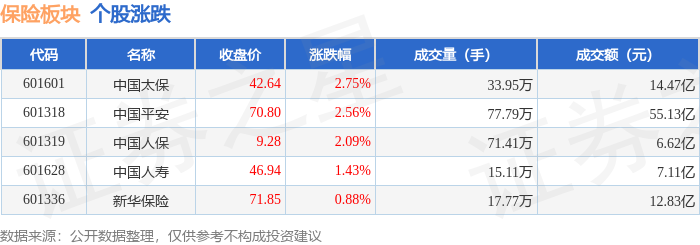
保险板块12月25日涨1.97%,中国太保领涨,主力资金净流入2.87亿元
Zheng Xing Xing Ye Ri Bao· 2025-12-25 09:03
Core Viewpoint - The insurance sector experienced a rise of 1.97% on December 25, with China Pacific Insurance leading the gains, while the Shanghai Composite Index and Shenzhen Component Index also saw increases of 0.47% and 0.33% respectively [1] Group 1: Market Performance - The closing price of China Pacific Insurance was 42.64, reflecting a gain of 2.75% with a trading volume of 339,500 shares [1] - China Ping An closed at 70.80, up by 2.56% with a trading volume of 777,900 shares [1] - China Life Insurance closed at 46.94, showing an increase of 1.43% with a trading volume of 151,100 shares [1] Group 2: Fund Flow Analysis - The insurance sector saw a net inflow of 287 million yuan from institutional investors, while retail investors experienced a net outflow of 258 million yuan [1] - China Ping An had a net inflow of 279 million yuan from institutional investors, but a net outflow of 345 million yuan from retail investors [2] - China Pacific Insurance experienced a net inflow of 65.44 million yuan from institutional investors, with retail investors seeing a net outflow of 53.36 million yuan [2]
保险基本面梳理 110:加强资产负债匹配,利好长期健康发展-20251225
Changjiang Securities· 2025-12-25 09:00
丨证券研究报告丨 行业研究丨专题报告丨保险Ⅱ [Table_Title] 加强资产负债匹配,利好长期健康发展 ——保险基本面梳理 110 报告要点 [Table_Summary] 目前 A/H 股保险估值反映的仍是中长期"利差损"的担忧。在新的保险分析框架之下,结合近 两年政策、市场、监管及行业发展趋势,我们判断保险行业利差有望在中长期持续提升。结合 近期负债端强势增长以及"存款搬家"逻辑,利差企稳到扩张的过程有望加速,估值有望加速 修复。持续看好保险板块,个股推荐新华保险、中国平安、中国人寿、中国人保。 分析师及联系人 [Table_Author] 吴一凡 谢宇尘 SAC:S0490519080007 SAC:S0490521020001 SFC:BUV596 请阅读最后评级说明和重要声明 research.95579.com 1 [Table_Title 加强资产负债匹配,利好长期健康发展 2] ——保险基本面梳理 110 [Table_Summary2] 新规发布的背景是什么:环境、政策、会计准则的变化 %% %% %% %% 内外的变化带来了资产负债管理的新要求。2025 年 12 月 19 日,金管 ...
固定收益点评:分红险复兴,如何影响保险配置偏好?
Guohai Securities· 2025-12-25 08:05
1. Report Industry Investment Rating No relevant content provided. 2. Core Viewpoints of the Report - The report addresses the asset allocation characteristics of dividend - paying insurance and the impact of its transformation on the bond market [4][10] - In 2025, the transformation of dividend - paying insurance became an industry trend, with significant growth in scale. The income of ordinary dividend - paying insurance of six listed insurance companies in the first half of 2025 reached 157.7 billion yuan, a year - on - year increase of 12%, and its proportion in total life insurance income rose from 15% at the end of 2024 to 16.3% [5][11] - The rapid expansion of dividend - paying insurance meets the needs of both clients and insurance companies. For clients, it offers "certainty of guaranteed return + elastic dividend expectation"; for insurance companies, it helps prevent interest spread losses and reduces the impact of investment asset prices on financial statements [5][14][15] - Compared with ordinary life insurance, the asset allocation logic of dividend - paying insurance is more return - oriented, increasing the allocation of high - volatility assets [5] - The growth rate of insurance companies' bond allocation scale may slow down marginally, and their preference for equities will continue. In terms of specific bond types, insurance companies may increase trading demand for ultra - long - term treasury bonds and allocation demand for secondary perpetual bonds while maintaining the allocation of ultra - long - term local government bonds [5][20][22] 3. Summary by Directory 3.1 Dividend - paying Insurance Transformation Initiation - In 2025, major listed insurance companies placed dividend - paying insurance at the core of their products, driving it to dominate new business. The income of dividend - paying insurance of six listed insurance companies in the first half of the year increased significantly [11] - Each major insurance company has taken measures to promote dividend - paying insurance. For example, China Ping An focused on dividend - paying products, and China Pacific Insurance optimized its product structure with increased dividend - paying insurance new - policy premium [12] 3.2 Reasons for the Rapid Increase in Dividend - paying Insurance Scale - Client side: In the context of low - interest rates and expected stock market improvement, the "certainty of guaranteed return + elastic dividend expectation" of dividend - paying insurance meets clients' demand for more elastic returns [5][14] - Insurance company side: It can prevent interest spread losses and reduce the impact of investment asset price fluctuations on financial statements [5][15] 3.3 Differences in the Asset Allocation Logic of Dividend - paying Insurance - Accounting mechanism: Dividend - paying insurance uses the "floating fee method" for measurement, allowing its liability - side price to be linked to the asset - side. It has a return smoothing mechanism, giving its account a higher risk tolerance [5][16][17] - Business transformation: Higher and stable investment returns are crucial for attracting customers, fulfilling dividend promises, and promoting successful transformation [17] 3.4 Impact on the Bond Market - Overall bond demand: The growth rate of insurance companies' bond allocation scale may slow down marginally, and their preference for equities will continue. In the first three quarters of 2025, the proportion of equity assets in insurance companies' new investments increased from 10.4% in 2024 to 39.9%, while the proportion of bonds decreased from 72.2% to 57.1% [20] - Specific bond types: Insurance companies may increase trading demand for ultra - long - term treasury bonds and allocation demand for secondary perpetual bonds while maintaining the allocation of ultra - long - term local government bonds [22]
保险股上涨,证券保险ETF年内涨超15%,保险证券ETF年内涨超11%
Ge Long Hui· 2025-12-25 06:26
Core Viewpoint - The insurance and securities sectors are experiencing significant growth, with the Securities Insurance ETF up over 15% and the Insurance Securities ETF up over 11% year-to-date, driven by strong performances from major companies in the industry [1][2]. Group 1: ETF Performance - The Securities Insurance ETF tracks the CSI 300 Non-Bank Financial Index, with 61.4% of its components being securities and 37.7% being insurance [3]. - The Insurance Securities ETF follows the CSI 800 Securities Insurance Index, with 73.8% of its components in securities and 25.6% in insurance [4]. Group 2: Industry Outlook - According to a recent report by CICC, the life insurance industry is expected to enter a golden development period by 2026, with a more positive trend in liabilities, shifting the investment logic from "seeking revaluation of existing businesses" to "valuing growth capabilities" [4]. - The current surge in the insurance sector is attributed to the expansion of asset under management (AUM) and the recovery of interest rate spreads, enhancing the certainty of investment returns [4]. - The insurance sector is seen as being in a critical window for performance and valuation recovery, supported by favorable policy and market conditions, with leading companies strengthening their advantages [4]. Group 3: Securities Firms - West Securities believes that there is a mismatch between profitability and valuation in the brokerage sector, indicating potential for future recovery [4]. - Guojin Securities highlights four themes for 2026: increased market activity from resident deposit migration, enhanced resilience and reduced volatility in capital markets, opportunities in direct financing for innovative enterprises, and ongoing mergers and acquisitions in the brokerage industry [5]. - Huatai Securities notes that the market remains active with daily trading volumes around 1.7 trillion yuan and financing balances stabilizing at 2.48 trillion yuan, indicating a favorable environment for brokerage value recovery [6].

中国人寿召开“培育弘扬中国特色金融文化” 经验交流会
Jin Rong Jie Zi Xun· 2025-12-25 06:21
会议强调,中国人寿作为中管金融企业,必须旗帜鲜明讲政治,全系统要以中国特色金融文化凝心聚 力,紧紧围绕"五要五不"重要要求,树立正确经营观、业绩观和风险观,将其深度融入公司治理、经营 管理、风险防控全过程,立足主责主业,更好服务党和国家工作大局,高质量推进集团"十五五"规划编 制与"333战略"落地见效,为中国式现代化建设贡献更大力量。 为培育弘扬中国特色金融文化,充分发挥先进典型的示范引领作用,推动全系统广大干部员工践行"五 要五不"重要要求,加快推进公司高质量发展,12月24日,中国人寿集团在京召开"培育弘扬中国特色金 融文化"经验交流会。集团党委书记、董事长蔡希良出席会议并讲话,党委副书记、总裁李祝用主持会 议。人民日报社、中国金融政研会、人民网、中央广播电视总台有关领导和嘉宾到场参会。 会上,7位来自不同业务板块的一线干部员工代表,结合中国特色金融文化和所在领域岗位职责,交流 分享了践行"五要五不"的经验和思考,充分展现了中国人寿践行中国特色金融文化的生动故事,推动全 系统干部员工理解把握"五要五不"重要要求,自觉践行金融工作的政治性、人民性。人民网记者作为媒 体代表,结合近年来媒体记者赴中国人寿基层 ...
保险证券ETF(515630)涨超1.1%,机构称龙头公司nbv有望在25%以上
Xin Lang Cai Jing· 2025-12-25 06:00
Group 1 - The China Securities and Insurance Index (399966) has seen a strong increase of 1.09%, with key stocks such as China Ping An (601318) rising by 2.81% and China Pacific Insurance (601601) by 2.55% [1] - A total of 54 new private securities managers have completed registration this year, with notable entries including Taikang Stable Walk (Wuhan) and Taibao Zhiyuan (Shanghai), both backed by insurance capital [1] - The long-term interest rates have stabilized, with the ten-year government bond yield rising to 1.85%, which is beneficial for the growth of insurance companies' net assets and profit reserves [1] Group 2 - The expected new business value (NBV) growth for listed insurance companies is around 15% for the full year of 2026, with leading companies potentially achieving over 25% [1] - The insurance companies have seen equity returns between 20% and 30% so far in 2025, with further benefits expected from the transition to OCI in the coming year [1] - The current price-to-earnings valuation (PEV) for most listed companies is between 0.5 and 0.7 times, which is within the historical valuation range of 40-50% [1] Group 3 - The Insurance Securities ETF closely tracks the China Securities and Insurance Index, providing investors with a diversified range of investment options [2] - As of November 28, 2025, the top ten weighted stocks in the China Securities and Insurance Index account for 63.12% of the index, with major players including China Ping An (601318) and CITIC Securities (600030) [2]


