GWMOTOR(601633)
Search documents
森麒麟:公司正持续加强全球一线车企的新能源汽车配套力度
Zheng Quan Ri Bao Wang· 2025-09-30 12:11
Core Viewpoint - The company aims to become a global leader in high-end electric vehicle tires, leveraging its product advantages in the electric vehicle sector [1] Group 1: Product Performance - The company has developed ultra-high-performance tires specifically for electric vehicles, excelling in NVH (Noise, Vibration, Harshness), dry and wet braking, and handling [1] - The rolling resistance of the tires has surpassed 0.5%, providing unique advantages in terms of energy efficiency and driving range [1] Group 2: Market Positioning - The company is continuously obtaining qualifications as a qualified supplier for globally renowned OEMs, including Volkswagen Group, Audi, Renault, Stellantis, GAC Toyota, Guangzhou Automobile, Great Wall Motors, Geely, BAIC, and Chery [1] - The company is enhancing its supply capabilities for electric vehicle components to leading global automakers, with expectations for a steady increase in the share of related automakers and models in the future [1]
特斯拉升级车辆前排安全气囊响应逻辑;中国汽车工业协会:8月汽车零部件产品进口金额20.5亿美元,同比下降17.9%丨汽车交通日报
创业邦· 2025-09-30 10:14
Group 1 - The import value of automotive parts in August 2025 reached $2.05 billion, a year-on-year decrease of 17.9% and a month-on-month increase of 3.5% [2] - From January to August 2025, the total import value of automotive parts was $14.27 billion, reflecting a year-on-year decline of 22.1% [2] - Tesla upgraded the front-row airbag response logic to enhance safety by predicting accidents through the Tesla Vision system [2] Group 2 - Great Wall Motors is advancing its "Four Modernizations Strategy," with engineering R&D personnel reaching 23,000 [4] - The company aims to provide a reference model for healthy development in the automotive industry through its differentiated approach [4] - A new supercar model from Great Wall Motors is planned for release by the end of 2026 [4]
魏建军:以“四项不为”守住汽车产业底线,长城汽车破局内卷
Guo Ji Jin Rong Bao· 2025-09-30 05:37
Core Insights - The interview with Wei Jianjun, Chairman of Great Wall Motors, reveals the company's strategy to navigate the challenges in the Chinese automotive market, emphasizing a shift from chaotic competition to value-based competition [5][23]. Group 1: Market Context - In 2025, the Chinese automotive market is experiencing an 8% year-on-year increase in passenger car sales, but industry profit margins have dropped to 5.1%, the lowest in five years, due to issues like excessive marketing and homogenized competition [1][5]. Group 2: Company Strategy - Wei Jianjun advocates for a long-term approach to overcome market challenges, encapsulated in the principle of "integrity and conscientious manufacturing," which serves as a guiding star against industry volatility [6][8]. - The company has committed over 10 billion yuan in R&D for three consecutive years, with a projected R&D investment ratio of 5.2% in 2024, positioning it among the leaders in domestic automotive R&D [8][9]. Group 3: R&D and Innovation - Great Wall Motors has established a robust R&D framework, including advanced facilities like the environmental wind tunnel and Asia's largest independent safety testing lab, reflecting its commitment to high-quality vehicle development [9][10]. - The company has a team of 23,000 engineers and has applied for nearly 50,000 patents, with over 30,000 granted, of which more than 40% are in the field of new energy [8][12]. Group 4: Global Expansion - Great Wall Motors has established three full-process bases in Thailand and Brazil, along with KD factories in Ecuador, and has over 1,400 overseas service channels, achieving cumulative overseas sales of over 2 million vehicles [10][12]. - The company's global strategy focuses on comprehensive output of technology, industry, and services, with overseas sales projected to reach 454,100 units in 2024, marking a 44.61% year-on-year increase [12][21]. Group 5: Value Principles - The company adheres to the "Four Not to" principles, which include respecting capital, valuing users, maintaining ethical standards, and protecting the industry ecosystem, aiming to reject short-term profit temptations [15][16]. - These principles are operationalized through a "user value audit" mechanism, ensuring that new vehicles meet rigorous real-world testing standards before market release [15][16]. Group 6: Strategic Framework - The "Four Modernizations Strategy" includes equal emphasis on fuel and electric vehicles, diversification of new energy sources, and strategic globalization, which are not isolated but interconnected approaches to enhance competitiveness [16][18]. - The company aims to ensure that fuel and electric vehicles meet the same quality standards, which has led to growth in a declining fuel vehicle market [18][20]. Group 7: Future Outlook - Wei Jianjun expresses optimism for the future of the automotive industry in China, suggesting that with perseverance, the country could emerge as a leading automotive power in 20 years [23].
长城汽车的底气:“四不为”筑底,“四化”开路
Nan Fang Du Shi Bao· 2025-09-29 13:33
Core Insights - Longhua Automobile plans to launch a supercar by the end of next year, showcasing its ambition to enter new market segments despite challenges in the automotive industry [1][7] - The company emphasizes value creation, integrity, and customer satisfaction as its core principles, which guide its operations and strategic decisions [1][4] Investment and R&D - Longhua has invested over 3 billion yuan in a state-of-the-art wind tunnel testing facility, which can simulate various environmental conditions, making it one of the few in the country [2][3] - The company has consistently invested over 10 billion yuan annually in R&D for the past three years, totaling over 50 billion yuan, and has established 11 core technology testing labs [3][8] - Longhua has completed over 600 million kilometers of vehicle validation, demonstrating its commitment to safety and quality [3][4] Safety and Quality Assurance - The company adheres to a strict quality control process, emphasizing safety as a top priority, with significant investments in crash testing and safety validation [4][9] - Longhua's recent crash tests showcased the effectiveness of its safety features, with high costs associated with the testing process, reflecting its dedication to protecting drivers [4][9] Strategic Vision - Longhua's strategic approach includes a "Four No's" principle, focusing on long-term value rather than short-term gains, and maintaining integrity in its operations [8][12] - The company aims for a global presence, with local production and job creation in international markets, such as achieving a 50% localization rate in Thailand and creating 2,000 jobs in Brazil [10][11] Market Performance - In Q2, Longhua reported revenue of 52.316 billion yuan, a year-on-year increase of 7.72%, and a net profit of 4.586 billion yuan, reflecting a strong performance in a challenging market [9][10] - The company sold 312,000 vehicles in Q2, marking an 11.63% increase year-on-year, indicating robust demand and operational efficiency [9][10] Future Outlook - Longhua is preparing to launch its supercar after four to five years of development, supported by significant investments in technology and talent acquisition [7][8] - The company advocates for a balanced approach to energy sources, promoting a diverse range of vehicle technologies, including internal combustion, hybrid, and electric vehicles [11][12]
上市公司“存款搬家”?多元化理财方式逐渐受青睐
Zheng Quan Shi Bao· 2025-09-29 11:59
Core Insights - The phenomenon of "deposit migration" among residents and enterprises is gaining attention due to the continuous decline in deposit interest rates and the advantages of wealth management products [1][8] - There is a noticeable trend of decreasing investment in wealth management products by listed companies, with a significant drop in cash deposits [1][4] Group 1: Deposit Migration - In August, new resident deposits decreased by 600 billion yuan year-on-year, marking a continuous negative growth for two months, while non-bank deposits increased by 5.5 billion yuan [1] - The "seesaw effect" between resident and non-bank deposits highlights the ongoing discussions around the "deposit migration" phenomenon [1] Group 2: Decline in Wealth Management Scale - As of September 26, 2023, 1,095 listed companies held a total of 12,395 wealth management products, with a subscription amount of 779 billion yuan, a year-on-year decrease of 13.04% [2] - The subscription amounts for wealth management products in 2023 and 2024 are projected to be 1,295.49 billion yuan and 1,216.66 billion yuan, respectively, indicating a downward trend [2] Group 3: Changes in Wealth Management Structure - Despite the overall decline in wealth management scale, the structure is becoming more diversified, with a growing preference for products linked to bonds, equities, and mixed assets [4][8] - The subscription amount for securities company wealth management products has reached 52.02 billion yuan, a year-on-year increase of 7.74% [4] Group 4: Factors Influencing the Shift - The decline in wealth management scale is attributed to strict controls on fund turnover and the limitations on bank structured deposits [3] - The low efficiency of traditional deposit models, influenced by declining interest rates, has led companies to seek more effective asset allocation strategies [7][8] Group 5: Increased Interest in Direct Securities Investment - Over 70 listed companies have announced plans to use idle funds for securities investment, indicating a shift towards direct investment as a means to enhance fund utilization and profitability [9] - The trend towards professionalization and diversification in the wealth management market is expected to continue, with companies dynamically adjusting their fund allocations [9]
长城汽车超跑计划2026年底亮相 魏建军:项目已启动四五年
Mei Ri Jing Ji Xin Wen· 2025-09-29 11:38
Core Insights - Great Wall Motors plans to unveil its supercar model by the end of 2026, a project that has been in development for four to five years under the direct supervision of Chairman Wei Jianjun [1][3] - The supercar's prototype has been completed, and the company is actively seeking suppliers with experience in ultra-luxury brands to assist in building its BG brand [3][5] - Wei Jianjun emphasizes a strategic focus on small electric vehicles for urban use, while advocating for hybrid models for larger vehicles, indicating a clear direction for the company's product lineup [3][4] Group 1 - The supercar project has been personally overseen by Chairman Wei Jianjun, with the prototype already completed [1] - Great Wall Motors is conducting a tender for suppliers to assist in the development of its ultra-luxury BG brand [3] - The company aims to create a true supercar, moving beyond just market survival [1] Group 2 - Wei Jianjun advocates for small electric vehicles as city cars, while promoting hybrid models for larger vehicles, reflecting a strategic product differentiation [3][4] - The Ora brand is expected to focus on A0 and A-level pure electric vehicles, aligning with the company's vision for electric mobility [4][5] - Great Wall Motors has set a "four modernization strategy" aimed at global expansion and product diversification, with a significant portion of sales coming from overseas markets [5]
人形机器人闪耀 2025 上海工博会
GUOTAI HAITONG SECURITIES· 2025-09-29 11:24
Investment Rating - The report maintains an "Overweight" rating for the automotive industry [4][18]. Core Insights - The humanoid robot sector is gaining attention, particularly showcased at the 2025 Shanghai Industrial Expo, indicating a growing demand for innovative technologies [2][16]. - The report emphasizes the importance of identifying high-cost performance technology routes similar to lithium iron phosphate batteries in the electric vehicle sector, and companies with inherent advantages like CATL [18][17]. - The domestic passenger car market is facing increased competition as the effects of vehicle replacement programs diminish, leading to a recommendation for companies that focus on differentiated competition [18][15]. Summary by Sections 1. Industry Weekly Market Review - The automotive index remained flat over the past week, while the new energy vehicle index fell by 2%. The commercial vehicle index decreased by 3% [2][7]. - Over the past month, the automotive index increased by 5%, while the new energy vehicle index decreased by 2% [8][9]. 2. Investment Strategy and Recommendations - The report suggests focusing on companies like Dechang Motor Holdings and Haoneng Co., which are positioned to benefit from the humanoid robot supply chain [18][19]. - It highlights the potential of companies like Great Wall Motors, SAIC Motor, and JAC Motors in the competitive passenger car market [18][19]. - Recommendations for the heavy truck market include China National Heavy Duty Truck Group, Foton Motor, and Weichai Power, which are expected to benefit from industry upgrades [18][19]. - In the automotive parts sector, companies like Nexteer Automotive and Asia-Pacific Holdings are recommended due to their growth potential [18][19]. 3. Passenger Car Weekly Sales - From September 1 to 21, 2025, retail sales of passenger cars reached 1.191 million units, a year-on-year increase of 1% [15]. - The retail penetration rate for new energy vehicles reached 58.5%, with cumulative retail sales of 8.267 million units this year, reflecting a 24% year-on-year growth [15][18]. 4. Humanoid Robots at the Expo - The report notes the participation of several humanoid robot manufacturers at the Shanghai Industrial Expo, showcasing advancements in robotics technology [16][17]. - Companies like Xynova Future are highlighted for their comprehensive production capabilities in the humanoid robot sector, indicating a trend towards innovation and cost efficiency [17][18].
到2035年新能源汽车将成主流
Dong Zheng Qi Huo· 2025-09-29 11:14
1. Report Industry Investment Rating - Not provided in the given content 2. Core Viewpoints of the Report - By 2035, new energy vehicles will become the mainstream of newly sold vehicles in China, with the net greenhouse gas emissions in the entire economic scope decreasing by 7%-10% from the peak, non-fossil energy consumption accounting for over 30% of the total energy consumption, and other goals to be achieved [1][109][118]. - The penetration rate of the Chinese new energy vehicle market exceeded 30% in 2023 and 50% in 2024. In 2025, high - competitiveness new car products are continuously launched, and price wars are gradually stopped. Overseas markets face trade protectionism in Europe and the United States, so attention should be paid to new growth points such as countries along the Belt and Road and the Middle East. The market share of independent brands continues to expand [3][120]. 3. Summary According to Relevant Catalogs 3.1 Financial Market Tracking - The one - week price changes of related sectors and listed companies are presented in charts. For example, BYD's one - week price decline was 1.65%, while Seres' was 9.48% [12][15]. 3.2产业链数据跟踪 3.2.1 China New Energy Vehicle Market Tracking - **Sales and Exports**: Data on China's new energy vehicle sales, penetration rate, domestic sales, exports, and sales of EV and PHV are presented in charts [16][21][23]. - **Inventory Changes**: Charts show the monthly new additions to new energy passenger vehicle channel inventory and manufacturer inventory [24][25]. - **Delivery Volumes of Chinese New Energy Vehicle Enterprises**: Monthly delivery volumes of enterprises such as Leapmotor, Li Auto, XPeng, NIO, etc., are presented in charts [27][28][32]. 3.2.2 Global and Overseas New Energy Vehicle Market Tracking - **Global Market**: From January to July, global new energy vehicle sales reached 9.233 million, a year - on - year increase of 25.9%. Except for China, Europe and other regions also had significant growth, with year - on - year increases of 29.5% and 53.4% respectively [2]. - **European Market**: Data on European new energy vehicle sales, penetration rate, and sales of EV and PHV in countries like the UK, Germany, and France are presented in charts [44][50][55]. - **North American Market**: In August, US new energy vehicle sales and penetration rate reached record highs. Due to the expiration of the federal electric vehicle tax credit on September 30, high market enthusiasm is expected to continue in September, followed by a sharp decline. Data on North American new energy vehicle sales, penetration rate, and sales of EV and PHV are presented in charts [2][119]. - **Other Regions**: Data on new energy vehicle sales, penetration rate, and sales of EV and PHV in regions such as Japan, South Korea, and Thailand are presented in charts [62][70][72]. 3.2.3 Power Battery Industry Chain - Data on power battery installation volume, export volume, weekly average price of battery cells, material costs, and the operating rates and prices of various battery materials are presented in charts [79][81][85]. 3.2.4 Other Upstream Raw Materials - Data on the daily prices of rubber, glass, steel, and aluminum are presented in charts [102][103][104]. 3.3 Hot News Summaries 3.3.1 China: Policy Dynamics - By 2035, new energy vehicles will become the mainstream of newly sold vehicles in China. From 2026, export license management will be implemented for pure - electric passenger vehicles [109]. 3.3.2 China: Industry Dynamics - From September 1 - 21, new energy vehicle retail sales increased by 10% year - on - year, and cumulative retail sales since the beginning of the year increased by 24%. In the 38th week (September 15 - 21), new energy passenger vehicle retail sales were 299,000, a year - on - year increase of 5.9%, and cumulative retail sales since the beginning of the year were 8.214 million, a year - on - year increase of 23.0% [111][112][113]. 3.3.3 China: Enterprise Dynamics - Chery Automobile was listed on the Hong Kong Stock Exchange, raising HK$9.14 billion. Li Auto and Sunwoda Power jointly established a battery company [114]. 3.3.4 Overseas: Policy Dynamics - Australia announced a 2035 emission reduction target, aiming to reduce emissions by 62 - 70% compared to 2005. The US lowered the import tariff on EU cars to 15%, and Turkey imposed new tariffs on imported passenger cars [114][116][119]. 3.3.5 Overseas: Enterprise Dynamics - BYD's Brazilian factory obtained an international green certificate. Porsche adjusted its product strategy, slowing down electrification and lowering its 2025 performance expectations [117][118]. 3.4 Investment Advice - Pay attention to new growth points such as countries along the Belt and Road and the Middle East. Focus on enterprises with strong product capabilities, smooth overseas expansion, and stable supply [3][120].
坦克撤出、专卖魏牌,长城直营启动变革 | 电厂
Xin Lang Cai Jing· 2025-09-29 10:58
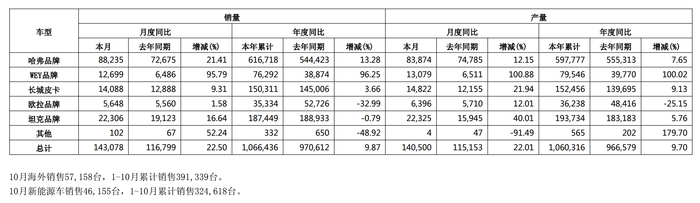
Core Viewpoint - Great Wall Motors is transitioning its "Great Wall Smart Selection" stores nationwide to "Weipai New Energy Direct Stores," focusing solely on Weipai brand vehicles and withdrawing the Tank models from direct sales channels [1][4][7] Group 1: Company Strategy - The transition aims to establish Weipai as the only direct sales brand under Great Wall, enhancing its presence in the high-end market while addressing the challenges faced by traditional dealerships [1][4] - The new CEO of Weipai, Feng Fuzhi, indicated that the Tank models would return to dealerships, allowing Weipai to focus on direct sales, which is seen as a solution to connect with high-end users [4][9] - Great Wall's sales data shows a significant increase in new car sales, with 115,600 units sold in August, marking a 22.33% year-on-year growth, and Weipai's sales reaching 8,028 units, up 167.51% [1][9] Group 2: Market Dynamics - The dual sales model, combining direct sales and dealership sales, has led to conflicts of interest, as dealerships can offer lower prices through external financing incentives, impacting direct store sales [6][7] - Great Wall's strategy to balance the interests of direct stores and dealerships is crucial, as the latter has a long-standing relationship with the company, complicating the transition to a direct sales model [6][7] Group 3: Financial Performance - Great Wall's net profit for the first half of 2025 dropped significantly by 36.39% to 3.581 billion, attributed to increased expenses, particularly in expanding direct sales channels [9][12] - Despite a 2.52% increase in sales volume to 568,900 units, revenue growth was only 0.99%, indicating a decline in the profitability of high-end models [9][12] Group 4: Brand Development - Weipai is positioned as a key brand for Great Wall's high-end strategy, with plans to increase the number of direct stores from 430 to over 600 by the end of the year, aiming for a total of 1,000 stores [10][12] - The brand has faced challenges, including consumer price concerns and delays in product launches, which are common issues for new entrants in the high-end market [12][13] Group 5: Industry Trends - The recovery of the traditional fuel vehicle market is beneficial for Great Wall, with a reported 13.5% year-on-year increase in sales of traditional fuel passenger vehicles in August [13] - Great Wall's strategy to maintain a balance between fuel and electric vehicles allows for greater flexibility in adapting to market changes [13]
魏建军提出“四化战略”,或成汽车行业破局之道
Jing Ji Guan Cha Wang· 2025-09-29 10:07
Core Viewpoint - The article discusses the rapid development of the new energy vehicle (NEV) industry in China, highlighting the need for "oil-electric equality" to address the tax and subsidy disparities between fuel and electric vehicles, as proposed by Wei Jianjun, Chairman of Great Wall Motors [1][2][3]. Summary by Sections New Energy Vehicle Development - From 2009 to 2019, China's subsidies for NEVs exceeded 100 billion yuan, leading to significant growth in the sector [1]. - By 2024, NEV retail sales are projected to reach 10.899 million units, with a penetration rate of 47.6%, which has surpassed 55% as of August this year [1]. Tax and Subsidy Disparities - Fuel vehicle owners face higher tax burdens, with taxes approximately 15% more than those for NEV owners [1]. - The automotive industry is increasingly advocating for oil-electric equality to create a fairer competitive environment [3]. Great Wall Motors' "Four Modernizations" Strategy - Wei Jianjun introduced the "Four Modernizations" strategy, which includes: 1. Pan-internal combustion engine development 2. Diversification of new energy sources 3. Oil-electric equality 4. Strategic globalization [2][3]. Importance of Oil-Electric Equality - Achieving oil-electric equality is crucial for fair development between fuel and NEVs, reducing tax burdens on fuel vehicle owners and promoting healthier market dynamics [3]. - The strategy aims to address the diverse demands of global markets by developing various power systems, including pure electric, hybrid, and hydrogen vehicles [3]. Hi4 Technology System - Great Wall Motors has developed the Hi4 technology system, which integrates high-efficiency engines, transmissions, and electric drives, offering a complete hybrid ecosystem [4]. - The Hi4 system is designed to meet different market needs, with specific models for various vehicle types, including compact SUVs and off-road vehicles [4]. Globalization Strategy - Great Wall Motors is implementing the "ONE GWM" brand strategy to adapt to different international markets, focusing on localized product development [5]. - The company has established a presence in multiple countries, with over 400,000 units of overseas production capacity and sales channels in more than 170 countries [8]. Financial Performance - In Q2 2025, Great Wall Motors reported revenue of 52.316 billion yuan, a year-on-year increase of 7.72%, and a net profit of 4.586 billion yuan, up 19.42% [8][9]. - NEV sales reached 97,900 units, reflecting a growth of 38.69%, while overseas sales also showed steady growth [9].