Workflow
QILU BANK(601665)
icon
Search documents
区域银行冲向科技金融
券商中国· 2025-10-09 11:16
Core Viewpoint - The article emphasizes the importance of fintech as a leading business segment for banks and financial institutions, highlighting the proactive approach of these entities in embracing technological advancements [1]. Group 1: Development of Fintech in Regional Banks - Many regional banks, particularly city and rural commercial banks, are following the lead of larger banks in developing fintech, although their progress may be limited by resources [2]. - Zhejiang Rural Commercial Bank has reported that since launching its fintech pilot in Jiaxing, the proportion of technology enterprise loans has exceeded 30% of corporate loans, covering 7,200 tech enterprises [2]. - Various county-level rural commercial banks in Jiaxing have begun to establish specialized mechanisms for fintech, such as dedicated departments and service models [3]. Group 2: Challenges and Strategies - The development of fintech is challenging for regional banks, which need to root their efforts in local economic structures and overcome internal limitations [5]. - A listed rural commercial bank indicated that it had been considering fintech since 2017, but only completed team formation in 2021, reflecting the long-term commitment required [4]. Group 3: Growth in Technology Loans - Despite smaller loan scales compared to larger banks, regional banks are accelerating their technology loan offerings, with significant growth rates reported [6]. - For instance, Jiangsu Bank's technology loan balance reached 2,740 billion yuan, growing by 17.80% year-on-year, while Hangzhou Bank's technology loans increased by 21.77% [7]. - Other regional banks, such as Qilu Bank and Qingdao Bank, also reported substantial growth in technology loans, with increases of 17.60% and 20.85% respectively [7]. Group 4: Organizational Structure and Specialization - Banks are adapting their organizational structures to support fintech, with many establishing dedicated departments and specialized branches [9]. - For example, Ningbo Bank has set up a technology finance department to provide comprehensive services to tech enterprises, while Qingdao Bank has developed a specialized mechanism for fintech [10]. - Hangzhou Bank has created a well-structured fintech system with multiple regional centers and specialized institutions [11].
城商行板块9月30日跌1%,苏州银行领跌,主力资金净流出4.62亿元
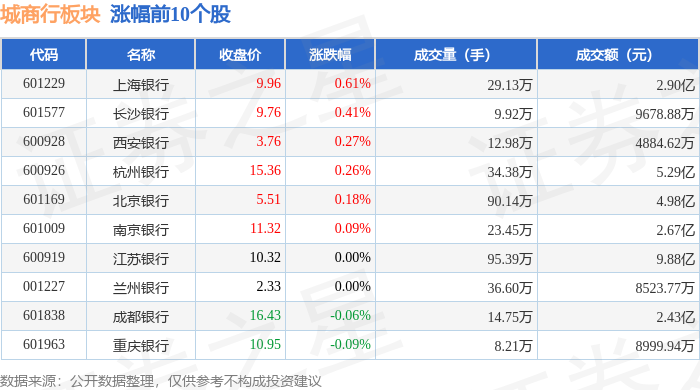
Core Insights - The city commercial bank sector experienced a decline of 1.0% on September 30, with Suzhou Bank leading the drop [1] - The Shanghai Composite Index closed at 3882.78, up 0.52%, while the Shenzhen Component Index closed at 13526.51, up 0.35% [1] Stock Performance Summary - Qingdao Bank: Closed at 4.76, unchanged; trading volume of 223,200 shares, turnover of 106 million [1] - Shanghai Bank: Closed at 8.96, down 0.55%; trading volume of 416,300 shares, turnover of 373 million [1] - Beijing Bank: Closed at 5.51, down 0.72%; trading volume of 2,311,600 shares, turnover of 1.272 billion [1] - Hangzhou Bank: Closed at 15.27, down 0.78%; trading volume of 157,990 shares, turnover of 883 million [1] - Lanzhou Bank: Closed at 2.36, down 0.84%; trading volume of 339,500 shares, turnover of 80.379 million [1] - Guiyang Bank: Closed at 5.76, down 0.86%; trading volume of 271,900 shares, turnover of 157 million [1] - Chongqing Bank: Closed at 8.93, down 0.89%; trading volume of 99,700 shares, turnover of 89.151 million [1] - Changsha Bank: Closed at 8.83, down 0.90%; trading volume of 276,800 shares, turnover of 244 million [1] - Chengdu Bank: Closed at 17.25, down 0.92%; trading volume of 279,700 shares, turnover of 482 million [1] - Zhengzhou Bank: Closed at 1.98, down 1.00%; trading volume of 756,400 shares, turnover of 150 million [1] Capital Flow Analysis - The city commercial bank sector saw a net outflow of 462 million from main funds, while speculative funds had a net inflow of 331 million, and retail investors had a net inflow of 131 million [2] - Suzhou Bank: Main fund net inflow of 55.9396 million, speculative fund net outflow of 11.5337 million, retail net outflow of 44.4059 million [3] - Changsha Bank: Main fund net inflow of 33.8793 million, speculative fund net outflow of 13.6525 million, retail net outflow of 20.2268 million [3] - Qilu Bank: Main fund net inflow of 8.6825 million, speculative fund net outflow of 2.7980 million, retail net outflow of 5.8846 million [3] - Hangzhou Bank: Main fund net inflow of 7.6881 million, speculative fund net inflow of 44.2474 million, retail net outflow of 51.9354 million [3] - Guiyang Bank: Main fund net inflow of 4.8665 million, speculative fund net outflow of 1.6412 million, retail net outflow of 3.2254 million [3]
济南科创债发行规模突破200亿元 发行家数及金额均居全省首位
Sou Hu Cai Jing· 2025-09-29 09:19
Core Insights - Jinan has launched a series of measures to promote the issuance of technology innovation bonds since the introduction of the "Technology Board" in the bond market on May 7, aiming to facilitate financing for local enterprises [2][8] - The city has successfully issued its first technology innovation corporate bond, raising 1 billion yuan, which will be used to support various technology sectors [4] - Jinan leads the province in the number of technology innovation bonds issued, with 13 enterprises issuing 22 bonds totaling 20.1 billion yuan, accounting for over 30% of the province's total [6][8] Group 1 - Jinan's financial office has organized multiple training sessions to enhance market awareness and understanding of technology innovation bonds [2] - A total of 45 technology enterprises have been identified and included in the reserve for technology innovation bonds [2] - The city has established a bond financing service mechanism and secured a pilot program for the "Bond Market City Action Plan" from the Shanghai Stock Exchange [2][8] Group 2 - The Jinan Financial Group successfully issued the first technology innovation corporate bond for state-owned enterprises in the city, with funds directed towards government-guided funds to support hard technology sectors [4] - Qilu Bank issued the first city commercial bank technology financial bond in the province, raising 2 billion yuan with a 5-year term and a coupon rate of 1.84%, attracting over four times the subscription amount [4][6] - The issuance of technology innovation bonds is part of a broader strategy to support high-quality development and technological innovation in Jinan [8]
上市银行“十四五回望”之资负结构与息差变迁
CMS· 2025-09-28 15:09
Investment Rating - The report maintains a recommendation for the banking industry [3] Core Insights - The report provides a comprehensive analysis of the asset-liability structure and interest margin changes of 42 A-share listed banks during the "14th Five-Year Plan" period, highlighting a shift towards corporate loans on the asset side and a stronger retail focus on the liability side [12][14] - The asset-liability structure indicates a significant increase in the proportion of corporate loans, rising from 57.02% to 63.22% from the end of 2020 to mid-2025, while the proportion of demand deposits decreased from 41.94% to 30% [12][14] - The report notes a decline in both asset yield and interest margin, with the yield on interest-earning assets dropping from 4.43% to 3.32% and the net interest margin decreasing from 2.23% to 1.53% during the same period [14][15] Summary by Sections Overall Asset-Liability Structure and Interest Margin Changes - The asset-liability structure shows an increase in loan-to-earning asset ratio from 54.19% to 56.49%, with corporate loans making up a larger share of total loans [14][15] - The average yield on interest-earning assets decreased significantly, with the loan yield falling from 5.34% to 3.82% [15] - The net interest margin for listed banks remains higher than that of commercial banks, despite a decline [14][15] Changes in Each Banking Sector's Asset-Liability Structure and Interest Margin - City commercial banks experienced a more significant increase in the proportion of corporate loans, with their interest margin narrowing less compared to other banks [18] - The report highlights that the proportion of deposits in interest-bearing liabilities for state-owned banks decreased, while it increased for rural commercial banks [18] - The decline in interest-bearing liabilities' cost rate was most pronounced in city commercial banks, leading to a smaller reduction in their interest margin [18]
济南市科创债发行规模突破200亿元
Zheng Quan Ri Bao Wang· 2025-09-28 14:13
Group 1 - Laishang Bank issued a 5-year sci-tech bond, raising 1 billion yuan, marking Jinan's total sci-tech bond issuance at 201 billion yuan, making it the first city in Shandong to exceed this threshold [1] - Since the launch of the "Technology Board" on May 7, Jinan has led Shandong in the number, volume, and amount of sci-tech bond issuances within just over four months [1] - Jinan Municipal Financial Office has implemented various measures to leverage the opportunities presented by the sci-tech bond policy, including training sessions and resource support [1][2] Group 2 - Jinan has established a bond financing service linkage mechanism and successfully secured the Shanghai Stock Exchange's "Bond Market City Action Plan" pilot [2] - The Municipal Financial Office has developed policies to subsidize guarantee and credit enhancement institutions, encouraging support for the issuance of sci-tech bonds by technology enterprises [2] - Jinan has organized experts to provide face-to-face guidance to 10 potential issuing companies, focusing on assisting private technology enterprises in accessing bond financing [2] Group 3 - Currently, 13 enterprises in Jinan have issued a total of 22 sci-tech bonds, accounting for 37.1%, 32.8%, and 34.9% of the total number, volume, and amount of issuances, respectively [3] - Notable issuances include the first national and Shandong sci-tech bonds by Inspur Electronic Information Industry Co., Ltd., and the first financial institution and city commercial bank sci-tech bonds in Shandong by Zhongtai Securities and Qilu Bank, respectively [3] - The two city commercial bank sci-tech bonds in Jinan will specifically support technology innovation through technology loans and investments in innovative enterprises [3]
鑫闻界|提升治理效率,超20家上市银行撤销监事会
Qi Lu Wan Bao· 2025-09-26 07:25
Core Points - Major Chinese banks, including Industrial and Commercial Bank of China, Agricultural Bank of China, Bank of China, China Construction Bank, and Bank of Communications, have announced the approval of amendments to their articles of association, eliminating the supervisory board [2] - The trend of abolishing supervisory boards is also seen in city commercial banks, with Qilu Bank recently voting to no longer establish a supervisory board [2] - Over 20 of the 42 listed banks have either announced the cancellation or are in the process of abolishing their supervisory boards, including several joint-stock banks and local banks [2] - The removal of supervisory boards is driven by the new Company Law effective from July 1, 2024, allowing companies to set up an audit committee within the board of directors to exercise the powers of the supervisory board [2] - The China Securities Regulatory Commission has indicated that listed companies must establish an audit committee by January 1, 2026, to replace the supervisory board [3] - The industry believes that replacing supervisory boards with audit committees will enhance corporate governance efficiency and reduce operational costs, while ensuring independence and professionalism in supervision [3]
热度不减!城商行成科创债发行主力
Guo Ji Jin Rong Bao· 2025-09-26 03:03
Core Viewpoint - The issuance of technology innovation bonds (科创债) has gained momentum among city commercial banks, with a total issuance amount of 12.9 billion yuan in September alone, indicating strong market demand and support from policies [1][2][3]. Group 1: Issuance Details - Ten banks, primarily city commercial banks, have issued a total of 12.9 billion yuan in technology innovation bonds as of September 25, with maturities of five years and coupon rates ranging from 1.84% to 2.03% [2][3]. - Qingdao Bank successfully issued 1 billion yuan in technology innovation bonds with a coupon rate of 1.87%, aimed at supporting technology innovation businesses [2][3]. - Chongqing Three Gorges Bank's technology innovation bond saw a subscription multiple of 2.87, leading to a total issuance of 2.5 billion yuan, exceeding its initial plan [2][3]. Group 2: Market Dynamics - The primary market for technology innovation bonds is characterized by strong policy support, rapid expansion, high credit ratings of issuers, and favorable coupon rates compared to traditional bonds [3][4]. - Since the announcement by the central bank and the securities regulatory authority in May, the issuance of technology innovation bonds by financial institutions has surged, with commercial banks issuing a total of 261.5 billion yuan [3][4]. Group 3: Benefits for Banks - Issuing technology innovation bonds allows small and medium-sized banks to lower financing costs and improve their liability duration structure, reducing reliance on short-term funding [4][5]. - These banks can provide flexible and targeted financial support for local technology projects, enhancing the efficiency of fund utilization in the technology sector [4][5].
银行取消监事会 治理改革面临新挑战
由新公司法驱动的银行治理变革正加速落地。近日,齐鲁银行、兴业银行等上市银行纷纷宣布不再设立 监事会。 业内人士认为,以审计委员会取代监事会可以提升公司治理效率、降低运营成本,但需解决监督的独立 性与专业性问题。此外,如何将原则性规定转化为可行的具体方案,也是银行需要面对的挑战。 纷纷取消监事会 9月23日,齐鲁银行召开股东大会,表决通过了《关于不再设立监事会的议案》。议案表示,根据相关 法律法规、监管制度的规定,结合实际情况,该行拟不再设立监事会及其下设专门委员会,由董事会审 计委员会行使公司法和监管制度规定的监事会职权。 齐鲁银行并非是取消监事会的唯一一家银行。4月29日,工商银行、农业银行、建设银行、中国银行、 交通银行五家国有大行集体宣布撤销监事会,招商银行、兴业银行、北京银行等股份行和城商行也陆续 跟进。 银行取消监事会需要从去年7月1日起施行的新公司法说起。根据法律规定,公司可以在董事会中设置由 董事组成的审计委员会,行使监事会的职权,不设监事会或者监事。此后,国家金融监督管理总局发布 相关通知称,金融机构可以按照公司章程规定,在董事会中设置由董事组成的审计委员会,行使公司法 和监管制度规定的监事会 ...
银行取消监事会治理改革面临新挑战
由新公司法驱动的银行治理变革正加速落地。近日,齐鲁银行、兴业银行等上市银行纷纷宣布不再设立 监事会。 业内人士认为,以审计委员会取代监事会可以提升公司治理效率、降低运营成本,但需解决监督的独立 性与专业性问题。此外,如何将原则性规定转化为可行的具体方案,也是银行需要面对的挑战。 纷纷取消监事会 9月23日,齐鲁银行召开股东大会,表决通过了《关于不再设立监事会的议案》。议案表示,根据相关 法律法规、监管制度的规定,结合实际情况,该行拟不再设立监事会及其下设专门委员会,由董事会审 计委员会行使公司法和监管制度规定的监事会职权。 齐鲁银行并非是取消监事会的唯一一家银行。4月29日,工商银行、农业银行、建设银行、中国银行、 交通银行五家国有大行集体宣布撤销监事会,招商银行、兴业银行、北京银行等股份行和城商行也陆续 跟进。 ● 李静 李蕴奇 业内人士认为,以审计委员会取代监事会有助于提升公司治理效率、降低运营成本,但必须确保监督的 独立性与专业性。 "由审计委员会替代监事会的监督职能,一是有助于提升银行治理效率;二是可以减少机构冗余,精简 公司治理结构;三是董事会对经营和监督全面负责,权责更加清晰,激励与约束机制更为一 ...
城商行板块9月25日跌0.94%,重庆银行领跌,主力资金净流出2.78亿元
Market Performance - The city commercial bank sector declined by 0.94% on September 25, with Chongqing Bank leading the decline [1] - The Shanghai Composite Index closed at 3853.3, down 0.01%, while the Shenzhen Component Index closed at 13445.9, up 0.67% [1] Individual Stock Performance - Chongqing Bank closed at 8.94, down 1.65% with a trading volume of 170,700 shares and a transaction value of 153 million [1] - Other notable declines include Xi'an Bank down 1.50% to 3.95, Zhengzhou Bank down 1.48% to 2.00, and Qingdao Bank down 1.44% to 4.78 [1] - Shanghai Bank and Xiamen Bank also saw declines of 1.43% and 1.39%, respectively [1] Capital Flow Analysis - The city commercial bank sector experienced a net outflow of 278 million from institutional investors, while retail investors saw a net inflow of 152 million [1] - The table indicates that Suzhou Bank had a significant net outflow from institutional investors of 48.08 million, while Qilu Bank had a net inflow of 25.86 million [2] - Chongqing Bank specifically had a net outflow of 5.68 million from institutional investors but a net inflow of 10.91 million from retail investors [2]