
CSCEC(601668)

Search documents
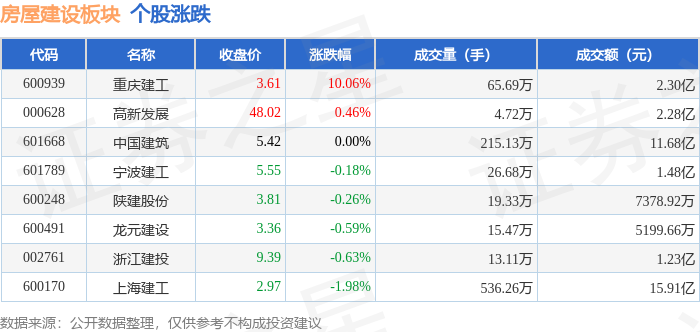
房屋建设板块11月6日跌0%,上海建工领跌,主力资金净流出183.24万元
Zheng Xing Xing Ye Ri Bao· 2025-11-06 08:51
Core Insights - The housing construction sector experienced a slight decline of 0.0% on November 6, with Shanghai Construction leading the losses [1] - The Shanghai Composite Index closed at 4007.76, up 0.97%, while the Shenzhen Component Index closed at 13452.42, up 1.73% [1] Sector Performance - The housing construction sector's individual stock performance varied, with Chongqing Construction seeing a significant increase of 10.06% to a closing price of 3.61 [1] - Other notable performances included: - High-tech Development: up 0.46% to 48.02 - China State Construction: unchanged at 5.42 - Ningbo Construction: down 0.18% to 5.55 - Shanghai Construction: down 1.98% to 2.97 [1] Capital Flow Analysis - The housing construction sector saw a net outflow of 183.24 thousand yuan from institutional investors and 2188.89 thousand yuan from speculative funds, while retail investors contributed a net inflow of 2372.13 thousand yuan [1] - Detailed capital flow for key stocks included: - China State Construction: net inflow of 10.2 million yuan from institutional investors, but net outflows from speculative and retail investors [2] - Chongqing Construction: net inflow of 7.5 million yuan from institutional investors, with net outflows from speculative and retail investors [2] - Zhejiang Construction: minimal net inflow from institutional investors and a net inflow from speculative investors [2]




央企建筑行业ESG评价结果分析:绿色发展与社会责任表现较强:A股央企ESG报告系列报告之十二
Shenwan Hongyuan Securities· 2025-11-06 08:30
Investment Rating - The report indicates a positive investment outlook for the construction state-owned enterprises (SOEs) in the ESG context, highlighting strong performance in green development and social responsibility [5][11]. Core Insights - The overall ESG scores for the 19 construction SOEs are good, with 8 companies scoring above 80 and 10 between 60-79, while only 1 company scored below 60. Climate governance and governance improvements are identified as key weaknesses [11][21]. - The importance assessment is well-disclosed among the companies, with 19 companies reporting their assessments, and 17 completing dual importance assessments. However, third-party verification is lacking, with only 3 companies engaging external validation [13][18]. - Environmental disclosures are mature, but climate disclosures need improvement. The total score for "environment + climate change response" ranges from 0 to 32 out of a maximum of 34, indicating a need for better climate-related disclosures [21][22]. - Social responsibility is a strong focus, with all 19 companies disclosing relevant information, particularly in rural revitalization and social welfare, showcasing their commitment to social responsibility [50][53]. - Governance structures are generally robust, with most companies having established boards and supervisory committees, although transparency in performance evaluation and ESG integration remains an area for improvement [60][65]. Summary by Sections Overall Performance - The ESG performance of the 19 construction SOEs is generally good, with strengths in green development and social responsibility, while climate governance remains a critical shortcoming [11][21]. Importance Assessment - All 19 companies have disclosed their importance assessments, with a high level of completeness. However, third-party verification is limited, indicating a need for greater transparency [13][18]. Environmental & Climate - Environmental disclosures are well-developed, but climate-related disclosures are lagging. The overall score for environmental and climate issues indicates a need for enhanced climate strategy integration [21][22]. Social Responsibility - Social issues are prominently featured in disclosures, with a focus on rural revitalization and community welfare, reflecting a strong commitment to social responsibility among the companies [50][53]. Governance - Governance frameworks are well-established, with most companies having comprehensive governance structures. However, the integration of ESG metrics into performance evaluations is not uniformly transparent [60][65].





A 股央企 ESG 报告系列报告之十二:央企建筑行业ESG评价结果分析:绿色发展与社会责任表现较强
Shenwan Hongyuan Securities· 2025-11-06 06:24
Investment Rating - The report rates the industry as "Positive" for A-share central enterprises in the construction sector, indicating an expectation of outperforming the overall market [3]. Core Insights - The ESG performance of 19 central enterprises in the construction industry is generally good, with strengths in green development and social responsibility, while climate governance and governance enhancement remain key weaknesses [5][13]. - The overall ESG scores show that 8 companies scored above 80, 10 companies scored between 60-79, and 1 company scored below 60, with a maximum score of 100 [13]. - Importance assessments are disclosed by all 19 companies, with 17 completing dual importance assessments, although third-party verification is lacking, with only 3 companies engaging third-party validation [16][18]. Summary by Sections 1. Overall Scores and Areas for Improvement - The ESG scores of the 19 central enterprises are generally good, with green development and social responsibility as strong areas, while climate governance and governance improvements are identified as critical weaknesses [5][13]. 2. Importance Assessment - All 19 companies disclosed importance assessments, with 17 completing dual assessments. However, third-party verification is limited, with only 3 companies providing such validation [16][18]. 3. Environmental & Climate - The total score for "Environment + Climate Change" among the 19 companies ranges from 0 to 32 points (out of 34). Two companies scored between 30-34, indicating strong performance in both environmental and climate disclosures. Twelve companies scored between 20-29, primarily focusing on environmental disclosures, while five companies scored between 10-19, showing limited engagement with climate issues [24][25]. 4. Social Responsibility - All 19 companies disclosed social responsibility initiatives, with a focus on rural revitalization and social welfare, reflecting a strong commitment to social responsibility. However, some disclosures lack quantitative performance indicators [57][60]. 5. Governance - The governance scores are primarily in the mid to high range, with most companies having established governance structures. However, the integration of ESG performance indicators into governance mechanisms remains unclear for many companies [68][73].
中国建筑:公司市值管理把提高企业发展质量作为基础
Zheng Quan Ri Bao· 2025-11-05 13:38
Group 1 - The core viewpoint is that China State Construction's market value performance is influenced by various factors, including market style and industry conditions [2] - The construction industry is currently experiencing a slowdown in growth, and the real estate market is facing adjustments [2] - The company focuses on improving the quality of enterprise development as a foundation for its market value management [2] Group 2 - The company aims to continuously enhance its value creation capability and increase its technological attributes [2] - It maintains a stable dividend policy to actively reward investors [2] - The company is committed to continuously enhancing its investment value [2]
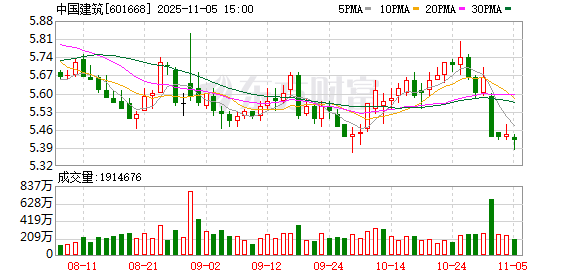
中国建筑:中建八局四公司是青岛西海岸"金沙乐府""楼盘项目的总承包单位
Ge Long Hui· 2025-11-05 11:36
格隆汇11月5日丨中国建筑(601668.SH)在投资者互动平台表示,中建八局四公司是青岛西海岸"金沙乐 府""楼盘项目的总承包单位,项目开发问题请与开发商联系。公司子企业将努力做好支持和配合工作。 ...
中国建筑(601668.SH):中建八局四公司是青岛西海岸"金沙乐府""楼盘项目的总承包单位
Ge Long Hui· 2025-11-05 11:34
格隆汇11月5日丨中国建筑(601668.SH)在投资者互动平台表示,中建八局四公司是青岛西海岸"金沙乐 府""楼盘项目的总承包单位,项目开发问题请与开发商联系。公司子企业将努力做好支持和配合工作。 ...
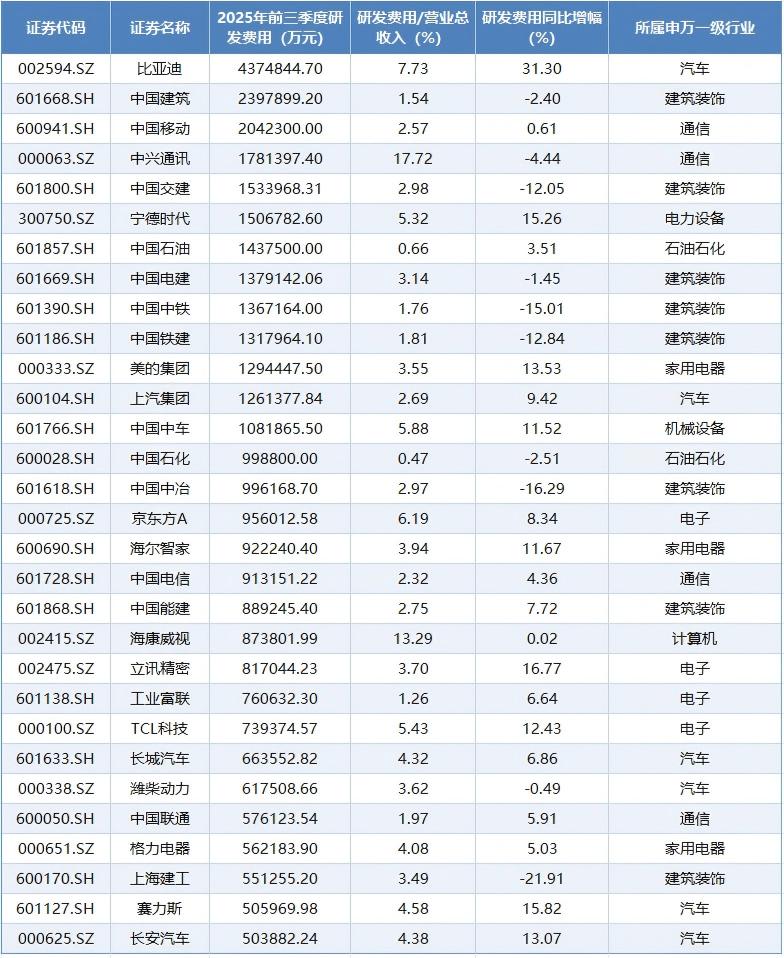
今年前三季度研发投入超1.16万亿,168家企业超十亿,科创板强度领先
3 6 Ke· 2025-11-05 10:52
Core Insights - A-share listed companies in China have seen a continuous increase in R&D investment, reaching a total of 1.16 trillion yuan in the first three quarters of 2025, marking a year-on-year growth of 3.88% [1][2] - High R&D investment is becoming a significant driver for performance growth among listed companies, particularly in sectors like biomedicine, semiconductors, and artificial intelligence [1][4] R&D Investment Overview - In the first three quarters of 2025, 168 companies invested over 1 billion yuan in R&D, with 13 companies exceeding 10 billion yuan [2] - BYD leads with R&D expenses of 43.748 billion yuan, followed by China State Construction and China Mobile with 23.979 billion yuan and 20.423 billion yuan respectively [2][3] Sector-Specific Insights - Companies with high R&D investment are primarily in biomedicine, semiconductors, and AI, which are crucial for building technological barriers and driving industry innovation [1][10] - China State Construction is advancing digital innovation and smart construction technologies, while China Mobile has established the world's first 6G small-scale test network [4] Notable Companies - ZTE Corporation reported R&D expenses of 17.814 billion yuan, accounting for 17.72% of its revenue, focusing on AI-related product development [4] - CATL's R&D expenses reached 15.068 billion yuan, with a year-on-year growth of 15.26%, highlighting its innovation in battery technology [5] R&D Intensity by Market Segment - The overall R&D intensity in the A-share market is 2.16%, with the Sci-Tech Innovation Board showing a significantly higher intensity of 11.22% [6] - The median R&D intensity for companies on the Sci-Tech Innovation Board is 12.4%, indicating a strong focus on technology [6][7] Industry Trends - The computer, biomedicine, and electronics sectors exhibit high R&D intensity, with 43 companies in computing, 25 in biomedicine, and 15 in electronics among the top 100 for R&D investment [8] - The differences in R&D investment ratios among A-share companies reflect industry characteristics and corporate strategies, with biomedicine and semiconductors requiring higher investment due to long development cycles and international competition [10]


社保基金长线坚守66只股(附股)
Zheng Quan Shi Bao Wang· 2025-11-05 04:21
Core Insights - The Social Security Fund has invested in 616 stocks by the end of Q3, with 66 stocks held for over 20 consecutive quarters, indicating a long-term investment strategy [1][2] Group 1: Investment Holdings - The longest-held stock by the Social Security Fund is China Overseas Land & Investment, held for 58 quarters since Q2 2011, with a holding of 57.6 million shares, accounting for 0.83% of the circulating shares [1][3] - Other notable long-term holdings include China South Publishing & Media, Hualu Hengsheng, and Zhongyuan Media, held for 55, 52, and 45 quarters respectively [1][3] - The top three stocks by the number of shares held at the end of Q3 are Changshu Bank (211 million shares), China State Construction (205 million shares), and Sany Heavy Industry (178 million shares) [1][2] Group 2: Changes in Holdings - Among the 66 stocks, 24 saw an increase in holdings, with significant increases in Zhongyuan Media (101.65%), Hongfa Technology (70.82%), and Jianda Holdings (58.68%) [2][3] - Conversely, 27 stocks were reduced, with the largest decreases in Chengyi Pharmaceutical (64.17%), Lao Fengxiang (62.12%), and Three Squirrels (61.30%) [2][3] - 15 stocks maintained unchanged holdings during this period [2] Group 3: Industry Performance - The 66 stocks are concentrated in the basic chemicals, pharmaceutical biology, and electronics sectors, with 7 stocks each from basic chemicals and pharmaceutical biology, and 5 from electronics [2] - The performance of these stocks shows that 42 out of 66 had a year-on-year increase in net profit, with notable increases from Wanbangda (390.47%), Jepter (97.30%), and Xiamen Xiangyu (83.57%) [3][4] - 23 stocks experienced a decline in net profit, with the largest decreases from Zhongqi Holdings (-622.16%), China Overseas Land & Investment (-85.76%), and Sany Heavy Industry (-69.18%) [3][4]



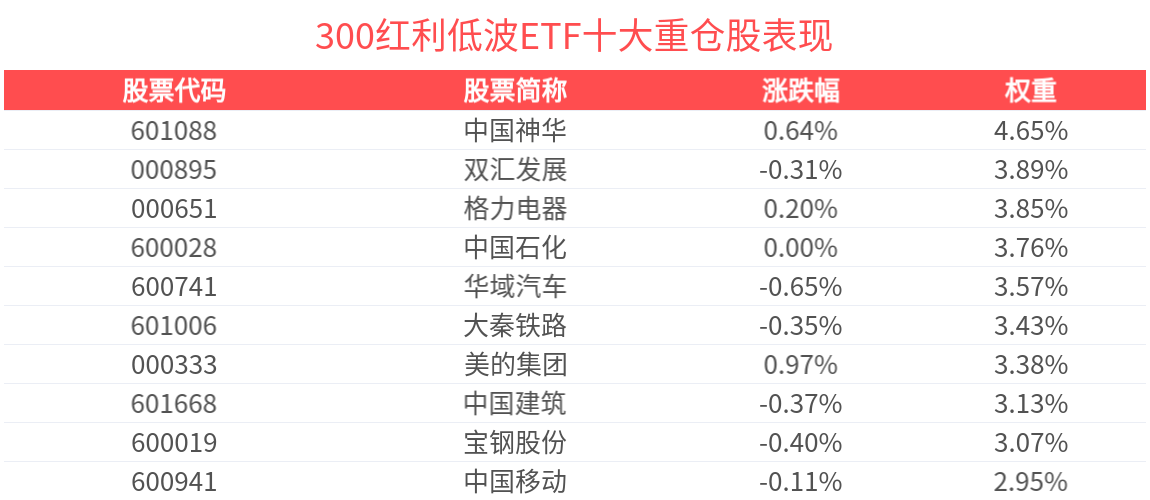
红利策略仍具配置价值,300红利低波ETF(515300)逆市红盘冲击3连涨!
Sou Hu Cai Jing· 2025-11-05 03:04
Group 1 - The core viewpoint indicates that the "insurance capital + industrial capital" may become an important source of incremental funds for the banking sector in the future [2] - The banking sector's holdings are at a historical low, revealing investment value, and the dividend strategy continues to hold allocation value [2] - The dividend sector shows greater allocation value during low interest rate periods, with excess returns negatively correlated with government bond yields [2] Group 2 - As of October 31, 2025, the top ten weighted stocks in the CSI 300 Dividend Low Volatility Index include China Shenhua, Shuanghui Development, Sinopec, Gree Electric Appliances, and others, accounting for a total of 35.78% [2] - The CSI 300 Dividend Low Volatility ETF has seen a net value increase of 59.42% over the past five years, ranking 81 out of 1033 index equity funds [1] - The ETF's highest single-month return since inception was 13.89%, with the longest consecutive monthly gain being five months and a maximum increase of 14.56% [1]



中国建筑科技馆古代建筑展厅焕新亮相
Ren Min Wang· 2025-11-05 02:12
Core Viewpoint - The article highlights the public interest in ancient architecture as demonstrated by the attendance at the China Architecture Museum's exhibition on ancient buildings [2][4][6][7] Group 1 - The exhibition at the China Architecture Museum attracted a significant number of visitors on November 4 [2][4][6] - The event showcases various aspects of ancient architecture, reflecting cultural heritage [7]
