CHINA TELECOM(601728)

Search documents
上证 180 基建指数上涨1.19%,前十大权重包含中国核电等
Jin Rong Jie· 2025-08-25 07:57
Group 1 - The Shanghai Composite Index opened high and rose, with the Shanghai 180 Infrastructure Index increasing by 1.19% to 1889.98 points and a trading volume of 39.504 billion yuan [1] - The Shanghai 180 Infrastructure Index has seen a decline of 2.53% over the past month, 1.62% over the past three months, and 3.00% year-to-date [2] - The index is based on the Shanghai 180 Index and includes listed companies in infrastructure, resources, and transportation themes, reflecting their overall performance in the secondary market [2] Group 2 - The top ten weighted stocks in the Shanghai 180 Infrastructure Index include: Yangtze Power (13.97%), China Telecom (8.57%), China State Construction (8.4%), China Mobile (7.18%), China Unicom (6.69%), China Nuclear Power (5.47%), Three Gorges Energy (4.45%), China Railway (4.31%), China Power Construction (3.9%), and Guodian Power (3.1%) [2] - The index's holdings are entirely from the Shanghai Stock Exchange, with the public utility sector accounting for 40.05%, industrial sector for 36.17%, and communication services for 23.79% [3] - The index samples are adjusted semi-annually, with adjustments occurring on the next trading day after the second Friday of June and December each year [3]





机器人产业持续催化,国产算力芯片迎来突破,持续看好相关产业投资机会
Great Wall Securities· 2025-08-25 06:19
Investment Rating - The report maintains a "Buy" rating for multiple stocks in the communication and robotics sectors, indicating a positive outlook for these industries [1]. Core Insights - The robotics industry is experiencing multi-dimensional catalysts, with significant investment opportunities in the related supply chain. Recent events, such as the World Robotics Conference and the World Humanoid Robot Games, showcase advancements in robot capabilities and interactions [2][3][40]. - The demand for high computing power driven by AI is expected to continue rising, with a focus on domestic computing chip industries. The release of DeepSeek-V3.1 highlights improvements in efficiency and performance, indicating a strong future for domestic AI chip development [4][20][41]. Summary by Sections Robotics Industry - The World Robotics Conference held in August 2025 in Beijing featured over 200 leading companies and showcased more than 1500 exhibits, emphasizing the ongoing technological advancements in robotics [2][24]. - The World Humanoid Robot Games included participation from 28 teams across 16 countries, demonstrating the competitive landscape and innovation in humanoid robotics [2][33]. - Domestic leaders like Zhiyuan Robotics and Yushun Technology are pushing for significant advancements, with goals to deploy over 100,000 general-purpose robots in the next three years [3][19][40]. AI and Computing Chips - The launch of DeepSeek-V3.1 on August 21, 2025, introduced a hybrid reasoning architecture that enhances both thinking and non-thinking modes, improving efficiency and agent capabilities [20][41]. - The new model's performance metrics show a significant increase in efficiency, with a 40% improvement in energy efficiency for domestic chips in reasoning scenarios [22][46]. - The report highlights the increasing domestic demand for computing power, driven by geopolitical factors and the need for stable supply chains, suggesting a robust future for domestic computing infrastructure [8][49][56]. Market Performance - The communication sector index rose by 10.84% during the week of August 18-22, 2025, outperforming the broader market, which indicates strong investor confidence in the sector [13][14]. - The report recommends a diverse range of stocks across various segments, including telecommunications, AI, and robotics, reflecting a comprehensive investment strategy [9][23].




云计算ETF沪港深(517390)涨近4%,2025数博会即将开幕,将集中呈现多领域前沿技术与应用成果
2 1 Shi Ji Jing Ji Bao Dao· 2025-08-25 06:05
Group 1: Cloud Computing and ETFs - A-shares experienced a slight pullback on August 25, while the cloud computing sector remained strong, with the cloud computing ETF (517390) rising by 3.86% and trading volume exceeding 30 million yuan [1] - Key components of the cloud computing ETF included Zhongke Shuguang, which hit the daily limit, and Zhongji Xuchuang, which rose over 10% [1] - The computer ETF (159998) saw a modest increase of 0.28% with a trading volume exceeding 90 million yuan, featuring top gainers such as Xiechuang Data, which rose over 8% [1] Group 2: Data Industry Expo - The 2025 China International Big Data Industry Expo will be held in Guiyang from August 28 to 30, organized by the National Data Bureau and the Guizhou Provincial Government [2] - A total of 375 companies, including major players like Huawei and China Telecom, have confirmed participation, showcasing advancements in digital infrastructure, AI models, data security, and smart terminals [2] - The expo will feature a series of activities including supply-demand matching, corporate roadshows, technical seminars, and product launches, creating a professional platform for technology exchange and business opportunities [2] Group 3: Challenges and Opportunities in AI and Cloud Computing - Citic Securities highlighted two main challenges for embodied intelligence companies: the correct model architecture and efficient data sampling, with a focus on the integration of large language models and visual models [3] - Companies with strong capital expenditure capabilities are expected to build competitive barriers through real data collection, while synthetic data and internet data will play a crucial role in the value of embodied models [3] - Central Securities noted an optimistic outlook for capital expenditure among leading cloud vendors by 2025, driven by AI development and the construction of large data centers, which will increase demand for optical device products [3]
2025“算力中国”重大成果揭晓 山西秦能“算电协同”技术跻身全国十大突破
Sou Hu Cai Jing· 2025-08-25 04:51
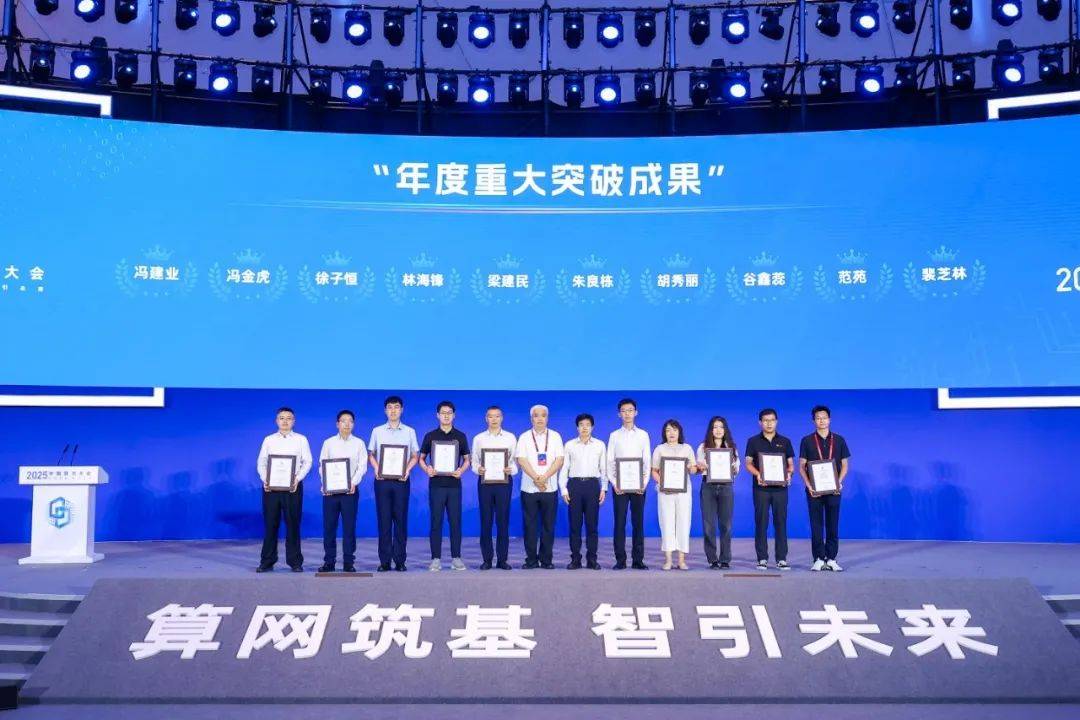
Core Insights - The 2025 China Computing Power Conference was held in Datong, Shanxi, showcasing ten innovative technologies that lead the global computing power industry, including the Shanxi Qineng Integrated Platform for Computing and Electricity [1][3] - The selected achievements demonstrate a leap from following to leading in the computing power industry, highlighting breakthroughs in core technologies and ecological innovation [3][4] Group 1: Key Technologies - The Shanxi Qineng Integrated Platform optimizes the dual-direction scheduling of computing and electricity resources, reducing electricity costs by 5%, carbon emission intensity by 25%, and improving computing efficiency by 30% [3][7] - China Mobile's "Jiuzhou" computing power optical network supports a backbone network with a computing capacity of 10 EFLOPS, expected to drive GDP growth by over 12.6 billion [4] - The FusionOne AI solution has served over 500 projects, achieving rapid deployment of AI applications [4][8] Group 2: Economic Impact - The Shanxi Qineng platform has saved 10 million yuan in electricity costs annually and reduced carbon emissions by 100,000 tons, contributing to a market worth tens of billions in computing and electricity collaboration services [3][4] - The conference highlighted Shanxi's innovative strength in the synergy of computing and energy, promoting a unique development path for the region [4] Group 3: Future Prospects - The promotion of these technologies is expected to further advance the green and intelligent upgrade of China's computing infrastructure, contributing to a new global digital civilization [4][11] - The integration of computing power and energy is seen as a key area for future growth, with significant implications for the digital economy and low-carbon transformation [3][4]




恒指季度检讨结果出炉!这些指数都要调整
Mei Ri Jing Ji Xin Wen· 2025-08-25 03:29
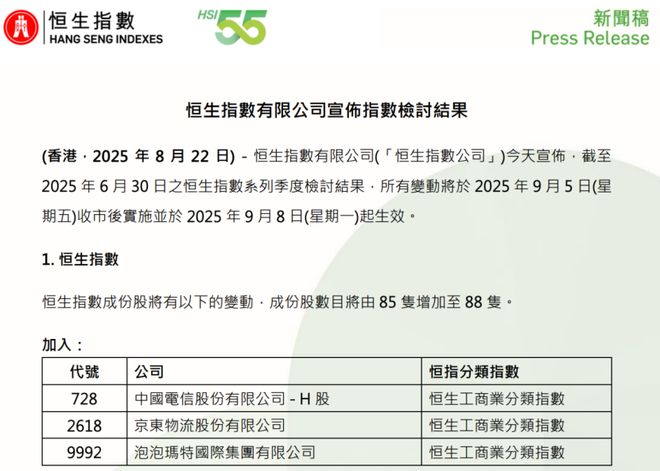
Core Viewpoint - The Hang Seng Index Company announced the quarterly review results of the Hang Seng Index series as of June 30, with adjustments to various indices set to take effect on September 8 [1] Group 1: Index Adjustments - The Hang Seng Index and the Hang Seng China Enterprises Index will include Pop Mart [1] - The Hang Seng Index will also add China Telecom and JD Logistics [1] - The Hang Seng Biotechnology Index will undergo significant changes, adding InnoCare Pharma-B and removing 21 stocks, reducing the total number of constituent stocks from 50 to 30, focusing more on innovative drugs [1] - The Hang Seng Internet Technology Index will include New Oriental Education, SUTENG, and Yunzhisheng [1]


超1600亿元“现金红包”!多家上市公司首次中期分红
Di Yi Cai Jing Zi Xun· 2025-08-24 12:27
Core Viewpoint - A significant increase in mid-term cash dividends has been observed among listed companies, with over 290 companies announcing plans to distribute more than 1640 billion yuan in total [2][5]. Group 1: Mid-term Dividend Announcements - Companies such as Juchip Technology, Zhonggang Tianyuan, and Taihe Co. have announced their first mid-term dividend plans, with cash dividends of approximately 17.42 million yuan, 45.23 million yuan, and 90 million yuan respectively [3][4]. - China CRRC plans to distribute a cash dividend of 3.157 billion yuan, with a cash dividend ratio of 43.57% [3][4]. - Changan Automobile and Hengli Petrochemical also announced their first mid-term dividends, with cash dividends of 496 million yuan and 563 million yuan respectively [4]. Group 2: Overall Dividend Statistics - As of August 24, 2024, 294 companies have disclosed mid-term dividend plans, with a total planned distribution of 1647.07 billion yuan [5][6]. - Three companies are set to distribute over 10 billion yuan, with China Mobile leading at over 54 billion yuan and a cash dividend ratio exceeding 64% [5][6]. - The average cash dividend ratio for disclosed mid-term dividends is approximately 80.87%, a significant increase from 36.14% in 2024 [6]. Group 3: High Dividend Ratios - Sixteen companies have reported cash dividend ratios exceeding 100%, while the average for the remaining companies is around 38% [6][7]. - Shuoshi Biotechnology has the highest cash dividend ratio, proposing a cash dividend of 285 million yuan, which is 71.42 times its net profit for the period [6]. - Other companies, such as Yisheng Shares, have also reported high dividend ratios, with Yisheng proposing a cash dividend of 163 million yuan against a profit of 615.51 million yuan [6]. Group 4: Companies with Losses Still Distributing Dividends - Some companies, including Delin Hai, Haoyun Technology, and Lanshield Optoelectronics, are planning to distribute mid-term dividends despite reporting net losses [8].






英伟达将公布Q3财报;互联网平台价格将进一步规范|周末要闻速递
Sou Hu Cai Jing· 2025-08-24 11:46
Group 1: Government Policies and Economic Measures - The State Council held a meeting to discuss the implementation of large-scale equipment updates and the trade-in policy for consumer goods, aiming to boost sports consumption and promote high-quality development in the sports industry [1] - The National Development and Reform Commission is drafting rules to regulate pricing behavior in the platform economy, emphasizing transparency and compliance with pricing regulations [2] - The People's Bank of China will conduct a 600 billion MLF operation on August 25 to maintain liquidity in the banking system [5] Group 2: Industry Developments - The China Photovoltaic Industry Association called for stronger industry self-discipline to combat malicious competition and ensure fair market order [3] - Industrial Fulian reported significant improvements in production and delivery of its GB200 series products, with expanded capacity to meet growing customer demand [9] - Longjiang Electric Power announced that its controlling shareholder plans to increase its stake in the company by 4 billion to 8 billion yuan within the next 12 months [10] Group 3: Market Movements and Corporate Actions - The Hang Seng Index Company announced the inclusion of China Telecom, JD Logistics, and Pop Mart in the Hang Seng Index, increasing the number of constituent stocks to 88 [7] - Dongfeng Group announced plans for privatization and delisting while its subsidiary, Lantu Automobile, is set to list on the Hong Kong Stock Exchange [8]






构建算力新生态 运营商这样布局
Jing Ji Guan Cha Wang· 2025-08-24 11:11
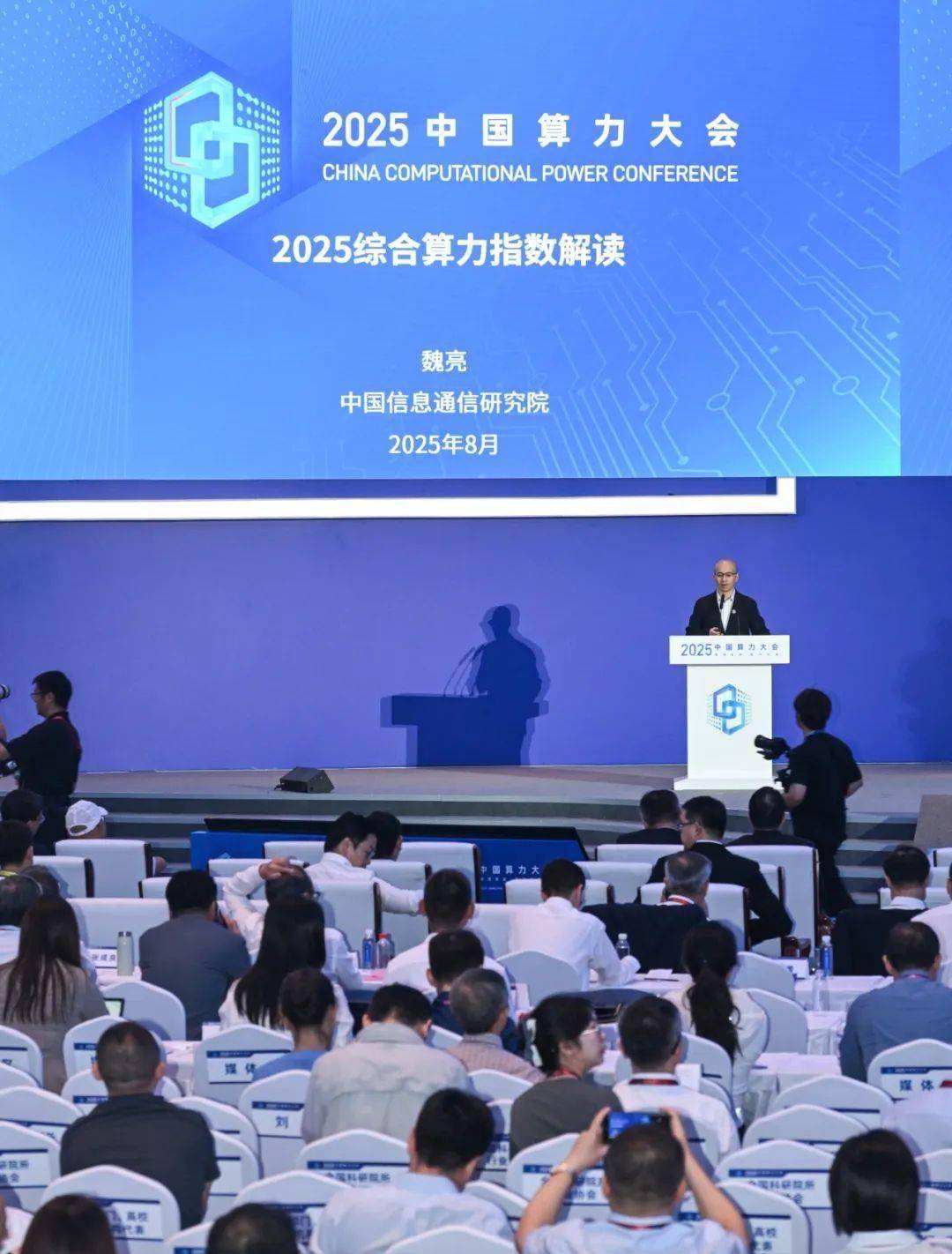
Core Insights - The 2025 China Computing Power Conference was held in Datong, Shanxi, focusing on building a new computing power ecosystem and stimulating new industrial momentum through computing power [1][4] - Major telecommunications operators and related enterprises discussed strategies for optimizing the computing power ecosystem and promoting high-quality development of the computing power industry [1] Group 1: China Telecom - China Telecom has developed an intelligent cloud system centered around its "Xiangran" technology, providing integrated intelligent cloud services through cloud-network integration [1] - Users can select, purchase, and activate computing resources via a computing power market, making the process as convenient as using utilities [1] - The "Lingze 2.0" platform has established a data element circulation trading platform in Shanxi, enhancing data rights and trusted circulation [1] Group 2: China Mobile - China Mobile introduced the computing network concept and launched the Computing Network Brain 3.0, marking a transition to an intelligent computing network era [2] - The Computing Network Brain integrates over 80 EFLOPS of diverse computing power and more than 250,000 network link resources [2] - A new "Chip Integration" platform was unveiled, providing a comprehensive service model for hardware and software adaptation, migration, testing, and certification [2] Group 3: China Unicom - China Unicom focuses on building new computing network infrastructure, with over 1 million standard racks and large-scale data centers in key regions [3] - The company has developed a GW-level park to support over 100,000 card clusters, achieving a computing capacity of 33 EFLOPS [3] - The "Xingluo" platform has been implemented in multiple regions, enhancing intelligent collaboration among massive clusters [3] Group 4: China Tower - China Tower is transforming communication rooms into data rooms, promoting edge computing infrastructure and resource sharing [3] - The company leverages 2.1 million tower sites and 1 million rooms to provide diverse products and services for edge computing [3] Group 5: Industry Trends - The transition from the "Information Age" to the "Intelligent Age" is driven by computing network infrastructure, which is deeply integrated with artificial intelligence [4] - The large-scale application of AI is propelling explosive growth in the computing power industry, leading to a rapid upgrade of computing infrastructure [4]
算力盛宴启幕!中国电信力挺山西,共铸“算力新心脏”蓝图
Sou Hu Cai Jing· 2025-08-24 09:46
Core Insights - The 2025 China Computing Power Conference in Datong marks a significant milestone in the country's computing power sector, themed "Building Foundations with Computing Networks, Guiding the Future with Intelligence" [1] - The conference highlighted the rapid development of China's computing power industry, achieving a scale of 788 EFLOPS in intelligent computing power and a total storage capacity exceeding 1680 EB during the 14th Five-Year Plan period [1] - The China Computing Power Platform has successfully integrated ten provincial sub-platforms, enhancing the overall ecosystem and resource allocation [1] Group 1 - The China Computing Power Platform aims to create a neutral, open, fair, and trustworthy service ecosystem, enhancing compatibility and interoperability among different systems [4] - As of July, the platform has registered over 1,000 enterprise users and onboarded more than 100 computing service providers, offering over 110 high-quality computing power products [4] - The platform has achieved "five major integrations" involving platform, entities, resources, ecosystem, and scenarios [4] Group 2 - Datong ranks third nationally in computing power index, positioning itself as a key player in transforming resource-based economies [5] - The city has invested 28.2 billion yuan in its computing power center, with a construction scale of 25,000 P, equivalent to over 326,000 standard racks, achieving an overall shelving rate of 90% [5] Group 3 - China Telecom announced its AI computing power ecosystem at the conference, revealing plans to establish Datong as a "new heart of computing power" [7] - The company has built a full liquid-cooled domestic intelligent computing cluster in the Beijing-Tianjin-Hebei and Yangtze River Delta regions, with a total computing power exceeding 77 EFLOPS [7] - China Telecom's new initiatives include the "Xirang" computing power scheduling system and the launch of the AI computing optimization AICO system, aimed at facilitating easier and more economical access to AI computing power for enterprises [7]
恒指季检结果出炉!中国电信、京东物流、泡泡玛特“染蓝”
Xin Lang Cai Jing· 2025-08-24 05:14
Group 1 - The Hang Seng Index will expand from 85 to 88 constituent stocks, with the inclusion of China Telecom, JD Logistics, and Pop Mart International Group [1][4] - The adjustment reflects the index's industry representation and diversity, with the new additions coming from different sectors: telecommunications, e-commerce logistics, and trendy toys [4][6] - The changes will take effect on September 8, 2025, and there will be no deletions, which helps maintain the stability of the index [4][6] Group 2 - The inclusion of Pop Mart was somewhat unexpected, despite some analysts predicting it; concerns were raised about potential fund absorption [6][10] - Pop Mart reported significant growth in its half-year results, with revenue of 13.88 billion yuan, a year-on-year increase of 204.4%, and a net profit of 4.71 billion yuan, up 362.8% [6][12] - The adjustment is expected to lead to substantial fund flows, as approximately $30.35 billion in ETFs tracking the Hang Seng Index will need to rebalance their portfolios [7][12] Group 3 - Despite recent fluctuations, there has been a consistent inflow of southbound funds into the Hong Kong market, indicating investor confidence in the long-term value of Hong Kong stocks [10][11] - The current valuation levels of the Hang Seng Index and the Hang Seng Technology Index are relatively low, with a TTM P/E ratio of 11.38 for the Hang Seng Index, suggesting a significant value opportunity [12]