
CHINA TELECOM(601728)

Search documents
造机器人:一场“谁都能干”的“全民运动”?
经济观察报· 2025-08-23 10:47
Core Viewpoint - The threshold for entering the robotics industry has significantly lowered, leading to a surge of diverse companies from various sectors attempting to manufacture robots, raising questions about the sustainability and viability of this trend [4][5][6]. Group 1: Industry Trends - The nature of "building robots" is changing, evolving from a complex task to a more accessible one, where assembling a robot is becoming a reality rather than a joke [3][6]. - The number of humanoid robot-related companies in China reached 834 by late July 2025, with over half having registered capital exceeding 10 million [6][11]. - The growth in registrations of humanoid robot companies surged by over 180% in the first half of 2025 compared to the previous year [6]. Group 2: New Players and Cross-Industry Involvement - Companies from various backgrounds, including traditional manufacturing and investment sectors, are entering the robotics field, such as Vision Technology and Jiuding Investment [4][5][13]. - Midea Group, leveraging its ownership of KUKA, is developing humanoid robots for home and factory applications, showcasing a strategic approach to robotics [15]. - Automotive companies like GAC Group are also entering the robotics space, emphasizing the technological synergies between automotive and robotics [15]. Group 3: Technological Advancements - The availability of standardized components for robots, such as sensors and actuators, has made it easier for companies to assemble robots [6][11]. - Domestic suppliers are beginning to break the monopoly of foreign brands in critical components like harmonic reducers and planetary roller screws [8][9]. - The development of specialized components, such as the BrainCo bionic hand and advanced laser radar from Hesai Technology, indicates significant progress in the robotics supply chain [7][8]. Group 4: Market Dynamics and Challenges - The influx of capital into the robotics sector has led to a competitive environment, with many companies seeking to establish themselves amid rising expectations [6][19]. - Despite the enthusiasm, the integration of various components and ensuring system stability remains a significant challenge for the industry [19][20]. - The industry is still in its early commercial stages, with many companies relying on external funding rather than self-sustaining business models [21]. Group 5: Future Outlook - The future of the robotics industry may lead to a diverse ecosystem where specialized companies coexist, focusing on niche applications while core component suppliers support the overall market [21]. - The successful companies will likely be those that can identify real-world applications and maintain resilience in a capital-intensive environment [21].




A股“红包雨”来袭 多家头部公司首次中期分红
Zheng Quan Ri Bao· 2025-08-23 04:03
Core Insights - A total of 65 listed companies announced their interim profit distribution plans, with a combined dividend amount of 177.3 billion RMB, indicating a trend towards mid-year dividends, especially among leading companies like CRRC, Hengli Petrochemical, and Changan Automobile [1][2][3] Company Summaries - CRRC reported a revenue of 1197.58 billion RMB for the first half of 2025, a year-on-year increase of 32.99%, and a net profit of 72.46 billion RMB, up 72.48%. The company announced its first interim dividend of 1.1 RMB per 10 shares, totaling 31.57 billion RMB, which is 43.57% of its net profit [2] - Hengli Petrochemical announced its first interim dividend, proposing a cash dividend of 0.08 RMB per share, amounting to 5.63 billion RMB, which represents 18.46% of its net profit for the first half of 2025 [3] - Changan Automobile proposed a cash dividend of 0.50 RMB per 10 shares, totaling 4.96 billion RMB, in line with the government's guidelines to enhance shareholder returns [3] Industry Trends - The new "National Nine Articles" policy encourages companies to enhance the stability, sustainability, and predictability of dividends, promoting multiple dividends within a year [4] - As of August 23, 2025, 284 companies have announced a total dividend of 1630.27 billion RMB for the first half of the year, with major players like China Mobile, China Telecom, and Sinopec planning dividends exceeding 10 billion RMB [4][5] - The trend towards high-frequency dividends is expected to continue, with improvements in dividend quality and transparency, driven by regulatory and market forces [5]



中国电信廊坊分公司构建企业安全新格局
Xin Lang Cai Jing· 2025-08-23 03:12
Group 1 - The event "I am the Best Installation and Maintenance Person" organized by China Telecom Langfang Branch successfully concluded, featuring 13 teams competing to enhance professional skills and service quality [1] - The competition emphasized safety production, integrating safety standards into every aspect of the event, promoting the awareness that "safety is the lifeline" among the installation and maintenance teams [1] - China Telecom Langfang Branch has revised and improved multiple safety management documents, including the "Safety Production Management Measures" and "Safety Specifications for High-altitude Operations," ensuring that employee safety is prioritized [1] Group 2 - The company has innovatively launched activities such as "Safety Reminder Videos" and "Letters of Appeal to Family Members," involving family members in safety management [1] - Regular family visits to installation and maintenance sites are organized, and safety reminder videos are recorded for staff to watch, fostering a culture of safety accountability among employees and their families [1] - The company adheres to the philosophy that "hidden dangers are accidents," conducting regular inspections and establishing a "Safety Hazard Reporting Reward Fund" to encourage employees to report safety hazards [1]
三大运营商的“钱袋子”也变瘪了
Hu Xiu· 2025-08-23 02:09
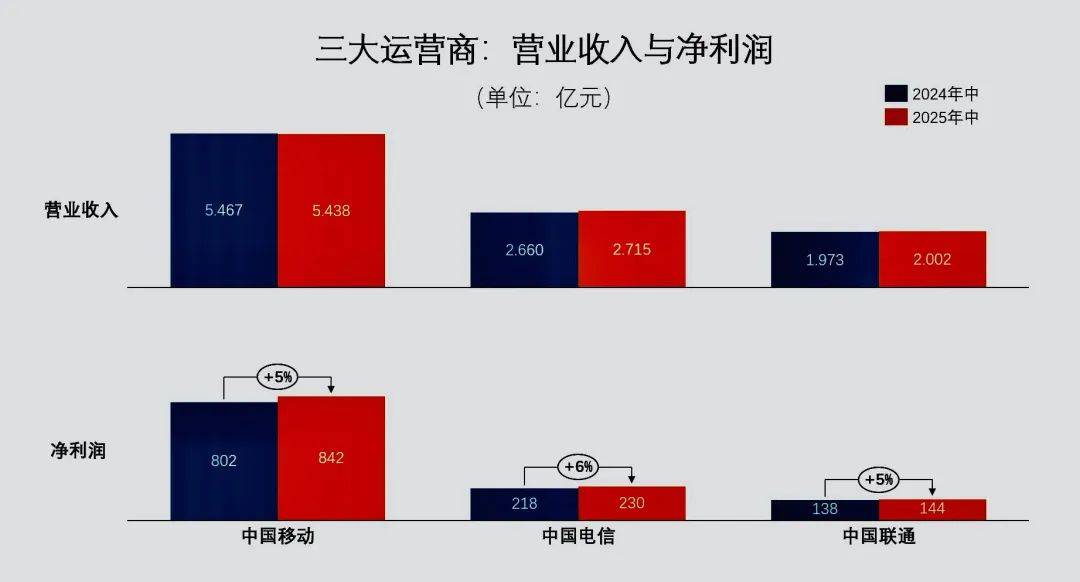
Core Viewpoint - The three major telecom operators in China reported a year-on-year net profit growth of over 5% for the first half of 2025, despite stable revenue levels, leading to media headlines emphasizing their profitability. However, the decline in free cash flow raises concerns about their actual cash-generating capabilities [1][9]. Group 1: Financial Performance - The telecom operators' free cash flow has shown a downward trend over the past three years, with China Mobile reporting a free cash flow of 25.5 billion, a 62% decrease year-on-year, while China Telecom and China Unicom also experienced significant declines compared to 2023 [6][8]. - Despite the net profit growth, the decline in free cash flow indicates a weakening ability to distribute dividends or reinvest, reflecting the true financial health of these operators [9]. Group 2: Capital Expenditure Trends - Following a peak in 5G investments from 2020 to 2023, the three operators have begun to reduce capital expenditures, with China Mobile, China Telecom, and China Unicom decreasing their capital expenditures by 9%, 28%, and 15% respectively in the first half of 2025 [12]. - The reduction in capital expenditures positively impacted free cash flow for China Telecom and China Unicom, which saw slight increases in free cash flow due to this decrease [12]. Group 3: Operating Cash Flow Analysis - The operating cash flow for the three operators declined significantly, with China Mobile's operating cash flow net amount halving compared to the same period in 2023, while China Telecom and China Unicom also reported decreases of 19% and 3% respectively [14]. - The primary reasons for the decline in operating cash flow include increased payments to suppliers and a rise in accounts receivable due to slower collection from government enterprise projects [16][21]. Group 4: Accounts Receivable and Bad Debt Provisions - Accounts receivable for the three operators increased significantly, with China Mobile, China Telecom, and China Unicom reporting year-on-year increases of 25%, 26%, and 19% respectively [22]. - The rise in accounts receivable has led to a substantial increase in bad debt provisions, with China Mobile and China Telecom seeing provisions grow by 33% and 59% respectively in 2025 [28][30]. Group 5: Strategic Implications - The operators need to shift focus from merely increasing revenue to ensuring cash flow generation, particularly in the government enterprise market, to avoid a cycle of "paper profits" without actual cash [36]. - A return to high-quality development is essential for the operators to maintain competitiveness and ensure that enterprise business becomes a growth engine rather than a cash drain [35][36].


1500余家上市公司披露半年报 六成净利润同比增长
Zhong Guo Zheng Quan Bao· 2025-08-22 22:17
Core Insights - As of August 22, 2025, 1526 A-share listed companies have disclosed their semi-annual reports, with 921 companies reporting a year-on-year net profit growth, accounting for approximately 60.35% [1][3] Group 1: Company Performance - Among the 1526 companies, 761 reported a net profit growth exceeding 10%, 501 exceeded 30%, 359 exceeded 50%, 210 exceeded 100%, and 66 exceeded 300% [3] - Notable companies with significant net profit growth include Shumai Video, Xinda Co., Zhimingda, Rongzhi Rixin, Shijia Photon, and Suotong Development [3] - Shumai Video achieved approximately 267 million yuan in revenue, a year-on-year increase of 24.7%, and a net profit of approximately 16.7 million yuan, a staggering increase of 2747.64% [3] - 567 companies reported net profits exceeding 100 million yuan, 180 exceeded 500 million yuan, 88 exceeded 1 billion yuan, 19 exceeded 5 billion yuan, and 8 exceeded 10 billion yuan [3] - Leading companies by net profit include China Mobile, Kweichow Moutai, CATL, China Telecom, Sinopec, Industrial Fulian, Muyuan Foods, Huaneng International, and Luoyang Molybdenum [3][4] Group 2: Industry Performance - Industries showing strong performance include electronics, transportation, agriculture, automotive, machinery, non-ferrous metals, home appliances, and social services [5] - Within the electronics sector, companies in consumer electronics and semiconductors performed exceptionally well [5] - In the agriculture sector, companies involved in breeding and animal health showed significant performance improvements [5] - Muyuan Foods reported revenue of 764.63 billion yuan, a year-on-year increase of 34.46%, and a net profit of 10.79 billion yuan, a remarkable increase of 952.92% [5] Group 3: Dividend Announcements - As of August 22, 2025, 265 A-share listed companies have announced their mid-term dividend plans [2][6] - Among these, 188 companies plan to distribute cash dividends exceeding 1 yuan per 10 shares (including tax), 77 companies exceeding 3 yuan, 38 exceeding 5 yuan, and 15 exceeding 10 yuan [6][7] - Notable companies with high cash dividends include Jibite, Ninebot, Shuoshi Biology, China Mobile, Dongpeng Beverage, Siwei Liekong, Dong'a Ejiao, and Aimeike [6] - Jibite reported revenue of 2.518 billion yuan, a year-on-year increase of 28.49%, and a net profit of 645 million yuan, a year-on-year increase of 24.50%, proposing a cash dividend of 66 yuan per 10 shares (including tax) [6] - Among the 265 companies, 111 plan to distribute dividends exceeding 100 million yuan, 77 exceeding 200 million yuan, and 37 exceeding 500 million yuan [7]



运营商“三朵云”增速放缓 互联网云巨头借AI回暖
Zhong Guo Jing Ying Bao· 2025-08-22 20:31
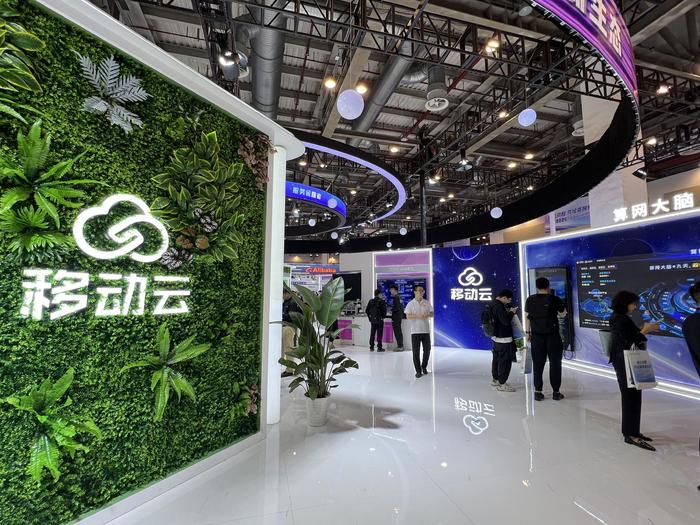
Core Insights - The cloud business of the three major telecom operators in China has shown a significant slowdown in growth compared to previous years, with average growth rates dropping from over 20% to lower single digits [2][3][4] - In contrast, internet cloud providers like Alibaba Cloud and Tencent Cloud are experiencing a resurgence, with Alibaba Cloud reporting an 18% year-on-year revenue growth in Q1 2025, marking its fastest growth in nearly three years [6][7] Telecom Operators' Cloud Business - The revenue for mobile cloud reached 56.1 billion yuan, up 11.3% year-on-year; China Unicom's cloud revenue was 37.6 billion yuan, up 4.6%; and Tianyi Cloud's revenue was 57.3 billion yuan, up 3.8% [2] - In the first half of 2024, mobile cloud revenue was 50.4 billion yuan, growing 19.3%; Tianyi Cloud revenue was 55.2 billion yuan, growing 20.4%; and China Unicom's cloud revenue was 31.7 billion yuan, growing 24.3% [3] - The rapid growth of the telecom operators' cloud business in the past three years saw mobile cloud and Tianyi Cloud achieving growth rates of 103.6% and 100.8% respectively in 2022 [4] Market Dynamics - The slowdown in growth for telecom operators is attributed to market saturation and a shift in demand towards high-performance computing and customized intelligent services, which have longer investment recovery periods [8][9] - The competitive landscape is changing, with AI playing a crucial role in the recovery of traditional cloud giants like Alibaba and Tencent, as they invest heavily in AI infrastructure [7][9] Future Outlook - The telecom operators are aware of the challenges they face and are transitioning towards AI and intelligent computing, with a significant portion of their revenue growth now coming from AI-related services [9][10] - Analysts suggest that while short-term growth may remain low, the long-term potential for recovery and profit margins will depend on the operators' ability to capitalize on the "AI + Cloud" monetization pathways [10]
1500余家上市公司披露半年报六成净利润同比增长
Zhong Guo Zheng Quan Bao· 2025-08-22 20:10
Core Insights - A total of 1526 A-share listed companies disclosed their 2025 semi-annual reports, with 921 companies achieving year-on-year net profit growth, representing approximately 60.35% [1] - The electronic, transportation, agriculture, automotive, machinery, non-ferrous metals, home appliances, and social services sectors showed strong performance [1] Group 1: Company Performance - Among the 1526 companies, 761 reported net profit growth exceeding 10%, 501 exceeded 30%, 359 exceeded 50%, 210 exceeded 100%, and 66 exceeded 300% [1] - Notable companies with significant net profit growth include Shumatech, XianDa Co., Zhimingda, Rongzhi Rixin, Shijia Photon, and Suotong Development [1] - 567 companies reported net profits over 100 million yuan, 180 over 500 million yuan, 88 over 1 billion yuan, 19 over 5 billion yuan, and 8 over 10 billion yuan [2] - China Mobile, Kweichow Moutai, CATL, China Telecom, Sinopec, Industrial Fulian, Muyuan Foods, Huaneng International, and Luoyang Molybdenum were among the top net profit earners [2] Group 2: Industry Performance - The electronic, transportation, agriculture, automotive, machinery, non-ferrous metals, home appliances, and social services sectors showed strong revenue performance [3] - In the electronic sector, companies in consumer electronics and semiconductors performed exceptionally well [3] - In agriculture, companies in breeding and animal health sectors showed significant performance improvements [3] - Muyuan Foods achieved revenue of 764.63 billion yuan, a year-on-year increase of 34.46%, and net profit of 107.9 billion yuan, a year-on-year increase of 952.92% [3] Group 3: Dividend Announcements - A total of 265 A-share listed companies announced their 2025 mid-term dividend plans [4] - 188 companies plan to distribute cash dividends exceeding 1 yuan per 10 shares, 77 companies exceeding 3 yuan, 38 companies exceeding 5 yuan, and 15 companies exceeding 10 yuan [4] - Notable companies with high cash dividends include JiBit, Ninebot, Shuoshi Bio, China Mobile, Dongpeng Beverage, Siwei Liekong, Dong'a Ejiao, and Aimeike [4] - Among the 265 companies, 111 plan to distribute over 100 million yuan, 77 over 200 million yuan, and 37 over 500 million yuan in dividends [4] Group 4: Specific Company Announcements - China CNR announced revenue of 1197.58 billion yuan, a year-on-year increase of 32.99%, and net profit of 72.46 billion yuan, a year-on-year increase of 72.48% [5] - The company plans to distribute cash dividends of 31.57 billion yuan [5]

恒指季检结果出炉!中国电信、京东物流、泡泡玛特染蓝 成份股增加至88只



Zhi Tong Cai Jing· 2025-08-22 18:31
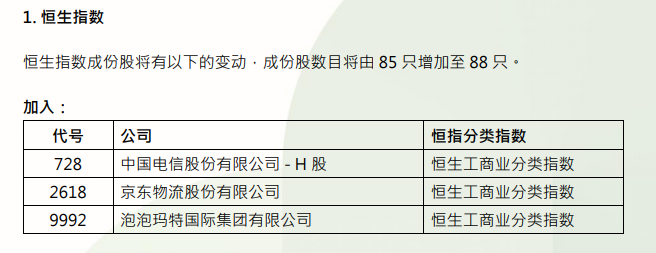
Group 1: Hang Seng Index Changes - China Telecom (00728), JD Logistics (02618), and Pop Mart (09992) will be included in the Hang Seng Index, increasing the number of constituent stocks from 85 to 88 [1][4]. - All changes will take effect after the market closes on September 5, 2025, and will be effective from September 8, 2025 [4]. Group 2: Hang Seng China Enterprises Index - Pop Mart will be included in the Hang Seng China Enterprises Index, maintaining the total number of constituent stocks at 50 [3]. Group 3: Hang Seng Composite Index Changes - China Foods (00506) and Jiangsu Hengrui Medicine (600276) will be added to the Hang Seng Composite Index, while companies like Crown City Watch and Jewelry (00256) and Sipai Health (00314) will be removed. The total number of constituent stocks will increase from 502 to 504 [8][9].
突破千亿!172家公司发布分红预案
Sou Hu Cai Jing· 2025-08-22 14:31
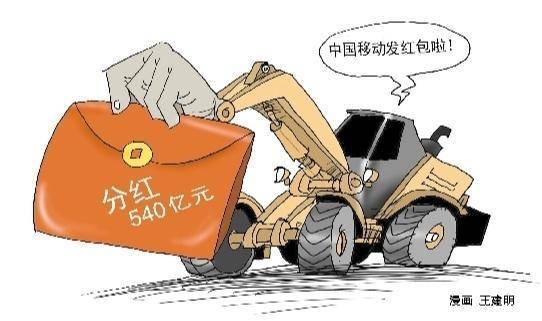
Group 1 - The core viewpoint of the article highlights that many listed companies in China are announcing substantial dividend plans, with total proposed dividends exceeding 100 billion yuan, indicating a trend towards increased shareholder returns [2][3] - China Mobile plans to distribute over 540 billion yuan in dividends, proposing a mid-term dividend of 2.75 HKD per share, equivalent to approximately 2.5025 RMB per share [2] - China Telecom intends to distribute 165.81 billion yuan in cash dividends, which represents 72% of its net profit for the first half of the year [2][3] Group 2 - Companies like Gigabit and Muyuan are also announcing significant dividends, with Gigabit proposing a cash dividend of 66 RMB per 10 shares, amounting to about 4.74 billion yuan, which is 73.46% of its net profit [3] - Regulatory bodies have been encouraging listed companies to increase cash dividends, aiming to enhance the stability and predictability of dividend distributions, thereby boosting investor confidence in the capital market [3][5] - Analysts suggest that high dividend strategies involve investing in mature companies with strong cash flow and high return on equity (ROE), emphasizing the importance of long-term investment and avoiding crowded sectors [4]

恒指季检纳入中国电信、京东物流和泡泡玛特 成分股增至88只
Zhong Guo Xin Wen Wang· 2025-08-22 14:12
Market Performance - The Hong Kong stock market indices continued to show volatility from August 18 to August 22, with the Hang Seng Index rising by 0.27% to close at 25,339.14 points, the Hang Seng Tech Index increasing by 1.89% to 5,647.68 points, and the China Enterprises Index gaining 0.45% to 9,079.93 points [1] Index Adjustments - The Hang Seng Index Company announced its quarterly review results, adding China Telecom, JD Logistics, and Pop Mart to the index, increasing the number of constituent stocks to 88. The Hang Seng Tech Index remained unchanged with 30 constituent stocks [1] Company Highlights - Pop Mart, a newly added constituent of the Hang Seng Index, reported a revenue of 13.88 billion yuan for the first half of 2025, representing a year-on-year growth of 204.4%. The adjusted net profit was 4.71 billion yuan, showing a significant increase of 362.8% year-on-year [1] - Huatai Securities expressed optimism about Pop Mart's growth potential as a one-stop platform for trendy toys, highlighting its expansion into new categories and innovative businesses such as theme parks, accessories, and desserts, as well as its content layout in film and animation, which is expected to enhance the global influence of its IP [1] Sector Performance - Technology stocks showed positive performance, with notable gains from SenseTime (up 5.75%), Kuaishou (up 4.39%), Xiaomi Group (up 2.34%), Alibaba (up 1.99%), Tencent Holdings (up 1.18%), Meituan (up 1.11%), and JD Group (up 0.25%) [2] - Semiconductor stocks also experienced significant increases, with Huahong Semiconductor rising by 17.85%, Jingmen Semiconductor by 10.64%, SMIC by 10.06%, Beike Micro by 9.15%, InnoCare by 7.09%, and Shanghai Fudan by 6.36% [2]