
BANK OF CHINA(601988)

Search documents
中国银行发布加强贵金属市场风险防范提示
Xin Lang Cai Jing· 2026-03-23 08:36
Core Viewpoint - The Bank of China has issued a warning regarding the increased risks in the precious metals market due to heightened global geopolitical risks and significant price fluctuations [1] Group 1: Market Conditions - Recent geopolitical tensions have led to increased volatility in both domestic and international precious metal prices [1] - The bank emphasizes the need for clients to be aware of market risks and to take appropriate measures to safeguard their investments [1] Group 2: Investment Recommendations - Clients are advised to conduct rational investments based on their financial status and risk tolerance [1] - It is recommended to manage precious metal positions wisely and consider long-term investments to mitigate the impact of short-term price fluctuations [1]
银行业周报:金融领域制度持续完善,关注业绩披露窗口期
Zhong Guo Yin He Zheng Quan· 2026-03-23 00:24
Investment Rating - The report maintains a "Recommended" rating for the banking sector, highlighting its dividend value and low valuation as attractive for long-term investors [5][10]. Core Insights - The banking sector outperformed the market, with a 0.36% increase compared to a 2.19% decline in the CSI 300 index. Notably, state-owned banks rose by 2.23%, while joint-stock banks saw a slight decline [5][14]. - The introduction of the "Interim Measures for the Regulatory Rating of Wealth Management Companies" is expected to accelerate the transformation of wealth management companies, emphasizing asset management and risk control capabilities as core competitive advantages [5][7][8]. - The draft of the "Financial Law" aims to enhance the legal framework in the financial sector, focusing on improving financial services, strengthening regulation, and ensuring financial stability [5][9]. - The first batch of 2025 annual reports from listed banks indicates a mixed performance, with some banks showing revenue growth while others faced declines. Overall, credit growth remains stable, and profitability is expected to improve due to narrowing interest margins and a decrease in non-performing loan ratios [5][10][11]. Summary by Sections Latest Research Insights - The report emphasizes the importance of the newly released regulatory measures for wealth management companies, which will enhance governance and risk management practices [7][8]. - The draft financial law is positioned to provide a comprehensive legal framework for the financial sector, promoting high-quality development and risk management [9]. Weekly Market Performance - The banking sector's performance was positive, with several banks, including CITIC Bank and Xiamen Bank, showing significant gains. The overall market sentiment remains cautious due to broader market declines [5][14]. Valuation and Company Performance - As of March 20, 2026, the banking sector's price-to-book (PB) ratio stands at 0.67, indicating a 35.83% discount compared to the overall A-share market. The sector's dividend yield is 4.5%, the highest among all industries [31][36].





中国银行洞察_2026 手册_资金流动与政策基本面China Banks Insight_ Handbook 2026_ Fundamentals over flows & policies
2026-03-22 14:35
Summary of China Banks Insight Equities Conference Call Industry Overview - The focus is on the Chinese banking sector, particularly the performance and outlook of major banks in 2026 and beyond. [2][11] Core Insights 1. Fundamentals - China banks are expected to enter a phase of fundamental improvement, with positive net interest income (NII) and fee income anticipated in 2026 due to stabilized net interest margins (NIM) and growth in wealth management. [2][5] - An estimated RMB66 trillion of deposits will be repriced lower, leading to a decline in funding costs by approximately 12 basis points. [2][38] - The quality of pre-provision operating profit (PPOP) is expected to improve, supporting potential expansions in price-to-earnings (PE) or price-to-PPOP multiples. [16][22] 2. Flows - Significant Southbound inflows were observed in 2024-25, with expectations of mild inflows in 2026. [3][61] - Insurers and pension funds have increased their equity allocations, positively impacting banks with high dividend yields. [3][5] - Southbound holdings are seen as stabilizers for the market, despite near-term volatility. [3][67] 3. Policies - Capital injections are anticipated for major banks like ICBC and ABC, with a confirmed injection of RMB300 billion. [4][54] - The People's Bank of China (PBoC) is expected to maintain policies that defend banks' NIMs, with mild rate cuts anticipated in 2026. [4][28] - De-regulation efforts are ongoing, allowing banks to expand into insurance and asset management sectors. [4][54] Investment Thesis - The market's focus is expected to shift towards earnings quality in 2026, as Southbound inflows slow. High dividend yields will remain attractive for risk-averse investors. [5][8] - Preferred stocks include ICBC-H and CCB-H for their solid balance sheets and higher dividend yields, while CMB-A is favored for its potential in wealth management. [5][8] Valuation Changes - Target prices and ratings have been adjusted for several banks, with ICBC-H and CCB-H maintaining a "Buy" rating, while ABC-A has been downgraded to "Reduce." [9][10] Additional Insights - The banking sector's performance has been resilient, with H-shares outperforming benchmarks despite earnings downgrades. [11][61] - The shift in investment from large banks to mid/smaller banks has been noted, indicating a changing market dynamic. [11][61] - The demand for wealth management products is expected to rise as deposit interest rates decline, leading to increased activity in mutual funds and bancassurance. [44][45] Conclusion - The Chinese banking sector is poised for a period of fundamental improvement, supported by favorable flows and policy adjustments. Investors are encouraged to focus on earnings quality and dividend yields as key drivers for investment decisions in 2026. [5][8][11]



银行资负跟踪20260322:通胀预期下广谱资产流动性收敛,关注负反馈
GF SECURITIES· 2026-03-22 14:06
Investment Rating - The industry investment rating is "Buy" [2] Core Insights - The report highlights that under inflation expectations, broad asset liquidity may contract, and attention should be paid to negative feedback effects [1][14] - The central bank's operations have resulted in a net injection of 215.8 billion CNY, with liquidity in the interbank market remaining ample and funding rates slightly declining [14] - The report emphasizes the potential for liquidity-driven valuation expansion to slow down in the second quarter due to rising inflation expectations and external geopolitical conflicts affecting oil prices [14][16] Summary by Sections 1. Inflation Expectations and Asset Liquidity - The interbank liquidity is currently abundant, with funding rates showing a slight decline. As of March 20, R001 and R007 rates were 1.40% and 1.48%, respectively [14] - The central bank conducted 242.3 billion CNY in 7-day reverse repos, with a maturity of 1,765 billion CNY, and a net injection of 215.8 billion CNY was achieved [14] - The report anticipates that liquidity may face contraction in Q2, influenced by inflation recovery expectations and external factors [14] 2. Central Bank Dynamics and Market Rates - The central bank's operations are characterized by small adjustments, maintaining a stable liquidity environment [15] - The report notes that government bond yields have shown mixed movements, with 1Y and 3Y yields decreasing by 2.0bp and 2.5bp, while longer-term yields have increased [16] - The report suggests that the market should prepare for potential upward pressure on long-term interest rates as economic recovery and inflation expectations evolve [16] 3. Bank Financing Tracking - The report indicates that the issuance of interbank certificates of deposit (NCD) has seen a weighted average issuance rate of 1.53%, down by 2bp from the previous period [19] - The total outstanding amount of interbank certificates of deposit is 18.17 trillion CNY, with a negative net financing of 4.042 billion CNY this period [19] - The report highlights that there were no new issuances of commercial bank bonds during this period, with a total outstanding amount of 3.35 trillion CNY [20]

银行投资观察20260322:二季度流动性逆风期的内涵
GF SECURITIES· 2026-03-22 11:05
Core Insights - The report indicates that the banking sector has shown resilience, with A-share banks rising overall while H-share banks outperformed A-shares during the observation period from March 16 to March 20, 2026 [17] - The report emphasizes the importance of liquidity trends, suggesting that the liquidity environment may tighten in the second quarter of 2026, impacting investment strategies [19][20] Section Summaries 1. Current Observation: A-share banks overall increased, H-share banks outperformed A - During the observation period, the Wind All A index fell by 4.1%, while the banking sector (CITIC first-level industry) rose by 0.3%, ranking second among all industries [17] - The performance of state-owned banks, joint-stock banks, city commercial banks, and rural commercial banks varied, with changes of 2.17%, -0.32%, -0.49%, and -0.54% respectively [17] - H-share banks saw a 2.0% increase, outperforming the Hang Seng Composite Index, which fell by 1.7% [17] 2. Investment Recommendations: Understanding the liquidity headwinds in Q2 - Historical liquidity assessments indicate a turning point expected in Q1 2026, driven by domestic fiscal policies and cross-border capital inflows [19] - The report suggests that the focus should shift from M1 to M2 as a key liquidity indicator, with expectations of a rebound in broad money supply [19] - The anticipated tightening of liquidity in Q2 2026 may lead to a recommendation for investing in state-owned banks to achieve relative returns [20] 3. Sector Performance: Banking sector increased, weekly turnover rate rose - The banking sector's weekly turnover rate was 1.42%, an increase of 0.06 percentage points from the previous week, ranking last among 30 CITIC first-level industries [42] - As of March 20, 2026, the banking sector's latest price-to-earnings (P/E) ratio was 6.89X, and the price-to-book (P/B) ratio was 0.67X, indicating relative stability in valuations [42] 4. Individual Stock Performance: A-share banks overall increased, state-owned banks performed better - The top-performing A-share bank was Industrial and Commercial Bank of China, which rose by 4.17%, while Qingdao Bank saw the largest decline at 4.67% [17] - In H-shares, Industrial and Commercial Bank of China also led with a 4.27% increase, while Zhengzhou Bank experienced a decline of 3.67% [17] 5. Convertible Bond Performance: Average price of bank convertible bonds fell by 1.01% - The average price of bank convertible bonds decreased by 1.01%, outperforming the Zhongzheng convertible bond index by 2.14 percentage points [18] - Notable individual bond performances included Qingnong Convertible Bond with a slight increase of 0.12% and Changyin Convertible Bond with a decline of 1.29% [18] 6. Profit Forecast Tracking: 2025 profit growth expectations remain largely unchanged - The report notes that four banks have seen changes in their 2025 profit growth expectations, including Jiangsu Bank and Changsha Bank [18] - The overall profit growth and revenue growth expectations for A-share banks in 2025 have remained stable, with minimal changes from the previous period [18]
2025H2公募基金销售机构保有数据点评:全品类规模均增长,头部集中度上行,积极布局指数产品
CMS· 2026-03-22 09:26
Investment Rating - The report maintains a positive investment rating for the industry, highlighting significant growth in fund holdings and a shift towards index products [6]. Core Insights - The overall fund holdings have shown substantial growth, with non-monetary fund holdings of the top 100 sales institutions reaching 11.7 trillion, a 14.7% increase from the previous half [2]. - Equity fund holdings have rebounded, with a 16.7% increase to 6.0 trillion, while fixed income holdings grew by 12.7% to 5.7 trillion [2]. - The growth rate of passive funds outpaces that of active funds, with stock index funds increasing by 23.7% to 2.4 trillion [2]. - The concentration of top institutions is rising, with 57 brokerage firms in the top 100, and notable entries and exits among various categories [3]. Summary by Sections Fund Holdings Growth - Non-monetary fund holdings of the top 100 institutions reached 11.7 trillion, up 14.7% from the previous half [2]. - Equity fund holdings increased to 6.0 trillion, a 16.7% rise, while fixed income holdings reached 5.7 trillion, up 12.7% [2]. Performance of Different Fund Types - The three major indices saw an average increase of 27.2%, with the Wind equity fund index rising by 23.5% [2]. - Passive equity funds grew significantly, while active equity funds saw a more modest increase of 12.4% [2]. Institutional Concentration - The top 100 institutions include 57 brokerage firms, 25 banks, and 17 internet firms, with notable changes in rankings [3]. - The market share of banks increased to 21.5%, while internet firms reached 17.7%, and brokerage firms accounted for 11.4% [3]. Internet Sector Insights - Ant Group maintains a strong position with a non-monetary scale of 1.8 trillion, a 15.5% increase, and a market share of 8.0% [4]. - There is a notable differentiation in fixed income and equity layouts among internet firms, with significant growth in specific funds [4]. Banking Sector Insights - China Merchants Bank leads the banking sector with a non-monetary scale of 1.2 trillion, a 19.8% increase, and a market share of 5.5% [10]. - The bank is actively embracing index products, with significant growth in its equity and fixed income holdings [10]. Brokerage Sector Insights - Brokerage firms have seen a strong increase in index fund holdings, with a total of 1.3 trillion, a 21.7% rise [11]. - There is a notable divergence in the performance of active equity funds among different brokerage firms, with some experiencing significant declines [11]. Investment Recommendations - The report suggests focusing on brokerage firms with strong wealth management capabilities, such as GF Securities and Guotai Junan, as the market evolves [11].



中国银行:公司将于2026年3月30日召开2025年年度业绩发布会
Zheng Quan Ri Bao· 2026-03-20 15:36
Group 1 - The core viewpoint of the article is that the Bank of China will hold its 2025 annual performance release meeting on March 30, 2026, from 17:00 to 18:15 via live streaming [2] Group 2 - The announcement was made through an official notice by the Bank of China [2]

中国银行(601988)披露赎回二级资本债券公告,3月20日股价下跌0.36%
Sou Hu Cai Jing· 2026-03-20 14:35
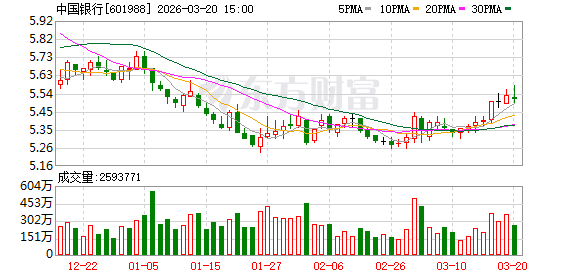
Group 1 - The core point of the article is that Bank of China has fully redeemed its tier 2 capital bonds issued in March 2021, amounting to 25 billion RMB, with the redemption executed on March 19, 2026 [1] - As of March 20, 2026, Bank of China's stock closed at 5.51 RMB, down 0.36% from the previous trading day, with a total market capitalization of 177.539 billion RMB [1] - The stock opened at 5.52 RMB, reached a high of 5.58 RMB, and a low of 5.49 RMB, with a trading volume of 1.436 billion RMB and a turnover rate of 0.12% [1]
中国银行信用卡中心副总经理李晖任职资格获批
Bei Jing Shang Bao· 2026-03-20 09:37
Core Viewpoint - The Beijing Financial Regulatory Bureau has approved the appointment of Li Hui as the Deputy General Manager of the Credit Card Center of Bank of China [1] Group 1 - The approval was officially announced on March 20 [1] - The document issued by the regulatory bureau is titled "Approval on the Qualification of Li Hui as Deputy General Manager of the Credit Card Center of Bank of China" [1]
中国银行(601988) - 中国银行股份有限公司关于赎回二级资本债券的公告
2026-03-20 09:32
中国银行股份有限公司董事会及全体董事保证本公告内容不存在任何虚假 记载、误导性陈述或者重大遗漏,并对其内容的真实性、准确性和完整性承担法 律责任。 证券代码:601988 证券简称:中国银行 公告编号:临 2026-004 中国银行股份有限公司 关于赎回二级资本债券的公告 2021 年 3 月 17 日,中国银行股份有限公司(简称"本行")发行了 规模为 250 亿元人民币的减记型二级资本债券,并于 2021 年 3 月 19 日发 布了《中国银行股份有限公司关于二级资本债券发行完毕的公告》(公告 编号:临 2021-020)。上述债券分为两个品种,其中品种一为 10 年期固 定利率债券,发行规模为人民币 150 亿元(简称"本期债券")。根据募 集说明书相关条款的规定,本期债券设有发行人赎回权,发行人有权在本 期债券第五年末,即 2026 年 3 月 19 日赎回本期债券。 截至本公告日,本行已行使赎回权,全额赎回了本期债券。 特此公告 中国银行股份有限公司董事会 二〇二六年三月二十日 ...