
CNCB(601998)

Search documents
新浪财经资讯AI速递:昨夜今晨财经热点一览 丨2026年1月24日
Xin Lang Cai Jing· 2026-01-23 23:31
Group 1 - US stock market showed mixed results with Nasdaq and S&P slightly up while Dow Jones declined, Intel's stock plummeted by 17% due to poor earnings guidance, while Nvidia and other chip stocks provided support [1] - The dollar index continued to weaken, and gold futures reached an all-time high, with silver breaking the $100 mark for the first time, driven by severe weather that caused US natural gas prices to surge by 70% in a week [1] - European countries hold approximately $3.6 trillion in US Treasury bonds, representing 40% of the overseas total, which could be used as leverage against the US amid tariff pressures, although coordinated selling may lead to significant losses [2][19] Group 2 - Japanese Prime Minister Fumio Kishida's tax cut promises have raised market concerns, leading to a massive sell-off of Japanese government bonds, causing long-term bond yields to soar to multi-year highs [3][20] - The US oil service giant SLB stated it could quickly expand operations in Venezuela if permitted, being the only international oil service company currently operating there, with competitors like Halliburton also looking to re-enter the market [4][21] - Canadian billionaire Eric Sprott has significantly profited from investing in the struggling Hycroft Mining Company, with a return on investment of 678%, capitalizing on the bull market for gold and silver [5][22] Group 3 - Silver prices have historically surpassed $100 per ounce, with a year-to-date increase of 40%, driven by strong industrial demand and ongoing structural supply shortages [6][23] - Economists have revised their expectations, indicating that the Federal Reserve may delay interest rate cuts until June, with inflation pressures and a robust labor market reducing the urgency for rate reductions [7][24] - Nomura's chief economist suggested gradually increasing farmers' pensions to 1,000 yuan per month, which could significantly improve rural elderly income expectations and stimulate consumption [8][25] Group 4 - The A-share market saw a surge in the photovoltaic sector, with major investment from well-known funds in commercial aerospace and semiconductor industries, indicating a strong institutional interest [10][26] - Musk's support for space-based solar power has led to a significant rally in photovoltaic stocks, with over 30 stocks hitting the daily limit up, although the industry still faces substantial technical and cost challenges [11][28] - China Merchants Bank has become the first bank to surpass 13 trillion yuan in total assets, indicating a potential turning point in its financial performance, while other banks also reached significant asset milestones [12][29]




2025年债券承销机构成绩单出炉:中国银行、中信证券领跑
2 1 Shi Ji Jing Ji Bao Dao· 2026-01-23 11:43
Core Insights - The bond underwriting market in 2025 shows a clear trend of "the strong getting stronger," with market share concentrated among a few leading institutions [1][4][8] - Competition among underwriters is intensifying, with banks and securities firms leveraging their unique strengths to differentiate themselves [2][6] - Regulatory bodies are taking steps to ensure market order and prevent irrational competition, particularly in pricing and underwriting practices [2][6] Group 1: Market Overview - The total bond issuance in 2025 reached 89.76 trillion yuan, a year-on-year increase of approximately 11% [2] - The issuance of interest rate bonds was 33.80 trillion yuan, up 18%, while credit bonds reached 21.95 trillion yuan, growing by 8% [2] - The market is characterized by a large total volume, diverse categories, and differentiated competition [2] Group 2: Competitive Landscape - In the banking sector, China Bank led with over 16 trillion yuan in underwriting, capturing more than 10% of the market share [4] - The top four state-owned banks collectively hold nearly 40% of the market share, indicating a strong position [4] - In the securities sector, CITIC Securities topped the list with 22,496.07 billion yuan in underwriting and a market share of 14.08% [4][5] Group 3: Sector-Specific Insights - Local government bond issuance reached a record high of approximately 10.29 trillion yuan, reflecting a year-on-year growth of 5.2% [6] - The financial bond market is predominantly led by securities firms, with CITIC Securities holding a market share of 17.56% [6] - The asset-backed securities (ABS) market shows a concentration of resources among leading firms, with CITIC Securities leading at 12.32% market share [7] Group 4: International Market Dynamics - The offshore bond market saw a total issuance of approximately $307.07 billion, a year-on-year increase of about 15.75% [7][8] - The market features a mix of domestic and foreign institutions, with China Bank leading at $14.70 billion in underwriting [8] - The competitive landscape in the offshore market is relatively dispersed, with no single institution dominating [8]


25Q4基金对银行持仓点评:主动基金环比持平,被动基金增持
GUOTAI HAITONG SECURITIES· 2026-01-23 11:10
Investment Rating - The report assigns an "Overweight" rating for the banking sector [4]. Core Insights - In Q4 2025, the proportion of active funds holding banks remained stable at 1.9%, while passive funds increased their holdings by 1.6 percentage points to 7.0%. Notable banks that received increased allocations from active funds include Ningbo Bank, Industrial Bank, Bank of China, and China Construction Bank [2][4]. - Active funds saw a decrease in the number of shares held by 5.0% to 2.56 billion shares, with a slight decline in market value by 0.4% to 30.58 billion yuan. Conversely, passive funds increased their holdings by 25.7% to 6.14 billion shares, with a market value increase of 31.3% to 110.4 billion yuan [4][14]. - The report highlights specific banks with significant changes in fund holdings, such as Industrial Bank (+1.23 percentage points) and Agricultural Bank (-0.13 percentage points) [4][15]. Summary by Sections Fund Holdings Overview - Active funds' market value in banks decreased slightly to 30.58 billion yuan, while passive funds' market value rose to 110.4 billion yuan, indicating a shift towards passive investment strategies [4][14]. - The report identifies banks with increased fund holdings, including Ningbo Bank (+0.08 percentage points), Industrial Bank (+0.05 percentage points), and Bank of China (+0.04 percentage points) [4][15]. Investment Recommendations - The report suggests focusing on three main investment themes for the banking sector in 2026: 1. Identifying banks with expected performance growth, recommending Ningbo Bank, China Merchants Bank, and Nanjing Bank. 2. Emphasizing banks with convertible bond expectations, recommending Chongqing Bank and Changshu Bank, with Shanghai Bank as a related target. 3. Continuing a dividend strategy, recommending Bank of Communications, Jiangsu Bank, Chongqing Rural Commercial Bank, and Shanghai Rural Commercial Bank [4][17].



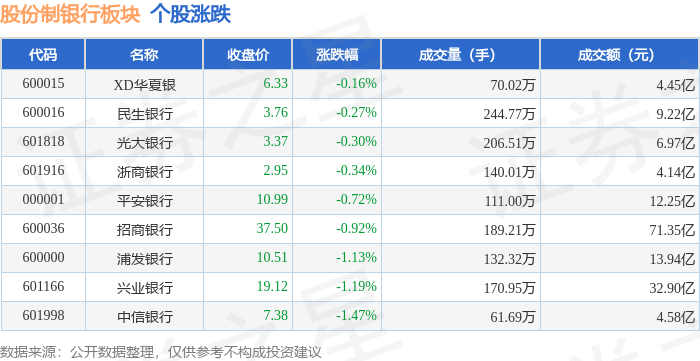
股份制银行板块1月23日跌0.99%,中信银行领跌,主力资金净流出12.22亿元
Zheng Xing Xing Ye Ri Bao· 2026-01-23 09:04
证券之星消息,1月23日股份制银行板块较上一交易日下跌0.99%,中信银行领跌。当日上证指数报收于 4136.16,上涨0.33%。深证成指报收于14439.66,上涨0.79%。股份制银行板块个股涨跌见下表: 以上内容为证券之星据公开信息整理,由AI算法生成(网信算备310104345710301240019号),不构成投资建议。 从资金流向上来看,当日股份制银行板块主力资金净流出12.22亿元,游资资金净流出1.24亿元,散户资 金净流入13.46亿元。股份制银行板块个股资金流向见下表: | 代码 | 名称 | 主力净流入(元) | 主力净占比 游资净流入 (元) | | 游资净占比 散户净流入 (元) | | 散户净占比 | | --- | --- | --- | --- | --- | --- | --- | --- | | 600000 | 浦发银行 | 8006.70万 | 5.74% | -435.47万 | -0.31% | -7571.23万 | -5.43% | | 600016 | 民生银行 | 5879.42万 | 6.38% | 1650.86万 | 1.79% | -7530.28 ...


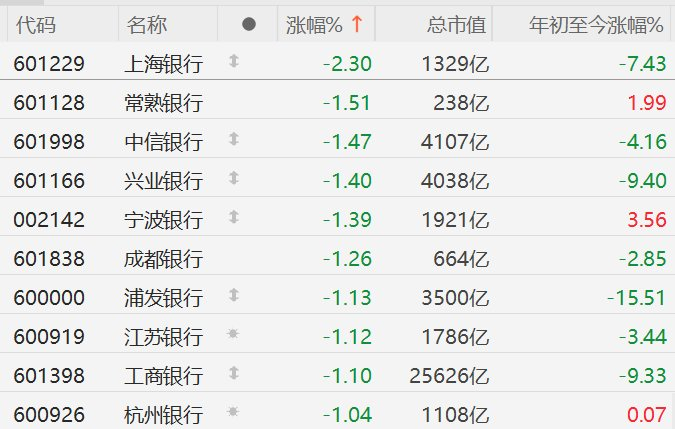
A股银行股普跌
Ge Long Hui A P P· 2026-01-23 07:20
| 代码 | 名称 | | 涨幅%↑ | 总市值 | 年初至今涨幅% | | --- | --- | --- | --- | --- | --- | | 601229 | 上海银行 | 1 | -2.30 | 1329亿 | -7.43 | | 601128 | 常熟銀行 | | -1.51 | 238亿 | 1.99 | | 601998 | 中信銀行 | 1 | -1.47 | 4107亿 | -4.16 | | 601166 | 兴业银行 | 1 | -1.40 | 4038亿 | -9.40 | | 002142 | 宁波银行 | 1 | -1.39 | 1921亿 | 3.56 | | 601838 | 成都银行 | | -1.26 | 664亿 | -2.85 | | 600000 | 浦发银行 | 1 | -1.13 | 3500亿 | -15.51 | | 600919 | 江苏银行 | 兼 | -1.12 | 1786亿 | -3.44 | | 601398 | 工商银行 | 1 | -1.10 | 25626亿 | -9.33 | | 600926 | 杭州银行 | 张 | -1.04 | ...


谁能跻身全球品牌价值500强?光大银行下滑71名,民生银行降60名
Xin Lang Cai Jing· 2026-01-23 01:08
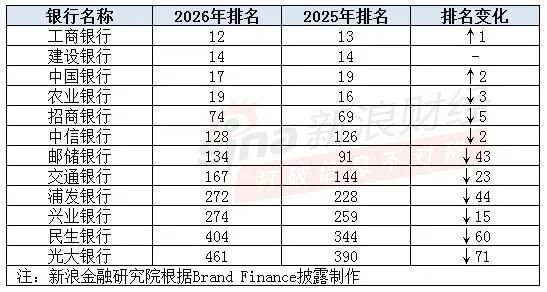
Group 1: Core Insights - The Brand Finance 2026 Global Brand Value 500 report was released, highlighting the performance of various banks and insurance companies [1][7] - Chinese brands have shown a double-digit growth in total value, indicating strong resilience and potential for future growth [7] Group 2: Banking Sector Summary - Major Chinese banks included in the ranking are Industrial and Commercial Bank of China (ICBC) at 12th, China Construction Bank at 14th, and Bank of China at 17th, with ICBC holding a brand value of $90.88 billion and a brand strength index of 91.5 [2][3] - China Bank surpassed Agricultural Bank, which dropped to 19th place, while China Merchants Bank ranked 74th as the highest among joint-stock banks [3][4] - Notable declines were observed for China Everbright Bank, which fell 71 places to 461st, and Minsheng Bank, which dropped 60 places to 404th [1][4] Group 3: Insurance Sector Summary - Among the insurance companies, Ping An Insurance ranked 32nd globally, being the only Chinese insurer in the top 100, with a brand strength rating of AAA- [5][6] - Other insurers like China Life and China Pacific Insurance also maintained positions within the top 200, while Prudential Insurance saw a significant drop of 117 places to 350th [5][6] - Notably, Cathay Life Insurance improved its ranking by 180 places to 407th [6] Group 4: Overall Brand Performance - The report indicates that 12 Chinese brands made it to the top 50 globally, with Douyin's brand value increasing by 45.1% to $153.54 billion, ranking 6th [7] - State Grid Corporation achieved a brand value of $102.44 billion, ranking first in the global utility sector, with a 19.6% increase in brand value [8]




四大证券报精华摘要:1月23日
Zhong Guo Jin Rong Xin Xi Wang· 2026-01-23 00:17
Group 1: Commercial Aerospace - The Chinese commercial aerospace sector is entering a new phase aimed at large-scale launches and commercial closed-loop systems, with significant breakthroughs expected in rocket capacity over the next 3 to 5 years [1] - By 2025, China's commercial aerospace is projected to complete 50 launches, accounting for 54% of total space launches, with 25 commercial rockets launched and 311 commercial satellites in orbit, representing 84% of total satellites [1] - The capital market for commercial aerospace companies is accelerating, with several leading firms preparing for IPOs, including Blue Arrow Aerospace and Zhongke Aerospace [1] Group 2: Public Fund Performance - The latest public fund reports reveal that the top ten holdings include companies like Zhongji Xuchuang, Ningde Times, and Tencent, with notable increases in holdings for companies like Zhongji Xuchuang, which saw an increase of 22.602 billion yuan [2] - The automotive industry is facing cost pressures due to rising prices of memory chips and metals, impacting supply chain dynamics and competition [2] Group 3: Biopharmaceutical Industry - Over 50 biopharmaceutical companies have disclosed their 2025 performance forecasts, with nearly 50% showing positive expectations, particularly in the CXO sector, where WuXi AppTec anticipates a revenue increase of approximately 15.84% [3] - The biopharmaceutical industry is expected to enter a new phase of high-quality development as structural reforms and supportive policies continue to evolve [3] Group 4: Fundraising and Market Trends - The public fund market has seen a resurgence, with several equity funds raising over 7 billion yuan, indicating a positive trend in active equity fund performance [4] - The Shanghai Suiruan Technology Co., Ltd. has received approval for its IPO, aiming to raise 6 billion yuan for product development and business expansion [5] Group 5: Aluminum Market - The aluminum market has shown strong performance, with prices rising over 12% since mid-December 2025, supported by favorable macroeconomic conditions and demand for aluminum in various applications [6] - The copper-aluminum price ratio exceeding 4 suggests a potential shift towards aluminum in sectors like air conditioning, indicating new demand growth [6] Group 6: Banking Sector - Five listed banks have reported a year-on-year increase in net profit for 2025, with improvements in non-performing loan ratios for three banks [9] - The banking sector is expected to maintain stable performance, supported by improved funding costs and a potential stabilization of net interest margins [9] Group 7: Chemical Industry - The chemical industry is experiencing positive performance, with over 60% of companies reporting improved earnings, driven by rising prices of certain chemical products [10] - The DOP market is expected to maintain upward momentum due to strong raw material prices and limited supply, indicating a stable support for pricing [10]





商业银行争夺“年终奖”
Jing Ji Ri Bao· 2026-01-22 22:06
Core Viewpoint - Major banks are competing for year-end bonuses by promoting exclusive investment products through digital channels, focusing on low-risk options to meet investor demand for stability and flexibility [1][2]. Group 1: Investment Strategies - Banks are shifting from selling individual products to offering comprehensive financial solutions, with features like "year-end bonus investment destinations" that allow for flexible selection across various asset classes [2]. - Financial institutions are leveraging their asset allocation capabilities to enhance customer loyalty and meet diverse needs, with tailored strategies such as "conservative + stable + progressive" approaches for year-end bonuses [2][3]. Group 2: Market Trends and Challenges - The wealth management business is becoming increasingly important for banks amid regulatory changes and pressure on interest margins, with year-end bonuses creating a unique opportunity for asset allocation [1][4]. - Banks face challenges such as product homogeneity and the risk of misleading marketing practices, which could lead to irrational decision-making among consumers [3]. Group 3: Customer-Centric Approaches - Banks are encouraged to focus on customer needs by providing clear explanations of asset logic in different market environments and enhancing financial literacy among clients [4]. - It is essential for banks to integrate internal financial data to create comprehensive customer profiles and offer dynamic, adjustable solutions while maintaining transparency regarding risks [4]. Group 4: Investor Guidance - Investors are advised to incorporate year-end bonuses into their overall wealth planning, focusing on key factors such as fund management, investment strategies, historical volatility, and fee structures to avoid impulsive decisions [4][5]. - It is recommended that investors clarify their financial needs and risk tolerance, prioritizing liquidity and safety for short-term funds while considering higher-yield products for medium to long-term investments [5].


5家上市银行披露业绩快报 归母净利润均实现同比增长
Zheng Quan Ri Bao Zhi Sheng· 2026-01-22 16:38
Group 1 - As of January 22, 2025, five listed banks in A-shares have reported their preliminary performance for the year, showing an overall increase in net profit attributable to shareholders compared to 2024 [1] - Among these banks, three have reported a decrease in non-performing loan (NPL) ratios compared to the end of 2024 [1] - Shanghai Pudong Development Bank (SPDB) reported a revenue of 173.96 billion yuan, a year-on-year increase of 1.88%, and a net profit of 50.02 billion yuan, up 10.52% [1] - CITIC Bank and Industrial Bank reported revenues of 212.48 billion yuan and 212.74 billion yuan, with net profits of 70.62 billion yuan and 77.47 billion yuan, reflecting year-on-year growth of 2.98% and 0.34% respectively [1] - Ningbo Bank and Su Nong Bank also reported positive growth, with Ningbo Bank's revenue at 71.97 billion yuan (up 8.01%) and net profit at 29.33 billion yuan (up 8.13%), while Su Nong Bank's revenue was 4.19 billion yuan (up 0.41%) and net profit was 204.3 million yuan (up 5.04%) [1] Group 2 - Ningbo Bank disclosed its revenue structure, reporting net interest income of 53.16 billion yuan (up 10.77%) and net fee and commission income of 6.09 billion yuan (up 30.72%) [2] - All five listed banks have shown steady growth in total assets, with SPDB and CITIC Bank both surpassing 1 trillion yuan in total assets, reaching 1.008 trillion yuan and 1.013 trillion yuan respectively, marking increases of 6.55% and 6.28% from 2024 [2] - Industrial Bank's total assets reached 1.109 trillion yuan, up 5.57%, while Ningbo Bank's total assets grew by 16.11% to 363 billion yuan, and Su Nong Bank's total assets increased by 8% to 231.1 billion yuan [2] - In terms of asset quality, SPDB, CITIC Bank, and Su Nong Bank reported declines in NPL ratios, with ratios of 1.26%, 1.15%, and 0.88% respectively, while Ningbo Bank's NPL ratio remained stable and Industrial Bank's increased by 0.01 percentage points [2] Group 3 - The banking industry is expected to maintain stable performance in 2025, supported by significant improvements in funding costs, which are likely to stabilize net interest margins and boost interest income [3] - Analysts predict that the growth rates of revenue and net profit for listed banks in 2025 will improve compared to the first three quarters of 2025, driven by stable net interest margins and declining credit costs [3] - SPDB noted a significant decrease in interest costs, leading to a stabilization of net interest margins, while Ningbo Bank benefited from a 33 basis point drop in deposit interest rates, resulting in substantial growth in interest income [3] - The effects of previous reductions in deposit rates are expected to continue into 2026, helping to improve funding costs and reduce pressure on net interest margins, indicating a potential recovery phase [3]

六大行集体公告 中小银行也纷纷响应 消费贷贴息政策升级包含这四大要点
Mei Ri Jing Ji Xin Wen· 2026-01-22 15:19
Group 1 - The Ministry of Finance, the People's Bank of China, and the Financial Regulatory Administration announced the optimization of the personal consumption loan interest subsidy policy, which has been positively received by major banks [1] - The implementation period for the personal consumption loan interest subsidy policy has been extended to the end of 2026, and restrictions on consumption fields for loans of 50,000 yuan and above have been removed [1] - Several banks, including China Bank and Bank of Communications, have stated that loans with completed subsidy applications will automatically apply the new subsidy policy starting from January 1, 2026, without the need for customers to re-sign subsidy agreements [1] Group 2 - The policy has expanded the range of institutions eligible to process personal consumption loan interest subsidies, including city commercial banks, rural cooperative financial institutions, foreign banks, and consumer finance companies [2] - The optimization of the policy is expected to stimulate consumption in third- and fourth-tier cities and rural areas, which are significant growth points for China's consumption market [2] - Several county-level financial institutions have also announced their participation in the subsidy program, indicating a broader reach of the policy [2]
