CNCB(601998)

Search documents
银行业“十五五”展望系列专题(上篇):回眸“十四五”,监管引导和主动求变下的银行经营理念重构
Shenwan Hongyuan Securities· 2025-12-31 11:51
Investment Rating - The report maintains a positive outlook on the banking industry, indicating a "buy" rating for the sector during the "15th Five-Year Plan" period [1]. Core Insights - The banking sector is transitioning from a focus on quantity to quality, emphasizing risk management and efficiency in capital utilization. This shift is driven by the need to support the real economy while managing risks effectively [2][3]. - The report highlights that the return on equity (ROE) for listed banks has remained resilient, averaging around 10%, with city commercial banks leading at 11%-12% ROE, while state-owned banks maintain about 10% [2][3]. - Key changes observed during the "14th Five-Year Plan" include a shift away from scale-driven growth towards a balanced approach between capital and efficiency, a stabilization of net interest margins, and an increased focus on capital markets as a revenue source [2][3]. Summary by Sections 1. From Quantity to Quality - The banking industry has evolved through three five-year plans, with a core transformation focusing on risk and efficiency rather than mere volume [2][3]. 2. High-Quality Development During the "14th Five-Year Plan" 2.1 ROE: Resilience of State-Owned and City Commercial Banks - Listed banks' ROE has slightly declined but remains around 10%, reflecting operational pressures while showcasing resilience [23]. 2.2 Credit: Balancing Capital and Efficiency - The focus has shifted from merely increasing credit volume to optimizing the structure of credit distribution, with significant changes in loan allocation towards technology and green sectors [16][19]. 2.3 Net Interest Margin: Stabilization Efforts - Regulatory support is expected to stabilize net interest margins, which have reached record lows, with proactive measures to prevent further declines [2][3]. 2.4 Risk Management: Provisioning for Stability - The banking sector has moved past peak risk levels, with provisions supporting ROE stability, while new economic challenges require ongoing risk management [2][3]. 2.5 Capital Markets: A New Revenue Stream - Capital market activities have become increasingly important, with banks leveraging these for revenue amidst pressure on interest income [2][3]. 3. Investment Analysis Opinion - The report suggests a focus on stable, high-quality development, with an expectation for bank valuations to return to 1x price-to-book (PB) ratios. It emphasizes a dual strategy of investing in leading banks and quality city commercial banks [3][4].






2025年中国创投:重拾向上动能,奔赴投资新程
Zheng Quan Shi Bao Wang· 2025-12-31 11:43
Group 1: Industry Recovery and Trends - In 2025, China's venture capital industry emerged from a two-year downturn, showing signs of recovery across the entire investment chain, driven by a combination of funding and project highlights, as well as supportive policies [1] - The year-end activities of venture capitalists indicate a strong return to the industry, fueled by a new wave of technological changes and ongoing policy benefits [1] Group 2: Government Investment Fund Policies - The State Council issued a significant document aimed at promoting the high-quality development of government investment funds, focusing on stricter controls on new fund establishments and optimizing investment policies [2] - Various local governments have responded by issuing supporting policy documents, further regulating the operation of government investment funds to promote high-quality industry development [2] Group 3: Banking Sector Involvement - Since the announcement of expanded pilot programs for bank-affiliated financial asset investment companies (AICs), banks have accelerated their entry into the primary market, with several major banks successfully establishing AICs [3] - As of now, AICs from six major state-owned banks and three national joint-stock banks have been established, with total investments reaching 45.272 billion yuan, a year-on-year increase of approximately 37.7% [3] Group 4: Special Bonds for Government Guidance Funds - Several local governments have issued special bonds to support government guidance funds, breaking the previous norm that prohibited such investments [4] - A total of 52 billion yuan in special bonds have been issued by nine provinces and cities, significantly enhancing the funding pool for the venture capital industry [4] Group 5: Long-Term Government Guidance Funds - New government guidance funds established this year have extended their duration beyond the typical 10 years, with some lasting up to 20 years, providing long-term support for projects [5] - This trend of extending fund durations is expected to create a more patient investment environment, allowing for better exit strategies [5] Group 6: Mergers and Acquisitions - The introduction of policies supporting private equity funds in acquiring listed companies has led to a surge in related acquisition cases, with several venture capital firms actively pursuing stakes in public companies [6][7] - The trend of startups acquiring listed companies is also on the rise, indicating a new strategy for both startups and venture capital firms to explore exit routes [7] Group 7: Domestic PE Firms Acquiring Foreign Brands - Domestic top-tier private equity firms have increasingly acquired the Chinese operations of overseas consumer brands, highlighting a trend of local capital participating in the localization of foreign brands [8] - This trend is driven by the combination of ample funding, local operational expertise, and the stable cash flow of established foreign brands [8] Group 8: Technology Innovation Bonds - The introduction of technology innovation bonds has opened new fundraising channels for venture capital institutions, with several private firms successfully issuing bonds at competitive interest rates [9] - The issuance of these bonds has significantly boosted market confidence and marked a transition towards a more normalized support phase for private venture capital institutions [9] Group 9: Mainland VC/PE Expansion into Hong Kong - Several mainland investment institutions have established offices in Hong Kong, attracted by the region's supportive environment for technological innovation [10] - The Hong Kong government's initiatives, including the establishment of a significant innovation and technology fund, have further encouraged mainland VC/PE firms to expand into the market [10] Group 10: Return of Dollar LPs to China - Multiple venture capital firms have successfully raised dollar-denominated funds, indicating a renewed interest from international investors in the Chinese market [11][12] - The return of dollar LPs coincides with the rapid growth of China's AI industry, highlighting the potential undervaluation of Chinese assets [11][12] Group 11: National Entrepreneurship Investment Fund - The establishment of a "carrier-level" national entrepreneurship investment fund aims to support startups across key economic regions in China, with a focus on early-stage investments [13] - This fund features a long duration of 20 years and aims to provide substantial financial backing to venture capital institutions and startups, enhancing the overall investment landscape [13]



芦苇出任行长8个月跳槽,中信银行董事长“一肩挑”
Xin Lang Cai Jing· 2025-12-31 10:18
Core Viewpoint - The resignation of Lu Wei as the president of CITIC Bank after less than a year in office highlights the bank's ongoing operational challenges, including declining revenues and pressure on net interest margins [1][2][3]. Group 1: Leadership Changes - Lu Wei resigned from his positions at CITIC Bank, including executive director and president, due to work adjustments, and was appointed as the president of Postal Savings Bank [1][2]. - Lu Wei had a 26-year career at CITIC Bank, having held various key positions before becoming president in April 2025, with his term originally set to end in April 2028 [1][2][3]. - Chairman Fang Heying will temporarily assume the role of president, bringing extensive experience from his previous leadership roles within CITIC Bank [7][28]. Group 2: Financial Performance - For the first three quarters of 2025, CITIC Bank reported operating income of CNY 156.6 billion, a decrease of 3.46% year-on-year, while net profit attributable to shareholders increased by 3.02% to CNY 53.4 billion [11][32]. - The bank's operating expenses fell to CNY 91.2 billion, down 8.57% year-on-year, indicating effective cost control measures [23][32]. - Credit impairment losses decreased by 12.91% to CNY 44.7 billion, contributing to a rise in operating profit despite declining revenues [12][33]. Group 3: Business Challenges - CITIC Bank faces multiple challenges, including pressure on net interest margins, declining non-interest income, and difficulties in retail banking [2][12][35]. - The bank's net interest income fell by 2.06% to CNY 107.7 billion, with a net interest margin of 1.63%, the largest decline among nine A-share listed banks [12][35]. - Non-interest income decreased by 6.4% to CNY 48.9 billion, with a significant drop in investment income and fair value changes [35][40]. Group 4: Retail Banking Issues - CITIC Bank's retail banking transformation has faced setbacks, with retail banking income stagnating and pre-tax profits declining significantly from 2021 to 2024 [38][39]. - The bank's credit card business has seen a reduction in loan balances and transaction volumes, leading to a 5.91% decline in credit card income for 2024 [19][40]. - Complaints regarding credit card practices, including high fees and aggressive collection methods, have increased, indicating potential reputational risks [19][40].


中信银行行长芦苇辞任,下一站“执掌”邮储银行
Huan Qiu Lao Hu Cai Jing· 2025-12-31 09:09
Group 1 - The core point of the news is the resignation of Lu Wei from his positions as Executive Director and President of CITIC Bank, with Chairman Fang Heying temporarily taking over the role [1] - Lu Wei's tenure as President lasted less than a year, having officially assumed the role in April 2023, with a term originally set to end in April 2028 [1] - During Lu Wei's leadership, CITIC Bank maintained steady growth, with a year-on-year increase in net profit of 3.02% for the first three quarters of the year, and total assets reaching 9.9 trillion yuan by the end of September [1] Group 2 - Lu Wei is set to join Postal Savings Bank as a core member of the management team, with his appointment as Executive Director candidate and President already announced [2] - Postal Savings Bank's asset scale has steadily expanded, reaching 18.61 trillion yuan by the end of the third quarter, an increase of 8.90% compared to the end of the previous year [2] - For the first three quarters, Postal Savings Bank reported a net profit of 76.562 billion yuan, a modest year-on-year growth of 0.98%, while net interest income faced pressure, decreasing by 4.442 billion yuan to 210.505 billion yuan [2]
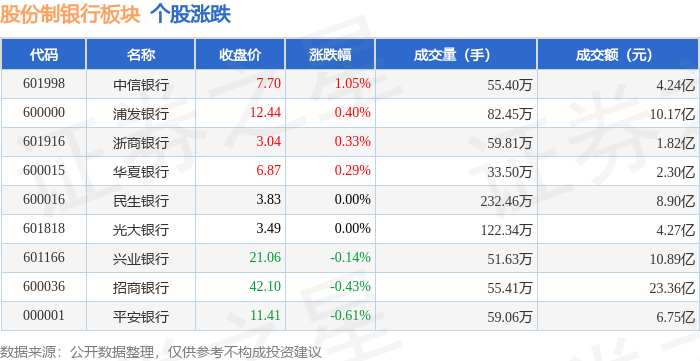
股份制银行板块12月31日跌0.01%,平安银行领跌,主力资金净流入1.77亿元
Zheng Xing Xing Ye Ri Bao· 2025-12-31 09:07
Group 1 - The banking sector experienced a slight decline of 0.01% on December 31, with Ping An Bank leading the drop [1] - The Shanghai Composite Index closed at 3968.84, up 0.09%, while the Shenzhen Component Index closed at 13525.02, down 0.58% [1] - Major banks such as CITIC Bank and Shanghai Pudong Development Bank saw positive price movements, with CITIC Bank increasing by 1.05% to 7.70 and Shanghai Pudong Development Bank rising by 0.40% to 12.44 [1] Group 2 - The net inflow of main funds in the banking sector was 177 million yuan, while retail funds saw a net inflow of 25.68 million yuan [1] - Retail investors showed a mixed response, with significant outflows from major banks like Ping An Bank and Minsheng Bank, while some smaller banks attracted retail inflows [2] - The data indicates that institutional investors favored certain banks, as seen in the net inflow percentages for banks like CITIC Bank and Shanghai Pudong Development Bank [2]




中信银行日照分行供应链金融助力普惠企业加“数”前行
Qi Lu Wan Bao· 2025-12-31 07:16
Core Insights - The integration of finance and the real economy is undergoing a systematic transformation driven by digital technology and ecosystem foundations [1] - CITIC Bank's Rizhao branch has embedded digital finance deeply into industrial structures, collaborating with core enterprises to create an innovative paradigm of inclusive supply chain finance [1] Group 1 - The collaboration between Rizhao branch and a core enterprise began with traditional credit services and quickly evolved into digital ecological collaboration [1] - The launch of the "Xin e Chain" product in 2022 marked a key turning point, facilitating the transition of core enterprises to online channels with embedded and customized financial support [1] Group 2 - Facing challenges from upstream suppliers that are scattered, small, and regionally diverse, Rizhao branch has developed a chain service system based on core enterprise credit and real transaction data [2] - Utilizing CITIC's intelligent platform product matrix, the branch introduced online factoring, allowing suppliers to apply for pure credit loans online based on accounts receivable data, with a maximum limit of 10 million yuan [2] - The financing cycle has been reduced from the traditional 7 days to within 8 hours, addressing the urgent financing needs of small and micro enterprises [2] - To date, the Rizhao branch has provided nearly 200 million yuan in financial support to over a dozen small and micro suppliers of the core enterprise through online factoring and other products [2] - This model is rooted in closely following regional development strategies, leveraging CITIC Group's comprehensive advantages to ensure transaction authenticity and build a credit system for chain enterprises [2]
中信银行开创千亿级“五篇大文章”债券承销全景矩阵
Jin Rong Jie· 2025-12-31 06:53
Core Viewpoint - The news highlights the significant role of CITIC Bank in the development of China's credit bond market, emphasizing its comprehensive financing advantages and innovative capabilities to support key sectors of the economy and achieve substantial growth by 2025 [1][2][3][4]. Group 1: Credit Bond Market Development - CITIC Bank has played a crucial role in the high-quality development of China's credit bond market, focusing on serving the real economy and key areas identified in the "Five Major Articles" [1]. - The bank aims to achieve a breakthrough in its overall operations by 2025, with a targeted bond underwriting service scale exceeding 1 trillion yuan within the year [1]. Group 2: Technological Financial Leadership - CITIC Bank has integrated its comprehensive financial services to establish a full lifecycle financial service system, including equity, loans, bonds, and insurance [1]. - The bank led the issuance of 15 national pilot technology innovation bonds, covering over 40% of the first batch of projects, demonstrating its leadership among financial institutions [1]. Group 3: Green Finance Initiatives - Since 2025, CITIC Bank has focused on green finance, achieving a bond underwriting scale exceeding 26 billion yuan, with a year-on-year growth of over 60% [2]. - The bank has explored innovative projects, such as underwriting a 20-year green bond for a power company, aligning with long-term investment recovery cycles [2]. Group 4: Inclusive Finance Expansion - In response to policies supporting rural revitalization, CITIC Bank has successfully underwritten over 10 billion yuan in rural revitalization bonds, leading the market [3]. - The bank aims to increase its credit bond underwriting client base to over 1,000 by 2025, achieving a market coverage rate of 42% [3]. Group 5: Pension Finance Development - CITIC Bank is actively exploring financial services for the aging population, launching a comprehensive pension finance service system [3]. - The bank has developed a tailored bond financing solution for the pension industry, marking the first issuance of pension finance bonds in the sector [3]. Group 6: Digital Finance Innovations - CITIC Bank is advancing digital finance by integrating cutting-edge technologies and expanding its financial service boundaries [4]. - The bank has underwritten over 15 billion yuan in asset securitization projects in the digital payment sector, supporting small and micro enterprises with low-cost financing [4]. - In 2025, CITIC Bank's total debt financing tool underwriting amount exceeded 900 billion yuan, maintaining its position as the only financial institution to cross this threshold for two consecutive years [4].
书写“金融为民”生动实践,中信银行全力为客户提供有温度的服务
Jin Rong Jie· 2025-12-31 06:53
Core Viewpoint - Citic Bank is committed to enhancing customer service quality and efficiency by implementing tailored service processes for special circumstances, ensuring compliance and risk management while providing warm and secure financial services [1][4]. Group 1: Service Innovations - Citic Bank has developed the "Four Special" service processes to address unique customer needs, focusing on special periods, clients, businesses, and scenarios [1]. - The bank has established specific service guidelines to create customized solutions that enhance service precision and convenience for clients [1]. Group 2: On-Site Services - For clients unable to visit branches due to mobility issues, Citic Bank has implemented an "on-site service" process, allowing staff to visit clients' homes to facilitate banking transactions [2]. - A case is highlighted where bank staff traveled over 6 hours to assist elderly clients with unprocessed deposits, receiving high praise for their dedication and service [2]. Group 3: Online Services - Citic Bank has introduced an "online service" process for clients abroad who cannot visit branches, utilizing video verification to complete transactions efficiently [3]. - In one instance, a client was able to resolve a banking issue for her daughter studying overseas through a video call, demonstrating the bank's commitment to customer care [3]. Group 4: Emergency Financial Assistance - The bank has protocols in place for urgent situations, such as providing immediate funds for medical expenses when clients are incapacitated [4]. - A specific case involved assisting a client in ICU by verifying family relationships and confirming the use of funds for medical payments, showcasing the bank's responsiveness and support during crises [4]. Group 5: Commitment to Customer-Centric Service - Citic Bank emphasizes its dedication to political and social responsibilities in financial services, aiming to respond swiftly to customer needs and enhance overall service experience [4].
中信银行焦作分行推进反诈宣传 筑牢金融安全防线
Huan Qiu Wang· 2025-12-31 06:37
Group 1 - The core viewpoint of the article highlights the proactive measures taken by CITIC Bank's Jiaozuo branch to combat telecom and online fraud through targeted promotional activities [1][2] Group 2 - The bank organized a series of anti-fraud promotional activities focusing on different target groups, including enterprises, university students, and customers visiting bank branches [1] - For enterprises, the bank conducted customized anti-fraud lectures, emphasizing prevalent scams such as impersonation and financial fraud, aiming to enhance the financial security of both companies and employees [1] - The bank collaborated with local universities to implement a "Financial Knowledge into Campus" initiative, raising awareness among students about common scams like campus loans and online job fraud [1] - In bank branches, anti-fraud messaging was integrated into daily services, utilizing electronic screens and staff interactions to educate customers, particularly the elderly, about potential fraud risks [1] Group 3 - The promotional activities reached thousands of employees, students, and customers, receiving positive social feedback [2] - The bank plans to continue innovating its promotional methods and deepen collaboration with law enforcement to protect public financial security and maintain regional financial stability [2]
中信银行少帅转战邮储,国有行股份行间高管流动折射何种变化
Nan Fang Du Shi Bao· 2025-12-31 04:36
Core Viewpoint - The recent appointment of Lu Wei as the president of Postal Savings Bank after his resignation from CITIC Bank highlights the increasing trend of executive mobility between state-owned and joint-stock banks in China, reflecting a shift towards breaking down institutional barriers and fostering financial innovation [2][9][12]. Group 1: Executive Changes - Lu Wei resigned from his positions at CITIC Bank, including president and executive director, due to work adjustments, and has been appointed as the president of Postal Savings Bank [3][5]. - Lu Wei has over 20 years of experience at CITIC Bank, having held various significant roles, including vice president and secretary of the board [3][4]. - Following Lu Wei's departure, CITIC Bank's chairman, Fang Heying, will temporarily assume the role of president [8]. Group 2: Industry Trends - The movement of executives between state-owned and joint-stock banks has become increasingly common, with several high-profile cases in recent years, indicating a trend towards more fluid talent mobility in the banking sector [9][10]. - Experts suggest that this trend is part of a broader strategy to enhance capital and talent flow, shift performance metrics from "loan scale" to "ecological value," and stimulate financial innovation [10][11]. - The transition of executives like Lu Wei poses challenges, as they must adapt their skills and experiences to different banking environments, particularly in rural contexts [11][12].