
Sugon(603019)

Search documents
半导体并购估值博弈加剧?差异化定价成各方共识
Zheng Quan Shi Bao Wang· 2026-01-12 23:29
Core Viewpoint - The semiconductor merger and acquisition (M&A) landscape is experiencing increased valuation disputes, leading to a rise in failure rates of deals, despite a more accommodating regulatory environment [1][2][4]. Group 1: M&A Activity and Trends - In 2025, the number of M&A cases in the semiconductor sector increased by nearly 25% year-on-year, reaching 161 cases, with 12 failures, marking a five-year high [2][3]. - The total M&A amount in China's semiconductor industry reached approximately 279.67 billion, with 496 cases and 32 failures, a more than twofold increase compared to previous years [3]. - The overall M&A market in A-shares saw about 4,773 cases in 2025, a 5% increase year-on-year, with a slight decline in overall failure rates [2][3]. Group 2: Valuation Discrepancies - There is a significant divergence in valuations between buyers and sellers, particularly as sellers' expectations remain high due to previous market conditions, while buyers are cautious due to industry adjustments [4][5]. - The average price-to-earnings ratio for the semiconductor industry peaked at 291 times in 2021 but fell to 53 times by 2024, reflecting a substantial valuation correction [5]. - The termination of several high-profile M&A deals, such as the merger between Haiguang Information and Zhongke Shuguang, was attributed to disagreements over core terms, particularly valuation [4][5]. Group 3: Differentiated Pricing Strategies - Industry experts suggest implementing differentiated pricing strategies to address valuation discrepancies, allowing for tailored exit options for different investor types [10][11]. - Recent M&A cases have shown a trend towards differentiated arrangements in terms of valuation, payment methods, and performance commitments, which can help align interests among diverse stakeholders [10][11]. - Regulatory support for differentiated M&A practices has increased, encouraging the use of various assessment methods and flexible payment structures [11][12]. Group 4: Challenges in M&A Execution - The semiconductor industry is characterized by high cyclicality, complicating M&A negotiations as both parties seek to capitalize on market recovery while managing inherent risks [6][12]. - The presence of a "trilemma" in M&A—high seller expectations, buyer performance commitments, and high success rate targets—poses significant challenges, especially during industry downturns [12][14]. - The need for performance guarantees in M&A deals has led to complications, particularly for unprofitable semiconductor firms, as they may resist signing performance commitments [12][14].



中国算力行业决策建议及项目可行性研究报告2026-2032年
Sou Hu Cai Jing· 2026-01-12 21:05
Group 1 - The report outlines the strategic importance of computing power as a new type of infrastructure and its collaborative relationship with data and algorithms [3][4] - The global computing power market is characterized by a significant scale and growth, with North America leading and the Asia-Pacific region rapidly catching up [4][5] - The report highlights the evolution of computing power technology, with heterogeneous computing architectures becoming mainstream [4][5] Group 2 - During the "14th Five-Year Plan" period, China's computing power scale has expanded significantly, with the total computing power surpassing previous levels [5][6] - The report discusses the impact of the East Data West Computing project on the geographical restructuring of computing power in China [5][6] - The establishment of a domestic computing ecosystem is underway, with a notable increase in the annual growth rate of domestic AI chip shipments [6][7] Group 3 - The report identifies key segments of the computing power industry chain, including advancements in chiplet technology and optical interconnects that enhance computing density [4][5] - The deployment of edge computing nodes in industrial and automotive internet applications is increasing, reflecting a shift towards more decentralized computing solutions [5][6] - The demand for computing power in various applications, such as AI model training, scientific computing, and smart manufacturing, is analyzed, indicating a growing need for high-performance computing resources [6][7] Group 4 - The competitive landscape of the global computing power industry is dominated by American companies, with major players like NVIDIA, AMD, and Intel leading the high-end computing ecosystem [6][7] - In China, the report highlights the emergence of a "national team" in domestic computing power, with traditional hardware manufacturers transitioning to computing service providers [7][8] - Key competitive dimensions include hardware performance, software ecosystem compatibility, and the ability to deliver comprehensive solutions [6][7] Group 5 - The report forecasts significant growth in the computing power market from 2026 to 2032, with an expected compound annual growth rate and a shift in the market structure towards AI computing power [10][11] - The analysis indicates that the domestic market share of Chinese computing power is projected to exceed 50% under certain scenarios [10][11] - The report emphasizes the importance of establishing a sustainable and efficient computing power ecosystem, with a focus on energy efficiency and green technologies [10][11]



半导体并购估值博弈加剧 差异化定价成各方共识
Zheng Quan Shi Bao· 2026-01-12 18:23
Core Viewpoint - The semiconductor M&A activity in A-shares is experiencing a surge in 2025, with a notable increase in the number of cases and a focus on asset integration and strategic cooperation, despite a rising failure rate in M&A transactions [1][2][3]. Group 1: M&A Activity and Trends - In 2025, the number of M&A cases in the A-share market reached approximately 4,773, reflecting a year-on-year increase of about 5%, while semiconductor-related M&A cases rose to 161, up nearly 25% year-on-year [2][3]. - The total M&A amount in China's semiconductor sector reached 279.67 billion yuan, with 496 cases reported, and 32 failures, marking a more than twofold increase in failures compared to previous years [3]. - The overall failure rate of M&A transactions in the semiconductor industry has increased, with 12 failures reported in 2025, the highest in five years [2][3]. Group 2: Valuation Discrepancies and Challenges - There is a significant divergence in valuations between buyers and sellers, complicating the consensus on core terms such as price and performance commitments, which has become a critical reason for M&A failures [1][4][5]. - The average price-to-earnings ratio in the semiconductor industry dropped from 291 times in 2021 to 53 times in 2024, reflecting a substantial valuation correction amid changing market conditions [5]. - The introduction of the "M&A Six Guidelines" in 2024 accelerated M&A activities, but the valuation discrepancies have intensified in 2025, particularly as sellers' expectations remain high due to historical peaks in valuations [4][10]. Group 3: Strategic Recommendations - Industry experts suggest adopting differentiated M&A strategies, including staged incubation through M&A funds, to mitigate risks associated with semiconductor M&A transactions [1][7][10]. - Companies are encouraged to implement differentiated pricing strategies based on various financing rounds, allowing for more flexible exit options for investors [8][10]. - Regulatory support for differentiated M&A is evident, with a shift towards more inclusive and prudent approval processes, allowing for diverse valuation methods and payment structures [11][12].

中科曙光涨2.02%,成交额31.37亿元,主力资金净流出5477.47万元
Xin Lang Cai Jing· 2026-01-12 03:25
Core Viewpoint - Zhongke Shuguang's stock price has shown a significant increase in early January 2024, with a year-to-date rise of 11.20% and a recent five-day increase of 8.46% [1] Group 1: Stock Performance - As of January 12, Zhongke Shuguang's stock price rose by 2.02% to 95.23 CNY per share, with a trading volume of 3.137 billion CNY and a turnover rate of 2.28%, resulting in a total market capitalization of 139.333 billion CNY [1] - The stock has experienced a decline of 11.48% over the past 60 days, indicating volatility in its recent performance [1] Group 2: Financial Performance - For the period from January to September 2025, Zhongke Shuguang reported a revenue of 8.82 billion CNY, reflecting a year-on-year growth of 9.68%, and a net profit attributable to shareholders of 966 million CNY, which is a 25.55% increase compared to the previous year [2] Group 3: Shareholder Information - As of December 19, 2025, the number of shareholders for Zhongke Shuguang was 355,300, a decrease of 0.59% from the previous period, while the average number of circulating shares per person increased by 0.60% to 4,116 shares [2] - The company has distributed a total of 1.922 billion CNY in dividends since its A-share listing, with 1.083 billion CNY distributed over the last three years [3] Group 4: Institutional Holdings - As of September 30, 2025, among the top ten circulating shareholders, Huatai-PB CSI 300 ETF held 24.9228 million shares, a decrease of 1.0626 million shares from the previous period, while E Fund CSI 300 ETF increased its holdings by 2.1347 million shares to 20.9110 million shares [3]
CES2026闭幕,全球AI算力平台能力持续提升
Ping An Securities· 2026-01-12 02:18
Investment Rating - The industry investment rating is "Outperform the Market" which indicates an expected performance that exceeds the market by more than 5% over the next six months [23] Core Insights - The CES 2026 event highlighted the continuous enhancement of global AI computing power platforms, with significant advancements from major chip manufacturers like NVIDIA and AMD [3][5] - NVIDIA's Rubin platform has achieved full-scale production, while AMD introduced its Helios platform, showcasing the ongoing improvements in AI computing infrastructure that are expected to drive the global AI industry forward [6][19] - The report emphasizes the synergy between the enhancement of AI computing infrastructure and the iterative upgrades of global large models, which will foster sustained growth in the AI sector [3][19] Summary by Sections Industry News and Commentary - CES 2026 concluded on January 9, 2026, showcasing advancements in AI computing chips from companies like NVIDIA and AMD [3][6] - NVIDIA's Rubin platform is designed for building advanced AI supercomputers and is now in full production, with products expected to be available in the second half of 2026 [7] - AMD's Helios platform aims to provide significant computational power for large parameter model training, enhancing bandwidth and energy efficiency [8] Weekly Market Review - The computer industry index rose by 8.49% this week, outperforming the CSI 300 index by 5.70 percentage points [12] - As of the last trading day, the overall P/E ratio for the computer industry was 58.8 times, with 325 out of 359 A-share component stocks experiencing price increases [16] Investment Recommendations - The report suggests a strong focus on AI-related investment opportunities, particularly in AI computing and algorithms [19] - Recommended stocks in AI computing include Haiguang Information, Longxin Zhongke, and Inspur Information, while strong recommendations in AI algorithms include Hengsheng Electronics and Zhongke Chuangda [19]


百亿级私募,调研路径曝光
Shang Hai Zheng Quan Bao· 2026-01-11 09:54
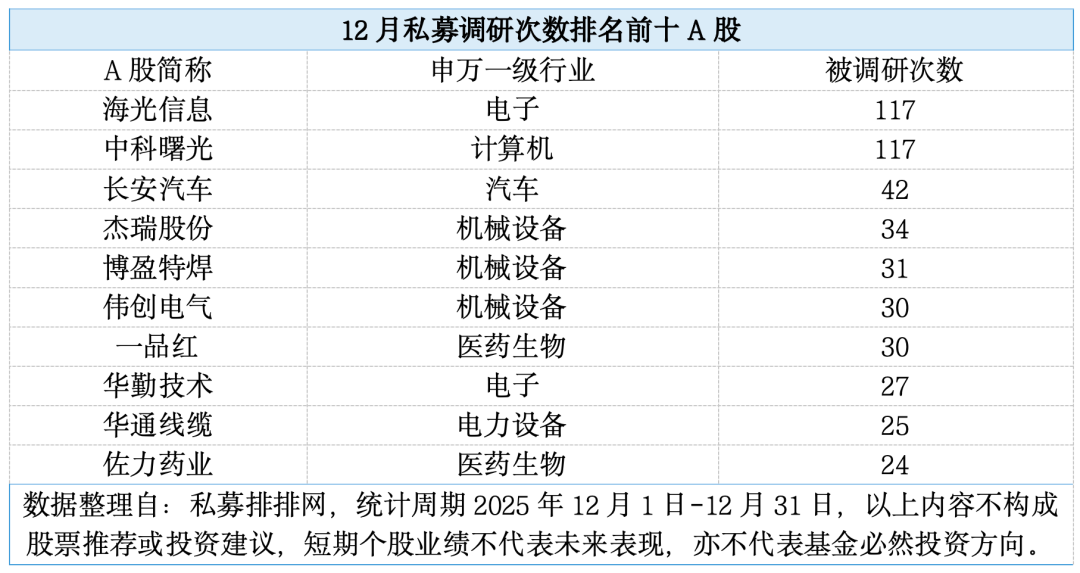
Group 1 - The core focus of private equity research in December 2025 was on the electronics and machinery sectors, with significant interest from major private equity firms [1][4][6] - A total of 713 private equity firms participated in A-share research activities, covering 392 stocks with a total of 1,765 research instances [2][5] - Notable companies such as Haiguang Information and Zhongke Shuguang were the most researched, each receiving 117 inquiries, with their stock prices increasing by 50% and 18.9% respectively in 2025 [2][3] Group 2 - The electronics sector had 60 stocks receiving private equity research, with a total of 384 inquiries, while the machinery sector had 64 stocks with 286 inquiries [4][5] - The computer, biomedical, automotive, and power equipment sectors also saw significant research activity, each exceeding 100 inquiries [4][5] - Major private equity firms showed a strong preference for technology stocks, particularly in the semiconductor industry, indicating a favorable outlook for domestic chip demand and equipment penetration [6][7] Group 3 - Investment strategies for 2026 are expected to focus on both technology and non-ferrous metals, suggesting a "two-legged" approach to investment [7] - The AI sector remains a key area for growth, while commodities like gold and copper are also seen as valuable investment opportunities due to geopolitical uncertainties and increasing demand [7] - The domestic supply structure for aluminum and other materials is positioned favorably, with new demands emerging from trends in automotive lightweighting and photovoltaic industries [7]
曙光云智能体服务入选国家级智能体报告
Bei Jing Shang Bao· 2026-01-09 13:40
Core Insights - Zhongke Shuguang (603019) announced that the National Industrial Information Security Development Research Center published the "2024-2025 China Intelligent Agent Application Research Report" [1] - The report includes the intelligent agent services provided by Shuguang Cloud for the Gansu Province "5G + Smart Highway" cloud platform project, which supports "intelligent decision-making in highway traffic construction" [1] - This service represents a significant application of intelligent agent technology in the field of transportation infrastructure [1]
瞄准英伟达,国产算力产业走向“闭环”
3 6 Ke· 2026-01-09 12:39
Core Insights - The Chinese computing power industry is experiencing rapid growth in capital operations, highlighted by significant IPOs and market enthusiasm for domestic semiconductor companies [1][2] - The focus of competition in the domestic computing power sector is shifting from hardware specifications to system stability, software ecosystem usability, and cost-effectiveness [3][4] Capital Market Activity - TianShuZhiXin Semiconductor Co., Ltd. went public on January 8, 2026, with over 400 times subscription, indicating strong market interest [1] - Other domestic GPU companies, such as MoEr Thread and MuXi Co., saw their stock prices surge on their debut, with MoEr Thread's market cap exceeding 305.5 billion yuan and MuXi's reaching 330 billion yuan [1] - ChangXin Technology submitted its IPO application on December 30, 2025, reporting revenue of 32.084 billion yuan for the first three quarters of 2025, showcasing the scale of domestic DRAM production [1] Technological Developments - The "Ten Thousand Card Cluster" concept is becoming a benchmark for evaluating domestic computing power, but it also presents challenges in reliability as system scale increases [3][4] - The introduction of the scaleX Ten Thousand Card Super Cluster by ZhongKe Shuguang, featuring 10,240 AI accelerator cards, represents a significant advancement in system architecture [3][4] - The need for high-quality, low-latency data transmission networks is critical for supercomputing, with domestic products now matching international standards [5][6] Storage Solutions - ChangXin Technology and ChangChun Group are positioned in the core areas of DRAM and NAND Flash, respectively, with ChangXin reporting a compound annual growth rate of over 70% in revenue from 2022 to 2024 [6][7] - The introduction of advanced technologies like Xtacking in NAND Flash production by ChangChun Group marks a significant technological breakthrough [7] Software Ecosystem - The transition to a robust software ecosystem is complex, with developers facing high costs in switching from established platforms like NVIDIA's CUDA [10][11] - MoEr Thread is addressing this by launching the MTT AIBOOK, which includes development tools to facilitate easier adoption of its platform [10] - Cloud service providers are playing a crucial role in integrating various hardware brands to create a unified software environment, addressing compatibility issues [11][12] Market Dynamics - The industry is witnessing a shift towards collaborative ecosystems, with companies recognizing the need for specialization rather than attempting to cover the entire supply chain independently [9][12] - The emergence of customized products from companies like Haiguang is aimed at meeting the specific needs of large enterprises, reflecting a trend towards more open architectures [15] Future Outlook - The domestic computing power industry is expected to face challenges related to global supply chain fluctuations, particularly in DRAM and NAND supply [13] - The successful integration of domestic computing solutions in high-stakes environments, such as the National High Energy Physics Data Center, indicates growing confidence in local technologies [14] - The potential easing of export restrictions on NVIDIA's H200 chip could impact the domestic ecosystem, but the established supply chain and customer preferences for security are likely to mitigate risks [17]
瞄准英伟达!国产算力产业走向“闭环”
经济观察报· 2026-01-09 10:28
Core Viewpoint - The rapid advancement of China's computing power industry is highlighted by significant capital market activities, including the successful IPOs of domestic semiconductor companies, while challenges remain in practical applications and system integration [2][4]. Group 1: Capital Market Activities - Shanghai Tensu Zhixin Semiconductor Co., Ltd. went public on January 8, 2026, with over 400 times subscription, indicating strong market enthusiasm [2]. - Other domestic GPU companies, such as Moer Thread and Muxi Co., saw their stock prices surge by 468.78% and 692.95% respectively on their debut, with market capitalizations exceeding 305.5 billion and 330 billion yuan [2]. - Changxin Technology submitted its IPO application on December 30, 2025, reporting revenue of 32.084 billion yuan for the first three quarters of 2025, showcasing the scale of domestic DRAM production [2][10]. Group 2: Technological Advancements - The focus of competition in the computing power sector is shifting from hardware specifications to system stability, software ecosystem usability, and cost-effectiveness in commercial applications [6]. - The introduction of the scaleX super cluster by Zhongke Shuguang, featuring 10,240 AI accelerator cards, emphasizes the need for high reliability in large-scale systems [6][7]. - The development of a native 400G RDMA network by Zhongke Shuguang aims to enhance data transmission quality and reduce latency, crucial for supercomputing applications [7][8]. Group 3: Software Ecosystem Development - Moer Thread is addressing the challenge of transitioning developers to domestic computing platforms by launching the MTT AIBOOK, which includes essential development tools [13]. - The company also introduced a code migration model, MUSACode, to facilitate the transition from CUDA to its own platform, aiming for a 93% compilation rate [13]. - Cloud service providers are playing a critical role in integrating various hardware brands, thereby mitigating compatibility issues and enhancing resource management [15][16]. Group 4: Supply Chain and Market Dynamics - The supply chain for DRAM and NAND flash is under pressure, prompting cloud vendors to adjust procurement strategies to ensure resource availability [17]. - The adoption of domestic computing facilities by institutions like the Chinese Academy of Sciences indicates growing confidence in local technology, despite some performance gaps compared to international counterparts [19]. - The emergence of customized products from companies like Haiguang reflects a shift towards meeting specific client needs, enhancing market competitiveness [20]. Group 5: Industry Ecosystem and Future Outlook - The domestic computing power industry is forming a closed-loop ecosystem, integrating various components from storage to computing and application layers [21][22]. - The rise of domestic large models, such as DeepSeek, is redefining hardware competition standards, necessitating support for mixed-precision computing [21]. - Concerns about potential disruptions from international competitors, such as NVIDIA's H200 chip, are countered by the established supply chain and ecosystem resilience of domestic firms [21][22].

国产算力产业走向“闭环”
Jing Ji Guan Cha Wang· 2026-01-09 08:41
Core Insights - The Chinese computing power industry is experiencing rapid acceleration in capital operations, highlighted by significant IPOs and market enthusiasm for domestic semiconductor companies [1][2] - The focus of competition in the domestic computing power sector is shifting from hardware specifications to system stability, software ecosystem usability, and cost-effectiveness in commercial applications [3][4] Capital Market Activity - TianShuZhiXin Semiconductor Co., Ltd. went public on January 8, 2026, with over 400 times subscription for its public offering, indicating strong market interest [1] - Other domestic GPU companies, such as MoEr Thread and MuXi Co., saw substantial stock price increases upon their listings, with MoEr Thread's stock rising by 468.78% on its debut [1] - ChangXin Technology submitted its IPO application on December 30, 2025, reporting revenue of 32.084 billion yuan for the first three quarters of 2025, showcasing the scale of domestic DRAM production [1] Technological Developments - The "Ten Thousand Card Cluster" concept is becoming a benchmark for evaluating computing power systems, with challenges in reliability and fault tolerance as system scales increase [3][4] - The introduction of the scaleX Ten Thousand Card Super Cluster by ZhongKe Shuguang, featuring 10,240 AI acceleration cards, represents a significant technological advancement [3][5] - The need for high-quality, low-latency data transmission networks is critical for supercomputing, with domestic products now matching international standards [6][7] Storage Solutions - ChangXin Technology and ChangJiang Storage are positioned in key storage sectors, with ChangXin reporting a compound annual growth rate of over 70% in revenue from 2022 to 2024 [7][8] - The introduction of DDR5 memory and advancements in NAND Flash technology are crucial for supporting AI computing needs [8] Software Ecosystem Challenges - Transitioning developers from NVIDIA's CUDA to domestic platforms presents significant challenges due to high code restructuring costs [11] - MoEr Thread is addressing this by launching tools to facilitate easier migration to its ecosystem, aiming to cultivate a developer base [11][12] Cloud Services and Integration - Cloud service providers like UCloud are playing a vital role in integrating various domestic chip brands, addressing compatibility issues and enhancing resource management [12][13] - The need for localized solutions is emphasized, as latency and privacy concerns with cloud-based AI solutions drive demand for on-premises systems [14] Market Dynamics and Future Outlook - The domestic computing power industry is forming a closed-loop ecosystem, with companies collaborating across the supply chain to enhance competitiveness [17] - The potential easing of export restrictions on NVIDIA's H200 chip raises concerns about its impact on the nascent domestic ecosystem, but domestic clients prioritize supply chain security [17]