Grace(603256)

Search documents
宏和科技(603256) - 宏和电子材料科技股份有限公司关于公司向特定对象发行股票申请文件的审核问询函回复及募集说明书等申请文件更新的提示性公告
2025-09-26 11:01
证券代码:603256 证券简称:宏和科技 公告编号:2025-065 宏和电子材料科技股份有限公司 关于向特定对象发行股票申请文件的审核问询函回复 公司本次向特定对象发行 A 股股票事项尚需通过上交所审核,并获得中国 证券监督管理委员会(以下简称"中国证监会")作出同意注册的决定后方可实 施,最终能否通过上交所审核,并获得中国证监会同意注册的决定及其时间尚存 在不确定性。公司将根据该事项的进展情况及时履行信息披露义务,敬请广大投 资者注意投资风险。 特此公告。 宏和电子材料科技股份有限公司 董事会 2025 年 9 月 26 日 及募集说明书等申请文件更新的提示性公告 本公司董事会及全体董事保证本公告内容不存在任何虚假记载、误导性陈述 或者重大遗漏,并对其内容的真实性、准确性和完整性承担个别及连带责任。 宏和电子材料科技股份有限公司(以下简称"公司")于 2025 年 9 月 1 日 收到上海证券交易所(以下简称"上交所")出具的《关于宏和电子材料科技股 份有限公司向特定对象发行股票申请文件的审核问询函》(上证上审(再融资) 〔2025〕263 号)(以下简称"《审核问询函》")。 公司收到《审核问询函》后 ...

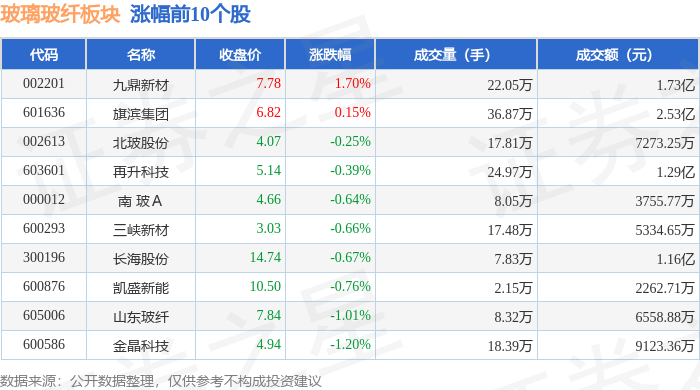
玻璃玻纤板块9月26日跌2.43%,宏和科技领跌,主力资金净流出4.48亿元
Zheng Xing Xing Ye Ri Bao· 2025-09-26 08:48
Market Overview - The glass and fiberglass sector experienced a decline of 2.43% on September 26, with Honghe Technology leading the drop [1] - The Shanghai Composite Index closed at 3828.11, down 0.65%, while the Shenzhen Component Index closed at 13209.0, down 1.76% [1] Stock Performance - Notable stock performances in the glass and fiberglass sector included: - Jiuding New Materials (002201) closed at 7.78, up 1.70% with a trading volume of 220,500 shares and a turnover of 173 million yuan [1] - Qibin Group (601636) closed at 6.82, up 0.15% with a trading volume of 368,700 shares and a turnover of 253 million yuan [1] - Honghe Technology (603256) closed at 35.00, down 4.50% with a trading volume of 141,500 shares and a turnover of 502 million yuan [2] Capital Flow - The glass and fiberglass sector saw a net outflow of 448 million yuan from institutional investors, while retail investors had a net inflow of 453 million yuan [2] - The capital flow for specific stocks showed: - Jiuding New Materials had a net inflow of 26.42 million yuan from institutional investors [3] - Yao Pi Glass (600819) had a net inflow of 21.22 million yuan from institutional investors [3] - Jinjing Technology (600586) experienced a significant net outflow of 17.34 million yuan from institutional investors [3]


宏和科技今日大宗交易折价成交12.4万股,成交额401.88万元
Xin Lang Cai Jing· 2025-09-25 09:36
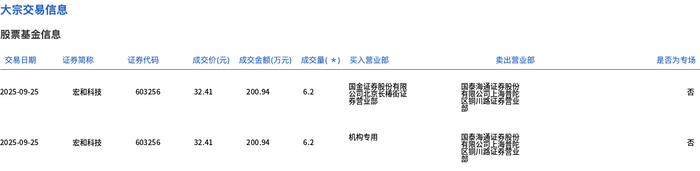
| 交易日期 | 证券简称 | 证券代码 | 成交价(元) 成交金额(万元) 成交量( *) 买入营业部 | | | 类出管业部 | 是否为专场 | | --- | --- | --- | --- | --- | --- | --- | --- | | 2025-09-25 | 宏和科技 | 603256 | 32.41 6.2 | 200.94 | 公司法案及成為整 野宮之 | 200 | KA | | 2025-09-25 | 宏和科技 | 603256 | 32.41 6.2 | 200.94 | 机构专用 | BONDER | Ka | 9月25日,宏和科技大宗交易成交12.4万股,成交额401.88万元,占当日总成交额的0.69%,成交价32.41 元,较市场收盘价36.65元折价11.57%。 ...
玻璃玻纤板块9月25日涨1.46%,中国巨石领涨,主力资金净流出2.02亿元
Zheng Xing Xing Ye Ri Bao· 2025-09-25 08:45
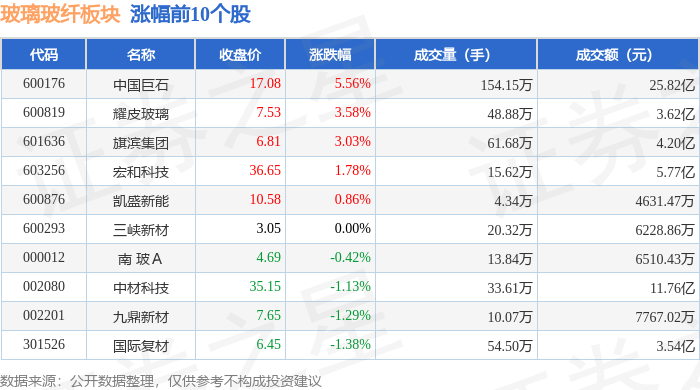
Market Overview - On September 25, the glass fiber sector rose by 1.46% compared to the previous trading day, with China Jushi leading the gains [1] - The Shanghai Composite Index closed at 3853.3, down 0.01%, while the Shenzhen Component Index closed at 13445.9, up 0.67% [1] Stock Performance - China Jushi (600176) closed at 17.08, up 5.56% with a trading volume of 1.5415 million shares [1] - Yao Pi Glass (618009) closed at 7.53, up 3.58% with a trading volume of 488,800 shares [1] - Qibin Group (601636) closed at 6.81, up 3.03% with a trading volume of 616,800 shares [1] - Honghe Technology (603256) closed at 36.65, up 1.78% with a trading volume of 156,200 shares [1] - Other notable performances include Kaisheng New Energy (600876) at 10.58, up 0.86%, and Sanxia New Materials (600293) at 3.05, unchanged [1] Capital Flow - The glass fiber sector experienced a net outflow of 202 million yuan from institutional investors, while retail investors saw a net inflow of 33.26 million yuan [2] - The sector's overall capital flow indicates a mixed sentiment among different investor types [2] Individual Stock Capital Flow - Yao Pi Glass saw a net outflow of 39.93 million yuan from institutional investors, while retail investors had a net inflow of 6.71 million yuan [3] - Honghe Technology had a net inflow of 5.24 million yuan from institutional investors, with a slight net outflow from retail investors [3] - Other stocks like North Glass (002613) and South Glass A (000012) also showed varied capital flows, indicating differing investor sentiments across the sector [3]



宏和科技5个多月暴涨348%,8只基金重仓押注!背后藏着哪些秘密?|掘金百分百
Hua Xia Shi Bao· 2025-09-25 08:04
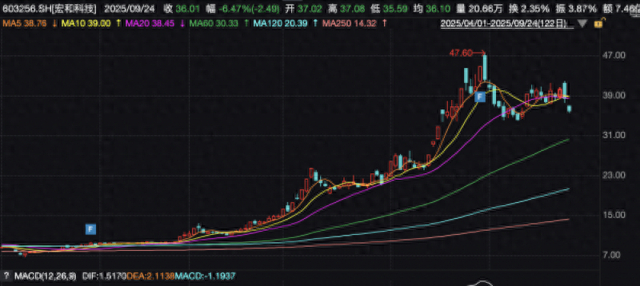
Core Viewpoint - Honghe Technology has become a focal point in the A-share market with a remarkable stock price increase of 348.20% since April 1, 2024, driven by strong institutional interest and significant performance in its half-year report [2][3]. Company Performance - The company reported a revenue of 550 million yuan for the first half of 2025, representing a year-on-year growth of 35% [3]. - The net profit attributable to shareholders reached 87.3751 million yuan, marking a staggering increase of 10,587.74% compared to the previous year [2][3]. Key Growth Drivers - The significant growth in performance is attributed to two main factors: the price increase of ordinary E-glass electronic-grade glass fiber cloth and the successful mass production and delivery of high-performance low dielectric cloth and low thermal expansion coefficient electronic cloth [3]. - The high-performance low dielectric constant electronic cloth is crucial for AI servers and 5G base station signal transmission, addressing the high transmission rate requirements of AI chips [3]. Competitive Advantage - Honghe Technology has established itself as one of the few domestic manufacturers capable of producing ultra-thin electronic-grade glass fiber yarn, enhancing its competitive edge in the high-end electronic cloth market [4]. - The company’s integrated production capacity of electronic yarn and cloth has significantly reduced reliance on imports, leading to improved cost control [3]. Market Trends - The demand for electronic cloth, particularly high-end products, is rapidly growing due to the expansion of emerging industries such as 5G devices, AI computing, and new energy vehicles [5]. - The electronic cloth industry is evolving towards thinner and more functional products, with high-end varieties experiencing growth rates significantly higher than traditional products [5]. Institutional Interest - As of June 30, 2025, eight funds have included Honghe Technology in their top ten holdings, indicating strong market confidence in the company [2][6]. - Notable funds include Nuon An Hengxin and Guoshou Anbao, which have positioned Honghe Technology as a key investment [6][7]. Future Outlook - Analysts suggest that 2025-2026 will be a critical period for Honghe Technology to capture a significant share of the high-end market alongside competitors [5]. - The ongoing development of AI-related products is expected to drive further growth in the second half of the year, with increasing penetration rates in consumer applications [5].
玻璃玻纤板块9月24日跌1.93%,宏和科技领跌,主力资金净流出1.38亿元
Zheng Xing Xing Ye Ri Bao· 2025-09-24 08:46
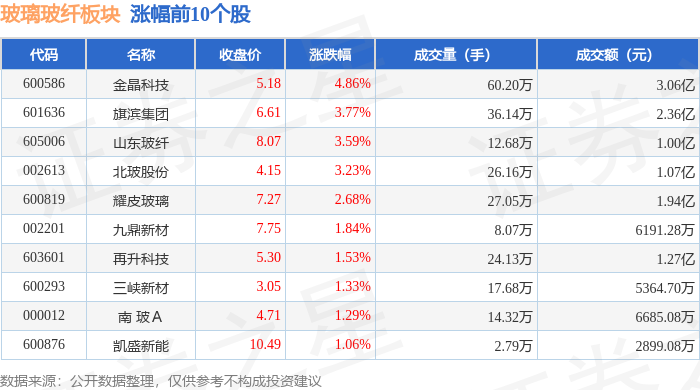
Market Overview - On September 24, the glass and fiberglass sector declined by 1.93%, with Honghe Technology leading the drop [1] - The Shanghai Composite Index closed at 3853.64, up 0.83%, while the Shenzhen Component Index closed at 13356.14, up 1.8% [1] Stock Performance - Key stocks in the glass and fiberglass sector showed varied performance, with Jin Jing Technology rising by 4.86% to a closing price of 5.18, and Honghe Technology falling by 6.47% to 36.01 [1][2] - The trading volume and turnover for major stocks included: - Jin Jing Technology: 602,000 shares, turnover of 306 million yuan - Qi Bin Group: 361,400 shares, turnover of 236 million yuan - Shandong Pofiber: 126,800 shares, turnover of 100 million yuan [1][2] Capital Flow - The glass and fiberglass sector experienced a net outflow of 138 million yuan from institutional investors and 174 million yuan from retail investors, while individual investors saw a net inflow of 312 million yuan [2] - Detailed capital flow for selected stocks included: - Jin Jing Technology: 77.61 million yuan net inflow from institutional investors - Qi Bin Group: 48.32 million yuan net inflow from institutional investors [3] Summary of Individual Stock Flows - Jin Jing Technology had a significant institutional net inflow of 77.61 million yuan, while retail investors showed a net outflow of 60.91 million yuan [3] - Qi Bin Group also saw a net inflow from institutional investors of 48.32 million yuan, with retail investors experiencing a net outflow of 28.91 million yuan [3]


建材行业2025年中报综述:周期建材有贝塔,消费建材看阿尔法
Shenwan Hongyuan Securities· 2025-09-24 06:43
Investment Rating - The report maintains a "Positive" outlook on the building materials industry for 2025, highlighting investment opportunities in the fiberglass and cement sectors, while suggesting stock selection in consumer building materials and early-cycle segments [2][3]. Core Insights - The building materials industry has shown signs of recovery, with a narrowing revenue decline and improved profitability in the cement and fiberglass sectors. The overall revenue for sample companies in the first half of 2025 was 277.57 billion yuan, a year-on-year decline of 4.1%, which is a 10.7 percentage point improvement compared to the entire year of 2024. Net profit attributable to shareholders reached 14.82 billion yuan, a year-on-year increase of 38.9% [5][15]. - The cement industry is experiencing a gradual recovery, with significant profit improvements. In the first half of 2025, the cement sector achieved a revenue of 118.8 billion yuan, down 7.5% year-on-year, but net profit surged by 1110.5% to 5.4 billion yuan. This recovery is partly due to a low base effect from 2024 and favorable pricing conditions [6][28]. - The fiberglass sector reported robust growth, with sample companies generating a total revenue of 31.1 billion yuan, a 20.9% increase year-on-year, and net profit rising by 127.0% to 3.29 billion yuan. The recovery in pricing and the growth in specialty fabric business are contributing factors [7][19]. - Consumer building materials showed a smaller revenue decline of 2.7%, with total revenue of 68.76 billion yuan and net profit down 13.2% to 4.35 billion yuan. Companies like Keda Manufacturing and Sankeshu are demonstrating strong alpha characteristics due to their unique market positions [6][7]. - The glass sector remains under pressure, with a revenue decline of 17.0% to 24.6 billion yuan and a net profit drop of 60.3% to 1 billion yuan, primarily due to high base effects and weak demand in the construction sector [5][19]. - Early-cycle industries are still facing challenges, but leading companies like Subote have reported revenue and profit growth by expanding into major engineering projects [8][19]. Summary by Sections 1. Industry Revenue Decline Narrowing, Cement and Fiberglass Perform Well - The building materials industry is categorized into six segments: cement, glass, fiberglass, early-cycle, consumer building materials, and new materials. The overall revenue decline has narrowed, and profitability has improved, particularly in the cement and fiberglass sectors [15][19]. 2. By Industry: Cement and Fiberglass Recovery, Consumer Building Materials Seek Alpha 2.1 Cement: Recovery Certainty Gradually Realized - The cement industry is showing signs of recovery with improved profitability. The first half of 2025 saw a revenue of 118.8 billion yuan, down 7.5% year-on-year, and a net profit of 5.4 billion yuan, up 1110.5% [28][34]. 2.2 Fiberglass: Profitability Out of Undervaluation, Steady Recovery Expected - The fiberglass sector has shown significant growth, with a total revenue of 31.1 billion yuan, a 20.9% increase year-on-year, and net profit rising by 127.0% [7][19]. 2.3 Consumer Building Materials: Revenue Stabilizing, Some Companies Show Profit Alpha - The consumer building materials segment experienced a revenue decline of 2.7%, totaling 68.76 billion yuan, with net profit down 13.2% to 4.35 billion yuan. Certain companies are demonstrating strong alpha characteristics [6][7]. 2.4 Glass: Photovoltaic Glass Phase Improvement, Building Glass Still Under Pressure - The glass industry is under pressure, with a revenue decline of 17.0% to 24.6 billion yuan and a net profit drop of 60.3% to 1 billion yuan [5][19]. 2.5 Early Cycle: Overall Pressure, Leading Companies Recover First - Early-cycle industries are still facing challenges, but leading companies like Subote have reported revenue and profit growth by expanding into major engineering projects [8][19].



缺货!从LowDK到Q布:揭秘特种电子布三大升级路径,谁将卡位下一代PCB材料?
材料汇· 2025-09-23 14:18
Core Viewpoints - The industry is experiencing a significant upgrade in special electronic fabrics, transitioning from LowDK-1 to LowDK-2, with urgent demand for LowCTE fabrics to address chip packaging warping issues, and quartz fiber fabrics (Q fabrics) emerging as the ultimate solution for next-generation applications [2][3][11]. Demand Side: Dual Acceleration Driving Product Iteration - The market for low dielectric electronic fabrics is projected to reach 168 million meters by 2026, driven by the demand from Nvidia's Rubin architecture and 1.6T switches, with Q fabric demand expected to reach 16.85 million meters, corresponding to a market size of approximately 4 billion yuan [3][11]. - The increasing performance requirements of high-end smartphones will drive the demand for LowCTE glass fiber fabrics, with a potential increase in demand exceeding 13.5 million meters if the usage in a single Apple phone rises from 0 to 0.05 meters [11][12]. Supply Side: Clear Trend of Domestic Substitution, Short-Term Supply Still Tight - High-end electronic fabric production faces significant barriers in raw material formulation, drawing processes, and weaving machines, with a forecasted supply gap for LowDK-2 and LowCTE products continuing until 2026, supporting price stability [3][12][14]. - Domestic manufacturers such as China National Materials, Honghe Technology, and others are rapidly expanding their production capacity, with domestic production capacity expected to exceed 6 million meters per month by August 2025 [7][13]. Competitive Landscape: High-End Overseas Leadership, Domestic Manufacturers Accelerating Technology and Capacity Enhancement - The global market for special electronic fabrics is currently dominated by a few manufacturers in Japan and Taiwan, but domestic companies are making significant technological breakthroughs and capacity expansions [7][13]. - Companies like Feilihua, a leader in the quartz fiber industry, are positioned to benefit from the growing demand for quartz fiber and Q fabrics, with a comprehensive supply chain advantage [7][13]. Unique Insights Compared to Market Views - The report indicates that all types of special electronic fabrics will remain in a state of supply tightness in 2025, with LowDK-2 and LowCTE experiencing continued shortages until 2026 due to rapid demand growth and supply-side barriers [8][14]. - Q fabrics are expected to enter mass production in 2026, but the demand and ramp-up pace will depend on the determination of technological routes and the market launch of end products [8][14].


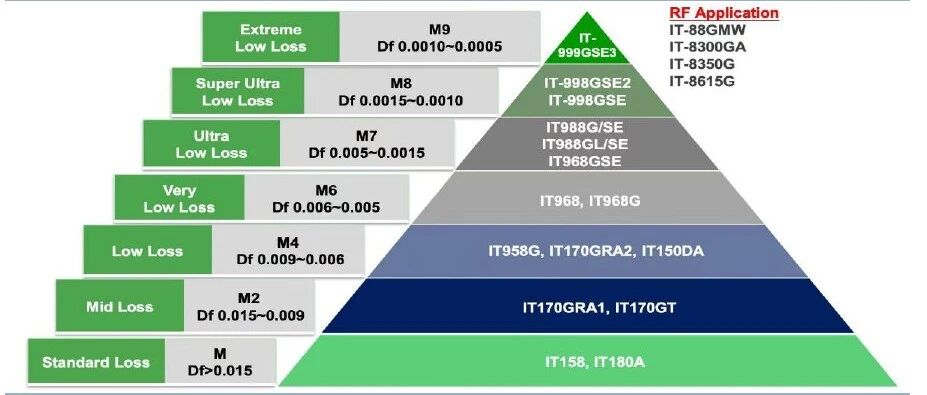
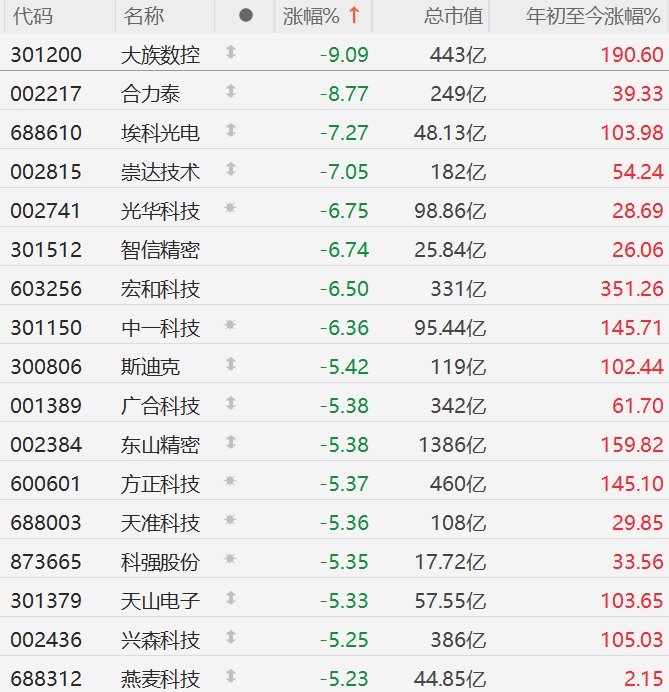
A股PCB概念股集体下挫,大族数控跌9%,合力泰跌超8%,埃科光电、崇达技术跌7%,光华科技、智信精密、宏和科技、中一科技跌6%
Ge Long Hui· 2025-09-23 06:05
Group 1 - The A-share market saw a collective decline in PCB concept stocks, with notable drops including Dazhu CNC down 9%, Helitai down over 8%, and Aikou Optoelectronics and Chongda Technology down over 7% [1][2] - Specific stock performances included Dazhu CNC with a market cap of 44.3 billion and a year-to-date increase of 190.60%, while Helitai had a market cap of 24.9 billion and a year-to-date increase of 39.33% [2] - Other companies such as Huaguan Technology, Zhixin Precision, and Honghe Technology experienced declines of over 6%, with market caps ranging from 25.84 billion to 331 billion [2]


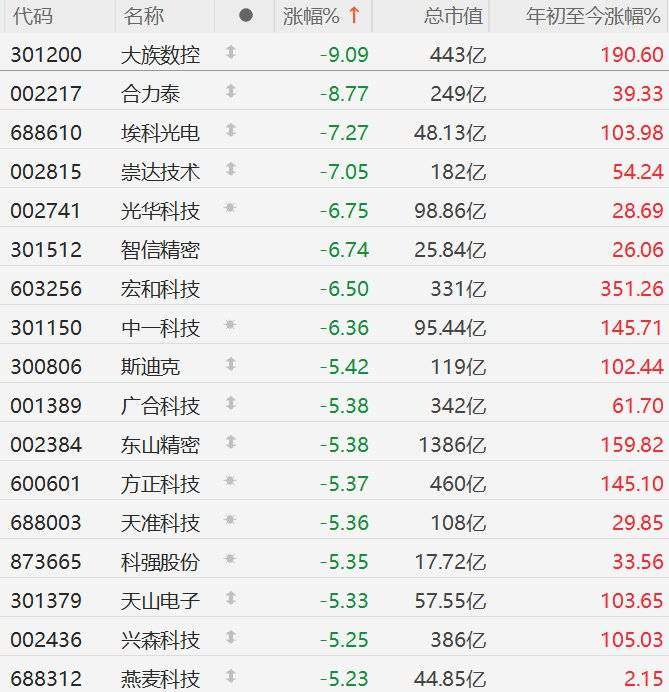
A股PCB概念股集体下挫,大族数控跌9%
Ge Long Hui A P P· 2025-09-23 05:50
Group 1 - The A-share market saw a collective decline in PCB concept stocks, with notable drops in several companies [1] - Dazhu CNC experienced a decline of 9.09%, while Helitai fell by 8.77% [2] - Other companies such as Aikemi, Chongda Technology, and Guanghua Technology also reported significant decreases, with drops exceeding 7% [1][2] Group 2 - The total market capitalization of Dazhu CNC is 44.3 billion, and it has increased by 190.60% year-to-date [2] - Helitai's market capitalization stands at 24.9 billion, with a year-to-date increase of 39.33% [2] - Aikemi's market capitalization is approximately 48.13 billion, showing a year-to-date increase of 103.98% [2]