
Cambricon(688256)

Search documents
撬动万亿资金规模,国家创业投资引导基金启动!AI主线走强,寒武纪涨超5%,科创人工智能ETF汇添富(589560)爆量涨超2%冲击6连涨
Sou Hu Cai Jing· 2025-12-29 05:37
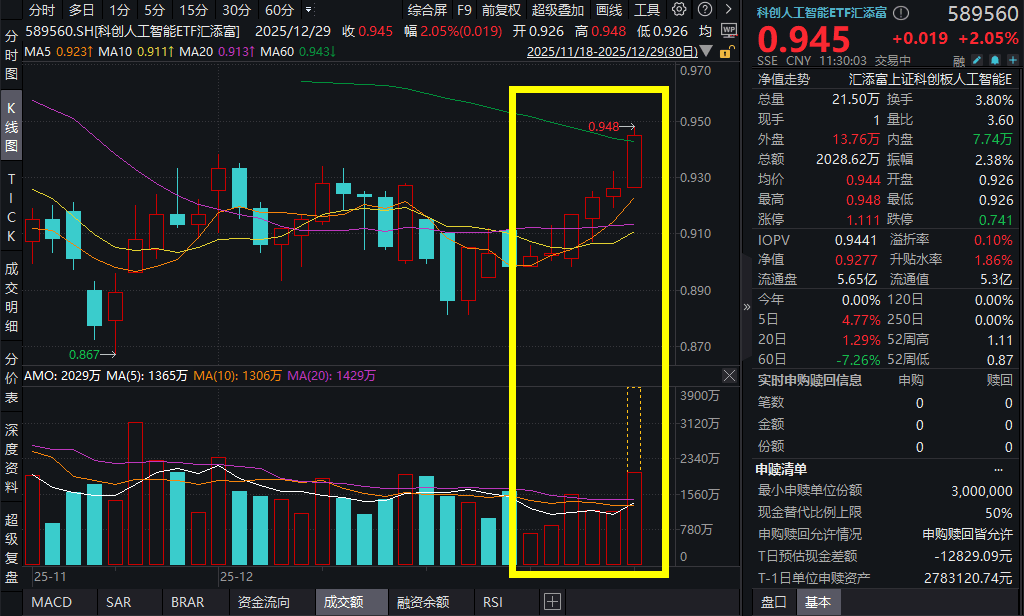
Core Viewpoint - The AI sector remains active, with significant movements in related ETFs, particularly the AI-focused ETF from Huatai-PineBridge, which has seen a notable increase in trading volume and price [1][6]. Group 1: Market Performance - The AI-focused ETF from Huatai-PineBridge (589560) surged by 2.05%, marking its sixth consecutive increase, with trading volume surpassing the previous day's total [1]. - The Sci-Tech Chip 50 ETF (588750) rose by 1%, recovering from the previous day's decline [1]. - Key stocks in the sector, such as Yuanjie Technology and Chip Origin, saw increases exceeding 7%, while others like Cambricon and SMIC also posted gains [4][5]. Group 2: Industry Trends - Semiconductor companies, including SMIC and World Advanced, have issued price increase notices to downstream clients, particularly for the 8-inch BCD process, with price hikes around 10% [6]. - The National Venture Capital Guidance Fund was launched on December 26, emphasizing a long-term investment strategy in hard technology, aiming to leverage significant fiscal resources to attract social capital [6]. - The recent National Financial Work Conference highlighted the importance of supporting technological innovation and the integration of industry innovation, aiming to cultivate new growth drivers by 2026 [6]. Group 3: Semiconductor Cycle - The semiconductor industry is entering a new upward cycle, driven by sustained demand for AI computing power, with high demand for GPUs, HBM, and advanced packaging [7]. - The current cycle differs from previous ones, as AI has introduced a high-growth demand that raises the ceiling for industry needs and extends the duration of the cycle [7]. - The semiconductor sector is expected to transition from "repairing expectations" to "verifying prosperity," with a focus on AI core beneficiaries [7]. Group 4: AI Chip Market - The global AI computing chip market is projected to exceed $370 billion by 2026 and $460 billion by 2027, driven by significant capital expenditures from major tech companies [11]. - The shortage of chips continues, particularly in memory and optical chips, with supply-demand imbalances expected to persist into 2026 and beyond [16]. - Domestic AI chip manufacturers are making significant progress, with a notable increase in self-sufficiency expected by 2028 [17]. Group 5: Investment Opportunities - The Sci-Tech Chip 50 ETF (588750) is highlighted for its strong growth potential, with a projected net profit growth rate of 97% for the full year of 2025, significantly outpacing peers [25]. - The ETF's index focuses on high-tech upstream and midstream segments of the chip industry, indicating a higher "chip content" and growth elasticity compared to other indices [22][25]. - Investors are encouraged to consider the Sci-Tech Chip 50 ETF for exposure to the core segments of the semiconductor industry, benefiting from the ongoing AI-driven market dynamics [26][27].




上周融资余额增加超390亿元,这些个股获大幅加仓
Sou Hu Cai Jing· 2025-12-29 04:32
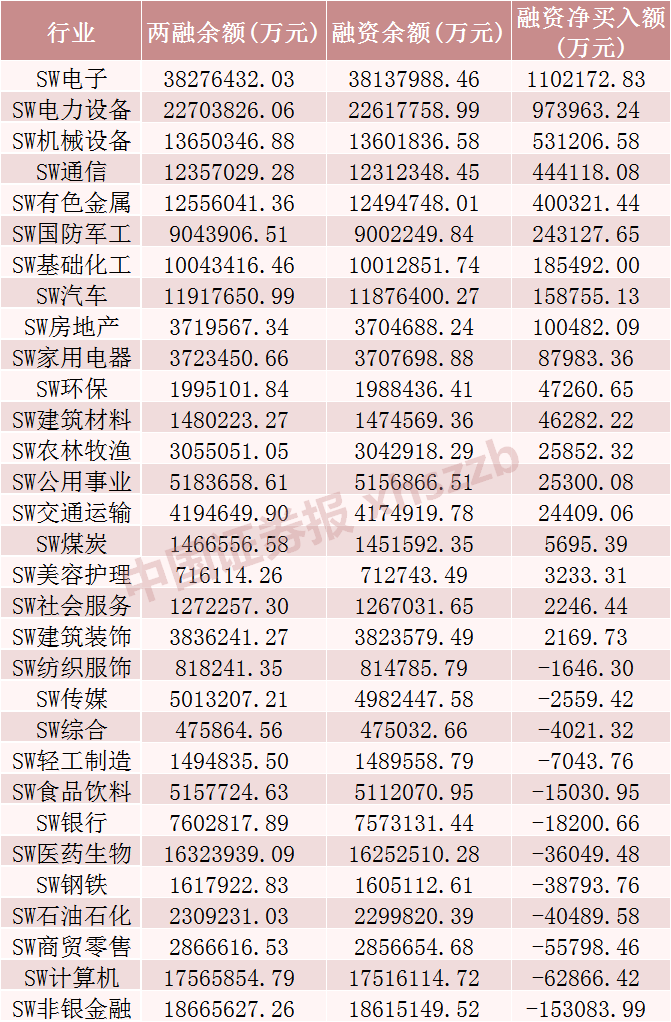
Core Viewpoint - The A-share market experienced a volatile increase last week, with both the margin trading balance and financing balance reaching historical highs on December 25, 2023, at 25,433.30 billion yuan and 25,264.62 billion yuan respectively [1]. Industry Summary - Among the 31 industries tracked, 19 saw an increase in financing balance, with the electronics, power equipment, and machinery sectors leading in net financing inflows of 11.02 billion yuan, 9.74 billion yuan, and 5.31 billion yuan respectively [1]. - Conversely, 12 industries experienced a decrease in financing balance, with non-bank financials, computers, and retail sectors showing the highest net outflows of 1.53 billion yuan, 629 million yuan, and 558 million yuan respectively [1]. Individual Stock Summary - A total of 168 stocks saw net purchases exceeding 100 million yuan, with the top ten stocks being Sunlight Power, Zhongji Xuchuang, Industrial Fulian, Hanwha U, Yingweike, Aerospace Development, Zhaoyi Innovation, SMIC, Goldwind Technology, and Xinyi Communication, which received net inflows of 2.807 billion yuan, 1.486 billion yuan, 1.193 billion yuan, 961 million yuan, 950 million yuan, 855 million yuan, 818 million yuan, 802 million yuan, 696 million yuan, and 666 million yuan respectively [4]. - All top ten stocks with increased financing saw price increases, with Xinyi Communication rising over 34% [4]. Financing Balance Changes - The financing balance for the electronics sector was reported at 38,137.99 million yuan, with a net inflow of 1,102.17 million yuan [3]. - The power equipment sector had a financing balance of 22,617.76 million yuan, with a net inflow of 973.96 million yuan [3]. - The machinery sector's financing balance stood at 13,601.83 million yuan, with a net inflow of 531.21 million yuan [3].




半日主力资金丨加仓电子、国防军工股 抛售电力设备股




Di Yi Cai Jing· 2025-12-29 04:02
主力资金早间净流入电子、国防军工、机械设备、计算机、汽车、基础化工等板块,净流出电力设备、 公用事业、食品饮料、商贸零售、医药生物、交通运输等板块。 具体到个股来看,寒武纪-U、拓维信息、海格通信获净流入29.21亿元、21.43亿元、17.70亿元。 净流出方面,紫金矿业、阳光电源、天际股份遭抛售10.68亿元、8.14亿元、8.06亿元。 ...
科创50指数涨超1%,寒武纪涨超7%
Xin Lang Cai Jing· 2025-12-29 03:28
Core Viewpoint - The Sci-Tech Innovation 50 Index increased by over 1% on December 29, indicating a positive market trend in the technology sector [1] Group 1 - The stock of Cambrian (寒武纪) rose by over 7%, reflecting strong investor interest and potential growth in the AI chip market [1] - Semiconductor Manufacturing International Corporation (中芯国际) saw its shares increase by over 2%, suggesting a favorable outlook for the semiconductor industry [1] - Hua Hong Semiconductor (华虹) also experienced a rise of over 2%, indicating positive market sentiment towards semiconductor companies [1]
2025年度产业经济十大热点事件:“科技叙事”重塑投资逻辑,“反内卷”再造产业生态
Sou Hu Cai Jing· 2025-12-29 03:25
Group 1: AI and Technology - The launch of DeepSeek-R1 in January 2025 injected strong momentum into the capital market, becoming the core investment theme for the year, with its top-tier reasoning performance achieved with minimal computing power [3] - The open-source model of DeepSeek-R1 lowered industry barriers, attracting significant capital attention to the related supply chain, including chips, devices, applications, and cooling systems [3] - The AI sector saw a shift from pure performance competition to a focus on cost, efficiency, and commercialization capabilities, allowing small and medium enterprises to build applications quickly based on open-source weights [3] Group 2: Film Industry - The animated film "Nezha 2," produced by Light Chaser Animation, achieved a box office of 15.4 billion yuan, breaking domestic records and entering the global top five, leading to a significant stock price surge for Light Chaser [5] - The success of "Nezha 2" highlighted the strong market potential of Chinese animation, with several other animated films also performing well in the box office [5] - The overall domestic film box office exceeded 50 billion yuan in 2025, reflecting a 75 billion yuan increase from 2024, with total audience numbers reaching 1.2 billion [5] Group 3: Robotics Industry - The humanoid robot industry entered a commercialized phase in 2025, with significant orders indicating a shift towards scalable applications [7][8] - Major companies like ZhiYuan and UBTECH secured large orders, with the total order amount exceeding 4.6 billion yuan and over 20,000 units ordered throughout the year [7] - The commercial success of humanoid robots attracted capital, technology, and talent, facilitating the industry's transition from an emerging sector to a mature industry [8] Group 4: Stock Market Dynamics - The competition for the title of "stock king" in the A-share market saw AI chip company Cambricon surpassing traditional consumer giant Kweichow Moutai, reflecting a shift in investor preference towards high-growth technology sectors [10] - By the end of 2025, Cambricon's stock experienced volatility, with Kweichow Moutai regaining its position, indicating changing market dynamics and investor sentiment [10] Group 5: Food Delivery Industry - The food delivery industry experienced intense competition in 2025, initiated by JD's entry with an innovative model, leading to significant market disruptions and a series of subsidy wars among major platforms [12] - The competition resulted in financial pressures for platforms, with Meituan reporting a significant loss despite record user numbers, prompting regulatory intervention to curb unhealthy competition [12] - The industry is transitioning towards a phase of high-quality development, moving away from aggressive expansion strategies [12] Group 6: Semiconductor and GPU Industry - The domestic GPU industry marked a significant milestone with the listing of domestic GPU manufacturers, indicating a shift from "usable alternatives" to "self-sufficient and effective" products [15] - The semiconductor sector experienced a wave of mergers and acquisitions, reflecting a strategic shift from "domestic substitution" to "global excellence" [15] - The A-share market saw a record high in cash dividends, with total cash dividends reaching 2.61 trillion yuan, indicating improved corporate profitability and shareholder returns [16]

寒武纪-U成交额达100亿元,现涨6.6%。
Xin Lang Cai Jing· 2025-12-29 03:15
Group 1 - The core point of the article is that Cambrian's transaction volume has reached 10 billion yuan, with a current increase of 6.6% [1] Group 2 - Cambrian's significant transaction volume indicates strong market activity and investor interest [1] - The 6.6% increase suggests positive market sentiment towards Cambrian's performance [1]
科创50指数涨超1%,寒武纪涨超7%,中芯国际、华虹涨超2%。
Xin Lang Cai Jing· 2025-12-29 03:10
Group 1 - The Sci-Tech Innovation 50 Index increased by over 1% [1] - Cambrian Biologics rose by more than 7% [1] - SMIC and Hua Hong Semiconductor both saw increases of over 2% [1]
半导体设备ETF(561980)盘中拉升,下游存储、晶圆涨价持续,AI驱动超级周期
Jin Rong Jie· 2025-12-29 03:01
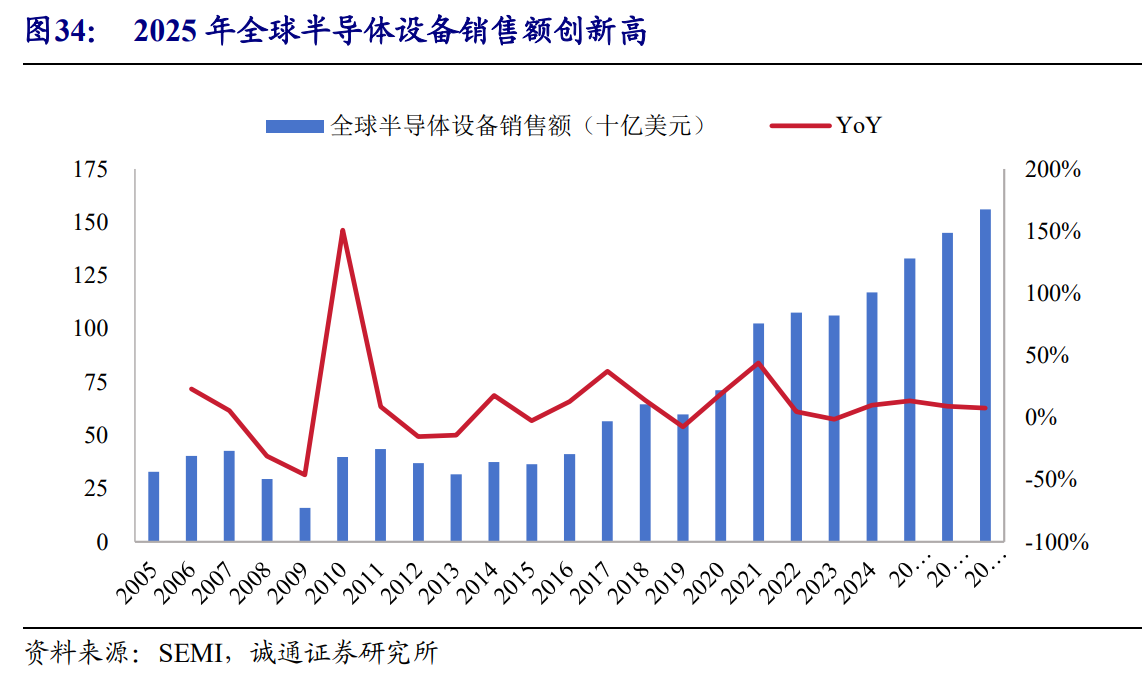
Group 1 - The Shanghai Composite Index opened lower but rose to challenge a nine-day winning streak, with strength in computing chip sectors. The semiconductor equipment ETF (561980) increased by 0.29%, with stocks like Cambricon and Liandong Technology rising over 4% [1] - The semiconductor equipment ETF (561980) has seen continuous capital inflow, with over 47 million yuan net inflow for two consecutive trading days [1] - According to a report by Chengtong Securities, semiconductor investments driven by AI should focus on two main lines: high-end logic chips and memory (HBM) that directly benefit from the surge in computing demand, and opportunities for domestic substitution in the semiconductor equipment sector [1] Group 2 - The storage market is experiencing price increases, with NAND flash wafer prices rising over 10% in December, and SSD prices increasing by 15% to 20%. Major suppliers like Samsung and SK Hynix have raised HBM3E prices by nearly 20% for 2026 [2] - Foundries are also raising prices, with SMIC implementing price increases of about 10% on some capacities [3] - The duration and magnitude of the storage price increase cycle have exceeded expectations, with projections for accelerated growth in domestic semiconductor equipment orders by 2026 due to AI demand driving global storage and advanced process capacity expansion [4] Group 3 - The global semiconductor equipment market is expected to grow significantly, with total sales projected to reach $133 billion by 2025, a 13.7% increase year-on-year, and further growth anticipated in the following years [5] - The domestic semiconductor equipment industry is seeing improvements in process coverage and market share, with domestic rates exceeding 50% in certain areas like etching and cleaning, while core high-end segments remain below 10%, indicating substantial room for domestic substitution [7] Group 4 - The semiconductor equipment ETF (561980) tracks the CSI semiconductor index, with nearly 60% of its components in "equipment" and over 90% in upstream sectors of the chip industry, highlighting significant domestic substitution potential [11] - The index focuses on leading companies in the sector, with the top ten holdings accounting for nearly 80% of the index, showing high elasticity characteristics. As of December 24, the CSI semiconductor index has seen a year-to-date increase of over 63% [11]


科创信息技术ETF摩根(588770)开盘涨0.44%,重仓股海光信息跌0.33%,中芯国际涨0.74%
Xin Lang Cai Jing· 2025-12-29 02:56
Core Viewpoint - The article discusses the performance of the Science and Technology Innovation Information Technology ETF Morgan (588770), highlighting its opening price and the performance of its major holdings [1]. Group 1: ETF Performance - The Science and Technology Innovation Information Technology ETF Morgan (588770) opened at 1.382 yuan, with a gain of 0.44% [1]. - Since its establishment on March 14, 2025, the fund has achieved a return of 37.55%, with a monthly return of 4.71% [1]. Group 2: Major Holdings Performance - Among the major holdings, Haiguang Information opened down by 0.33%, while SMIC (Semiconductor Manufacturing International Corporation) increased by 0.74% [1]. - Other notable performances include Cambrian (up 0.47%), Chipone (up 1.64%), and Stone Technology (up 0.03%), while Kingsoft Office and Huahong Group saw declines of 0.25% and 0.48%, respectively [1].

