Zelgen(688266)

Search documents
数据看盘多家机构激烈博弈医药股 量化、一线游资合力抢筹大众公用
Sou Hu Cai Jing· 2025-10-31 11:40
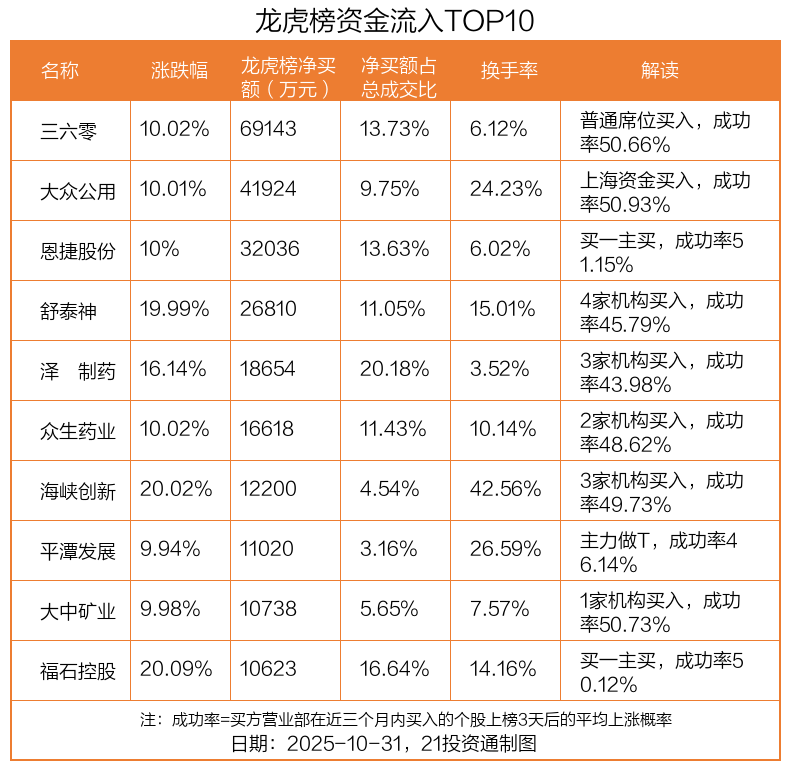
Summary of Key Points Core Viewpoint - The trading volume of the Shanghai and Shenzhen Stock Connect reached a total of 284.26 billion, with significant activity in specific stocks and sectors, indicating a dynamic market environment [1]. Group 1: Trading Volume and Key Stocks - The total trading amount for the Shanghai Stock Connect was 139.75 billion, while the Shenzhen Stock Connect was 144.51 billion [2]. - The top traded stocks in the Shanghai Stock Connect included Industrial Fulian (28.60 billion), Huaiwu Technology (14.93 billion), and Zhaoyi Innovation (14.00 billion) [3]. - In the Shenzhen Stock Connect, the leading stocks were Zhongji Xuchuang (50.82 billion), Sunshine Power (34.72 billion), and CATL (33.95 billion) [3]. Group 2: Sector Performance - The cultural media sector saw the highest net inflow of funds, amounting to 4.53 billion, while the electronic sector experienced the largest outflow, totaling -30.56 billion [5][6]. - Other sectors with notable inflows included pharmaceutical and AI applications, while insurance and storage chips faced declines [4]. Group 3: ETF Trading Activity - The Hong Kong Innovative Drug ETF (159567) saw a remarkable trading volume increase of 226% compared to the previous trading day, reaching 33.27 billion [11]. - The top ETFs by trading volume included the Hong Kong Securities ETF (150.19 billion) and the Hong Kong Innovative Drug ETF (132.22 billion) [9][10]. Group 4: Futures Positioning - In the futures market, all major contracts (IH, IF, IC, IM) saw a reduction in both long and short positions, with the IM contract showing the largest decrease in long positions [12]. Group 5: Institutional and Retail Activity - Institutional activity was high, with notable purchases in stocks like Zexin Pharmaceutical (2.65 billion) and Shutaishen (2.29 billion), while significant sell-offs were observed in stocks like Industrial Fulian (-32.25 billion) [13][14]. - Retail investors showed strong interest in Dazhong Public Utilities, which hit the daily limit, attracting substantial buying from prominent retail funds [16].




6.91亿资金抢筹三六零,机构狂买泽璟制药(名单)丨龙虎榜


2 1 Shi Ji Jing Ji Bao Dao· 2025-10-31 11:13
Core Viewpoint - On October 31, the Shanghai Composite Index fell by 0.81%, the Shenzhen Component Index by 1.14%, and the ChiNext Index by 2.31%. The most significant net inflow of funds was into 360 (601360.SH), amounting to 6.91 billion yuan, while China Nuclear Engineering (601611.SH) experienced the largest net outflow of 5.21 billion yuan [1][2][4]. Group 1: Stock Performance - 360 saw a closing price increase of 10.02% with a turnover rate of 6.12%, and it accounted for 13.73% of the total trading volume [2][4]. - China Nuclear Engineering closed down by 10.03% with a turnover rate of 8.17%, representing 15.58% of the total trading volume [5][4]. Group 2: Institutional Activity - A total of 33 stocks appeared on the trading leaderboard, with institutions net buying 3.75 billion yuan, net buying 17 stocks and net selling 16 stocks [5][6]. - The stock with the highest net institutional buying was Zexin Pharmaceutical (688266.SH), which rose by 16.14% and had a turnover rate of 3.52% [6][7]. Group 3: Northbound Capital - Northbound funds participated in 18 stocks on the leaderboard, with a total net purchase of 730 million yuan. The highest net purchase was also in 360, amounting to 252 million yuan [11][14]. - The stock with the highest net selling by northbound funds was Yifang Bio (688382.SH), with a net outflow of 53.28 million yuan, while it closed up by 15.3% [11][15]. Group 4: Common Trends - Institutions and northbound funds jointly net bought stocks such as Zhongsheng Pharmaceutical, Te Yi Pharmaceutical, Zexin Pharmaceutical, and Foxit Software, while they jointly net sold stocks like Siwei Liekong, Zhongtung High-tech, and Yingxin Development [14][15].
龙虎榜丨机构今日买入这23股,抛售时空科技1.22亿元
Di Yi Cai Jing Zi Xun· 2025-10-31 10:53
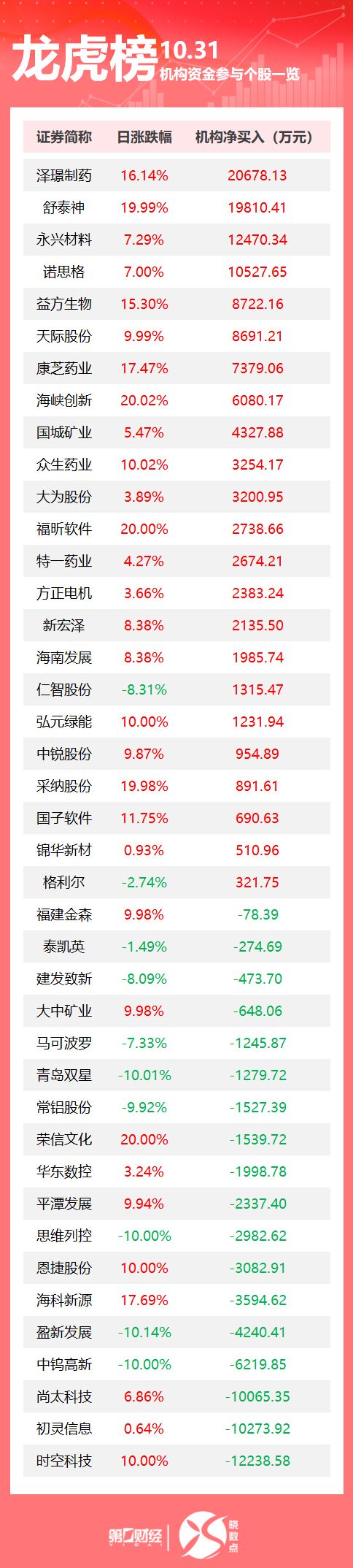
Core Insights - On October 31, a total of 41 stocks appeared on the trading leaderboard, with 23 showing net institutional buying and 18 showing net institutional selling [1] Group 1: Institutional Buying - The top three stocks with the highest net institutional buying were Zejing Pharmaceutical, Shutai Shen, and Yongxing Materials, with net buying amounts of 207 million, 198 million, and 125 million respectively [1][2] - Other notable stocks with significant net institutional buying included Nuo Si Ge (105 million), Yi Fang Bio (87 million), and Tian Ji Co. (86 million) [2] Group 2: Institutional Selling - The top three stocks with the highest net institutional selling were Shikong Technology, Chuling Information, and Shangtai Technology, with net selling amounts of 122 million, 103 million, and 101 million respectively [1][3] - Additional stocks with notable net institutional selling included Zhong Tung Gao Xin (622 million), Ying Xin Development (424 million), and Si Wei Lie Control (298 million) [3][4]



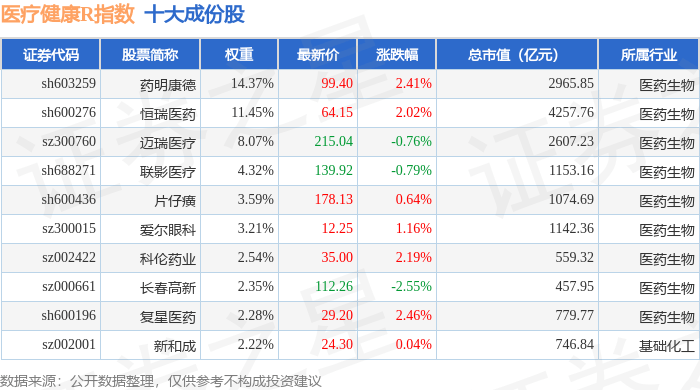
10月31日医疗健康R(480016)指数涨1.68%,成份股泽璟制药(688266)领涨
Sou Hu Cai Jing· 2025-10-31 10:51
Core Points - The Medical Health R Index (480016) closed at 7755.61 points, up 1.68%, with a total transaction volume of 40.103 billion yuan and a turnover rate of 1.25% [1] - Among the index constituents, 43 stocks rose, with Zai Jian Pharmaceutical leading with a 16.14% increase, while 6 stocks fell, with Kailai Ying leading the decline at 4.33% [1] Index Constituents Summary - The top ten constituents of the Medical Health R Index include: - WuXi AppTec (603259) with a weight of 14.37%, latest price at 99.40 yuan, and a 2.41% increase, total market value of 296.585 billion yuan [1] - Hengrui Medicine (600276) with a weight of 11.45%, latest price at 64.15 yuan, and a 2.02% increase, total market value of 425.776 billion yuan [1] - Mindray Medical (300760) with a weight of 8.07%, latest price at 215.04 yuan, and a 0.76% decrease, total market value of 260.723 billion yuan [1] - United Imaging Healthcare (688271) with a weight of 4.32%, latest price at 139.92 yuan, and a 0.79% decrease, total market value of 115.316 billion yuan [1] - Pianzai Shou (600436) with a weight of 3.59%, latest price at 178.13 yuan, and a 0.64% increase, total market value of 107.469 billion yuan [1] - Aier Eye Hospital (300015) with a weight of 3.21%, latest price at 12.25 yuan, and a 1.16% increase, total market value of 114.236 billion yuan [1] - Kelun Pharmaceutical (002422) with a weight of 2.54%, latest price at 35.00 yuan, and a 2.19% increase, total market value of 55.932 billion yuan [1] - Changchun High-tech (000661) with a weight of 2.35%, latest price at 112.26 yuan, and a 2.55% decrease, total market value of 45.795 billion yuan [1] - Fosun Pharma (600196) with a weight of 2.28%, latest price at 29.20 yuan, and a 2.46% increase, total market value of 77.977 billion yuan [1] - New Hope Liuhe (002001) with a weight of 2.22%, latest price at 24.30 yuan, and a 0.04% increase, total market value of 74.684 billion yuan [1] Capital Flow Summary - The net inflow of main funds into the Medical Health R Index constituents totaled 406 million yuan, while speculative funds saw a net outflow of 644 million yuan, and retail investors had a net inflow of 237 million yuan [1] - Specific capital flow details for key stocks include: - Mindray Medical (300760) with a main fund net inflow of 262 million yuan and a speculative fund net outflow of 127 million yuan [2] - BeiGene (688235) with a main fund net inflow of 233 million yuan and a speculative fund net outflow of 225 million yuan [2] - Haizhi Pharmaceutical (002653) with a main fund net inflow of 92.778 million yuan and a retail net outflow of 95.916 million yuan [2] - New Hope Liuhe (002001) with a main fund net inflow of 90.378 million yuan and a speculative fund net outflow of 43.538 million yuan [2] - Renfu Pharmaceutical (600079) with a main fund net inflow of 71.683 million yuan and a speculative fund net outflow of 41.302 million yuan [2]




20%涨停!创新药,大爆发!
证券时报· 2025-10-31 09:24
Market Overview - A-shares experienced a decline on October 31, with the ChiNext Index dropping over 2% and the Hang Seng Index falling more than 1% [1][2] - The Shanghai Composite Index closed down 0.81% at 3954.79 points, while the Shenzhen Component fell 1.14% to 13378.21 points [2] - The total trading volume in the Shanghai, Shenzhen, and Beijing markets was 23.501 billion yuan, a decrease of 1.145 billion yuan from the previous day [2] Innovation Drug Sector - The innovation drug sector saw a significant surge, with companies like Sanofi and Shuyou Pharmaceutical hitting the 20% daily limit [5] - Other notable performers included Zai Lab and Yifang Bio, which rose over 15%, and several other stocks also reached their daily limit [5][6] - Analysts suggest that the domestic innovation payment system has allowed some innovative products to achieve a positive cycle of R&D investment returns, with sales reaching new highs [7] - Investment opportunities are identified in dual/multi-antibody drugs targeting unmet clinical needs and in areas like ADCs and small nucleic acids [7] AI Application Sector - The AI application sector was notably active, with stocks like Fushik Holdings and Foxit Software hitting the 20% limit [9] - The rapid growth of AI-driven content, particularly in the form of AI-manufactured dramas, is expected to expand significantly, with a projected market size exceeding 20 billion yuan [11] - The growth is attributed to AI's ability to reduce production costs and time, alongside support from video platforms [11] Company Highlights - Shikong Technology achieved an 8-day consecutive limit-up, reaching a historical high, despite warnings about potential market overheating and risks associated with its acquisition plans [12][13] - The company is in the process of acquiring 100% of Jiahe Jingwei, which involves significant uncertainties and risks related to integration and market conditions [13]


刚刚,20%涨停!重磅消息引爆!
天天基金网· 2025-10-31 08:38
Core Viewpoint - The article highlights a significant surge in the innovative drug sector in China, driven by the introduction of a new commercial insurance innovation drug directory and an increase in business development (BD) activities for domestic innovative drugs, indicating a shift towards global market integration [3][6][8]. Group 1: Market Performance - On October 31, A-share innovative drug stocks experienced a collective surge, with notable gains such as 20% limit-up for Sangfor and 19.99% for Shuyitai [4][5]. - Other stocks like Zai Lab and Yifang Bio also saw increases exceeding 10%, reflecting a strong market sentiment towards innovative drugs [4][5]. Group 2: Policy Changes - The 2025 National Medical Insurance negotiations commenced on October 30, introducing a "commercial insurance innovation drug directory" mechanism, which aims to include innovative drugs that are not yet part of the basic medical insurance directory but have high clinical value [6][7]. - A total of 121 drug names passed the preliminary review for the commercial insurance directory, indicating a robust pipeline of innovative drugs awaiting approval [6]. Group 3: Business Development Activities - There has been a notable acceleration in the "going global" strategy for Chinese innovative drugs, with significant BD transactions reported, including a $11.4 billion deal between Innovent Biologics and Takeda [8][9]. - As of October 21, 2023, there were 115 licensing agreements for Chinese innovative drugs, totaling $101.24 billion, surpassing the entire amount for 2024 [8][9]. Group 4: Industry Outlook - Analysts suggest that the innovative drug sector in China is transitioning from a focus on generics to a more robust innovative landscape, with a long-term positive growth trend evident in BD transaction volumes [9]. - The introduction of the commercial insurance directory is expected to create broader market opportunities for innovative drugs, enhancing their commercial viability [6][7].



A股10月收官日,创新药赛道大爆发,舒泰神20CM涨停!
2 1 Shi Ji Jing Ji Bao Dao· 2025-10-31 08:08
Group 1 - The core viewpoint of the articles highlights a significant surge in the innovative drug sector within the A-share market, particularly on October 31, where several stocks, including Shuyat and Sanofi, hit the 20% daily limit increase [1] - The A-share market experienced fluctuations, with the ChiNext index dropping over 2%, and the total trading volume in the Shanghai and Shenzhen markets reaching 2.32 trillion yuan, a decrease of 103.9 billion yuan compared to the previous trading day [1] - The introduction of the "Commercial Insurance Innovative Drug Directory" mechanism during the national medical insurance negotiations is expected to benefit innovative drugs that are highly innovative and clinically valuable but are not yet included in the basic directory [1] Group 2 - According to Guosen Securities, the Chinese innovative drug industry is showing a long-term positive development trend, particularly evident in the explosive growth of BD transactions in recent years [2] - For most domestic innovative drugs, external licensing is often just the starting point for global development, with the progress of partners overseas and subsequent global clinical data readings enhancing the certainty of commercialization in the global market [2] - The long-term logic of investing in innovative drugs is favored, with a focus on stocks that are showing signs of bottom reversal [2]


创新药概念爆发,三生国健、舒泰神20%涨停,泽璟制药等大涨
Zheng Quan Shi Bao Wang· 2025-10-31 07:04
Core Viewpoint - The innovation drug sector is experiencing significant market activity, driven by supportive government policies aimed at promoting the development of innovative drugs and medical devices in China [1] Group 1: Market Performance - Companies such as Sanofi, Sihuan Pharmaceutical, and Zai Lab have seen stock price increases of 20% or more, indicating strong investor interest in the innovation drug sector [1] - Other companies like Maiwei Biotech and Deyuan Pharmaceutical have also reported stock price increases exceeding 10% [1] Group 2: Policy Support - The "14th Five-Year Plan" suggests support for the development of innovative drugs and medical devices, with a focus on four key areas: R&D support, commercial health insurance innovation drug catalog, optimization of drug pricing mechanisms, and support for the application of innovative drugs and devices [1] - The Chinese government has reiterated its commitment to supporting the innovation drug sector starting in 2025, indicating a long-term strategy for growth [1] Group 3: Industry Challenges and Solutions - According to CITIC Securities, the current bottlenecks in the domestic innovation drug development are primarily in the payment and application sectors [1] - The development of commercial health insurance is deemed essential, with the establishment of a commercial insurance catalog playing a guiding role in market pricing for innovative drugs [1] - Strategies such as DRG/DIP exclusion payment, accelerated hospital promotion, and diversified payment methods are identified as key measures for the domestic development of innovative drugs [1]
刚刚,20%涨停!重磅消息,引爆!
Zheng Quan Shi Bao Wang· 2025-10-31 06:50
Core Viewpoint - The A-share and Hong Kong stock markets for innovative drug concept stocks have experienced a significant surge, driven by the introduction of a new "commercial insurance innovative drug directory" mechanism in the national medical insurance negotiations for 2025, which began on October 30 [1][4]. Group 1: Market Performance - As of October 31, A-share innovative drug stocks collectively surged, with companies like Sanofi and Shuyai Shen achieving a 20% limit-up, while others like Zai Lab and Yifang Bio saw increases exceeding 10% [2][3]. - The Hong Kong innovative drug sector also showed strength, with stocks like InnoCare and Sanofi rising over 11% [2][3]. Group 2: Policy Changes - The 2025 national medical insurance negotiations introduced a "commercial insurance innovative drug directory," which includes innovative drugs that are not yet part of the basic medical insurance directory but have high innovation and clinical value [4]. - A total of 535 drug names passed the formal review for the basic drug directory, while 121 drug names were approved for the commercial insurance directory, with 79 of them applying for both [4]. Group 3: Industry Trends - The acceleration of Chinese innovative drugs "going global" has been notable in October, with multiple significant business development (BD) transactions, indicating that the Chinese innovative drug industry is entering the global mainstream [6]. - As of October 21, 2023, there were 115 licensing occurrences for Chinese innovative drugs, totaling $101.24 billion, significantly surpassing the $51.9 billion for the entire year of 2024 [6]. Group 4: Future Outlook - Analysts suggest that the introduction of the commercial insurance directory could open up broader market opportunities for innovative drugs, as it allows for the inclusion of high-innovation drugs that are not covered by basic medical insurance [4]. - The Chinese pharmaceutical industry has completed a transition from generics to innovation, with innovative drugs significantly contributing to new growth trajectories for companies [7].

刚刚,20%涨停!重磅消息,引爆!
券商中国· 2025-10-31 06:44
Core Viewpoint - The innovation drug sector in China is experiencing a significant surge, driven by the introduction of a new commercial insurance innovation drug directory and an acceleration in international business development (BD) activities for domestic innovative drugs [1][4][6]. Group 1: Market Performance - On October 31, A-share innovative drug concept stocks collectively surged, with companies like Sanofi and Shuyou Pharmaceutical hitting a 20% limit up, while others like Zai Lab and Yifang Bio saw increases exceeding 10% [2][3]. - The Hong Kong stock market also showed strength in the innovative drug sector, with companies such as InnoCare and Sanofi Pharmaceutical rising over 11% [2]. Group 2: Policy Changes - The 2025 National Medical Insurance Negotiation commenced on October 30, introducing a "commercial insurance innovation drug directory" mechanism for the first time, which aims to include innovative drugs that are not yet part of the basic medical insurance directory but have high clinical value [4]. - A total of 535 drug names passed the formal review for the basic drug directory, while 121 drug names were approved for the commercial insurance innovation drug directory, indicating a significant focus on high-innovation drugs [4]. Group 3: Business Development Acceleration - Since October, there has been a notable increase in the "outbound" progress of domestic innovative drugs, with several high-profile BD transactions, including a strategic cooperation deal worth up to $11.4 billion between Innovent Biologics and Takeda [6][7]. - As of October 21, 2023, there were 115 outbound licensing agreements for Chinese innovative drugs, totaling $101.24 billion, significantly surpassing the $51.9 billion for the entire year of 2024 [7]. Group 4: Industry Outlook - Analysts indicate that the recent surge in BD transactions reflects China's innovative drug industry entering the global mainstream, transitioning from a focus on generic drugs to becoming a leader in certain areas of innovation [7][8]. - The Chinese pharmaceutical industry has completed a transformation from old to new growth drivers, with innovative drugs opening new growth avenues for companies [8].