Daqo Energy(688303)

Search documents
电力设备及新能源行业周报:优必选人形再获1.43亿元订单,最新输配电促进新能源消纳利用-20251202
Shanxi Securities· 2025-12-02 07:01
Investment Rating - The report maintains an investment rating of "Synchronize with the market - A" for the power equipment and new energy industry [1] Core Viewpoints - The power equipment and new energy industry has shown significant market performance over the past year, with a focus on enhancing the utilization of renewable energy through new pricing mechanisms [1][4] - The report highlights the recent order of 143 million yuan received by UBTECH for humanoid robots, indicating strong demand in the robotics sector [3] - The National Development and Reform Commission (NDRC) is actively addressing issues of price disorder in certain industries, which may impact market dynamics [3] Summary by Relevant Sections Market Performance - The power equipment and new energy industry has experienced notable developments, including the introduction of new pricing methods aimed at promoting renewable energy consumption [4] Company Orders - UBTECH's total order amount for humanoid robots in 2025 has reached 1.3 billion yuan, showcasing robust growth in this segment [3] Pricing Trends - The report provides insights into the pricing of polysilicon, silicon wafers, battery cells, and modules, indicating stability in polysilicon prices and a downward trend in silicon wafer and battery cell prices due to high inventory levels [5][7][8] Investment Recommendations - The report recommends several companies for investment based on their strategic positioning in the industry, including Aikang Co., Longi Green Energy, and Daqo New Energy, among others [6][9]


大全能源(688303) - 大全能源关于续聘德勤华永会计师事务所(特殊普通合伙)为公司2025年度审计机构的公告
2025-11-28 09:30
证券代码:688303 证券简称:大全能源 公告编号:2025-051 新疆大全新能源股份有限公司 关于续聘德勤华永会计师事务所(特殊普通合伙)为 公司 2025 年度审计机构的公告 本公司董事会及全体董事保证公告内容不存在任何虚假记载、误导性陈述 或者重大遗漏,并对其内容的真实性、准确性和完整性依法承担法律责任。 重要提示: 新疆大全新能源股份有限公司(以下简称"公司"或"大全能源")拟聘任德 勤华永会计师事务所(特殊普通合伙)(以下简称"德勤华永")为公司 2025 年财 务报告审计及内部控制审计机构。 一、拟聘任会计师事务所的基本情况 (一)机构信息 1、基本信息 德勤华永会计师事务所(特殊普通合伙)的前身是 1993 年 2 月成立的沪江德 勤会计师事务所有限公司,于 2002 年更名为德勤华永会计师事务所有限公司,于 2012 年 9 月经财政部等部门批准转制成为特殊普通合伙企业。德勤华永注册地址 为上海市黄浦区延安东路 222 号 30 楼。 德勤华永具有财政部批准的会计师事务所执业证书,并经财政部、中国证监 会批准,获准从事 H 股企业审计业务。德勤华永已根据财政部和中国证监会《会 计师事务所从 ...
大全能源(688303) - 大全能源关于召开2025年第二次临时股东会的通知
2025-11-28 09:30
证券代码:688303 证券简称:大全能源 公告编号:2025-052 新疆大全新能源股份有限公司 关于召开2025年第二次临时股东会的通知 本公司董事会及全体董事保证公告内容不存在任何虚假记载、误导性陈述或 者重大遗漏,并对其内容的真实性、准确性和完整性依法承担法律责任。 重要内容提示: 一、 召开会议的基本情况 (一) 股东会类型和届次 2025年第二次临时股东会 召开日期时间:2025 年 12 月 15 日 14 点 00 分 召开地点:上海市浦东新区张杨路 838 号华都大厦 29 层 A/J 座会议室 (五) 网络投票的系统、起止日期和投票时间。 网络投票系统:上海证券交易所股东会网络投票系统 网络投票起止时间:自2025 年 12 月 15 日 至2025 年 12 月 15 日 (七) 涉及公开征集股东投票权 不适用 二、 会议审议事项 本次股东会审议议案及投票股东类型 | 序号 | | 议案名称 | 投票股东类型 | | --- | --- | --- | --- | | | | | 股股东 A | | 非累积投票议案 | | | | | 1 | 关于续聘德勤华永会计师事务所(特殊普通合 | ...
大全能源(688303) - 大全能源关于召开2025年第三季度业绩说明会的公告
2025-11-27 09:30
证券代码:688303 证券简称:大全能源 公告编号:2025-050 新疆大全新能源股份有限公司 关于召开 2025 年第三季度业绩说明会的公告 本公司董事会及全体董事保证公告内容不存在任何虚假记载、误导性陈述 或者重大遗漏,并对其内容的真实性、准确性和完整性依法承担法律责任。 重要提示: 投资者可于 2025 年 11 月 28 日(星期五)至 12 月 04 日(星期四)登录上证 路演中心网站首页点击"提问预征集"栏目或通过公司邮箱 dqir@daqo.com 进行 提问。公司将在说明会上对投资者普遍关注的问题进行回答。 新疆大全新能源股份有限公司(以下简称"公司")已于 2025 年 10 月 28 日 发布公司 2025 年第三季度报告,为便于广大投资者更全面深入地了解公司 2025 年第三季度经营成果、财务状况,公司计划于 2025 年 12 月 05 日(星期五) 11:00-12:00 举行 2025 年第三季度业绩说明会,就投资者关心的问题进行交流。 一、说明会类型 (三)会议召开方式:上证路演中心网络互动 三、参加人员 公司出席本次说明会的人员:董事兼总经理朱文刚先生;董事、董事会秘书 孙 ...
光伏行业2026年年度策略:反内卷加速市场出清,关注细分领域龙头
Zhongyuan Securities· 2025-11-27 09:08
Core Insights - The report emphasizes that the photovoltaic industry is entering a continuous capacity clearance cycle, driven by anti-involution policies and market dynamics, which will gradually improve the performance of existing photovoltaic companies [4][22][50] - The investment recommendation maintains a "stronger than market" rating, suggesting a focus on leading companies in niche sectors such as energy storage inverters, polysilicon materials, photovoltaic glass, and integrated component manufacturers [4][36][50] Group 1: 2025 Review and 2026 Outlook - In 2025, the photovoltaic sector saw a significant increase in installed capacity, with a total of 240.27 GW added, representing a year-on-year growth of 64.73% [4][36] - The report notes a bifurcation in stock performance, with the photovoltaic industry index yielding a return of 21.53% from January to November 2025, outperforming the Shanghai and Shenzhen 300 index, which returned 13.18% [14][20] - The outlook for 2026 indicates a slowdown in new installations, with expectations of stable demand and a focus on improving the quality of the industry through capacity reduction and consolidation [4][36][50] Group 2: Investment Recommendations - The report suggests that the energy storage inverter sector will benefit from a global upturn in energy storage demand, with significant growth expected in the market [4][36] - For polysilicon, the report highlights that anti-involution measures are likely to reverse the industry's challenges, recommending a focus on leading companies with performance elasticity [5][9] - The photovoltaic glass market is entering a phase of capacity optimization, with a recommendation to focus on leading companies that possess cost advantages [9][10] Group 3: Market Dynamics - The report indicates that the traditional markets in Europe and the U.S. are experiencing sluggish growth, while demand in Asia-Pacific and Africa remains robust, with imports of components continuing to grow rapidly [4][41][42] - The report outlines that the U.S. market is facing challenges due to the expiration of investment tax credits, which is expected to impact new installations negatively [45][46] - In contrast, the Middle East and Africa are emerging as hotspots for photovoltaic demand due to their energy transition needs and favorable market conditions [41][47]



光伏设备板块11月24日涨0.12%,阿特斯领涨,主力资金净流出6.32亿元
Zheng Xing Xing Ye Ri Bao· 2025-11-24 09:12
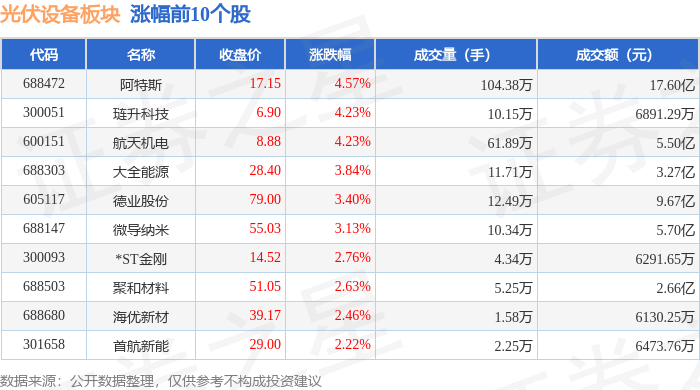
Market Performance - The photovoltaic equipment sector increased by 0.12% on November 24, with Canadian Solar leading the gains [1] - The Shanghai Composite Index closed at 3836.77, up 0.05%, while the Shenzhen Component Index closed at 12585.08, up 0.37% [1] Stock Performance - Key stocks in the photovoltaic equipment sector showed the following closing prices and percentage changes: - Canadian Solar (688472): 17.15, up 4.57% with a trading volume of 1.0438 million shares and a turnover of 1.76 billion [1] - Sangsheng Technology (300051): 6.90, up 4.23% with a trading volume of 101,500 shares and a turnover of 68.91 million [1] - Aerospace Electromechanical (600151): 8.88, up 4.23% with a trading volume of 618,900 shares and a turnover of 55 million [1] - Other notable stocks include Daqian Energy (688303), DeYe Co., Ltd. (605117), and Weidao Nano (688147) with respective increases [1] Capital Flow - The photovoltaic equipment sector experienced a net outflow of 632 million from institutional investors, while retail investors saw a net inflow of 181 million [2] - Notable capital flows for specific stocks include: - Aerospace Electromechanical (600151): 73.22 million net inflow from institutional investors, but a net outflow from retail investors [2] - Canadian Solar (688472): 26.83 million net inflow from retail investors, but a significant net outflow from institutional investors [2] - Other stocks like JinkoSolar (688223) and Weidao Nano (688147) also showed varied capital flows [2]


大全能源11月21日获融资买入2465.71万元,融资余额7.16亿元
Xin Lang Cai Jing· 2025-11-24 01:36
Core Viewpoint - Daqo Energy's stock price declined by 3.76% on November 21, with a trading volume of 353 million yuan, indicating a significant market reaction to recent financial data and trading activities [1] Financing Summary - On November 21, Daqo Energy had a financing buy-in amount of 24.66 million yuan and a financing repayment of 44.35 million yuan, resulting in a net financing outflow of 19.70 million yuan [1] - As of November 21, the total financing and securities lending balance for Daqo Energy was 719 million yuan, with the financing balance at 716 million yuan, accounting for 1.22% of the circulating market value, which is above the 70th percentile of the past year [1] - The securities lending activity on November 21 included a repayment of 14,300 shares and a sale of 30,600 shares, with a selling amount of 836,000 yuan, while the securities lending balance was 2.53 million yuan, exceeding the 80th percentile of the past year [1] Company Performance - As of September 30, Daqo Energy had 40,000 shareholders, an increase of 14.07% from the previous period, with an average of 53,635 circulating shares per person, up by 240.25% [2] - For the period from January to September 2025, Daqo Energy reported a revenue of 3.24 billion yuan, a year-on-year decrease of 46%, and a net profit attributable to shareholders of -1.07 billion yuan, a year-on-year increase of 2.36% [2] - Since its A-share listing, Daqo Energy has distributed a total of 9.74 billion yuan in dividends, with 8.59 billion yuan distributed over the past three years [2] Institutional Holdings - As of September 30, 2025, Daqo Energy's top ten circulating shareholders included notable ETFs, with E Fund's SSE STAR 50 ETF holding 23.26 million shares, a decrease of 3.38 million shares from the previous period [2] - Other significant shareholders included Huaxia's SSE STAR 50 ETF with 22.73 million shares (down 12.83 million shares) and Hong Kong Central Clearing Limited with 21.88 million shares (down 990,970 shares) [2]
中原证券研究所2026年年度十大金股组合
Zhongyuan Securities· 2025-11-21 10:51
Group 1 - The core investment theme for 2026 is transitioning from extreme growth to balanced allocation, focusing on sectors with strong performance potential [3][11] - In the technology sector, the report highlights that industries related to artificial intelligence and embodied intelligence are expected to experience a slowdown in profit growth after rapid valuation increases, suggesting a focus on segments with relatively low historical valuations and strong earnings support [3][11] - For traditional industries, the report recommends focusing on upstream sectors benefiting from "AI+" enhancements and profit recovery opportunities following capacity clearance driven by anti-involution policies [3][11] Group 2 - The report identifies a potential recovery in downstream consumer sectors during the 2026-2027 inventory cycle, alongside a gradual return of long-term capital to the market, suggesting a sustained allocation window for industries such as food and beverage, pharmaceuticals, and duty-free concepts [3][11] - The recommended top ten stocks for 2026 include: 300568.SZ Xingyuan Material, 601233.SH Tongkun Co., 603755.SH Richen Co., 300442.SZ Runze Technology, 688303.SH Daqian Energy, 002920.SZ Desay SV, 688041.SH Haiguang Information, 603993.SH Luoyang Molybdenum, 603583.SH Jiechang Drive, and 002027.SZ Focus Media [4][13] - The report provides a detailed earnings forecast and valuation for the recommended stocks, indicating expected earnings per share (EPS) and price-to-earnings (PE) ratios for 2025 and 2026 [16]




大全能源跌6.7% 中原证券年内高位维持增持评级

Zhong Guo Jing Ji Wang· 2025-11-20 09:47
Group 1 - The core viewpoint of the article highlights that Daqo Energy's stock price has decreased by 6.70% to 28.42 yuan, following a peak of 35.74 yuan on September 5 [1] - Zhongyuan Securities analyst Tang Junman released a report on September 9, maintaining an "overweight" investment rating for Daqo Energy despite the company's losses in the first half of the year [1]
光伏设备板块11月20日跌2.59%,大全能源领跌,主力资金净流出19.65亿元
Zheng Xing Xing Ye Ri Bao· 2025-11-20 09:04
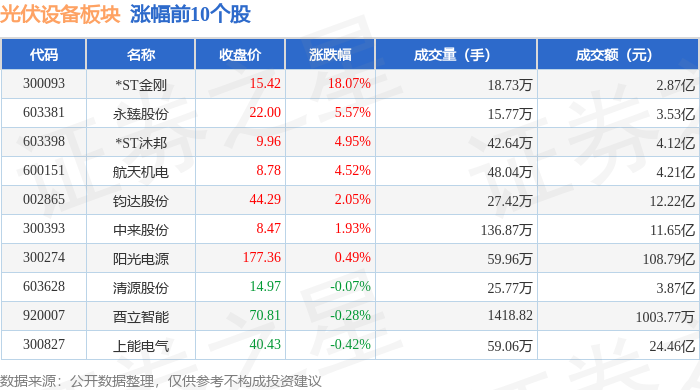
Core Insights - The photovoltaic equipment sector experienced a decline of 2.59% on November 20, with Daqo Energy leading the drop [1][2] - The Shanghai Composite Index closed at 3931.05, down 0.4%, while the Shenzhen Component Index closed at 12980.82, down 0.76% [1] Stock Performance - Notable gainers included: - *ST Quangang: Closed at 15.42, up 18.07% with a trading volume of 187,300 shares [1] - Yongshou Co.: Closed at 22.00, up 5.57% with a trading volume of 157,700 shares [1] - Major decliners included: - Daqo Energy: Closed at 28.42, down 6.70% with a trading volume of 172,800 shares [2] - Longi Green Energy: Closed at 20.10, down 5.19% with a trading volume of 2,338,800 shares [2] Capital Flow - The photovoltaic equipment sector saw a net outflow of 1.965 billion yuan from institutional investors, while retail investors contributed a net inflow of 1.747 billion yuan [2][3] - The capital flow for key stocks showed: - Sunshine Power: Net inflow of 391 million yuan from institutional investors [3] - Junda Co.: Net outflow of 329 million yuan from retail investors [3]