
Daqo Energy(688303)

Search documents
“反内卷”纠偏初显成效!光伏行业扭困现曙光
证券时报· 2025-08-29 08:14
Core Viewpoint - The photovoltaic industry is facing significant losses across the supply chain, with major manufacturers reporting substantial deficits in their financial results for the first half of the year [1][4][6]. Financial Performance - The top five manufacturers in terms of module shipments reported a combined loss of approximately 160 billion yuan in the first half of the year [1][6]. - JinkoSolar reported a revenue of 31.83 billion yuan, a year-on-year decrease of 32.63%, with a net loss of 2.91 billion yuan, a year-on-year increase in losses of 342.4% [4]. - Longi Green Energy's revenue was 32.81 billion yuan, down 14.83% year-on-year, with a net loss of 2.57 billion yuan, a reduction in losses of 26.61% compared to the previous year [4]. - Trina Solar and JA Solar both reported significant revenue declines and net losses, with Trina Solar's revenue at 31.06 billion yuan (down 27.72%) and a net loss of 2.92 billion yuan (up 654.47%) [4]. - Tongwei Co. achieved a revenue of 40.51 billion yuan, down 7.51%, with a net loss of 4.96 billion yuan, an increase in losses of 58.35% [5]. Cash Flow Health - Cash flow has emerged as a critical indicator of survival for photovoltaic companies, with several firms reporting improvements in cash flow despite overall losses [8][9]. - TCL Zhonghuan reported a net cash flow from operating activities of 523 million yuan, a year-on-year increase of 308.4% [9]. - Trina Solar's net cash flow was 1.843 billion yuan, with a second-quarter figure of 2.679 billion yuan [9]. - However, companies like Daqo New Energy reported negative cash flow, with a net cash flow of -1.608 billion yuan [9]. Industry Pricing and Competition - The photovoltaic industry is undergoing a "reverse involution" movement, with a reduction in low-price sales and fierce competition [1][10]. - Regulatory bodies have initiated measures to combat low-price, disorderly competition, emphasizing the need for quality improvement and the orderly exit of outdated production capacity [11]. - Recent trends indicate a recovery in prices across various segments of the supply chain, with manufacturers expressing hope for prices to stabilize above cost levels [11][12].





产量增加叠加需求下滑,光伏涨价遭遇拦路虎
Jing Ji Guan Cha Wang· 2025-08-29 07:52
Core Viewpoint - The photovoltaic industry is currently facing challenges due to upstream inventory accumulation and a decline in terminal demand, leading to a complex situation of rising prices amidst high inventory levels [1][3][11]. Upstream Price and Inventory Dynamics - The recent surge in multi-crystalline silicon prices has not effectively transmitted through the industry chain to downstream sectors, raising concerns about the sustainability of the price increase [1][3]. - In the first half of the year, domestic multi-crystalline silicon production was approximately 596,000 tons, a significant year-on-year decrease of 44.1%, while inventory dropped from about 400,000 tons at the end of 2024 to approximately 366,000 tons by the end of June [1][2]. - Despite a production increase to around 107,800 tons in July (up 5.7% month-on-month), the anticipated production for September is projected to be between 125,000 and 130,000 tons, leading to an expected inventory rise to approximately 390,000 tons by the end of September [2][3]. Midstream Pricing Challenges - The price increase in multi-crystalline silicon has not led to a corresponding rise in photovoltaic module prices due to sufficient supply and resistance from downstream demand [5][6]. - The recent reports of "shortages and price increases" in photovoltaic modules are primarily structural and phase-related, rather than a direct result of upstream price hikes [6][7]. Downstream Demand Decline - The newly installed solar power capacity in July was only 11.04 million kilowatts, a significant year-on-year decline of 47.55%, indicating a downward trend in demand [8][9]. - The decline in demand is attributed to a combination of policy changes, market conditions, and the industry's transition from rapid growth to high-quality development [9][10]. Industry Outlook and Solutions - The "anti-involution" policy is expected to help stabilize the market by curbing low-price competition, but its effectiveness in addressing upstream inventory issues remains uncertain [11][12]. - Key strategies for overcoming the current challenges include industry self-discipline, technological innovation, and expanding into new value chains such as energy storage and digital services [12].

大全能源:上半年实现营收14.7亿元 三季度继续践行减产策略
Zhong Zheng Wang· 2025-08-28 06:54
中证报中证网讯(记者何昱璞)大全能源8月27日发布2025年半年报,数据显示,公司上半年实现营业收 入14.7亿元,归属于上市公司股东的净利润亏损11.47亿元。公司表示,业绩下降主要因多晶硅市场价格 同比下跌33.63%(单位销售价格从47.01元/公斤降至31.20元/公斤),叠加公司主动减产导致销量同比减少 52.47%(销量从9.71万吨降至4.61万吨)。 报告期内,大全能源通过主动减产、降本增效、技术创新等多维度发力,以短期"阵痛"换取长期健康发 展。 在光伏行业深度调整的浪潮中,大全能源以主动变革的姿态,不仅实现了自身的韧性生长,更以龙头企 业的担当助推行业破浪向前。 面对行业供需失衡的困境,大全能源积极响应"反内卷"倡议,主动推行减产策略。2025年上半年,公司 多晶硅产量为5.08万吨,同比下降约60%。这一战略性调整虽对短期产出造成影响,却有效缓解了市场 供给压力,规避了同质化恶性竞争。 大全能源表示,2025年第三季度将继续落实减产策略,根据市场价格和下游需求灵活调整发货计划,控 制合理库存水平。公司预计第三季度多晶硅产量为2.7万吨-3万吨,全年产量为11万吨-13万吨。面向未 来,大 ...
大全能源(688303):精细化管理有效降本,资金充足+低负债运营助力公司穿越周期
Minsheng Securities· 2025-08-28 06:33
Investment Rating - The report maintains a "Recommended" rating for the company, indicating a positive outlook based on its ability to navigate through industry cycles [4][7]. Core Insights - The company's performance is under pressure primarily due to supply-demand imbalances in the photovoltaic industry, leading to lower product prices [1]. - The company has actively implemented production cuts in response to national initiatives, resulting in a significant decrease in polysilicon production and sales in the first half of 2025 [2]. - Despite the reduction in production, the company has managed to lower its cash costs, demonstrating effective cost control and management strategies [2]. - The company has a strong financial position with a cash reserve of 12.09 billion and a low debt ratio of 8.04%, which provides a solid foundation for navigating industry cycles [3]. Financial Projections - Revenue projections for 2025, 2026, and 2027 are estimated at 3.85 billion, 8.48 billion, and 12.21 billion respectively, with corresponding net profits of -1.53 billion, 0.79 billion, and 1.51 billion [4][6]. - The company is expected to achieve a significant revenue growth rate of 120% in 2026 and 44% in 2027, following a decline in 2025 [6][12]. - The price-to-earnings (PE) ratios for 2026 and 2027 are projected to be 79x and 42x, respectively, indicating potential for future profitability [4][12].
民生证券:给予大全能源买入评级
Zheng Quan Zhi Xing· 2025-08-28 06:10
Core Viewpoint - Daqo Energy's recent half-year report indicates significant revenue decline and net losses, attributed to supply-demand imbalance in the photovoltaic industry and low product prices, but the company maintains a buy rating due to effective cost management and strong financial position [2][5]. Financial Performance - In H1 2025, Daqo Energy reported revenue of 1.47 billion yuan, a year-on-year decrease of 67.93%, with a net loss of 1.15 billion yuan [2]. - Q2 2025 revenue was 563 million yuan, down 64.87% year-on-year and 37.96% quarter-on-quarter, with a net loss of 589 million yuan [2]. Production and Cost Management - The company implemented a production cut in response to the national "anti-involution" initiative, resulting in a 60% decrease in polysilicon production to 50,800 tons in H1 2025 and a 52% drop in sales to 46,100 tons [3]. - Despite increased fixed costs due to reduced production, cash costs fell to 37.66 yuan/kg, a 6.6% decrease from the previous year [3]. Financial Stability - As of H1 2025, Daqo Energy had a total cash reserve of 12.09 billion yuan and a low debt ratio of 8.04%, with no interest-bearing debt [4]. - The strong financial position is expected to support the company through industry cycles and provide strategic options at the bottom of the cycle [4]. Investment Outlook - Revenue projections for 2025, 2026, and 2027 are 3.85 billion yuan, 8.48 billion yuan, and 12.21 billion yuan, respectively, with expected net profits of -1.53 billion yuan, 791 million yuan, and 1.51 billion yuan [5]. - The company is positioned as a leading player in the silicon material sector, with effective cost control and financial strength anticipated to help navigate through market challenges [5].
大全能源2025年中报简析:净利润同比下降71.1%,三费占比上升明显
Zheng Quan Zhi Xing· 2025-08-27 22:56
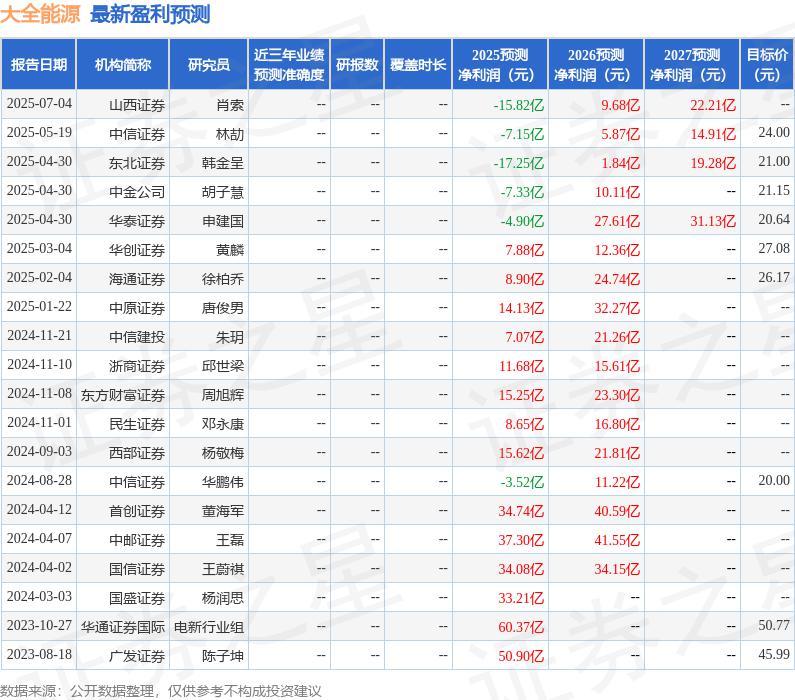
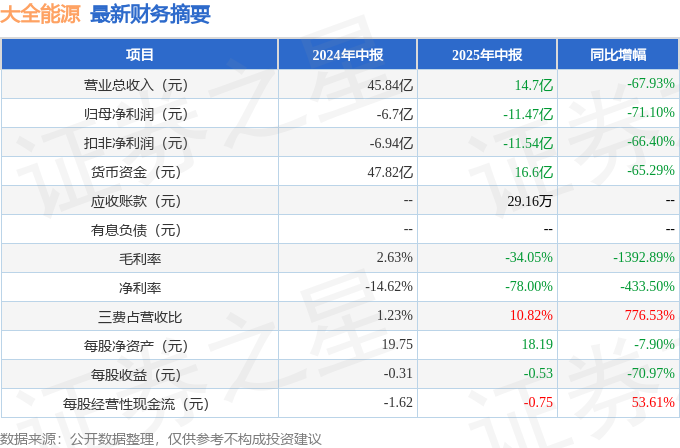
Core Viewpoint - Daqo Energy (688303) reported a significant decline in financial performance for the first half of 2025, with total revenue dropping by 67.93% year-on-year to 1.47 billion yuan and a net loss of 1.15 billion yuan, a 71.1% decrease compared to the previous year [1] Financial Performance Summary - Total revenue for the first half of 2025 was 1.47 billion yuan, down from 4.58 billion yuan in 2024, reflecting a decrease of 67.93% [1] - The net profit attributable to shareholders was -1.15 billion yuan, compared to -670 million yuan in 2024, marking a decline of 71.1% [1] - Gross margin fell to -34.05%, a decrease of 1392.89% year-on-year, while net margin dropped to -78.0%, down 433.5% [1] - The total of selling, administrative, and financial expenses reached 159 million yuan, accounting for 10.82% of total revenue, an increase of 776.53% year-on-year [1] - Earnings per share were -0.53 yuan, a decrease of 70.97% from the previous year [1] Changes in Financial Items - Cash and cash equivalents decreased by 66.86% due to funds being allocated to time deposits and structured deposits [3] - Accounts receivable increased by 118.26% as the semiconductor business expanded [3] - Contract liabilities decreased by 44.64% due to falling prices and sales volumes of polysilicon [4] - Accounts payable rose by 267.9% as new bank acceptances were issued for operational expenses [3] Cost and Expense Analysis - Operating costs decreased by 55.84% due to lower sales volumes [4] - Selling expenses fell by 27.0% as overall spending decreased with reduced sales scale [4] - Administrative expenses decreased by 16.44% due to the expiration of employee stock incentives [5] - Financial expenses increased by 106.12% due to lower bank deposit balances and interest rates [6] - R&D expenses decreased by 61.12% as project scales were reduced [7] Cash Flow Analysis - Net cash flow from operating activities improved by 53.6% due to lower unit cash costs and reduced output [7] - Net cash flow from investing activities decreased by 83.15% as there were no new projects [7] - Net cash flow from financing activities decreased by 99.97% as there were no cash dividends due to last year's losses [7] Market Position and Future Outlook - Analysts expect Daqo Energy's performance for 2025 to be a net loss of 1.58 billion yuan, with an average earnings per share of -0.74 yuan [8] - The company's historical financial performance shows a median ROIC of 14.44%, but the worst year recorded a ROIC of -5.91%, indicating a fragile business model [7]
上半年主动减产六成仍大幅增亏,大全能源披露三季度减产策略
Di Yi Cai Jing· 2025-08-27 08:00
Core Viewpoint - The company remains optimistic about the overall development of the photovoltaic industry and product price trends despite facing significant challenges in the current market environment [1]. Group 1: Company Performance - In the first half of 2025, the company reported a revenue of 1.47 billion yuan, a year-on-year decrease of 67.93%, and a net loss attributable to shareholders of 1.147 billion yuan, compared to a loss of 670 million yuan in the same period last year, indicating a substantial increase in losses [1]. - The company's main product is high-purity polysilicon, with an annual production capacity of 305,000 tons. In the first half of 2025, the company's polysilicon output was 50,821 tons, accounting for 8.52% of the domestic total of 596,000 tons, ranking it among the top tier in the industry [1][2]. - The company implemented a proactive production reduction strategy, resulting in a 60% year-on-year decrease in polysilicon output, which, while impacting unit costs, is expected to alleviate market supply pressure in the long term [2]. Group 2: Cost and Financial Management - The unit cost of production increased by approximately 19.80% year-on-year to 55.07 yuan per kilogram, up from 45.97 yuan per kilogram in the previous year, due to fixed costs associated with idle production lines [2]. - The company managed to reduce its cash cost to 37.66 yuan per kilogram, a decrease of 6.6% year-on-year, indicating improved cash flow management despite the overall losses [2]. - As of June 30, 2025, the company had a strong financial position with total cash reserves of 12.09 billion yuan and an asset-liability ratio of 8.04%, with no interest-bearing debt, contrasting sharply with the industry average [3]. Group 3: Market Outlook - The company plans to continue its production reduction strategy in the third quarter, with expected polysilicon output between 27,000 to 30,000 tons, and a total annual production forecast of 110,000 to 130,000 tons for 2025 [3]. - The company maintains a positive outlook on the future development of the photovoltaic industry, citing recent policy measures aimed at eliminating irrational competition and addressing capacity mismatches [3]. - From June to August, domestic polysilicon prices experienced a significant rebound, with the average price of N-type recycled material rising nearly 36.9% from 34,400 yuan per ton at the end of June to 47,100 yuan per ton by the end of July [3].
大全能源近1年半均亏损 2021年上市2募资共174.5亿
Zhong Guo Jing Ji Wang· 2025-08-27 06:43
Financial Performance - In the first half of 2025, the company reported operating revenue of 1.47 billion, a year-on-year decrease of 67.93% [1] - The net profit attributable to shareholders was -1.15 billion, compared to -670 million in the same period last year [1] - The net profit attributable to shareholders after deducting non-recurring gains and losses was -1.15 billion, down from -694 million year-on-year [1] - The net cash flow from operating activities was -1.61 billion, an improvement from -3.47 billion in the previous year [1] - For 2024, the company achieved operating revenue of 7.41 billion, a year-on-year decrease of 54.62% [1] - The net profit attributable to shareholders for 2024 was -2.72 billion, compared to 5.76 billion in the previous year [1] - The net cash flow from operating activities for 2024 was -5.39 billion, down from 8.74 billion year-on-year [1] Fundraising Activities - The company raised a total of 6.45 billion through its initial public offering, with a net amount of 6.07 billion, exceeding the original plan by 1.07 billion [2] - The initial plan was to raise 5 billion for projects including the production of high-purity semiconductor materials and polycrystalline silicon [2] - The total issuance costs for the IPO were 379.81 million, with underwriting fees amounting to 344.32 million [2] Stock Issuance - In 2022, the company issued A-shares to specific investors, raising a total of approximately 10.99 billion, with a net amount of about 10.94 billion after deducting issuance costs [3] - The issuance price was set at 51.79 per share, with a total of 212,396,215 shares issued [3] - As of December 31, 2023, the company had utilized approximately 10.95 billion of the raised funds, with all funds from the 2022 issuance fully utilized [3] - The current stock price is below the issuance price [3] Total Fundraising - The total amount raised by the company from both fundraising activities is 17.447 billion [4]
大全能源:半年度计提资产减值准备6.75亿元
2 1 Shi Ji Jing Ji Bao Dao· 2025-08-27 04:17
Core Points - Daqo Energy (688303.SH) announced an asset impairment provision of 674.86 million yuan for the first half of 2025, primarily due to inventory write-down losses [1] - This provision resulted in a reduction of the company's total profit by 69.33 million yuan for the same period [1] - During the period, the company reversed inventory impairment provisions amounting to 605.53 million yuan [1]
23只科创板股获融资净买入额超5000万元
Zheng Quan Shi Bao Wang· 2025-08-27 02:35
Core Viewpoint - The total margin balance of the STAR Market reached 216.09 billion yuan on August 26, showing an increase of 4.27 billion yuan from the previous trading day [1] Group 1: Margin Balance - The financing balance amounted to 215.35 billion yuan, increasing by 4.26 billion yuan from the previous trading day [1] - The margin trading balance was 7.44 billion yuan, with a slight increase of 0.05 billion yuan [1] Group 2: Stock Performance - On August 26, 357 stocks on the STAR Market experienced net financing inflows, with 23 stocks having net inflows exceeding 50 million yuan [1] - Cambricon Technologies led the net financing inflow with an amount of 593 million yuan, followed by SMIC, Haiguang Information, Dongxin Co., Jiewa Technology, Zhongwei Company, Huafeng Technology, and Daqo Energy, all exceeding 100 million yuan in net inflows [1]




