HUA HONG SEMI(688347)

Search documents
华虹公司股价涨5.01%,国联安基金旗下1只基金重仓,持有3万股浮盈赚取15.81万元
Xin Lang Cai Jing· 2025-12-24 06:58
Group 1 - The core viewpoint of the news is that Huahong Semiconductor Company has seen a significant increase in its stock price, rising 5.01% to 110.47 yuan per share, with a total market capitalization of 191.77 billion yuan as of December 24 [1] - Huahong Semiconductor, established on January 21, 2005, specializes in specialty process wafer foundry services, providing a diverse range of platforms including embedded/non-volatile memory, power devices, analog and power management, logic, and RF [1] - The company's main revenue sources are integrated circuit wafer foundry (94.60%), other services (4.78%), and rental income (0.62%) [1] Group 2 - According to data, Guolian An Fund has a significant holding in Huahong Company, with its Guolian An New Technology Mixed Fund (007305) holding 30,000 shares, representing 4.24% of the fund's net value, making it the third-largest holding [2] - The Guolian An New Technology Mixed Fund has achieved a year-to-date return of 46.75%, ranking 1313 out of 8088 in its category, and a one-year return of 45.98%, ranking 1268 out of 8058 [2] - The fund manager, Gao Si, has a tenure of 6 years and 91 days, with the fund's total assets amounting to 95.96 million yuan, and the best return during his tenure being 131.39% [3]
中芯国际部分产能涨价10%,芯片代工行业产能紧张
Guan Cha Zhe Wang· 2025-12-24 06:53
Core Viewpoint - Semiconductor industry is experiencing increased demand driven by mobile applications and AI, leading to price hikes in wafer foundry services, with SMIC implementing a 10% price increase on some capacities [1] Group 1: Price Increases and Demand - SMIC has raised prices on certain capacities by approximately 10%, with expectations for quick implementation [1] - The increase in demand for chips is attributed to the growth in mobile applications and AI, alongside rising raw material costs [1] - TSMC is consolidating its 8-inch capacity and plans to shut down some production lines by the end of 2027, which may lead to further price increases in wafer foundry services [1] Group 2: TSMC's Challenges - TSMC's mature process capacity utilization is impacted by the rise of China's mature processes, with its Kumamoto factory facing losses due to declining demand from major Japanese automakers [1] - TSMC's Kumamoto factory, which focuses on 28nm processes for automotive chips, has seen low capacity utilization and increasing losses [1] - TSMC plans to shift its future Kumamoto factory construction from 6nm to 2nm processes to cater to clients like NVIDIA and AMD for AI chips [1] Group 3: Capacity Utilization and Revenue Growth - SMIC's capacity utilization rose from 92.5% in Q2 to 95.8% in Q3, equating to a monthly capacity of one million 8-inch wafers [3] - Huahong Semiconductor also reported high utilization at 109.5% in Q3, shipping approximately 1.4 million 8-inch wafers [3] - Both companies experienced significant revenue growth in Q3, with SMIC reporting revenue of 17.162 billion yuan (up 6.9% quarter-on-quarter) and a net profit of 1.517 billion yuan (up 43.1% year-on-year) [3] - Huahong Semiconductor achieved a record high revenue of $635.2 million in Q3, reflecting a year-on-year growth of 20.7% [3] Group 4: Market Position and Future Outlook - By Q3 2025, SMIC is projected to hold a 5.1% market share, ranking third globally in wafer foundry sales, while Huahong Semiconductor is expected to rank sixth with a 2.6% market share [3] - SMIC's CEO noted that the industry is undergoing rapid changes, with ongoing inventory replenishment and increased output, despite a seasonal slowdown in Q4 [4] - The average selling price for SMIC's products increased by 3.8% quarter-on-quarter due to the complexity of products being shipped [4]




半导体板块继续走强
Di Yi Cai Jing· 2025-12-24 04:17
Group 1 - Shenghui Integration and Chuangyuan Technology both achieved a three-day consecutive increase in stock prices [1] - Demingli, Beijing Junzheng, Xinyuanwei, Huicheng Co., and Huahong Company also saw significant gains in their stock prices [1]


存储芯片板块盘初走强,胜通能源走出9连板,沪银主力合约涨超7%
Xin Lang Cai Jing· 2025-12-24 02:39
Market Overview - On December 24, the A-share market opened slightly higher, with the Shanghai Composite Index at 3920.35 points, up 0.01% [1][21] - The market experienced a pullback after an initial rise, with the Shanghai Composite Index and Shenzhen Component Index showing slight gains, while the ChiNext Index was in the red [1][21] Sector Performance - The storage chip sector showed strength in early trading, with companies like Shenghui Integrated and Chuangyuan Technology achieving three consecutive trading limits [3][22] - The glass fiber sector remained active, with notable gains in stocks such as Jiu Ding New Materials and Zai Sheng Technology, both hitting the daily limit [12][33] Notable Stocks - Victory Energy achieved a nine-day trading limit, closing at 34.79 CNY per share, with a cumulative increase of 114.44% over the past eight trading days [13][34] - Semiconductor stocks in Hong Kong, including Shanghai Fudan, SMIC, and Huahong Semiconductor, also saw significant gains, with SMIC raising prices by approximately 10% for some production capacities [12][32] Commodity Market - Domestic precious metal futures continued to surge, with the main silver contract on the Shanghai Futures Exchange increasing by 7% [35][36] - Spot silver prices rose above 72.7 USD per ounce, driven by expectations of interest rate adjustments by the Federal Reserve following a lower-than-expected CPI in November [38][39]

A股头条:我国科学家实现新一代光计算芯片研究新突破;首块L3级自动驾驶牌照诞生;摩尔线程发布新一代GPU架构
Jin Rong Jie· 2025-12-22 10:12
Group 1 - The State Council emphasizes the need for all departments to align their actions with the central government's economic work requirements for the upcoming year, enhancing responsibility and urgency in implementing tasks [1] - The Ministry of Commerce highlights the importance of high-quality business development and international trade coordination, aiming to boost domestic and international economic cycles [2] - Researchers at Shanghai Jiao Tong University have achieved a breakthrough in all-optical computing chips, which could significantly enhance computational efficiency for AI and large-scale data processing [3] Group 2 - The National Internet Information Office and the China Securities Regulatory Commission have taken action against 17 accounts spreading rumors and illegal stock recommendations, emphasizing the need for accurate financial information dissemination [4] - Fujian Province has introduced a comprehensive financial support plan for technology innovation, aiming for a 10% annual growth in loans to technology-related industries by 2025-2027 [5] - The world's first commercial supercritical carbon dioxide power generation unit has successfully commenced operations, marking a significant advancement in energy technology [6] Group 3 - Moore Threads has launched a new GPU architecture, "Huagang," which boasts a 50% increase in computing density and a tenfold improvement in energy efficiency [7][8] - The first L3-level autonomous driving license has been issued to Changan Automobile, marking a significant milestone in the development of autonomous driving technology [9] - Nine U.S. pharmaceutical companies have reached agreements with the government to lower drug prices, indicating a shift towards more affordable healthcare solutions [10] Group 4 - The market has shown signs of recovery with a three-day rebound, although caution is advised as the overall trend has not yet confirmed a sustained upward movement [11] - Samsung has unveiled the world's first 2nm smartphone chip, which is expected to enhance performance significantly, indicating advancements in semiconductor technology [12]



科创板半导体头部企业掀“补链强链、价值协同”的并购热潮
Zhong Guo Xin Wen Wang· 2025-12-22 08:43
Group 1 - The core viewpoint of the articles highlights a surge in mergers and acquisitions (M&A) within the semiconductor sector, driven by policy incentives and the need for industry upgrades, particularly among leading companies on the Sci-Tech Innovation Board [1][2][3] - The Sci-Tech Innovation Board has seen the accumulation of 125 companies in the integrated circuit field, covering essential areas such as design, manufacturing, and testing, as well as supporting sectors like equipment and materials [1] - Notable transactions among leading firms like SMIC and Hua Hong are progressing steadily, indicating a shift in the Chinese semiconductor industry from quantity accumulation to qualitative leaps, reflecting the strategic goal of becoming globally competitive [1] Group 2 - Recent terminations of some semiconductor M&A transactions have raised market concerns, but this is viewed as a natural outcome of a more rational market approach rather than a cooling of industry consolidation [2] - Since the release of the "Eight Articles" policy, over 150 M&A transactions have been disclosed on the Sci-Tech Innovation Board, with more than 70% successfully completed, while a number of others are actively progressing [2] - The innovative mechanisms introduced by the Sci-Tech Innovation Board, such as differentiated valuations and multi-payment tools, have facilitated complex industry integrations, removing institutional barriers for companies [2] Group 3 - The current phase of industry consolidation is characterized by optimizing resource allocation in the new productivity sector, rather than mere scale accumulation, and is crucial for nurturing leading "chain master" enterprises [3]


摩尔、沐曦接踵而至,国产算力群星闪耀
Ping An Securities· 2025-12-22 05:35
证券研究报告 摩尔、沐曦接踵而至,国产算力 群星闪耀 电子行业 强于大市(维持) 平安证券研究所 TMT团队 核心摘要 摩尔、沐曦接踵而至,国产算力群星闪耀。2025年12月以来,国产算力大厂摩尔线程-U,C沐曦-U接连登陆A股科创板,为 AI产业发展及投资注入新的活力。在当前全球智能化时代的新一轮产业竞争过程中,AI算力已然成为兵家必争之地,虽然 英伟达为代表的美国算力厂商正处于执全球之牛耳的地位,然而国产算力厂商经过最近数年的磨砺,同样具备与之争锋的 潜力。除寒武纪、海光信息、昇腾之外,沐曦、摩尔线程、壁仞、天数、燧原、昆仑芯等也在快速进步中,ASIC、通用 GPU齐发力,共同推动AI算力芯片的国产进程。 根据沐曦股份招股说明书(12月10日),截止其报告期末,沐熙GPU累计销量已超过25000 颗,部署于10余个智算集群, 在国内AI算力芯片市场拥有一定的市场份额。根据摩尔线程招股说明书(11月27日),基于其自主研发的MUSA架构,公司 率先实现了单芯片架构同时支持AI计算加速、图形渲染、物理仿真和科学计算、超高清视频编解码的技术突破,有力推动 了我国GPU产业的自主可控进程。随着摩尔、沐曦为代表的算 ...

长三角A股市值首超30万亿
第一财经· 2025-12-22 04:01
2025.12. 22 本文字数:2953,阅读时长大约5分钟 作者 | 第一财经 魏中原 从长三角地区来看,总市值达到31.51万亿元,占A股总市值的26.2%,其中,苏州、无锡、杭州等 市值增长幅度排名居前。合肥、武汉、绍兴等今年相继跨入万亿市值城市阵营。 市值变化背后,是经济增长动能的新旧转换。透过上市公司市值排名的升降,不仅可以看到各地产业 结构的差异,更能看出资本对区域经济前景的投票。 在城市竞争中,除传统金融与科技中心外,一 批制造业基础扎实、创新生态活跃的地级市正迎头赶上,推动A股市值地图向更加均衡、多元的方向 演进。 五强稳固,福建夺目,贵州下滑 2025年A股总市值跨过100万亿关口,截至12月19日已达120.31万亿,较年初增长22.2%。 从一杯白酒到一束"光",A股上市公司四川省市值头把交椅的变化,正是电子行业爆发的缩影。 在川渝地区, 五粮液(000858.SZ)不再是四川省独一份的存在,取而代之的是光模块龙头新易盛 (300502.SZ),该股首次问鼎四川省市值第一 。 即将过去的这一年,AI掀起巨浪,电子与通信产业毫无悬念地站上潮头,科技牛股在各个行业加速 涌现,更在区域维度上 ...





AI巨浪“掀桌”,A股市值版图重塑,长三角市值首超30万亿|回望2025
Di Yi Cai Jing· 2025-12-22 03:25
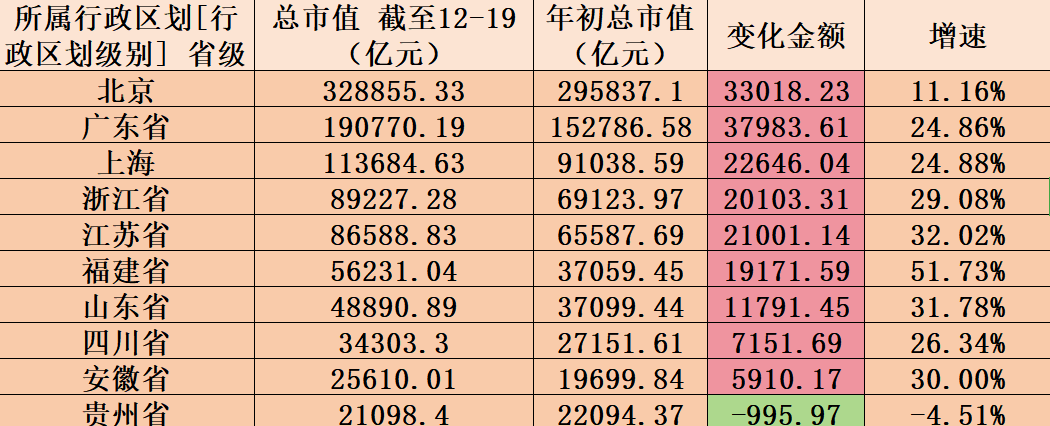
Group 1 - The core point of the article highlights the shift in market capitalization leadership in Sichuan Province from Wuliangye to the optical module leader, Xinyi Sheng, reflecting the explosive growth in the electronics industry [2][3] - The AI wave has significantly impacted the electronic and communication industries, leading to a surge in technology stocks across various sectors and driving profound changes in the market landscape [3][4] - The total market capitalization of A-shares has increased from 48.6 trillion yuan at the beginning of the year to 56.5 trillion yuan by year-end, marking a growth of nearly 8 trillion yuan [4] Group 2 - As of December 19, 2025, the total market capitalization of A-shares reached 120.31 trillion yuan, representing a year-to-date increase of 22.2% [5][6] - The top five provinces in terms of market capitalization are Beijing, Guangdong, Shanghai, Zhejiang, and Jiangsu, with a highly concentrated "pyramid" structure in market value distribution [5][6] - Fujian Province saw a remarkable market capitalization growth of 51.73%, driven by the strong performance of major companies like CATL and Zijin Mining, moving from seventh to sixth place in rankings [9] Group 3 - The Yangtze River Delta region leads with a total market capitalization of 31.51 trillion yuan, accounting for 26.2% of the A-share market, with significant contributions from semiconductor and AI hardware companies [10][11] - The market capitalization of Jiangsu and Zhejiang provinces grew by over 29%, showcasing their robust private economy and industrial upgrade momentum [11][12] - The total market capitalization of the Pearl River Delta reached 18.3 trillion yuan, benefiting from the development of electronics, automotive, and biomedicine industries [12] Group 4 - Major cities like Beijing, Shenzhen, and Shanghai continue to dominate A-share market capitalization, with Beijing's market value at 32.88 trillion yuan, supported by state-owned enterprises and tech companies [15] - Shenzhen's market capitalization increased by 23.1% to 12.23 trillion yuan, driven by key players in technology, finance, and new energy sectors [15] - The city of Suzhou experienced a significant market capitalization increase of 8839 billion yuan, with strong performances in advanced manufacturing sectors [16]





科创板半导体并购迈向“质变”新阶段 头部企业产业链整合不断加速
Zheng Quan Shi Bao Wang· 2025-12-22 01:03
Core Viewpoint - The semiconductor industry in China is experiencing a wave of mergers and acquisitions (M&A) driven by policy incentives and the need for industrial upgrades, with leading companies focusing on "supply chain enhancement and value synergy" [1] Group 1: M&A Trends and Strategies - Leading semiconductor companies on the Sci-Tech Innovation Board are engaging in M&A to consolidate resources and enhance competitiveness, reflecting a shift from "quantity accumulation" to "quality leap" in the industry [1][2] - The semiconductor sector has seen 125 companies on the Sci-Tech Innovation Board, accounting for over 60% of A-share counterparts, indicating a strong presence across various segments including design, manufacturing, and testing [2] - Major players like SMIC and Hua Hong Semiconductor are pursuing strategic acquisitions to enhance their market share and technological capabilities, such as SMIC's move to gain full control of its subsidiary [2][3] Group 2: Sector-Specific M&A Activities - In the equipment segment, companies are using M&A to overcome technical barriers and transition towards platform development, as seen with the acquisition of Zhongsil Technology by Zhongwei [3] - The design, IP, and EDA sectors are witnessing urgent M&A needs, with domestic firms focusing on acquiring scarce resources to compete against established foreign leaders [3] - Notable transactions include Jingfeng Mingyuan's acquisition of a leading wireless charging firm to strengthen its market position and capabilities [3] Group 3: Market Dynamics and Transaction Rationality - The recent termination of some semiconductor M&A deals is viewed as a natural outcome of a rational market rather than a cooling of industry consolidation [4] - Since the implementation of the "Eight Articles" policy, over 150 M&A transactions have been disclosed, with more than 70% successfully completed, indicating a robust M&A environment [4] - The semiconductor industry is characterized by complex shareholder structures and high valuations, leading to increased negotiation challenges and a higher likelihood of deal terminations [4][5] Group 4: Institutional Innovation and Future Outlook - The rational prosperity of the semiconductor M&A market is supported by institutional innovations that enhance transaction flexibility and inclusivity [6] - The adoption of innovative payment mechanisms, such as convertible bonds and differentiated pricing, has facilitated strategic investments while safeguarding long-term interests [6] - Future M&A activities are expected to focus on optimizing resource allocation and fostering technological integration, marking a shift from mere scale expansion to creating substantial value [6]