
Bloomage Biotech(688363)

Search documents
华熙生物: 北京市通商律师事务所关于华熙生物科技股份有限公司差异化分红事项之专项法律意见书
Zheng Quan Zhi Xing· 2025-07-07 11:19
Core Viewpoint - The legal opinion issued by Tongshang Law Firm confirms that Huaxi Biological Technology Co., Ltd.'s differentiated dividend distribution plan for 2024 complies with relevant laws and regulations, ensuring no harm to the interests of the company and its shareholders [3][6]. Group 1: Differentiated Dividend Distribution - The reason for the differentiated dividend distribution is due to the company's share repurchase plan, which will result in a discrepancy between the total share capital and the shares participating in profit distribution [3][4]. - Huaxi Biological plans to distribute a cash dividend of RMB 0.11 per share (tax included) based on the total share capital minus the shares held in the repurchase account, with no capital reserve conversion or bonus shares [4][5]. - As of the date of the legal opinion, the total share capital of Huaxi Biological is 481,678,242 shares, with 3,315,538 shares in the repurchase account, leading to a total of 478,362,704 shares eligible for the cash dividend distribution, amounting to a total of RMB 52,619,897.44 (tax included) [5]. Group 2: Calculation Basis for Dividend Distribution - The calculation for the ex-dividend reference price is based on the formula: (previous closing price - cash dividend) ÷ (1 + change in circulating shares ratio), with the circulating shares ratio being 0 since only cash dividends are distributed [5]. - The closing price of the stock on June 23, 2025, was RMB 50.67 per share, leading to an ex-dividend reference price of RMB 50.56 per share after accounting for the cash dividend [5][6]. - The impact of the differentiated dividend on the ex-dividend reference price is less than 1%, indicating a minimal effect [6]. Group 3: Legal Compliance and Conclusion - The legal opinion asserts that the differentiated dividend distribution does not violate the Company Law, Securities Law, or self-regulatory guidelines, and does not harm the interests of the company or its shareholders [6].

华熙生物: 华熙生物2024年年度权益分派实施公告
Zheng Quan Zhi Xing· 2025-07-07 11:12
Core Viewpoint - The company has announced a differentiated dividend distribution plan, with a cash dividend of RMB 0.11 per share (tax included) for the 2024 fiscal year, approved at the annual shareholders' meeting on June 11, 2025 [1][2]. Dividend Distribution Plan - The total share capital, excluding shares in the company's repurchase account, is 481,678,242 shares, with 3,315,538 shares in the repurchase account, resulting in 478,362,704 shares eligible for the dividend distribution [2]. - The cash dividend distribution will not involve capital reserve conversion to share capital or the issuance of bonus shares [1][2]. - The reference price for the ex-dividend (ex-rights) calculation is determined by the formula: (previous closing price - cash dividend) / (1 + change in circulating shares ratio) [2]. Tax Implications - For individual shareholders and securities investment funds, dividends are subject to different tax treatments based on the holding period. If held for over one year, dividends are exempt from individual income tax. For holdings of one year or less, tax will be calculated upon the sale of shares [3][4]. - Qualified Foreign Institutional Investors (QFIIs) will have a 10% corporate income tax withheld on dividends, resulting in a net cash dividend of RMB 0.099 per share [4]. - For Hong Kong investors holding shares through the "Shanghai-Hong Kong Stock Connect," a 10% withholding tax will also apply, leading to a net cash dividend of RMB 0.099 per share [4]. Implementation Details - Cash dividends will be distributed through the China Securities Depository and Clearing Corporation Limited Shanghai Branch, with specific arrangements for different types of shareholders [3][5]. - Shareholders who have not completed designated trading will have their dividends held by the clearing company until the trading is completed [3].
华熙生物(688363) - 北京市通商律师事务所关于华熙生物科技股份有限公司差异化分红事项之专项法律意见书
2025-07-07 11:01
中国北京建国门外大街 1 号国贸写字楼 2 座 12-15 层 100004 12-15th Floor, China World Office 2, No. 1 Jianguomenwai Avenue, Beijing 100004, China 电话 Tel: +86 10 6563 7181 传真 Fax: +86 10 6569 3838 电邮 Email: beijing@tongshang.com 网址 Web: www.tongshang.com 北京市通商律师事务所 关于华熙生物科技股份有限公司 差异化分红事项之专项法律意见书 的陈述应是完整、真实、准确和有效的,并无隐瞒、虚假或重大遗漏之处;签 署文件的主体均应具有签署文件的权利能力和行为能力,所提供文件中的所有 签字和印章均是真实的;文件材料为副本或复印件的,应与正本或原件是一致 和相符;一切足以影响本法律意见书的事实和文件均应向本所披露,而无任何 隐瞒、遗漏、虚假或误导之处;该等事实和文件于提供给本所之日至本法律意 见书出具之日,未发生任何变更; 3、对出具本法律意见书至关重要而又无法得到独立的证据支持的事实,本 所依赖政府有关部门、公 ...
华熙生物(688363) - 华熙生物2024年年度权益分派实施公告
2025-07-07 11:00
证券代码:688363 证券简称:华熙生物 公告编号:2025-025 华熙生物科技股份有限公司 2024年年度权益分派实施公告 本公司董事会及全体董事保证公告内容不存在任何虚假记载、误导性陈述或 者重大遗漏,并对其内容的真实性、准确性和完整性依法承担法律责任。 重要内容提示: | 股权登记日 | 除权(息)日 | 现金红利发放日 | | --- | --- | --- | | 2025/7/11 | 2025/7/14 | 2025/7/14 | 一、 通过分配方案的股东大会届次和日期 本次利润分配方案经公司2025 年 6 月 11 日的2024年年度股东大会审议通过。 二、 分配方案 1. 发放年度:2024年年度 2. 分派对象: 截至股权登记日下午上海证券交易所收市后,在中国证券登记结算有限责任 公司上海分公司(以下简称"中国结算上海分公司")登记在册的除华熙生物科技 股份有限公司回购专用证券账户外的本公司全体股东。 3. 差异化分红送转方案: (1) 差异化分红送转方案 根据公司 2024 年年度股东大会审议通过的《关于公司 2024 年度利润分配预 由于公司本次进行差异化分红送转,上述公式中现金 ...
2025年中国医疗美容细分市场分析:轻医美市场贡献过半
Qian Zhan Wang· 2025-07-07 04:14
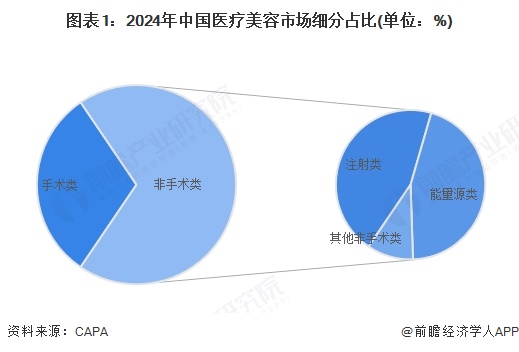
Core Insights - The light medical beauty market in China has surpassed half of the overall medical beauty market, becoming the mainstream beauty method by 2024, with significant contributions from non-invasive and minimally invasive procedures [1][2] Market Overview - Light medical beauty is defined as professional medical beauty projects that fall between surgical procedures and lifestyle beauty, utilizing non-invasive or minimally invasive methods for skin management, contour modification, and anti-aging effects [1] - The rapid growth of the light medical beauty market is attributed to its advantages such as minimal trauma, quick recovery, significant results, and relatively low risks, aligning with modern consumers' dual demands for beauty and quality of life [2] Consumer Trends - The penetration rate of the light medical beauty market is increasing, with 34% of consumers planning to engage in light medical beauty services in the coming year, marking a 36% increase from the previous year [4] - Among the interested consumer group, over one-third are new entrants, injecting fresh growth vitality into the Chinese medical beauty industry [4] Popular Products - Injectable and photothermal products are the main attractions for light medical beauty consumers, with ultrasound-based products (e.g., ultrasound scalpel) rapidly gaining popularity [5] Consumption Behavior - Consumers are increasingly rational in their light medical beauty choices, prioritizing needs-based combinations of projects and products, with over half selecting options based on specific needs [7] - The average planned consumption has increased to 2.4 projects per consumer, reflecting a 14% year-on-year growth [7] Consumer Demographics - The consumer base for light medical beauty exhibits high retention and strong growth, with seasoned consumers making up 35% of the existing market, indicating their essential role in the market [10] - Among the new consumer group, high-end novices represent 38%, characterized by high standards for beauty and a willingness to pay, with a focus on facial anti-aging solutions [10]




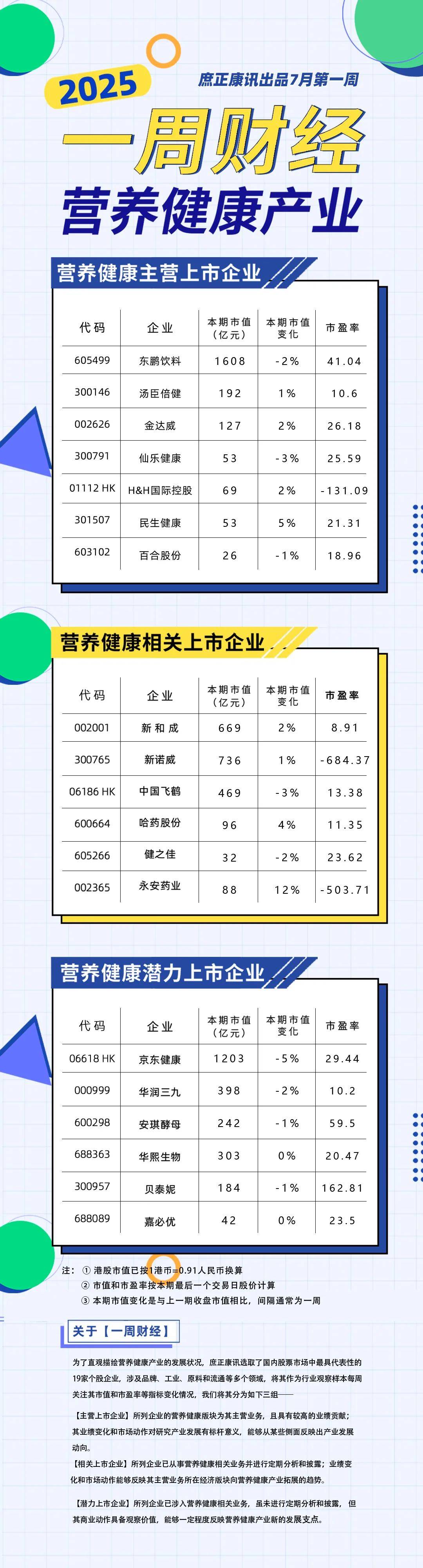
衡美健康北交所IPO受理 市场总局助推保健食品企业风险防控能力【一周财经】
Sou Hu Cai Jing· 2025-07-06 01:27
Core Insights - The article discusses recent developments in the nutrition and health industry, highlighting regulatory changes, new product approvals, and market trends that could impact investment opportunities [2][3][4][5][6]. Regulatory Developments - The State Administration for Market Regulation issued a guideline clarifying the definition of commercial advertising under the Advertising Law, addressing ongoing disputes in advertising enforcement [2]. - The National Health Commission approved D-alloheptulose and four other substances as new food raw materials, indicating a push for innovation in the nutrition sector [3]. - The market regulator released multiple responses to proposals regarding health food regulations, signaling a focus on traditional Chinese medicine formulations as a potential growth area [4]. Market Trends and Investment Opportunities - Yangtuo Technology Inc. submitted an IPO application to the Hong Kong Stock Exchange, aiming to raise funds for market expansion and supply chain optimization, reflecting growing investor interest in the nutrition and health sector [5]. - A report on 68 nutrition and health companies showed an average market value increase of 20% in the first half of the year, driven by rising consumer health awareness and demand for nutritional products [6]. Company Performance - New Hope Liuhe (002001) projected a net profit of 3.3 billion to 3.75 billion yuan for the first half of 2025, representing a year-on-year growth of 50% to 70% [12]. - Brother Technology (002562) expects a net profit of 60 million to 75 million yuan for the same period, marking an increase of 325% to 431% compared to the previous year [13]. New Product Launches - Guangji Pharmaceutical (000952) received a notice of administrative penalty for information disclosure violations, indicating regulatory scrutiny in the sector [14]. - TCM brand Tongrentang launched its first OTC glucosamine product, expanding its product line in the bone and joint health category [14].

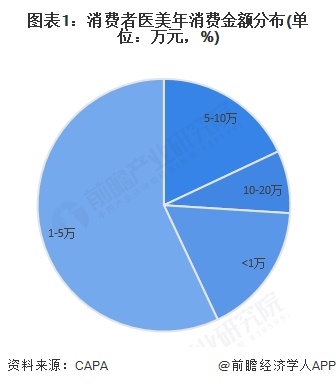
2025年中国医疗美容用户画像分析:男性医美需求激增,出境医美趋热
Qian Zhan Wang· 2025-07-03 08:54
Group 1 - The majority of consumers in the medical beauty market spend between 10,000 to 50,000 yuan annually, indicating a diverse range of services from basic skincare to moderately complex cosmetic procedures [1] - First-tier cities dominate the medical beauty consumption market, accounting for approximately 69% of total spending, driven by concentrated medical resources and advanced consumer capabilities [3] - The average age of consumers in the medical beauty sector is around 35 years, with over 72% of high-end consumers aged 30 and above, reflecting a mature and stable consumption mindset [5][7] Group 2 - There is a notable increase in male consumers seeking medical beauty services, with 43% planning to increase their spending in this area, highlighting a shift in self-image management among men [7][8] - The demand for outbound medical beauty services is rising, particularly in Japan and South Korea, with about 31% of middle to high-income consumers planning to seek these services abroad in 2024 [10]
蹲点调查|探寻透明质酸产业发展的“第二增长曲线”
Da Zhong Ri Bao· 2025-07-03 05:47
Group 1 - The Shandong provincial government has implemented a plan to boost consumption, focusing on six key tasks and 20 specific measures, including the enhancement of health consumption and the development of health-related industries such as health tourism and biomedicine [2] - The hyaluronic acid industry in Shandong, led by companies like Huaxi Bio and Furuida, has formed a trillion-level industrial cluster, responding to rapidly changing consumer aesthetics and demands [2][14] - Huaxi Bio has emphasized the importance of establishing scientific and unified testing standards for the industry, following a public dispute with competitor Juzhi Bio regarding product quality and testing methods [3][6] Group 2 - The competition between Huaxi Bio and Juzhi Bio has highlighted the challenges in the hyaluronic acid market, with Huaxi Bio accusing Juzhi Bio of misleading research that undermines the hyaluronic acid industry [6][8] - Despite the ongoing competition, the hyaluronic acid market is experiencing a decline in product prices, with some high-end products dropping to as low as 10% of their previous prices [9][10] - The three major players in the hyaluronic acid sector, including Huaxi Bio, have reported negative growth in revenue and net profit in recent quarters, contrasting with the strong performance of companies in the recombinant collagen sector [10][11] Group 3 - Huaxi Bio has maintained a leading position in the global hyaluronic acid market, holding a 44% share of global sales in 2021 and actively participating in the development of industry standards [16] - The company is undergoing a strategic upgrade, investing over 100 million yuan in innovative business areas such as regenerative medicine and nutritional science [16] - Furuida is also expanding into the recombinant collagen market, recognizing the need for transformation and innovation in response to industry pressures [19][20] Group 4 - Experts suggest that the hyaluronic acid industry has reached maturity and needs to explore a "second growth curve" to maintain competitiveness and sustainable development [21] - The relationship between hyaluronic acid and collagen is viewed as complementary rather than competitive, with both having unique advantages in various applications [20] - The industry is focusing on developing new business models and products that align with consumer health trends, including functional foods and personalized raw materials [19][20]

被华熙生物暗指“伪科学”!巨子生物回应:不作评价
Nan Fang Du Shi Bao· 2025-07-02 15:23
Core Viewpoint - Huaxi Biological asserts that claims exempt from scientific verification are inherently pseudoscientific, emphasizing the necessity of measurable and verifiable scientific methods in the industry [1][2]. Group 1: Huaxi Biological's Position - Huaxi Biological argues that the absence of standardized testing methods does not negate the existence of scientific methods for validation, using their product "Runbaiyan" as an example of verifiable testing results for recombinant collagen [2][5]. - The company highlights the use of High-Performance Liquid Chromatography-High-Resolution Mass Spectrometry (HPLC-HRMS) as a reliable method to accurately measure recombinant collagen content, claiming it effectively avoids complex matrix interference [5][12]. Group 2: Response from Juzhi Biological - Juzhi Biological acknowledged the limitations of their existing quality standards and testing methods in a statement, indicating a need for continuous optimization to meet industry advancements [6][9]. - The company plans to collaborate with research institutions to enhance the qualitative and quantitative detection methods for recombinant collagen in cosmetics, aiming for greater transparency and industry standardization [9][10]. Group 3: Testing Method Controversy - The debate over testing methods arose when beauty blogger Dazui Doctor (Hao Yu) questioned the recombinant collagen content in a product, using a high-precision HPLC amino acid quantification method, which Juzhi Biological claimed was not included in industry standards [10][11]. - Experts noted that both HPLC amino acid quantification and HPLC-HRMS methods have their unique applications and challenges, particularly in detecting low concentrations of collagen in complex cosmetic formulations [12][13].
2025中国轻医美行业现状报告
Jia Shi Zi Xun· 2025-07-02 13:58
Investment Rating - The report indicates a strong growth potential for the non-surgical medical aesthetic industry in China, with an expected compound annual growth rate (CAGR) of over 20% in the coming years, positioning it as one of the fastest-growing markets globally [9][10]. Core Insights - The Chinese non-surgical medical aesthetic market has surpassed 150 billion RMB in 2023 and is projected to exceed 250 billion RMB by 2025, driven by rising disposable income, changing beauty standards, and technological advancements [9][10]. - The market is characterized by a significant shift towards non-surgical procedures, with injectables like hyaluronic acid and botulinum toxin leading the growth, supported by technological innovations in materials and devices [9][10]. - The industry is undergoing a transformation towards compliance and regulation, with increased scrutiny from government bodies aimed at eliminating illegal practices and ensuring consumer safety [9][10]. Summary by Sections Chapter 1: Overview of the Non-Surgical Medical Aesthetic Industry - The non-surgical medical aesthetic industry is defined as a blend of medical and cosmetic services that utilize non-invasive or minimally invasive techniques for skin care and rejuvenation [12]. - The industry has evolved through three phases: exploration (pre-2015), rapid growth (2015-2021), and regulation and integration (2022-present) [19][21]. - The macro environment analysis indicates a tightening regulatory framework, rising disposable income, and shifting societal beauty standards as key drivers of industry growth [25][27]. Chapter 2: Market Size and Consumer Insights - The market size has grown from approximately 65 billion RMB in 2018 to over 150 billion RMB in 2023, with a CAGR exceeding 20% [30][31]. - Non-surgical procedures are increasingly favored due to their lower risk and quicker recovery times, leading to a growing market share for these services [34][35]. - Consumer demographics show a significant trend towards younger consumers, with those born in the 1990s and 2000s becoming the primary market [39]. Chapter 3: Industry Chain Analysis - The industry chain consists of three segments: upstream (product and equipment manufacturers), midstream (medical aesthetic service providers), and downstream (marketing and referral platforms) [45]. - Upstream manufacturers face high technical barriers and are experiencing a shift towards domestic brands replacing international ones, driven by innovation and cost advantages [46][47]. - Midstream service providers are characterized by intense competition and high customer acquisition costs, prompting a trend towards brand consolidation and chain operations [49]. Chapter 4: Competitive Landscape and Key Players - The competitive landscape shows a high concentration of international brands in the high-end market, while domestic brands are rapidly gaining market share through innovation and localized strategies [46][47]. - The report highlights key players such as Ai Meike and Huaxi Biological, which are leveraging technological advancements to challenge established foreign brands [47]. Chapter 5: Regulatory Policies and Compliance - The regulatory environment is becoming increasingly stringent, with multiple government agencies implementing measures to ensure compliance and consumer safety [24][25]. - The report outlines the impact of these regulations on market dynamics, emphasizing the need for companies to adapt to a more compliant operational framework [24][25]. Chapter 6: Industry Challenges, Opportunities, and Future Trends - The industry faces challenges such as price wars and a shortage of qualified professionals, but also opportunities in market penetration and technological innovation [8][10]. - Future trends indicate a shift towards personalized and diversified consumer demands, with an emphasis on natural results and preventive care [44].