
Breo(688793)

Search documents
软件开发行业上市公司财务总监PK:唯一双本科学历董秘为三六零张海龙,年薪高达474.33万元,远超其他学历
Xin Lang Cai Jing· 2025-08-08 06:51
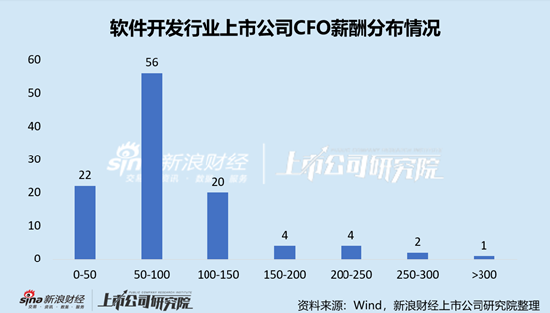
Core Insights - The report highlights that as of July 29, 2024, there are 5,817 listed companies in the A-share market, with 1,144 CFOs earning over 1 million yuan, accounting for over 21% of the total [1] CFO Compensation Overview - The total compensation for CFOs in the A-share market reached 4.243 billion yuan in 2024, with an average salary of 760,300 yuan [1] - In the software development sector, there are 109 CFOs, with an average salary of 883,800 yuan, ranking 53rd among 124 industries [1] - The average salary for software development CFOs increased by 38,200 yuan compared to the previous year, also ranking 53rd in terms of salary growth [1] Salary Distribution in Software Development - Among the 109 CFOs in the software development industry, 56 earn between 500,000 and 1 million yuan, making up over half of the total [2] - There are 31 CFOs with salaries exceeding 1 million yuan, representing nearly 30% of the total [2] - The highest-paid CFO is Zhang Hailong from 360, with a salary of 4.7433 million yuan, followed by Liu Erming from Huada Jiutian at 2.7218 million yuan [2] Age and Educational Background of CFOs - The age distribution of CFOs ranges from 35 to 60 years, with the majority (53 CFOs) aged between 42 and 50, accounting for nearly 60% [4] - The age group with the highest average salary is 35 years, with an average of 2.509 million yuan, driven by the high salary of Ye Jiajie from Hehe Information [4] - The oldest CFO is Cui Yinqiao from Jinchengzi, aged 65, while the youngest is Li Kui from Zhongwang Software, aged 31 [6] - Among the CFOs, 50 hold a bachelor's degree and 47 hold a master's degree, totaling 97 individuals, which is nearly 90% of the total [6] Relationship Between CFO Compensation and Company Performance - A negative correlation exists between CFO compensation and company performance in the software development sector [8] - Revenue growth rates corresponding to three salary segments (0-1.5 million yuan) are 43.56%, -2.74%, and -4.98%, indicating a decline as CFO salaries increase [8] - The corresponding net profit growth rates are -31.23%, -126.54%, and -314.36%, further demonstrating the negative correlation with CFO compensation [8]






倍轻松亮相樟宜机场COMPASS峰会 创新模式引领高端出行健康服务
Zheng Quan Shi Bao Wang· 2025-08-08 02:51
Core Insights - Changi Airport in Singapore was awarded the title of "World's Best Airport" in 2025, highlighting its exceptional service and experience [1] - Breo, a leading brand in high-end smart health technology from China, gained significant attention at the COMPASS summit for its innovative "product + service" model in the high-end travel health service sector [1] Group 1: Breo's Service Model - Breo's stores at Changi Airport serve as a "comfort oasis" for travelers, offering services like smart eye massages and neck massages to meet the core demands for relaxation and energy recovery during fragmented waiting times [1] - The company emphasizes a comprehensive solution built around "instant, professional, and holistic relaxation," showcasing that "product is service, and service deepens product" as a key strategy to address diverse and personalized needs [2] Group 2: Strategic Developments - Breo's model is supported by three pillars: smart hardware technology, professional service in high-value locations like airports, and comprehensive coverage of diverse consumer needs from single-item care to full-body relaxation solutions [2] - The collaboration between Breo and Changi Airport is set to deepen, with a new store opening in the Jewel complex on September 5, 2025, aimed at enhancing the partnership with a top global aviation hub and exploring more potential service models [2] - The new store will introduce an upgraded "instant relaxation full-body solution," designed to efficiently recharge travelers during their short stays [2]
小家电板块8月6日涨0.66%,ST德豪领涨,主力资金净流出7418.63万元
Zheng Xing Xing Ye Ri Bao· 2025-08-06 08:31
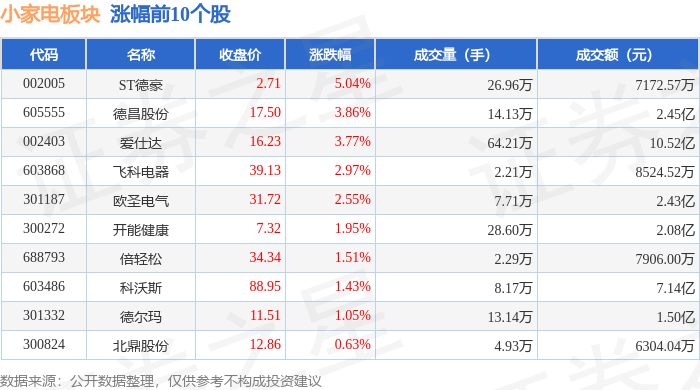
Market Overview - On August 6, the small home appliance sector rose by 0.66% compared to the previous trading day, with ST Dehao leading the gains [1] - The Shanghai Composite Index closed at 3633.99, up 0.45%, while the Shenzhen Component Index closed at 11177.78, up 0.64% [1] Stock Performance - ST Dehao (002005) closed at 2.71, with a gain of 5.04%, trading volume of 269,600 shares, and a transaction value of 71.73 million yuan [1] - Dechang Co. (605555) closed at 17.50, up 3.86%, with a trading volume of 141,300 shares and a transaction value of 245 million yuan [1] - Yanshida (002403) closed at 16.23, up 3.77%, with a trading volume of 642,100 shares and a transaction value of 1.052 billion yuan [1] - Other notable stocks include Feike Electric (603868) at 39.13 (+2.97%) and Ousheng Electric (301187) at 31.72 (+2.55%) [1] Capital Flow - The small home appliance sector experienced a net outflow of 74.19 million yuan from institutional investors, while retail investors saw a net inflow of 164 million yuan [2] - The overall capital flow indicates a mixed sentiment, with institutional investors withdrawing funds while retail investors increased their positions [2] Individual Stock Capital Flow - Dechang Co. (605555) had a net inflow of 31.29 million yuan from institutional investors, but a net outflow of 24.54 million yuan from speculative funds [3] - Ousheng Electric (301187) saw a net inflow of 19.85 million yuan from institutional investors, while retail investors had a net outflow of 20.49 million yuan [3] - ST Dehao (002005) had a net inflow of 8.79 million yuan from institutional investors, but also saw outflows from both speculative and retail investors [3]


倍轻松再爆实控人马学军占用上市公司资金
Xin Lang Cai Jing· 2025-08-04 09:42
Core Viewpoint - The actual controller of Beiliang Company, Ma Xuejun, has been found to have occupied company funds through various means, raising concerns about financial transparency and governance [1][4][5]. Group 1: Fund Occupation Details - From October 2021 to the end of 2022, Ma Xuejun occupied a total of 408,230 yuan through employee loans [1]. - Additionally, the company made advance payments totaling 8 million yuan to a supplier, which were later identified as funds occupied by Ma Xuejun [3]. - The occupied funds have been returned, but the interest accrued remains a concern for regulatory compliance [4]. Group 2: Regulatory Implications - The occupation of funds by the major shareholder may lead to regulatory penalties, as it constitutes a violation of information disclosure obligations [4][5]. - Legal experts indicate that the actions could potentially violate securities laws and may result in criminal charges if certain conditions are met [5][6]. Group 3: Company Financial Performance - Beiliang Company has reported continuous losses over the past three years, with revenues of 895 million yuan, 1.275 billion yuan, and 1.085 billion yuan from 2022 to 2024, respectively [7]. - The net profit figures for the same period were -124 million yuan, -50.24 million yuan, and 1.019 million yuan, indicating a lack of significant recovery [7]. - High sales expenses have been a persistent issue, with sales expenses reaching 482 million yuan, 680 million yuan, and 544 million yuan, leading to high sales expense ratios [9]. Group 4: Market Position and Strategy - The company primarily relies on direct sales and has established a significant presence in physical retail locations, which incurs high fixed costs [11]. - The product category is characterized as non-essential, leading to reliance on promotional activities to drive sales, which further increases marketing costs [11]. - There is potential for improvement in sales efficiency and cost management, but the company is currently in an expansion phase that necessitates high marketing expenditures [11].

倍轻松(688793) - 2025年第三次临时股东会会议资料
2025-08-04 08:15
深圳市倍轻松科技股份有限公司 2025 年第三次临时股东会会议资料 深圳市倍轻松科技股份有限公司 2025 年第三次临时股东会 会议资料 二零二五年八月 1 深圳市倍轻松科技股份有限公司 2025 年第三次临时股东会会议资料 证券代码:688793 证券简称:倍轻松 深圳市倍轻松科技股份有限公司 2025 年第三次临时股东会会议资料目录 一、2025 年第三次临时股东会会议须知 二、2025 年第三次临时股东会会议议程 三、2025 年第三次临时股东会会议议案 2 议案一:《关于取消监事会、修订<公司章程>并办理工商变更登记的议案》 议案二:《关于制定、修订、废止公司部分治理制度的议案》 议案三:《关于为公司及董监高购买责任险的议案》 深圳市倍轻松科技股份有限公司 2025 年第三次临时股东会会议资料 深圳市倍轻松科技股份有限公司 2025 年第三次临时股东会会议须知 一、公司负责本次股东会的议程安排和会务工作,出席会议人员应当听从公司工作人 员安排,共同维护好会议秩序。 二、为保证股东会的正常秩序,除出席会议的股东或者股东代理人、董事、监事、董 事会秘书、其他高级管理人员、见证律师、本次会议议程有关人员及会 ...
倍轻松:7月31日召开董事会会议
Mei Ri Jing Ji Xin Wen· 2025-08-04 05:11
Group 1 - The company Beisen (SH 688793) announced on August 1 that its sixth board meeting was held on July 31, 2025, in Shenzhen, discussing the adjustment of the organizational structure [2] - For the year 2024, Beisen's revenue composition shows that health smart hardware accounts for 99.79% of total revenue, while other businesses contribute only 0.21% [2]
从“智能硬件”到“泛健康生态”:倍轻松加码智能实感交互技术
Zheng Quan Ri Bao Wang· 2025-08-04 04:45
Core Viewpoint - Shenzhen Beiliang Technology Co., Ltd. (referred to as "Beiliang") announced the use of surplus fundraising for the "Information Technology Upgrade Project" to build and research a sensor matrix for immersive interactive intelligence, positioning itself in a key technological trend of multimodal sensor fusion in the next generation of artificial intelligence [1][2]. Group 1: Project Objectives - The project focuses on three core objectives: 1. Building a multimodal sensor matrix that includes pressure, temperature, motion, and bioelectric sensors for precise data collection across multiple dimensions [2]. 2. Developing algorithms for immersive interactive intelligence to achieve environmental perception, user behavior prediction, and personalized health services [2]. 3. Integrating the multimodal sensor matrix with the developed algorithms into next-generation smart health products [2]. Group 2: Company Strategy and Market Position - Beiliang has evolved from a single massage device manufacturer to a comprehensive health technology service provider, integrating "smart hardware + rapid massage services + health AI + pan-health ecosystem" over two decades [2]. - The company aims to address the industry's shift from single-function products to intelligent and personalized solutions by leveraging "immersive interactive intelligence" as a breakthrough point, reinforcing its technological advantages and market position [2].
从“智能硬件”到“泛健康生态”:倍轻松加码智能实感交互技术,开启健康科技新赛道
Zheng Quan Shi Bao Wang· 2025-08-04 04:12
Core Viewpoint - The company, Beiliang, is leveraging surplus fundraising for an "Information Technology Upgrade Project" to develop a sensor matrix focused on immersive interactive intelligence, positioning itself strategically in the smart health hardware sector and laying the groundwork for future health AI and broader health ecosystem services [2]. Group 1: Project Objectives - The project aims to achieve three core objectives: 1. Building a multi-modal sensor matrix that includes pressure, temperature, motion, and bioelectric sensors for precise data collection and interaction, enabling devices to perceive the environment and respond like humans [3]. 2. Developing algorithms for immersive interactive intelligence to facilitate environmental perception, user behavior prediction, and personalized health services [3]. 3. Integrating the sensor matrix with the developed algorithms into next-generation smart health products to enhance interactivity and intelligence, thereby creating new market advantages for the company [3]. Group 2: Company Evolution - As a pioneer in the portable massager industry and a leader in health technology, the company has evolved from a single massager manufacturer to a comprehensive health technology service provider, integrating smart hardware, effective massage services, health AI, and a broad health ecosystem over two decades [4]. - The company is responding to the industry's shift from single-function products to intelligent and personalized solutions by focusing on "immersive interactive intelligence" as a breakthrough, reinforcing its technological advantages and market position [4].
从"智能硬件"到"泛健康生态":倍轻松加码智能实感交互技术,开启健康科技新赛道
Zheng Quan Shi Bao Wang· 2025-08-04 03:56
Core Viewpoint - The company, Beiliang, is leveraging surplus fundraising for an "Information Technology Upgrade Project" to develop a sensor matrix focused on immersive interactive intelligence, positioning itself strategically in the smart health hardware sector and laying the groundwork for future health AI and broader health ecosystem services [1]. Group 1: Project Objectives - The project aims to achieve three core objectives: 1. Establish a multi-modal sensor matrix that includes pressure, temperature, motion, and bioelectric sensors for precise data collection and interaction, enabling devices to perceive the environment and respond like humans [2]. 2. Develop algorithms for immersive interactive intelligence to facilitate environmental perception, user behavior prediction, and personalized health services [2]. 3. Integrate the sensor matrix with the developed algorithms into next-generation smart health products to enhance interactivity and intelligence, thereby creating new market advantages for the company [2]. Group 2: Company Evolution - As a pioneer in the portable massager industry and a leader in health technology, the company has evolved from a single massager manufacturer to a comprehensive health technology service provider over twenty years, integrating smart hardware, effective massage services, health AI, and a broad health ecosystem [3]. - The company is responding to the industry's shift from single-function products to intelligent and personalized solutions by focusing on "immersive interactive intelligence" as a breakthrough, reinforcing its technological advantages and market position [3].
深圳市倍轻松科技股份有限公司 第六届董事会第十五次会议决议公告
Zhong Guo Zheng Quan Bao - Zhong Zheng Wang· 2025-08-01 23:13
Group 1 - The company held its 15th meeting of the 6th Board of Directors on July 31, 2025, with all 7 directors present, confirming the legality and validity of the meeting [2][3] - The Board unanimously approved the proposal to cancel the supervisory board and amend the company's articles of association, which will require shareholder approval [3][4] - The Board also approved the proposal to formulate, revise, and abolish certain governance systems, which will also need to be submitted to the shareholders for approval [5][6] Group 2 - The company will no longer have a supervisory board, with its functions transferred to the audit committee of the Board, in compliance with relevant laws and regulations [13] - Amendments to the articles of association will be made to align with the latest legal requirements and the company's operational needs, pending shareholder approval [14] - The company plans to synchronize the revision and abolition of certain governance systems with the amendments to the articles of association, with some requiring shareholder approval to take effect [15]