
PAB(000001)

Search documents
银行零售信贷“缩表”,调整期持续?
券商中国· 2025-10-08 08:10
Core Viewpoint - Recent adjustments by some joint-stock banks to reduce credit card overdraft rates to "0" aim to increase volume by lowering costs [1] Group 1: Credit Card Loan Trends - Credit card loan balances are a key indicator of retail banking customer activity, with recent adjustments reflecting banks' efforts to compete for existing customers during a retail "cold season" [2] - Many listed banks have seen a further expansion of negative growth in credit card loan balances this year, alongside a decline in other retail loan categories such as consumer loans and mortgages [2][4] - Major state-owned banks like Bank of China and Postal Savings Bank reported declines in credit card loan balances of 13.88% and 5.67% respectively, while some joint-stock banks also experienced negative growth [3] Group 2: Overall Retail Lending Environment - The retail lending sector is undergoing an "adjustment period," with 17 out of 42 listed banks reporting a contraction in personal loan balances as of mid-2023 [4] - The contraction in personal housing mortgage loans has been a significant factor, with a reported negative growth of 1.6% in personal housing loan balances at the end of 2023, marking the first decline since 1997 [5][6] Group 3: Retail Loan Risk Assessment - Retail loan risks are on the rise, with the non-performing loan (NPL) ratio for retail loans increasing to 1.23% as of mid-2023, compared to a decrease in corporate loan NPL ratios [9] - Specific segments such as mortgage loans, consumer loans, and credit cards have seen their NPL ratios rise, indicating a challenging environment for retail lending [9][10] - The overall retail loan risk trend remains upward, with banks acknowledging the need for improved risk management practices in response to these challenges [10]






房地产不良见顶回落,零售风险接棒,银行如何迎接下一场大考?
Jing Ji Guan Cha Wang· 2025-10-06 10:15
Core Insights - The Chinese banking industry is at a crossroads of new and old risks, with a focus on the evolving asset quality and the impact of retail loan defaults [1][6] - The report from Guosen Securities highlights a 15-year trend of bad debt clearance across various sectors, with a notable shift from corporate loans to retail loans in recent years [1][2] Group 1: Historical Context and Risk Management - The report identifies 2011 as the starting point of the current asset quality cycle, marked by a liquidity crisis in Wenzhou and a peak non-performing loan (NPL) rate of 4.41% [2] - Systemic pressure primarily arose from the manufacturing and wholesale retail sectors, with NPL rates peaking at 7.79% in 2016 and 6.12% in 2018, respectively [2] - Banks proactively reduced their exposure to these sectors and shifted credit resources towards personal loans, particularly housing loans, effectively mitigating corporate asset quality deterioration [2] Group 2: Real Estate Sector Analysis - The real estate sector has become the new focal point for asset quality issues, with corporate loan NPL rates rising from below 1.4% to a peak of 4.42% in 2023, before showing signs of decline [3] - The report suggests that the peak of NPL generation in the real estate sector has passed, largely due to banks' preemptive risk management strategies [3] - Despite the high NPL rates, the overall impact on banks' asset quality is considered manageable due to the relatively low proportion of real estate loans in the total loan portfolio [3] Group 3: Retail Loan Risks - As corporate loan risks recede, retail loan defaults are becoming a central concern, with rising NPL rates across personal housing, consumption, credit card, and business loans [4][5] - The NPL rate for personal housing loans has been increasing since 2021, influenced by adjustments in the real estate market, with no clear signs of stabilization [5] - The rapid rise in NPL rates for personal business loans and a slight rebound in consumption loans are attributed to previous aggressive lending practices and rising household leverage [5] Group 4: Future Outlook and Industry Stability - The report indicates that 2023 marks the end of the current performance downturn cycle, with expectations for improvement in the industry’s fundamentals in 2024 [5] - The 15-year history of risk management in the Chinese banking sector demonstrates a mechanism for maintaining financial stability through phased bad debt exposure and dynamic credit structure adjustments [6] - However, the sustainability of this risk management model is questioned, particularly as banks face rising retail loan risks and the limitations of excess provisions [6]

2025年前三季度ABS承销排行榜
Wind万得· 2025-10-01 03:18
Core Insights - The ABS market in China saw a total of 1,777 new issuance projects in the first three quarters of 2025, with an issuance scale of 16,336 billion yuan, representing a 17% increase from 14,007 billion yuan in the previous year [6][2]. Market Overview - As of the end of the first three quarters of 2025, the cumulative market size reached approximately 33,810 billion yuan, with credit ABS at 4,017 billion yuan, enterprise ABS at 21,405 billion yuan, ABN at 6,348 billion yuan, and public REITs at 2,040 billion yuan [4]. Credit ABS - In the credit ABS segment, 172 new projects were issued, totaling 1,866 billion yuan, a 2% decrease year-on-year. The largest issuance came from non-performing loans, with 134 projects totaling 634 billion yuan, followed by personal auto loans with 17 projects totaling 536 billion yuan [8][6]. Enterprise ABS - The enterprise ABS market saw 1,127 new projects issued, totaling 9,951 billion yuan, which is a 22% increase compared to the previous year. The largest issuance was in financing lease receivables, with 214 projects totaling 2,163 billion yuan, followed by corporate receivables with 160 projects totaling 1,497 billion yuan [10][6]. ABN - The ABN market had 460 new projects issued, totaling 4,157 billion yuan, marking an 18% increase year-on-year. The largest issuances were in bank/internet consumer loans, with 159 projects totaling 1,415 billion yuan, followed by general small loan receivables with 114 projects totaling 1,038 billion yuan [11][6]. Underwriting Rankings - In the underwriting rankings for the first three quarters of 2025, CITIC Securities led with 390 projects and a total underwriting amount of 1,851 billion yuan, followed by Guotai Junan with 328 projects totaling 1,449.9 billion yuan, and Ping An Securities with 208 projects totaling 1,231.2 billion yuan [15][14]. Detailed Underwriting Performance - In the credit ABS market, China Merchants Securities ranked first with 86 projects totaling 314.4 billion yuan, followed by CITIC Securities with 81 projects totaling 295.2 billion yuan [21][23]. - In the enterprise ABS market, CITIC Securities topped the rankings with 222 projects totaling 1,239.8 billion yuan, followed by Ping An Securities with 182 projects totaling 1,177.4 billion yuan [25][26]. ABN Market Rankings - In the ABN market, China Merchants Securities led with 80 projects totaling 413 billion yuan, followed by Bank of China with 90 projects totaling 356.1 billion yuan [29][30]. Asset Class Rankings - The top three asset classes by issuance scale are bank/internet consumer loans, financing leases, and general small loans, with detailed underwriting statistics available for these categories [33].





平安银行:2025年半年度分红每10股派2.36元(含税)
Zheng Quan Ri Bao· 2025-09-30 12:16
Group 1 - The company announced a cash dividend distribution of RMB 2.36 per 10 shares, totaling RMB 4.58 billion, based on a total share capital of 19,405,918,198 shares as of June 30, 2025 [2] - The record date for the dividend distribution is set for October 14, 2025, and the ex-dividend date is October 15, 2025 [2] - The company will not issue bonus shares or convert reserves into share capital during this distribution [2]
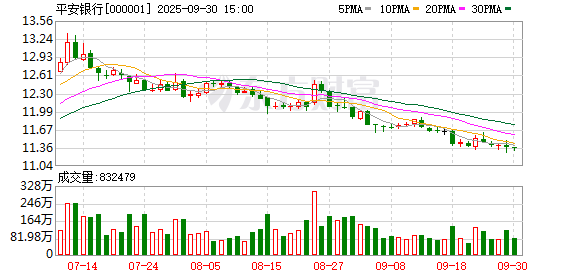
平安银行:截至2025年6月末,本行普通股股东总户数为443583户
Zheng Quan Ri Bao· 2025-09-30 12:16
Core Insights - Ping An Bank reported that as of June 30, 2025, the total number of ordinary shareholders is expected to reach 443,583 [2] Company Summary - Ping An Bank is actively engaging with investors through its interactive platform, indicating a focus on transparency and communication [2] - The projected growth in the number of shareholders suggests a potential increase in investor interest and confidence in the bank's future performance [2]
平安银行:上半年不良贷款生成率1.64%
Zheng Quan Ri Bao· 2025-09-30 12:16
Core Viewpoint - Ping An Bank is actively enhancing its risk management policies and asset quality, demonstrating a stable overall performance in its financial health [2] Group 1: Risk Management - The bank is strengthening its forward-looking risk policy assessments and agile adjustments to manage risks effectively [2] - There is a focus on early warning and resolution of risks associated with existing assets [2] Group 2: Asset Quality - As of June 30, 2025, the non-performing loan (NPL) ratio is 1.05%, a decrease of 0.01 percentage points from the end of the previous year [2] - The NPL generation rate for the first half of the year is 1.64%, down by 0.05 percentage points year-on-year [2] - The provision coverage ratio stands at 238.48%, indicating strong risk compensation capabilities [2] Group 3: Retail Loan Structure - The bank is continuously optimizing the structure of its retail loan assets, leading to a corresponding reduction in impairment provisions [2]
平安银行:2025年上半年,本行净息差1.80%,较去年同期下降16个基点
Zheng Quan Ri Bao Wang· 2025-09-30 12:11
Core Viewpoint - Ping An Bank reported a net interest margin of 1.80% for the first half of 2025, a decrease of 16 basis points compared to the same period last year, primarily due to declining market interest rates and adjustments in loan business structure [1] Group 1: Financial Performance - The bank's net interest margin is expected to face continued downward pressure, although the rate of decline is anticipated to slow down [1] - The bank aims to enhance asset-liability management and implement refined pricing strategies to mitigate the impact of declining net interest margins [1] Group 2: Asset Management Strategy - On the asset side, the bank will focus on optimizing asset allocation and encouraging high-quality credit investments [1] - The bank plans to strengthen market analysis and dynamically adjust interbank asset allocations to improve fund utilization efficiency [1] Group 3: Liability Management Strategy - On the liability side, the bank will concentrate on attracting low-cost deposits while managing high-cost deposits to control and reduce overall funding costs [1]
平安银行:截至2025年6月末,本行零售客户数12668.01万户,较上年末增长0.9%
Zheng Quan Ri Bao Wang· 2025-09-30 12:11
Core Viewpoint - Ping An Bank has reported growth in both retail and corporate customer numbers and loan balances as of June 30, 2025, indicating a stable expansion in its lending business [1] Retail Banking - As of June 30, 2025, the number of retail customers reached 126.68 million, representing a year-on-year growth of 0.9% [1] - The personal loan balance stood at 1,725.98 billion yuan [1] Corporate Banking - The number of corporate clients reached 909,100, showing a year-on-year increase of 6.5% [1] - The corporate loan balance was reported at 1,682.52 billion yuan, reflecting a growth of 4.7% compared to the previous year [1]
监管披露多张罚单!五家银行合计被罚超4600万元
Bei Jing Shang Bao· 2025-09-30 11:23
Group 1 - The National Financial Regulatory Administration and its Beijing branch announced administrative penalties totaling 46.4267 million yuan for five banks [1] - Postal Savings Bank and Citic Baixin Bank were fined a combined total of 39.1167 million yuan, with Postal Savings Bank facing penalties of 27.9167 million yuan for various management violations [1] - Citic Baixin Bank was fined 11.2 million yuan for issues related to internet loan management and non-compliance in regulatory data reporting [1] Group 2 - Beijing Bank was fined 5.3 million yuan for multiple violations, including inaccurate loan risk classification and inadequate impairment provisions for financial investments [2] - Ping An Bank's Beijing branch was fined 2 million yuan for using improper means to attract deposits, with a related individual banned for life from the banking industry [2] - Industrial and Commercial Bank of China’s Beijing Mudanyuan branch received a warning and a fine of 10,000 yuan for damaging its financial license [2]


探索产业金融服务新模式,平安银行上海分行协办“AI赋能低空经济”论坛
Guan Cha Zhe Wang· 2025-09-30 11:17
Core Insights - The forum held on September 23 focused on the integration of AI and the low-altitude economy, highlighting the evolving role of financial institutions in supporting technology-driven industries [1][3] Group 1: Financial Institution's Role - Ping An Bank showcased its tailored financial service system for technology innovation enterprises, covering a range of products from credit loans for startups to cross-border mergers and acquisitions for mature companies [1][3] - The bank's participation signifies a shift from traditional credit providers to active participants in the industrial ecosystem, addressing the financing needs of technology and capital-intensive industries [1][3][4] Group 2: Industry Characteristics and Financial Strategies - Financial institutions need to adjust their service approach to meet the unique characteristics of the low-altitude economy, which is driven by technology and primarily relies on intellectual property and R&D equipment [2][3] - Ping An Bank's strategy includes a comprehensive financial support system throughout the enterprise lifecycle, emphasizing a "pragmatic" attitude, "long-termism," and "open innovation" to adapt to industry needs [2][3] Group 3: Industry Trends and Applications - The low-altitude economy is recognized as a strategic emerging industry, with commercial applications in logistics, inspection, and urban management already in pilot projects, although large-scale implementation faces challenges [3][4] - The integration of AI technology is expected to significantly enhance the intelligence and operational efficiency of low-altitude vehicles, with ongoing improvements in regulatory frameworks and infrastructure investment [2][3] Group 4: Collaborative Ecosystem Development - Ping An Bank aims to strengthen collaboration with government, associations, and research institutions to build an "industry + finance + technology" ecosystem, aligning with national policies supporting the low-altitude economy and AI [3][4] - The evolving role of financial institutions is shifting from passive policy responders to proactive participants in the industrial chain, which may accelerate the maturity of the low-altitude economy [3][4]