GRANDJOY(000031)

Search documents
大悦城跌2.05%,成交额1357.47万元,主力资金净流出134.05万元
Xin Lang Zheng Quan· 2025-11-18 01:50
11月18日,大悦城盘中下跌2.05%,截至09:39,报3.34元/股,成交1357.47万元,换手率0.09%,总市值 143.16亿元。 资金流向方面,主力资金净流出134.05万元,特大单买入109.91万元,占比8.10%,卖出0.00元,占比 0.00%;大单买入30.17万元,占比2.22%,卖出274.13万元,占比20.19%。 责任编辑:小浪快报 大悦城所属申万行业为:房地产-房地产开发-商业地产。所属概念板块包括:首发经济、中粮集团、新 型城镇化、低价、证金汇金等。 截至9月30日,大悦城股东户数8.97万,较上期减少7.16%;人均流通股47810股,较上期增加15.33%。 2025年1月-9月,大悦城实现营业收入206.48亿元,同比增长0.83%;归母净利润-5.33亿元,同比增长 9.17%。 分红方面,大悦城A股上市后累计派现20.54亿元。近三年,累计派现0.00元。 机构持仓方面,截止2025年9月30日,大悦城十大流通股东中,香港中央结算有限公司位居第五大流通 股东,持股5319.14万股,相比上期增加2859.41万股。工银价值精选混合A(019085)位居第六大流通 ...
地产央企大悦城即将正式退市
Di Yi Cai Jing Zi Xun· 2025-11-17 16:19
Core Viewpoint - Dalian City Real Estate is set to privatize, ending its listing journey that began in 2013, with the delisting expected on November 27, 2023 [2] Company Overview - Dalian City Real Estate, a commercial real estate platform under COFCO Group, manages 32 projects across five major city clusters in China, including first-tier city investment properties and luxury hotels [2] - The company is a consolidated subsidiary of Dalian City Holdings, which is listed on the A-share market [2] Privatization Details - The privatization resolution was approved by shareholders during a court meeting on November 17, 2023 [2] - The total cost for the share buyback is approximately HKD 29.32 billion [2] Shareholding Structure - Before the agreement, COFCO Group held 64.18% of shares, while after the privatization, its stake will increase to 96.13% [3] - This change indicates that Dalian City Holdings will have almost complete control over Dalian City Real Estate post-privatization [3] Financial Performance - Dalian City Holdings has reported continuous losses over the past three years, with losses of CNY 2.882 billion in 2022, CNY 1.465 billion in 2023, and an estimated CNY 2.977 billion in 2024, totaling over CNY 7 billion [4] - The company anticipates turning a profit by the first half of 2025, aided by the privatization [4] Industry Trends - The trend of privatization among real estate companies has been increasing, with several firms, including China Hongtai Development and Huafa Property, announcing similar moves [4][5] - Key reasons for privatization include insufficient stock liquidity, loss of financing capabilities, and the need for strategic flexibility amid a challenging market environment [5] - The real estate industry is undergoing significant adjustments, with expectations of continued consolidation and restructuring in the next 2-3 years [5]

地产央企大悦城即将正式退市
第一财经· 2025-11-17 16:08
Core Viewpoint - Daxiyucheng Real Estate is set to privatize, ending its public listing after being established in 2013 and planning to delist by November 27, 2025, following shareholder approval at a court meeting [3][4]. Group 1: Company Overview - Daxiyucheng Real Estate, a commercial real estate platform under COFCO Group, manages 32 projects across five major city clusters in China, including luxury hotels and investment properties in first-tier cities [4]. - The company is a subsidiary of Daxiyucheng Holdings, which is listed on the A-share market, representing a less common "A-share controlled red chip" structure in the industry [4]. Group 2: Privatization Details - The total cost for the share buyback and delisting is approximately HKD 29.32 billion, driven by low stock liquidity, limited financing capabilities, and increased governance complexity [5]. - Post-privatization, Daxiyucheng Holdings' ownership in Daxiyucheng Real Estate will increase from 64.18% to 96.13%, significantly enhancing its control and potential profit margins [5]. Group 3: Financial Performance - Daxiyucheng Holdings has reported continuous losses over the past three years, with losses of CNY 2.882 billion in 2022, CNY 1.465 billion in 2023, and an estimated CNY 2.977 billion in 2024, totaling over CNY 7 billion [5]. - The company anticipates a turnaround to profitability by the first half of 2025, aided by the privatization plan which is expected to bolster its financial performance [5]. Group 4: Industry Trends - The trend of privatization among real estate companies has been increasing, with several firms like China Hongtai Development and Huafa Property also opting for delisting due to market pressures and operational challenges [6][7]. - Key reasons for this trend include insufficient stock liquidity, loss of financing capabilities, and the need for strategic flexibility amid a challenging real estate market environment [7].
12年上市路终结 地产央企大悦城即将正式退市
Di Yi Cai Jing· 2025-11-17 14:09
Core Viewpoint - Dalian City Real Estate is set to privatize after being listed since 2013, with the decision approved by shareholders during a court meeting on November 17, 2023 [2][3]. Group 1: Company Overview - Dalian City Real Estate, a commercial real estate platform under COFCO Group, has established a presence in five major city clusters across China, managing 32 commercial projects and luxury hotels [3]. - The company plans to delist from the Hong Kong Stock Exchange on November 27, 2023, following a share buyback agreement valued at approximately HKD 29.32 billion [3]. Group 2: Financial Performance - Dalian City Real Estate has faced significant losses over the past three years, with reported losses of CNY 2.882 billion in 2022, CNY 1.465 billion in 2023, and an estimated CNY 2.977 billion in 2024, totaling over CNY 7 billion [4]. - The company aims to achieve profitability by the first half of 2025, with the privatization expected to enhance its equity and improve net profit margins [4]. Group 3: Industry Context - The trend of privatization among real estate companies has been increasing, with several firms, including China Hongtai Development and Huafa Property, announcing similar plans in recent years [4][6]. - Key reasons for this trend include insufficient stock liquidity, loss of financing capabilities, and the need for strategic flexibility amid a challenging market environment [5][6].
12年上市路终结,地产央企大悦城即将正式退市
Di Yi Cai Jing· 2025-11-17 14:04
Core Viewpoint - The trend of real estate companies delisting is expected to continue over the next 2-3 years, with Dalian City Real Estate's privatization plan set to conclude its public listing journey by 2025 [1][4]. Company Summary - Dalian City Real Estate (00207.HK) announced that shareholders approved the privatization resolution during a court meeting on November 17, 2023 [1]. - The company's listing status on the Hong Kong Stock Exchange is expected to be officially revoked on November 27, 2023 [2]. - Dalian City Real Estate is a commercial real estate platform under COFCO Group, managing 32 projects across five major city clusters in China, including luxury hotels and investment properties [2]. - The total cost for the share repurchase plan is approximately HKD 29.32 billion [2]. - Prior to the agreement, COFCO Group held 64.18% of the shares, which will increase to 96.13% post-privatization [2]. Financial Performance - Dalian City Real Estate has reported continuous losses over the past three years, with losses of CNY 2.882 billion in 2022, CNY 1.465 billion in 2023, and an estimated CNY 2.977 billion in 2024, totaling over CNY 7 billion [3]. - Dalian City Holdings is expected to turn profitable by mid-2025, benefiting from the increased equity in Dalian City Real Estate post-privatization [3]. Industry Trends - The increase in privatization and delisting among real estate companies is attributed to several factors: insufficient stock liquidity, loss of financing capabilities, and ongoing losses and debt crises [4]. - Privatization allows companies to implement long-term strategies and enhance operational flexibility while reducing regulatory costs [4]. - The real estate industry is undergoing significant adjustments, with declining sales and a complex market environment, indicating that the trend of privatization will likely persist [4].
大悦城地产:上市地位预期将于11月27日下午四时正起撤销
Zhi Tong Cai Jing· 2025-11-17 11:34
Core Viewpoint - The company Doyou City (000031) has received shareholder approval for a resolution regarding a court meeting scheduled for November 17, 2025, which will impact its listing status on the stock exchange [1] Group 1 - The court meeting will take place on November 17, 2025, where shareholders can attend in person or appoint representatives to vote [1] - Following the approval of the plan, the company's shares are expected to be delisted from the stock exchange on November 27, 2025, at 4 PM [1]
大悦城地产(00207):上市地位预期将于11月27日下午四时正起撤销

智通财经网· 2025-11-17 11:32
Core Viewpoint - The company Doyou City Real Estate (00207) has received shareholder approval for a resolution regarding a court meeting scheduled for November 17, 2025, which will impact its listing status on the Hong Kong Stock Exchange [1] Group 1 - The court meeting will take place on November 17, 2025, where shareholders can attend in person or appoint representatives to vote [1] - Following the approval of the plan, the company's shares are expected to be delisted from the Hong Kong Stock Exchange on November 27, 2025, at 4:00 PM [1]
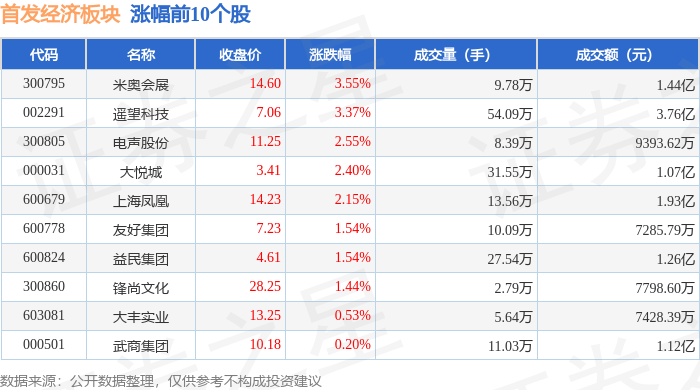
首发经济板块11月17日跌0.04%,*ST亚振领跌,主力资金净流出1.13亿元




Sou Hu Cai Jing· 2025-11-17 09:21
Market Overview - The primary economic sector experienced a slight decline of 0.04% compared to the previous trading day, with *ST Yazhen leading the drop [1] - The Shanghai Composite Index closed at 3972.03, down 0.46%, while the Shenzhen Component Index closed at 13202.0, down 0.11% [1] Stock Performance - Notable gainers included: - Miao Exhibition (300795) with a closing price of 14.60, up 3.55% on a trading volume of 97,800 shares and a turnover of 144 million [1] - Remote Technology (002291) closed at 7.06, up 3.37% with a trading volume of 540,900 shares and a turnover of 376 million [1] - Major decliners included: - *ST Yazhen (603389) closed at 45.89, down 4.99% with a trading volume of 32,300 shares and a turnover of 149 million [2] - Kai Kai Industry (600272) closed at 14.83, down 4.14% with a trading volume of 312,500 shares and a turnover of 46.3 million [2] Capital Flow - The primary economic sector saw a net outflow of 113 million from main funds, while speculative funds had a net inflow of 37.65 million, and retail investors saw a net inflow of 75.09 million [2] - Specific stock capital flows indicated: - Miao Exhibition had a main fund net inflow of 21.1 million, while retail investors experienced a net outflow of 22.96 million [3] - Remote Technology had a main fund net inflow of 13.22 million, with retail investors seeing a net outflow of 19.80 million [3]
地产及物管行业周报:国务院支持民间投资项目发行REITs,央行明确完善房地产金融基础性制度-20251116
Shenwan Hongyuan Securities· 2025-11-16 07:12
Investment Rating - The report maintains a "Positive" rating for the real estate and property management sectors [2][3]. Core Insights - The real estate market is expected to continue bottoming out, with core cities stabilizing sooner. Two major opportunities are highlighted: the rise of favorable policies for housing and the potential for commercial real estate assets to be revalued during a monetary easing cycle [2][3]. Industry Data - New home sales in 34 key cities totaled 201 million square meters last week, up 11.9% week-on-week, with first and second-tier cities increasing by 12.6% and third and fourth-tier cities by 3.2% [4][5]. - Year-on-year, new home sales in November are down 39%, with first and second-tier cities down 37.8% and third and fourth-tier cities down 49.2% [5][7]. - The inventory of unsold residential properties in 15 cities was 89.538 million square meters, with a slight increase of 0.03% week-on-week [22][23]. Policy and News Tracking - The State Council supports the issuance of REITs for private investment projects and the central bank aims to improve the foundational financial system for real estate [31][32]. - Local policies include the promotion of purchasing existing homes for affordable housing in Hangzhou and the launch of online applications for housing provident fund loans in Zhengzhou [31][34]. Company Dynamics - Several real estate companies reported their sales data for October 2025. China Jinmao achieved sales of 12 billion yuan, up 3%, while other companies like New Town Holdings and CIFI Holdings saw significant declines [38][39]. - China Resources Land announced a placement of 49.5 million shares, raising approximately 2.06 billion HKD, maintaining a 70.1% stake post-placement [38][39]. Sector Performance Review - The SW Real Estate Index rose by 2.7%, outperforming the CSI 300 Index, which fell by 1.08%, ranking 7th among 31 sectors [43][47]. - Notable stock performances included China Wuyi and Huaxia Happiness, which saw significant gains, while companies like Asia Pacific Real Estate and Shenzhen Real Estate A experienced declines [47].



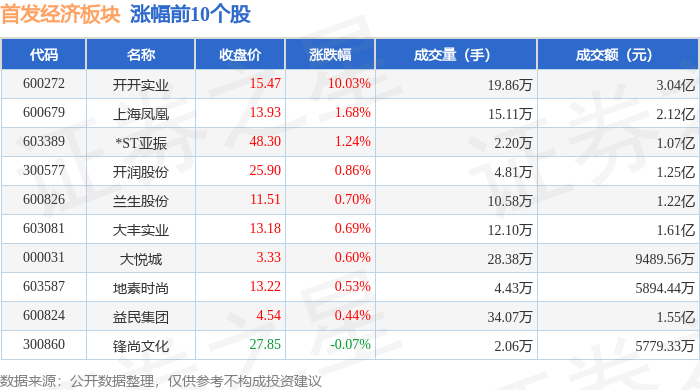
首发经济板块11月14日涨0.12%,开开实业领涨,主力资金净流出908.72万元




Sou Hu Cai Jing· 2025-11-14 09:24
Core Insights - The primary focus of the news is the performance of the initial public offering (IPO) economy sector, which saw a slight increase of 0.12% compared to the previous trading day, with notable gains from specific companies like Kaikai Industrial [1] Group 1: Market Performance - The Shanghai Composite Index closed at 3990.49, down by 0.97% [1] - The Shenzhen Component Index closed at 13216.03, down by 1.93% [1] - Kaikai Industrial led the IPO economy sector with a closing price of 15.47, reflecting a significant increase of 10.03% [1] Group 2: Individual Stock Performance - The table lists various stocks within the IPO economy sector, highlighting their closing prices, percentage changes, trading volumes, and transaction amounts [1] - Notable performers include: - Shanghai Phoenix with a closing price of 13.93, up by 1.68% [1] - ST Yazhen with a closing price of 48.30, up by 1.24% [1] - Kai Run Co. with a closing price of 25.90, up by 0.86% [1] Group 3: Capital Flow Analysis - The IPO economy sector experienced a net outflow of 9.09 million yuan from institutional investors, while retail investors saw a net inflow of 38.01 million yuan [2] - The capital flow table indicates the net inflow and outflow for various stocks, with Kaikai Industrial showing a net inflow of 98.32 million yuan from institutional investors [3] - Other stocks like Da Feng Industrial and Kai Run Co. had mixed capital flows, with some experiencing net outflows from institutional and speculative investors [3]