
ZTE(000063)

Search documents
中兴通讯公布国际专利申请:“通信系统的训练方法、通信方法、设备、系统及存储介质”
Sou Hu Cai Jing· 2026-02-07 21:47
Core Viewpoint - ZTE Corporation has filed an international patent application for a communication system training method, with the application number PCT/CN2025/087057, set to be published on February 5, 2026 [1] Group 1: Patent Application - The patent application is titled "Training Method, Communication Method, Equipment, System, and Storage Medium for Communication Systems" [1] - This marks one of the 159 international patent applications filed by ZTE in 2023, which is a decrease of 27.4% compared to the same period last year [1] Group 2: R&D Investment - In the first half of 2025, ZTE invested 12.665 billion yuan in research and development, reflecting a year-on-year decrease of 0.48% [1]



每周股票复盘:中兴通讯(000063)拟合计出资3.17亿元参投两只基金
Sou Hu Cai Jing· 2026-02-07 17:20
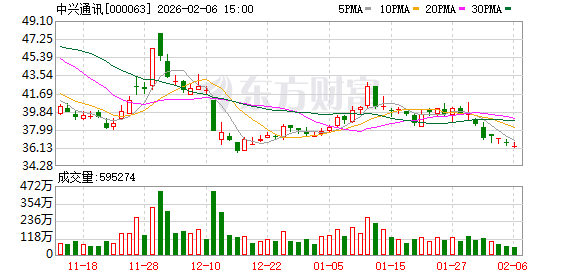
Core Viewpoint - ZTE Corporation's stock price has decreased by 5.66% to 36.31 CNY as of February 6, 2026, with a total market capitalization of 173.69 billion CNY, ranking 4th in the communication equipment sector and 97th in the A-share market [1] Trading Information Summary - On February 5, 2026, ZTE Corporation executed a block trade with a net institutional purchase of 7.5444 million CNY [2][5] Company Announcement Summary - ZTE Corporation plans to invest 117 million CNY as a limited partner in the Shaanxi Jianxing Zhanlu Equity Investment Partnership, which has a total fund size of 300 million CNY, focusing on new generation information technology, new energy, artificial intelligence, and advanced manufacturing [3] - ZTE Corporation intends to invest 200 million CNY in the Guangdong-Hong Kong-Macao Greater Bay Area Venture Capital Guidance Fund, with the relevant proposal approved by the board of directors [3][5] - As of January 31, 2026, ZTE Corporation has not yet implemented its A-share repurchase plan, which was approved for a total repurchase amount of 1 to 1.2 billion CNY at a price not exceeding 63.09 CNY per share [3][5]
超500亿元基金启航!000063、002138参与认购
Shang Hai Zheng Quan Bao· 2026-02-07 10:52
Core Viewpoint - Both ZTE Corporation and Sunlord Electronics announced their intention to invest 200 million yuan as limited partners in the Guangdong-Hong Kong-Macao Greater Bay Area Venture Capital Guidance Fund [2][8]. Group 1: Fund Overview - The Guangdong-Hong Kong-Macao Fund was established on December 22, 2025, with a total scale of 50.45 billion yuan, focusing on areas supported by national policies such as new-generation information technology, biotechnology, high-end equipment manufacturing, new materials and new energy, and electronic hardware [5][7]. - The fund is one of three regional funds under the National Venture Capital Guidance Fund, which has a registered capital of 100 billion yuan and is fully owned by the Ministry of Finance [7]. - The fund aims to support seed and early-stage technology companies in strategic emerging industries and future industries, promoting original and disruptive technological innovation [7]. Group 2: Investment Strategy - The fund adopts a "sub-fund + direct investment" model, primarily targeting equity investments in strategic emerging industries [7]. - The fund's partners include notable entities such as the National Guidance Fund, which has committed 20 billion yuan, accounting for 39.64% of the total contributions [7][8]. - The investment strategy emphasizes long-term investments in hard technology, with a focus on achieving significant technological advancements and converting major scientific achievements into productive forces [7]. Group 3: Company Involvement - ZTE Corporation stated that its investment in the Guangdong-Hong Kong-Macao Fund supports the strategic execution of its core business and aims to achieve investment returns through quality industry investments [8]. - Sunlord Electronics indicated that its participation in the fund allows it to leverage the resources and advantages of professional investment institutions in equity investment and industry cultivation, aiming for long-term investment returns [8]. - The investment areas of the fund align with the main business operations of both companies, facilitating external business development and enhancing overall competitiveness and profitability [8].


中兴通讯公布国际专利申请:“信息传输方法、装置、存储介质及程序产品”
Sou Hu Cai Jing· 2026-02-07 04:37
Core Insights - ZTE Corporation (000063) has filed an international patent application titled "Information Transmission Method, Device, Storage Medium, and Program Product" with application number PCT/CN2025/089515, which is set to be published internationally on February 5, 2026 [1] Group 1: Patent Activity - ZTE has announced a total of 153 international patent applications this year, representing a decrease of 30.14% compared to the same period last year [1] Group 2: R&D Investment - In the first half of 2025, ZTE invested 12.665 billion yuan in research and development, which is a slight decrease of 0.48% year-on-year [1]
中兴通讯公布国际专利申请:“一种感知移动性管理方法及装置”
Sou Hu Cai Jing· 2026-02-06 22:59
Core Viewpoint - ZTE Corporation has filed an international patent application for a mobility management method and device, indicating ongoing innovation efforts despite a decrease in patent filings this year [1] Group 1: Patent Application - The patent application is titled "A Method and Device for Perceiving Mobility Management" with application number PCT/CN2025/088624, and it is set to be published internationally on February 5, 2026 [1] - ZTE has announced a total of 153 international patent applications this year, which represents a decrease of 30.14% compared to the same period last year [1] Group 2: Research and Development Investment - In the first half of 2025, ZTE invested 12.665 billion yuan in research and development, showing a slight decrease of 0.48% year-on-year [1]
中兴通讯公布国际专利申请:“无线网络通信方法和装置、存储介质及程序产品”
Sou Hu Cai Jing· 2026-02-06 22:59
Group 1 - The core point of the article is that ZTE Corporation (000063) has filed an international patent application for a wireless communication method and device, with the application number PCT/CN2025/083511, published internationally on February 5, 2026 [1] - ZTE has announced a total of 153 international patent applications this year, which represents a decrease of 30.14% compared to the same period last year [1] - In the first half of 2025, ZTE invested 12.665 billion yuan in research and development, showing a slight decrease of 0.48% year-on-year [1]
中兴通讯公布国际专利申请:“通信方法、电子装置和计算机程序产品”
Sou Hu Cai Jing· 2026-02-06 22:59
Group 1 - The core point of the article is that ZTE Corporation (000063) has filed an international patent application for a communication method, electronic device, and computer program product, with the application number PCT/CN2025/084782 and an international publication date set for February 5, 2026 [1] - ZTE has announced a total of 153 international patent applications this year, which represents a decrease of 30.14% compared to the same period last year [1] - In the first half of 2025, ZTE invested 12.665 billion yuan in research and development, showing a slight decrease of 0.48% year-on-year [1]
中兴通讯公布国际专利申请:“数据传输方法、通信节点及存储介质”
Sou Hu Cai Jing· 2026-02-06 22:59
Core Viewpoint - ZTE Corporation has filed an international patent application for a data transmission method, communication nodes, and storage medium, with the application number PCT/CN2025/105784, set to be published internationally on February 5, 2026 [1] Group 1: Patent Application - The patent application by ZTE is part of its ongoing innovation efforts in the telecommunications sector [1] - The company has filed a total of 153 international patent applications this year, which represents a decrease of 30.14% compared to the same period last year [1] Group 2: R&D Investment - In the first half of 2025, ZTE invested 12.665 billion yuan in research and development, showing a slight decrease of 0.48% year-on-year [1]
中兴通讯公布国际专利申请:“小区切换管理方法、通信装置、存储介质及程序产品”
Sou Hu Cai Jing· 2026-02-06 22:59
Core Viewpoint - ZTE Corporation has filed an international patent application for a "cell switching management method, communication device, storage medium, and program product," with the application number PCT/CN2025/082922, published internationally on February 5, 2026 [1] Group 1: Patent Application - The patent application reflects ZTE's ongoing innovation efforts in communication technology [1] - The company has filed a total of 153 international patent applications this year, which is a decrease of 30.14% compared to the same period last year [1] Group 2: R&D Investment - In the first half of 2025, ZTE invested 12.665 billion yuan in research and development, representing a year-on-year decrease of 0.48% [1]
中兴通讯股份有限公司第十届董事会第二十次会议决议公告
Shang Hai Zheng Quan Bao· 2026-02-06 19:24
Core Viewpoint - ZTE Corporation has approved an investment of 200 million RMB to subscribe for shares in the Guangdong-Hong Kong-Macao Greater Bay Area Venture Capital Guidance Fund, aiming to support strategic execution and gain investment returns [1][2][37]. Investment Details - ZTE Corporation will act as a limited partner and invest 200 million RMB in the Guangdong-Hong Kong-Macao Greater Bay Area Venture Capital Guidance Fund [8][2]. - The investment was approved during the 20th meeting of the 10th Board of Directors held on February 6, 2026, and does not require shareholder approval as it does not involve related transactions [8][28]. - The fund has a total registered capital of 450.5 billion RMB and focuses on private equity investments, asset management, and investment management [8][28]. Fund Structure and Partners - The fund is structured as a limited partnership and has a maximum duration of 20 years, focusing on sectors supported by national policies such as information technology, biotechnology, and new materials [28][29]. - The general partner and executive partner of the fund is Shenrun Guochuang (Shenzhen) Investment Co., Ltd., which is a joint venture of Shenzhen Innovation Investment Group [9][10]. Fund Management and Decision-Making - The fund will have a decision-making committee responsible for investment decisions, requiring a majority vote for approval [32]. - The fund's profit distribution follows a "return of capital first, then profit sharing" principle, ensuring that all partners receive their initial contributions before any profits are distributed [33]. Impact on ZTE Corporation - The investment is expected to support ZTE's core business strategy and provide access to quality investment opportunities, although it will not be consolidated into ZTE's financial statements [37].