TCL TECH.(000100)

Search documents
格局重塑!TCL控股索尼电视业务
Guan Cha Zhe Wang· 2026-01-22 13:28
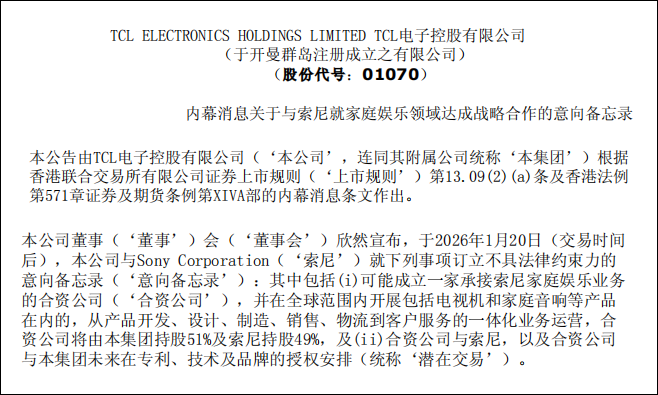
Core Viewpoint - The collaboration between Sony and TCL represents a strategic response to the shifting dynamics of the global television industry, moving from incremental expansion to a focus on existing market competition and complementary advantages [1][3]. Group 1: Company Collaboration - Sony and TCL announced plans to establish a joint venture, with TCL holding 51% and leading operations, while Sony retains 49% ownership [1]. - The new company will take over Sony's global television and home audio equipment business, including R&D, design, manufacturing, sales, logistics, and customer service, while continuing to use the Sony and BRAVIA brands [1][4]. - The partnership is seen as a necessary adaptation to the challenges posed by rising costs and declining profits in the television market, with both companies aiming to leverage their respective strengths [3][4]. Group 2: Market Context - The global television market is projected to see a slight decline in shipment volume, with an expected 2.21 million units in 2025, down 0.7% year-on-year [3]. - Sony's global television shipment is forecasted to be around 4.1 million units in 2025, giving it a market share of 1.9%, ranking it tenth globally [3]. - TCL is expected to ship approximately 30.4 million televisions in 2025, capturing a market share of 13.8%, making it the second-largest player after Samsung [4]. Group 3: Strategic Advantages - Sony's focus on high-end markets and its technological advantages, such as the XR cognitive chip, allow it to maintain premium pricing in the OLED segment, despite challenges in profitability [3][4]. - TCL's strengths lie in its scale and supply chain capabilities, particularly in Mini LED technology, where it holds over 40% of the global market share [4]. - The collaboration is expected to combine Sony's brand and technology with TCL's manufacturing and operational expertise, creating a synergistic effect that enhances competitiveness in the market [5].


索尼退场,日本电视全军覆没
远川研究所· 2026-01-22 13:17
Core Viewpoint - Sony's decision to form a joint venture with TCL for its home entertainment business marks a significant shift in the global television market, indicating the complete exit of Japanese companies from the competitive landscape of television manufacturing [4][10]. Group 1: Sony's Strategic Move - Sony will transfer its television business and the BRAVIA brand to TCL, with TCL holding a 51% stake in the new joint venture [4]. - This move reflects Sony's inability to produce display panels, which are crucial for profitability in the television market, relying instead on LG and TCL for panel supply [4][10]. - Sony's market share in the global television sector has been consistently low, often categorized under "others," indicating a lack of competitive presence [5][10]. Group 2: TCL's Positioning - For TCL, acquiring Sony's brand equity is a strategic advantage, allowing it to leverage its panel production capabilities to challenge Samsung's dominance in the global market [9]. - TCL is currently the only domestic television brand in China with display panel production capabilities, positioning itself uniquely in the industry [25]. Group 3: Decline of Japanese Brands - The exit of Sony signifies the end of an era for Japanese television brands, which have been in decline since the 2010s, with major players like Sharp and Toshiba also having sold their television businesses [10][13]. - The loss of panel production capabilities has been a critical factor in the decline of Japanese brands, as they have lost pricing power and market relevance [29]. - The shift in focus for Japanese companies has been towards higher-margin components rather than low-margin consumer electronics, reflecting a strategic pivot in response to competitive pressures [16][17]. Group 4: Historical Context - The rise and fall of Japanese television brands can be traced back to their initial dominance in the 1990s, where they controlled over 90% of the global market, primarily due to their advanced panel production technologies [20]. - The financial crisis of 2008 and subsequent strategic missteps led to significant losses for these companies, prompting a reevaluation of their business models [15][16]. - The transition from being manufacturers of consumer electronics to component suppliers has been a common theme among Japanese firms, as they adapt to the changing landscape of the electronics industry [29].

去年净利润大涨!CEO却选择卸任
Sou Hu Cai Jing· 2026-01-22 10:57
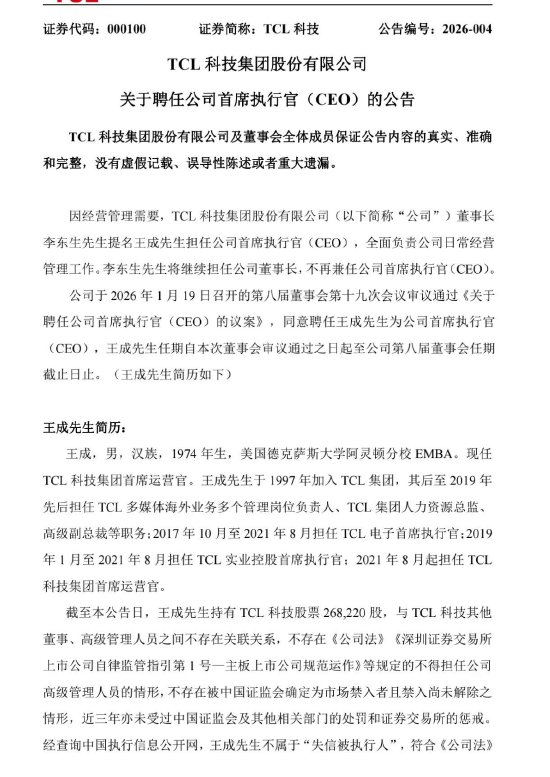
Group 1 - TCL Technology Group Co., Ltd. announced the appointment of Wang Cheng as CEO, effective immediately, while Li Dongsheng continues as Chairman [1] - Wang Cheng has been with TCL for over 28 years, holding various management positions, including COO since August 2021 [2][3] - The leadership transition is seen as a move towards modernizing corporate governance and reflects confidence in the current management team [5] Group 2 - TCL Technology forecasts a significant increase in net profit for 2025, estimating between 4.21 billion to 4.55 billion yuan, a year-on-year growth of 169% to 191% [5] - The expected surge in profits is attributed to the cyclical recovery of the semiconductor display business, with TCL Huaxing benefiting from stabilized mainstream panel prices and scale effects [5] - TCL Huaxing's recent acquisition of LG Display's facility in Guangzhou further strengthens its global position in the large-size panel market [5]
李东生卸任TCL科技CEO,70后“老将”王成接棒
Nan Fang Du Shi Bao· 2026-01-22 08:55
Group 1 - TCL Technology Group Co., Ltd. announced the appointment of Wang Cheng as the new CEO, effective immediately, while Li Dongsheng will continue as Chairman of the Board [2] - Wang Cheng has been with TCL for over 28 years, holding various management positions, including COO since August 2021 [2] - The leadership change is seen as a move towards modernizing corporate governance and reflects confidence in the current management team [3] Group 2 - TCL Technology expects a significant increase in net profit for 2025, projecting between 4.21 billion to 4.55 billion yuan, a year-on-year growth of 169% to 191% [3] - The net profit excluding non-recurring gains is forecasted to be between 2.89 billion to 3.20 billion yuan, representing a staggering increase of 869% to 973% year-on-year [3] - The growth is attributed to the cyclical recovery of the semiconductor display business, with TCL Huaxing benefiting from stabilized mainstream panel prices and enhanced profitability [3]
湖北国资“控盘”湖北消费金融
Sou Hu Cai Jing· 2026-01-22 08:21
Core Viewpoint - Hubei Consumer Finance Co., Ltd. has undergone a capital increase and share expansion, raising its registered capital from approximately 1.358 billion RMB to about 2.308 billion RMB, resulting in Hubei state-owned assets achieving absolute control over the company [2][4]. Group 1: Company Overview - Hubei Consumer Finance is a national non-bank financial institution established with approval from the China Banking and Insurance Regulatory Commission, headquartered in Wuhan [2]. - The company officially commenced operations in April 2015 and has completed three rounds of capital increases in 2016, 2020, and 2022, with a registered capital of 1.0058 billion RMB as of the end of 2023 [2]. Group 2: Shareholding Structure - Prior to the recent capital increase, Xinjiang Teyi Information Technology Co., Ltd. was the largest shareholder with a 35.48% stake, while Hubei state-owned assets held 23.14% through Hubei Bank, making it the second-largest shareholder [3]. - Following the capital increase, Hubei Bank's shareholding will rise to 49.55%, making it the largest shareholder, while Hubei Provincial Small and Medium Enterprises Financial Service Center will hold 20.79%, resulting in Hubei state-owned shareholders collectively holding over 70% [4]. Group 3: Capital Contribution Details - The new shareholding structure post-capital increase includes: Hubei Bank with a contribution of 1.1441 billion RMB (49.55%), Hubei Provincial Small and Medium Enterprises Financial Service Center with 480 million RMB (20.79%), and Xinjiang Teyi Information Technology with 246.1 million RMB (10.66%) [3].



2025年度并购报告,广东赢麻了
投中网· 2026-01-22 06:06
Group 1 - In 2025, the Chinese M&A market saw a total of 5,086 announced transactions, a decrease of 20.27% year-on-year, while the total transaction amount reached 2,373.515 billion yuan, an increase of 29.08% [7] - The completed transactions in 2025 amounted to 3,342, a slight increase of 0.45% year-on-year, with a total transaction value of 1,485.131 billion yuan, up 54.41% year-on-year, indicating a structural optimization trend in the market [9][10] - The Guangdong province continued to lead the M&A market in China, benefiting from the dual innovation drive of the Guangdong-Hong Kong-Macao Greater Bay Area, with electronic information, traditional manufacturing, healthcare, and energy mining being the hot sectors [10][31][32] Group 2 - In 2025, private equity funds showed a recovery in exit numbers, with 469 exits, a year-on-year increase of 22.77%, and a total capital recovery of 64.215 billion yuan, up 8.54% year-on-year [17] - Notable exits included TCL Technology's acquisition of a 21.53% stake in Shenzhen Huaxing Optoelectronics for 11.562 billion yuan and Silex Group's acquisition of Chongqing Liangjiang New Area Longsheng New Energy for 3.509 billion yuan [20][21] Group 3 - In 2025, there were 20 M&A transactions exceeding 10 billion yuan, with the largest being China Shipbuilding Industry's acquisition of China Shipbuilding Heavy Industry for 115.15 billion yuan, marking a significant milestone in China's shipbuilding industry [23] - Major domestic M&A cases included Guotai Junan's merger with Haitong Securities for approximately 97.609 billion yuan and Shandong Hongchuang's acquisition of Shandong Hongtu for 63.518 billion yuan [24][25] Group 4 - The cross-border M&A market in 2025 saw a total of 144 transactions, with outbound M&A accounting for 79 and inbound M&A for 65, reflecting a year-on-year decline of 13.77% [26] - Notable cross-border transactions included Midea Group's acquisition of Teka Group for 8.287 billion yuan and Zijin Mining's acquisition of Newmont Golden Ridge for 7.315 billion yuan [27][29] Group 5 - The M&A market in 2025 was characterized by a structural differentiation of "quantity reduction and price increase," with a notable shift from quantity dividends to quality dividends [10] - The electronic information sector led the number of transactions with 579 deals, accounting for 17.32%, while the financial sector had the largest disclosed transaction value at 203.596 billion yuan, representing 13.71% of the total [34][36]




2025年面板价格回顾与2026年Q1展望
WitsView睿智显示· 2026-01-22 05:43
Core Viewpoint - The global display industry shifted from scale competition to a value game focused on profits and control capabilities in 2025, with supply-side adjustments significantly influencing price trends as capacity expansion cycles ended and industry concentration increased [1]. Group 1: TV Panel Market Dynamics - In 2025, TV panel prices exhibited clear phase characteristics, rising in the first half due to demand and policy drivers, then adjusting downwards in the second half due to inventory corrections, stabilizing by year-end under strong supply-side interventions [2]. - The first half of 2025 saw strong market demand, driven by China's "old-for-new" policy, particularly boosting demand in lower-tier markets, alongside a trend towards larger sizes, which increased panel manufacturers' confidence and pricing power [2]. - In the latter half of 2025, demand cooled as promotional effects waned, leading to high inventory levels among brand manufacturers, who adopted conservative procurement strategies, resulting in price declines of $1 to $3 across various panel sizes [2][3]. Group 2: IT Panel Market Performance - The IT panel market remained relatively stable in 2025, with minor price fluctuations, as the U.S. temporarily exempted certain IT products from tariffs, leading to a mild price increase in Q2 due to concentrated procurement [5]. - Despite a decrease in demand in the second half of 2025, prices did not significantly drop, supported by strong cost factors and a long-standing loss situation for mainstream display panels, leading manufacturers to maintain firm pricing stances [5]. - The notebook panel market experienced a steady yet pressured state throughout 2025, with prices remaining flat in the first half due to cautious strategies amid complex international trade environments, and slight price reductions in Q4 due to rising costs from memory prices [7]. Group 3: Industry Consolidation and Technology Shift - The price fluctuations in 2025 reflected a deep restructuring of the competitive landscape, with the LCD sector entering an oligopolistic phase and OLED technology becoming a new investment focus [9]. - Mergers and acquisitions became the main theme in capacity layout, with significant consolidations like BOE acquiring a stake in Xianyang Rainbow and TCL Huaxing merging with LGD, further increasing industry concentration [9]. - Investment in the LCD sector has stagnated, with funds increasingly directed towards OLED technology, which accounted for 55% of the nearly 180 billion yuan planned investments by major domestic panel manufacturers over the past two years [9][12]. Group 4: Q1 2026 Outlook - The TV panel market is expected to see a "good start" in Q1 2026, with prices projected to rise by $1 across various sizes due to strong supply-side adjustments and proactive production cuts by major manufacturers ahead of the Chinese New Year [13][15]. - Demand factors for Q1 2026 include the FIFA World Cup, which typically boosts demand for large TVs, and the continuation of the "old-for-new" policy, which supports domestic sales [15]. - The IT panel market is anticipated to maintain stable prices in January, with potential upward support from the TV panel price increase and production cuts, while notebook panel prices may face downward pressure due to seasonal demand [15]. Group 5: Long-term Industry Strategies - The market operation in 2025 indicates that adjusting production rates to balance supply and demand has become a normalized strategy for panel manufacturers, with a focus on leveraging market opportunities from sports events in 2026 [16]. - Long-term strategies for panel companies should include upgrading product structures towards larger sizes and accelerating the layout of mid-size OLED technology to enhance profitability and competitive barriers [16].


李东生卸任TCL科技CEO,TCL集团COO王成接棒
Xin Lang Cai Jing· 2026-01-22 04:15
Core Viewpoint - TCL Technology has appointed Wang Cheng as the new CEO, marking a significant management transition as founder Li Dongsheng steps down from the CEO role while retaining the position of Chairman [5][6]. Group 1 - Wang Cheng has been with TCL Group since 1997, holding various key positions including head of overseas multimedia business, HR director, and COO since August 2021 [4][8]. - The management change is seen as a strategic move towards professional management, leveraging Wang Cheng's nearly 30 years of industry experience and deep understanding of the company [4][8]. - As of the announcement date, Wang Cheng holds 268,220 shares in TCL Technology, confirming his eligibility for the CEO position [4][8].
日系彩电时代“彻底落幕”
Hua Er Jie Jian Wen· 2026-01-21 15:17
Core Insights - TCL's acquisition of Sony's television business marks a significant shift in the global TV market, indicating the end of the dominance of Japanese brands like Sony, Sharp, and Panasonic [3][6] - The joint venture between TCL and Sony aims to enhance TCL's position in the high-end TV market and increase its global market share [4][5] Group 1: Acquisition Details - On January 20, TCL and Sony announced a memorandum of understanding to form a joint venture, with TCL holding 51% and Sony 49%, to manage Sony's home entertainment business [2] - The joint venture will take over Sony's TV and home audio systems, including R&D, design, manufacturing, sales, logistics, and customer service, while retaining the "Sony" and "BRAVIA" brands [2] Group 2: Market Impact - The merger is expected to reshape the global TV market, with TCL and Sony's combined market share potentially reaching 16.7%, surpassing Samsung and marking a historic shift in brand competition [5] - The global TV shipment volume is projected to decline slightly by 0.7% in 2025, with TCL expected to grow by 5.4%, solidifying its position as a leading brand [5] Group 3: Strategic Rationale - The acquisition allows TCL to leverage Sony's high-end technology and brand reputation, enhancing its competitive edge in the premium TV segment [4][6] - Sony's decision to divest its TV business reflects its strategic shift towards more profitable areas like OTT media platforms and content ecosystems, as it faces declining market share and sales [6][7] Group 4: Historical Context - The transition from Japanese dominance in the TV market to the rise of Chinese and Korean brands illustrates a significant evolution in the industry, with TCL emerging as a key player [6][7] - Historically, Japanese brands held nearly 40% of the global TV market share, but have struggled to maintain their position due to increased competition and technological advancements from Chinese manufacturers [7]

索尼剥离电视业务,与中国TCL合资
日经中文网· 2026-01-21 03:07
Group 1 - The core point of the article is that Sony Group is divesting its television business and forming a joint venture with TCL, where TCL will hold a 51% stake and Sony will hold 49% [1][3] - The new company will leverage TCL's cost competitiveness in the global television market, focusing on the development, design, production, and sales of televisions and home audio systems [3] - Sony's television business is shrinking, with a projected decrease in TV shipments to 4.1 million units in 2025, resulting in a global market share of 1.9%, ranking tenth [3][5] Group 2 - TCL's estimated TV shipment volume for 2025 is expected to grow by 5% compared to 2024, reaching 30.4 million units, with a global market share of 13.8% [3] - Sony's display business revenue for the fiscal year 2024 is projected to be 597.6 billion yen, a year-on-year decrease of 10%, which will negatively impact the overall revenue and operating profit of the electronics division [3][5] - Sony is shifting its focus from traditional electronics manufacturing to becoming a comprehensive entertainment company, with the electronics division expected to contribute only about 10% to the operating profit for the fiscal year 2025 [5]