YUNNAN BAIYAO(000538)

Search documents
云南白药(000538):医药工业双位数增长经营质量稳步提升
Yin He Zheng Quan· 2025-09-01 12:05
Investment Rating - The report maintains a "Recommended" rating for Yunnan Baiyao [1] Core Views - Yunnan Baiyao achieved a revenue of 21.257 billion yuan in H1 2025, representing a year-on-year growth of 3.92%. The net profit attributable to shareholders was 3.633 billion yuan, up 13.93% year-on-year [4] - The pharmaceutical industry experienced double-digit growth, with the company's gross margin improving due to a focus on core products and optimization of the industrial structure [4] - The company has a clear short, medium, and long-term product development strategy, focusing on both traditional Chinese medicine and innovative drugs [4] Financial Performance Summary - In Q2 2025, the company reported a revenue of 10.416 billion yuan, a year-on-year increase of 7.59%, and a net profit of 1.698 billion yuan, up 14.22% year-on-year [4] - The industrial revenue for H1 2025 was 8.504 billion yuan, with a year-on-year growth of 11.13%, accounting for 40.01% of total revenue [4] - The core product, Yunnan Baiyao aerosol, achieved sales revenue of 1.453 billion yuan, with a significant year-on-year growth of over 20.9% [4] Future Projections - The report forecasts revenues of 42.7 billion yuan, 45.4 billion yuan, and 48.1 billion yuan for 2025, 2026, and 2027 respectively, with year-on-year growth rates of 7%, 6%, and 6% [5] - The net profit attributable to shareholders is projected to be 5.314 billion yuan, 5.708 billion yuan, and 6.201 billion yuan for the same years, with growth rates of 11.9%, 7.4%, and 8.6% respectively [5] - The company is expected to maintain a high dividend payout ratio in the coming years [4]

深化产学研融合,北京大学携手云南白药绘就发展新图景
2 1 Shi Ji Jing Ji Bao Dao· 2025-09-01 10:56
Core Insights - The Chinese biopharmaceutical industry is experiencing a dual benefit of increased policy support and accelerated industrial upgrades, with a focus on high-quality development driven by technological breakthroughs and deep integration of industry, academia, and research [2][3] - Yunnan Baiyao, as a leading traditional Chinese medicine enterprise, is actively engaging in innovation and transformation, leveraging its resource integration capabilities and academic collaboration to connect industry needs with research outcomes [2][3] Industry Developments - The "2025 Pharmaceutical Innovation and Technology Frontier Forum" was held in Kunming, co-hosted by Peking University and Yunnan Baiyao, attracting over 500 experts to discuss advancements in oncology, reproductive medicine, trauma orthopedics, and oral medicine [2] - Yunnan Baiyao aims to collaborate with top global research institutions to focus on drug development, clinical trials, and translational medicine, enhancing core technology breakthroughs and the commercialization of research outcomes [3][4] Collaborative Models - The Peking University-Yunnan Baiyao Medical Center exemplifies successful industry-academia collaboration, emphasizing the importance of integrating research and application to enhance the pharmaceutical industry's core competitiveness [3][4] - The center's collaborative model focuses on three main aspects: complementary advantages, resource alignment, and co-creation, aiming to build a world-class medical research center [4] Research and Development Strategies - The core value of industry-academia collaboration lies in effective "outcome transformation," requiring a complete closed-loop mechanism from problem identification to joint research and industrial validation [5] - Yunnan Baiyao is advancing its traditional medicine projects through clinical and foundational research, with significant progress in products like Qixuekang oral liquid, which has shown notable cardiovascular health benefits [6] International Expansion - Yunnan Baiyao is addressing the challenge of insufficient evidence for traditional Chinese medicine in international markets by implementing a differentiated strategy, initially focusing on Southeast Asia and Belt and Road countries [7] - The company emphasizes the need for standardization, scientific validation, and clear communication of active components to align with international standards [7] Innovation in Drug Development - Yunnan Baiyao is expanding its innovative drug portfolio, focusing on nuclear medicine, biopharmaceuticals, and chemical drugs, with several projects achieving significant milestones [8][9] - The company maintains a balanced strategy of licensing and independent research, gradually building its R&D capabilities while leveraging collaborations with top experts and institutions [9][10]

中药板块9月1日涨0.75%,振东制药领涨,主力资金净流出2970.85万元
Zheng Xing Xing Ye Ri Bao· 2025-09-01 08:44
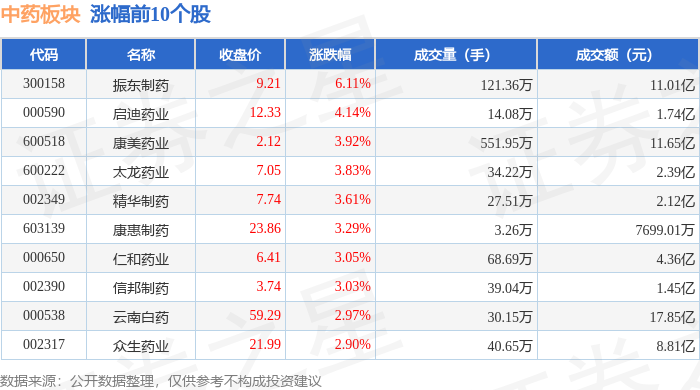
Market Overview - The Chinese medicine sector rose by 0.75% on September 1, with Zhendong Pharmaceutical leading the gains [1] - The Shanghai Composite Index closed at 3875.53, up 0.46%, while the Shenzhen Component Index closed at 12828.95, up 1.05% [1] Top Gainers in Chinese Medicine Sector - Zhendong Pharmaceutical (300158) closed at 9.21, up 6.11% with a trading volume of 1.2136 million shares and a turnover of 1.101 billion yuan [1] - Qidi Pharmaceutical (000590) closed at 12.33, up 4.14% with a trading volume of 140,800 shares and a turnover of 174 million yuan [1] - Kangmei Pharmaceutical (600518) closed at 2.12, up 3.92% with a trading volume of 5.5195 million shares and a turnover of 1.165 billion yuan [1] Top Losers in Chinese Medicine Sector - Tianmu Pharmaceutical (600671) closed at 19.44, down 1.87% with a trading volume of 86,000 shares and a turnover of 170 million yuan [2] - Jilin Aodong (000623) closed at 20.13, down 1.66% with a trading volume of 284,000 shares and a turnover of 573 million yuan [2] - *ST Changyao (300391) closed at 4.19, down 1.64% with a trading volume of 86,000 shares and a turnover of 36.1 million yuan [2] Capital Flow Analysis - The Chinese medicine sector experienced a net outflow of 29.7085 million yuan from institutional investors, while retail investors saw a net inflow of 253 million yuan [2][3] - Notable net inflows from retail investors were observed in Yunnan Baiyao (000538) with 436.788 million yuan and in Zhongsheng Pharmaceutical (002317) with 82.0845 million yuan [3] Individual Stock Capital Flow - Yunnan Baiyao (000538) had a net inflow of 188 million yuan from institutional investors, but a net outflow of 144 million yuan from speculative funds [3] - Zhongsheng Pharmaceutical (002317) saw a net inflow of 54.7945 million yuan from institutional investors, while retail investors experienced a net outflow of 82.0845 million yuan [3] - Dong'e Ejiao (000423) had a net inflow of 53.6307 million yuan from institutional investors, with a net outflow of 40.1030 million yuan from speculative funds [3]


财联社9月1日早间新闻精选
Xin Lang Cai Jing· 2025-09-01 00:51
Group 1 - The Ministry of Commerce of China held discussions with U.S. officials regarding the implementation of agreements from the recent talks between the two countries' leaders [1] - The U.S. Department of Commerce removed several Chinese semiconductor companies from the "validated end-user" list, prompting a response from the Chinese Ministry of Commerce to protect the rights of its enterprises [2] - The China Securities Regulatory Commission (CSRC) plans to deepen reforms in the capital market to enhance its attractiveness and promote long-term investment strategies [3] Group 2 - In August, the manufacturing Purchasing Managers' Index (PMI) was reported at 49.4%, a slight increase of 0.1 percentage points from the previous month, while the non-manufacturing business activity index was at 50.3%, indicating continued expansion [4] - As of June, the "national team" of central financial institutions held stock ETFs valued at 1.28 trillion yuan, an increase of nearly 23% from the end of the previous year [5] - The Ministry of Industry and Information Technology issued a plan for the steel industry, targeting an average annual growth rate of 4% from 2025 to 2026 [7] Group 3 - Semiconductor companies such as SMIC and Huahong Group are planning significant equity purchases and capital raises, indicating ongoing consolidation in the sector [9][10] - Several companies reported substantial increases in net profits for the first half of the year, including BYD with a net profit of 15.51 billion yuan, up 13.79%, and TCL Technology with a net profit of 1.883 billion yuan, up 89.26% [13] - Conversely, companies like Magpowr and China Shenhua reported declines in net profits, with Magpowr down 44.82% [14] Group 4 - Alibaba reported a revenue of 247.65 billion yuan for the first quarter of fiscal year 2026, a 2% year-on-year increase, and plans to invest heavily in AI and daily service consumption sectors [23]



云南白药净利润创历史新高,豪掷超18亿元现金分红
Zhong Guo Ji Jin Bao· 2025-08-31 09:42
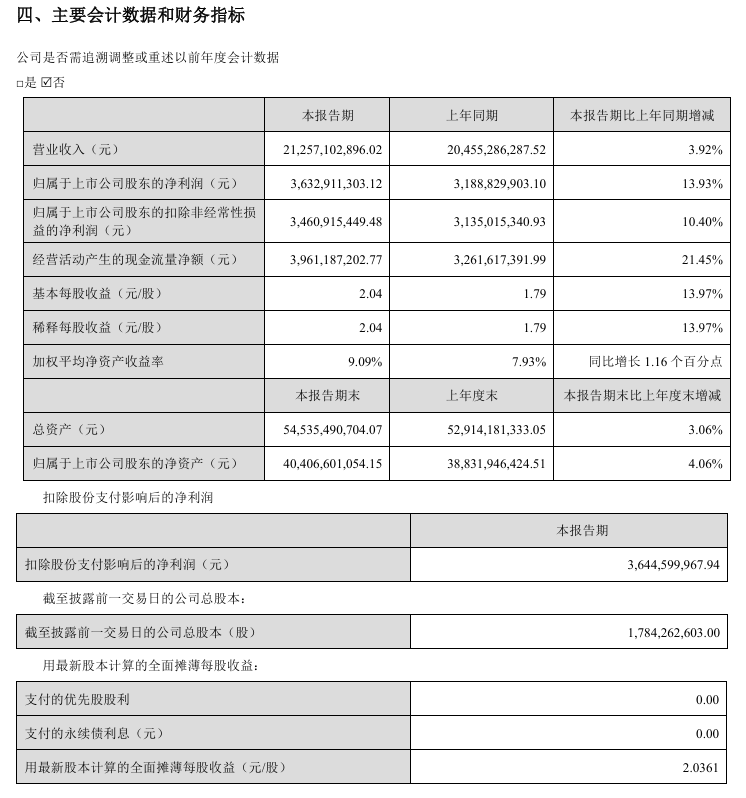
Core Insights - Yunnan Baiyao reported record high performance for the first half of 2025, with revenue of 21.257 billion yuan, a year-on-year increase of 3.92%, and net profit of 3.633 billion yuan, up 13.93% [1] - The company announced a special cash dividend of 10.19 yuan per 10 shares, totaling approximately 1.818 billion yuan, which represents 50.05% of its net profit for the first half of 2025 [2] Financial Performance - The weighted average return on equity reached 9.09%, the highest in nearly eight years, with operating cash flow net amounting to 3.961 billion yuan, a growth of 21.45% year-on-year [2] - The core product, aerosol spray, generated sales revenue exceeding 1.453 billion yuan, reflecting a growth of over 20.9% [4] Product and Market Development - The health product segment, primarily focused on toothpaste, achieved revenue of 3.442 billion yuan, a year-on-year increase of 9.46%, with Yunnan Baiyao holding the largest market share in the domestic toothpaste market [4] - The company's pharmaceutical segment, Yunnan Provincial Pharmaceutical Co., Ltd., reported main business revenue of 12.164 billion yuan and a net profit of 351 million yuan, up 17.75% [4] Industry Positioning - The Yunnan provincial government emphasizes the development of the traditional Chinese medicine industry, positioning Yunnan Baiyao as a "chain leader" in the industry cluster [5] - The traditional Chinese medicine resource segment achieved external revenue of 914 million yuan, with a year-on-year growth of approximately 6.3% [5] - Yunnan Baiyao has implemented a comprehensive operational model for traditional Chinese medicine, covering planting planning, source research, planting standards, processing, purchasing, and sales [5]
000538宣布,每10股分红10.19元
中国基金报· 2025-08-31 08:41
Core Viewpoint - Yunnan Baiyao reported record high net profit and announced a cash dividend exceeding 1.8 billion yuan, reflecting strong performance despite market challenges [2][4]. Financial Performance - In the first half of 2025, Yunnan Baiyao achieved operating revenue of 21.257 billion yuan, a year-on-year increase of 3.92% [2]. - The company realized a net profit attributable to shareholders of 3.633 billion yuan, up 13.93% year-on-year, marking a historical high for the period [2]. - The net profit excluding non-recurring items was 3.461 billion yuan, reflecting a 10.40% year-on-year growth, also a historical high [2]. - The weighted average return on equity reached 9.09%, the highest level in nearly eight years [4]. - Operating cash flow net amount was 3.961 billion yuan, an increase of 21.45% compared to the same period last year [4]. Dividend Announcement - Yunnan Baiyao proposed a special dividend of 10.19 yuan per 10 shares (tax included), totaling approximately 1.818 billion yuan, which accounts for 50.05% of the net profit attributable to shareholders for the first half of 2025 [4]. Product Performance - The sales revenue of Yunnan Baiyao's aerosol product exceeded 1.453 billion yuan, with a year-on-year growth of over 20.9% [8]. - Other core products, including ointments, capsules, and band-aids, also showed significant growth compared to the previous year [8]. - The health product segment, primarily focused on toothpaste, achieved operating revenue of 3.442 billion yuan, a year-on-year increase of 9.46%, with Yunnan Baiyao toothpaste holding the largest market share in China [8]. Business Segment Performance - Yunnan Province Pharmaceutical Co., a subsidiary, reported main business revenue of 12.164 billion yuan and a net profit of 351 million yuan, reflecting a year-on-year growth of 17.75% [9]. Industry Development - The Yunnan provincial government emphasizes the development of the traditional Chinese medicine industry, positioning Yunnan Baiyao as the "chain leader" in the industry cluster [11]. - The traditional Chinese medicine resource segment of Yunnan Baiyao generated external revenue of 914 million yuan, with a year-on-year growth of approximately 6.3% [11]. - The company is advancing a unified operational model for planting, research, standards, processing, purchasing, and management in the traditional Chinese medicine industry [11]. - Yunnan Baiyao has achieved full coverage of ten innovative medicinal sources and expanded its GAP management base by over 7,000 acres, with cross-border business transactions exceeding 1 billion yuan [11].

云南白药:上半年净利润同比增长13.93% 拟大额分红18.18亿元
Zhong Zheng Wang· 2025-08-31 03:24
Core Viewpoint - Yunnan Baiyao reported record high performance for the first half of 2025, with significant growth in revenue and net profit, alongside a special dividend proposal [1] Financial Performance - In H1 2025, the company achieved operating revenue of 21.257 billion yuan, a year-on-year increase of 3.92% [1] - The net profit attributable to shareholders reached 3.633 billion yuan, up 13.93% year-on-year [1] - Basic earnings per share were 2.04 yuan, reflecting a growth of 13.97% [1] - The weighted average return on equity was 9.09%, the highest level in nearly eight years [1] - A special dividend of 10.19 yuan per 10 shares (before tax) is proposed, totaling 1.818 billion yuan, which accounts for 50.05% of the net profit for H1 2025 [1] Business Structure and Growth - The industrial revenue accounted for 40.01% of total operating revenue, an increase of 2.6 percentage points year-on-year, marking a nine-year high [1] - Industrial revenue grew by 11.13% year-on-year [1] Pharmaceutical Segment - The pharmaceutical segment generated main business revenue of 4.751 billion yuan, a year-on-year increase of 10.8% [2] - Sales of Yunnan Baiyao aerosol exceeded 1.453 billion yuan, up 20.9% [2] - Significant growth was noted in products for cardiovascular and respiratory systems, with sales of Qianling Jianpi Granules exceeding 100 million yuan and sales of Pudilan Anti-inflammatory Tablets nearing 100 million yuan [2] - Online sales achieved a breakthrough with GMV reaching 254 million yuan [2] Health Products Segment - The health products segment reported revenue of 3.442 billion yuan, a year-on-year increase of 9.46% [2] - Yunnan Baiyao toothpaste maintained the top market share in China [2] Commercial Sector - Yunnan Provincial Pharmaceutical Company achieved main business revenue of 12.164 billion yuan, with a net profit of 351 million yuan, up 17.75% [2] - The company strengthened its hospital drug distribution and commercial distribution business, with non-drug sales growing by 10.6% year-on-year [2] Traditional Chinese Medicine Resources - The traditional Chinese medicine resources segment generated external revenue of 914 million yuan, with a year-on-year growth of 6.3% [3] - The company is advancing a comprehensive operational model for traditional Chinese medicine, covering planting, research, standards, processing, and sales [3] Research and Development - The company focuses on short-term projects for secondary development of existing products, with new progress in products like Qixue Kang Oral Liquid [3] - Mid-term projects are progressing in clinical trials, while long-term projects focus on innovative drug development [3] - The company is advancing digital transformation, achieving online transactions exceeding 1 billion yuan through the "Digital Cloud Medicine" platform [3] Future Strategy - Yunnan Baiyao plans to drive growth through both internal efficiency improvements and external strategic acquisitions and collaborations [3]
云南白药拟每10股派10.19元
Zhong Guo Zheng Quan Bao· 2025-08-31 01:23
Core Insights - Yunnan Baiyao reported a revenue of 21.26 billion yuan for the first half of 2025, marking a year-on-year growth of 3.92% [1][2] - The net profit attributable to shareholders reached 3.63 billion yuan, up 13.93% year-on-year, achieving a historical high for the same period [1][2] - The company plans to distribute a cash dividend of 10.19 yuan per 10 shares, totaling approximately 1.82 billion yuan, which represents 50.05% of the net profit for the first half of 2025 [1][2] Financial Performance - Revenue for the first half of 2025: 21.26 billion yuan, up from 20.46 billion yuan in the same period last year [2] - Net profit attributable to shareholders: 3.63 billion yuan, compared to 3.19 billion yuan last year [2] - Net profit after deducting non-recurring gains and losses: 3.46 billion yuan, a 10.40% increase year-on-year [2] - Operating cash flow: 3.96 billion yuan, reflecting a 21.45% increase [2] - Basic and diluted earnings per share: 2.04 yuan, up 13.97% from 1.79 yuan [2] - Total assets: 54.54 billion yuan, a 3.06% increase from the previous year [2] - Net assets attributable to shareholders: 40.41 billion yuan, a 4.06% increase [2] Business Segments - The pharmaceutical segment generated 4.75 billion yuan in revenue, a 10.8% increase, with core products like aerosol sales exceeding 1.45 billion yuan, up over 20.9% [4] - The health products segment achieved revenue of 3.44 billion yuan, a 9.46% increase, with Yunnan Baiyao toothpaste leading the domestic market share [4] - The commercial segment, through Yunnan Provincial Pharmaceutical Company, reported 12.16 billion yuan in revenue, with a net profit of 351 million yuan, up 17.75% [4] Industry Context - The Yunnan provincial government emphasizes the development of the traditional Chinese medicine industry, positioning Yunnan Baiyao as a key player in the industry cluster [5] - The company is committed to innovation in both traditional Chinese medicine and innovative pharmaceuticals, focusing on resource development and clinical needs [6] - The national "14th Five-Year Plan" identifies biomedicine as a strategic emerging industry, presenting new opportunities for the pharmaceutical sector [6]
云南白药2025年中报简析:营收净利润同比双双增长,盈利能力上升
Zheng Quan Zhi Xing· 2025-08-30 23:24
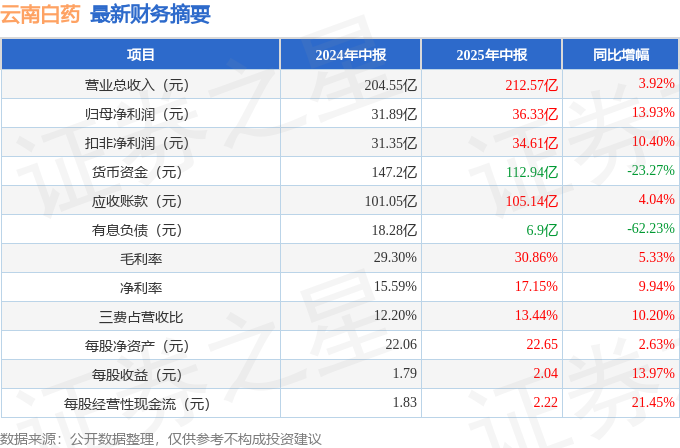
据证券之星公开数据整理,近期云南白药(000538)发布2025年中报。截至本报告期末,公司营业总收 入212.57亿元,同比上升3.92%,归母净利润36.33亿元,同比上升13.93%。按单季度数据看,第二季度 营业总收入104.16亿元,同比上升7.59%,第二季度归母净利润16.98亿元,同比上升14.22%。本报告期 云南白药盈利能力上升,毛利率同比增幅5.33%,净利率同比增幅9.94%。 本次财报公布的各项数据指标表现尚佳。其中,毛利率30.86%,同比增5.33%,净利率17.15%,同比增 9.94%,销售费用、管理费用、财务费用总计28.57亿元,三费占营收比13.44%,同比增10.2%,每股净 资产22.65元,同比增2.63%,每股经营性现金流2.22元,同比增21.45%,每股收益2.04元,同比增 13.97% 偿债能力:公司现金资产非常健康。 | 项目 | 2024年中报 | 2025年中报 | 同比增幅 | | --- | --- | --- | --- | | 营业总收入(元) | 204.55 Z | 212.57 乙 | 3.92% | | 归母净利润(元) | 31. ...
千亿龙头,拟每10股派10.19元!
Zhong Guo Zheng Quan Bao· 2025-08-30 14:24
Core Viewpoint - Yunnan Baiyao, a leading company in the traditional Chinese medicine industry, reported strong financial performance for the first half of 2025, achieving record high net profit and revenue growth [1][2]. Financial Performance - The company achieved operating revenue of 21.26 billion yuan, a year-on-year increase of 3.92% [2]. - The net profit attributable to shareholders reached 3.63 billion yuan, up 13.93% year-on-year, marking a historical high for the period [1][2]. - The net profit after deducting non-recurring gains and losses was 3.46 billion yuan, reflecting a 10.40% increase year-on-year [2]. - The net cash flow from operating activities was 3.96 billion yuan, a significant increase of 21.45% [2]. - Basic and diluted earnings per share were both 2.04 yuan, representing a 13.97% increase [2]. - The weighted average return on equity rose to 9.09%, an increase of 1.16 percentage points year-on-year [2]. Dividend Announcement - The company announced a special dividend plan, proposing to distribute 10.19 yuan per 10 shares (including tax), totaling approximately 1.82 billion yuan, which accounts for 50.05% of the net profit for the first half of 2025 [1][2]. Product Performance - The core product, aerosol spray, generated over 1.45 billion yuan in revenue, with a significant year-on-year growth of over 20.9% [4][5]. - The pharmaceutical business segment reported revenue of 4.75 billion yuan, a 10.8% increase year-on-year [5]. - The health products segment achieved revenue of 3.44 billion yuan, reflecting a 9.46% growth [6]. - The commercial segment, Yunnan Provincial Pharmaceutical Co., Ltd., reported a revenue of 12.16 billion yuan, with a net profit of 351 million yuan, up 17.75% [6]. Industry Development - The Yunnan provincial government emphasizes the development of the traditional Chinese medicine industry, positioning it as a key focus for the province's agricultural economy [6]. - The company is committed to building an industrial cluster centered around itself, promoting collaboration across the supply chain [6]. Innovation Strategy - The company adheres to an innovation-driven development strategy, focusing on both traditional Chinese medicine and innovative pharmaceuticals [8]. - It aims to enhance its research and development capabilities for traditional Chinese medicine while also exploring innovative drug development [8]. - The national "14th Five-Year Plan" includes support for the biopharmaceutical industry, presenting new opportunities for the healthcare sector [8].