
GUJING(000596)

Search documents
酒价内参1月28日价格发布 梦之蓝M6+上涨2元/瓶
Xin Lang Cai Jing· 2026-01-28 01:35
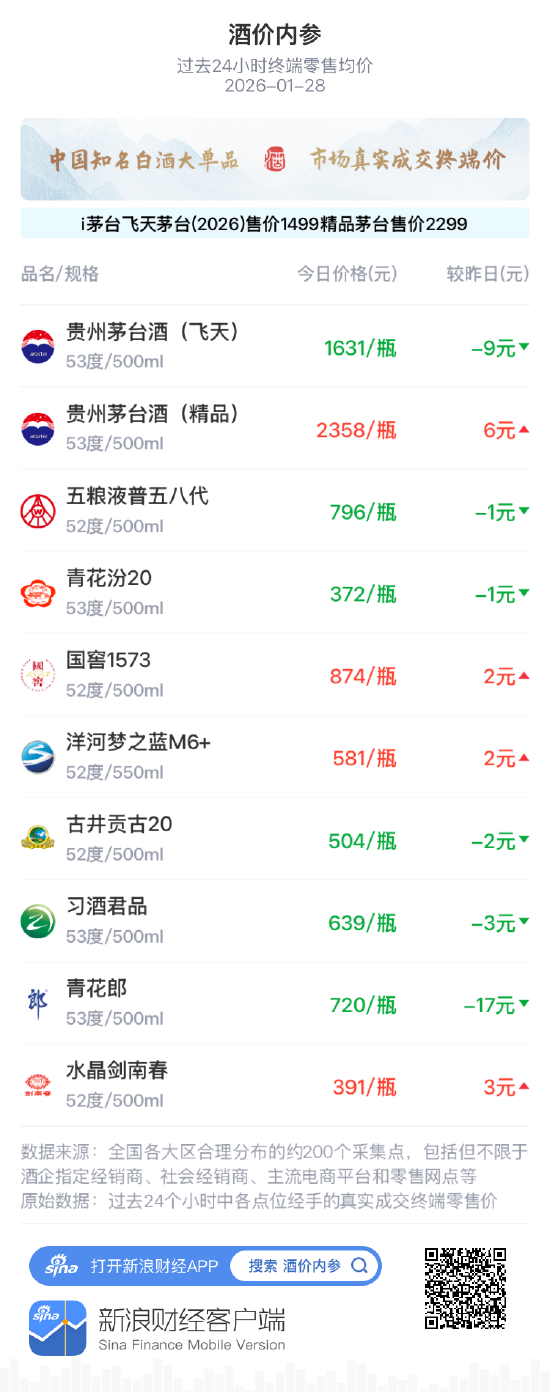
Core Viewpoint - The Chinese liquor market is experiencing a mixed trend in retail prices for the top ten products, with a total price of 8866 yuan, marking a decrease of 20 yuan from the previous day, reaching a new low in five days [1] Price Trends - The market shows four price increases and six decreases today, with premium Moutai leading the increase by 6 yuan per bottle, followed by Crystal Jian Nan Chun up by 3 yuan, and Guojiao 1573 and Dream Blue M6+ each up by 2 yuan [1] - On the downside, Qinghua Lang saw a significant drop of 17 yuan per bottle, while Feitian Moutai decreased by 9 yuan due to normalized supply from the iMoutai platform [1][4] - Other declines include Xijiu Junpin down by 3 yuan, Gu Qing Gong Gu 20 down by 2 yuan, and both Qinghua Fen 20 and Wuliangye down by 1 yuan, indicating a relatively stable trend [1] Market Analysis - The daily data from "Wine Price Insider" is sourced from approximately 200 collection points across major regions, aiming to provide an objective and traceable overview of retail prices in the well-known liquor market [5] - The introduction of new sales channels for Feitian Moutai and premium Moutai has begun to show a magnetic influence on their market retail prices [5] - The A-share liquor sector has seen a decline, with the China Securities Liquor Index dropping to 8293.16 points, the lowest since September 19, 2024, and the sector has experienced a continuous six-year annual decline [5] - Among the stocks, only Guizhou Moutai showed a slight increase, while Yanghe Co. fell nearly 3.6%, and several other stocks, including Wuliangye and Shanxi Fenjiu, saw declines exceeding 1% [5] - In the past 11 trading days, the average decline for 20 stocks in the liquor sector was nearly 8.5%, with a median drop of 6.6%, and six stocks experienced declines of over 10% [5] - Despite the market adjustment, financing clients have been increasing their positions, with Guizhou Moutai seeing a net purchase of 3.166 billion yuan in the last 10 trading days, reaching a new high in financing balance in one and a half years [5]





酒价内参1月28日价格发布 习酒君品下跌3元/瓶
Xin Lang Cai Jing· 2026-01-28 01:35
Core Viewpoint - The Chinese liquor market is experiencing a mixed trend in retail prices, with the average price of the top ten liquor products showing a decline, indicating potential market volatility and shifts in consumer demand [1][5]. Price Trends - As of January 28, the total retail price for a package of the top ten liquor products is 8866 yuan, down 20 yuan from the previous day, marking a new low in the past five days [1]. - The market shows four price increases and six decreases today, with premium Moutai leading the increase by 6 yuan per bottle, while Qinghua Lang saw a significant drop of 17 yuan per bottle [1][4]. Market Dynamics - The introduction of the iMoutai platform selling Moutai at 1499 yuan per bottle and premium Moutai at 2299 yuan per bottle has begun to influence market prices, reflecting a magnetic effect on retail prices [5]. - The A-share liquor sector has seen a decline, with the China Securities White Liquor Index dropping to 8293.16 points, the lowest since September 19, 2024, and the sector has experienced a continuous six-year decline [5]. Stock Performance - Within the liquor sector, 20 constituent stocks have averaged a decline of nearly 8.5% over the past 11 trading days, with a median drop of 6.6% [5]. - Six stocks have seen declines exceeding 10%, representing nearly 30% of the sector's total stocks, including Shanxi Fenjiu and Yanghe Brewery [5]. Financing Activity - Despite the market downturn, there is a trend of increased investment from financing clients, with Guizhou Moutai seeing a net purchase of 3.166 billion yuan over the last ten trading days, reaching a new high in financing balance [5].

酒价内参1月28日价格发布 青花汾20微跌1元/瓶
Xin Lang Cai Jing· 2026-01-28 01:23
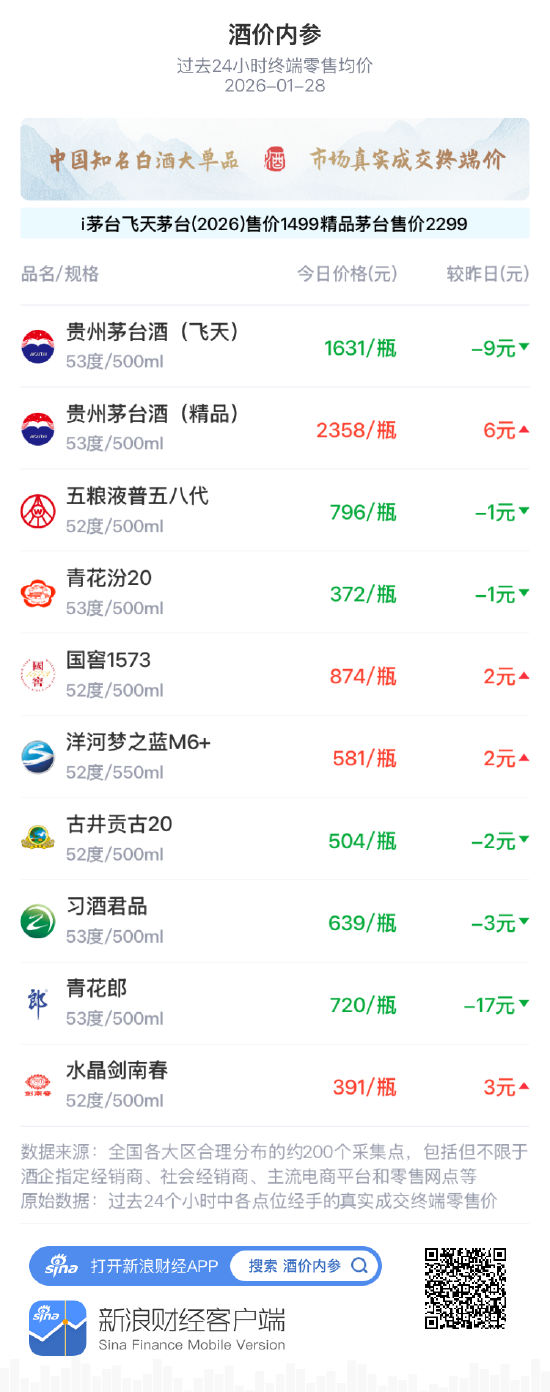
Core Insights - The article discusses the launch of "Wine Price Reference" by Sina Finance, which provides real-time data on the retail prices of major Chinese liquor brands, highlighting a recent decline in prices [1][5] Price Trends - As of January 28, the average retail price of the top ten Chinese liquor products was 8,866 yuan, a decrease of 20 yuan from the previous day, marking a new low in the past five days [1][7] - The market showed a mixed performance with four products increasing in price and six decreasing; notable increases included a 6 yuan rise for premium Moutai and a 3 yuan rise for Crystal Jian Nan Chun [1][5] - Significant declines were observed in products like Qinghua Lang, which dropped 17 yuan, and Feitian Moutai, which fell by 9 yuan due to the impact of the iMoutai platform's regular supply [1][5] Market Analysis - The A-share liquor sector experienced a downturn, with the China Securities Liquor Index hitting a new low of 8,293.16 points, marking a continuous decline over six years [5][9] - Among the 20 stocks in the liquor sector, the average decline over the past 11 trading days was approximately 8.5%, with a median drop of 6.6% [5][9] - Despite the market adjustment, there was an increase in financing purchases, with Guizhou Moutai seeing a net buy of 3.166 billion yuan over the last ten trading days, reaching a 1.5-year high in financing balance [5][9]
酒价内参1月28日价格发布 总价创五日新低青花郎领跌
Xin Lang Cai Jing· 2026-01-28 01:17
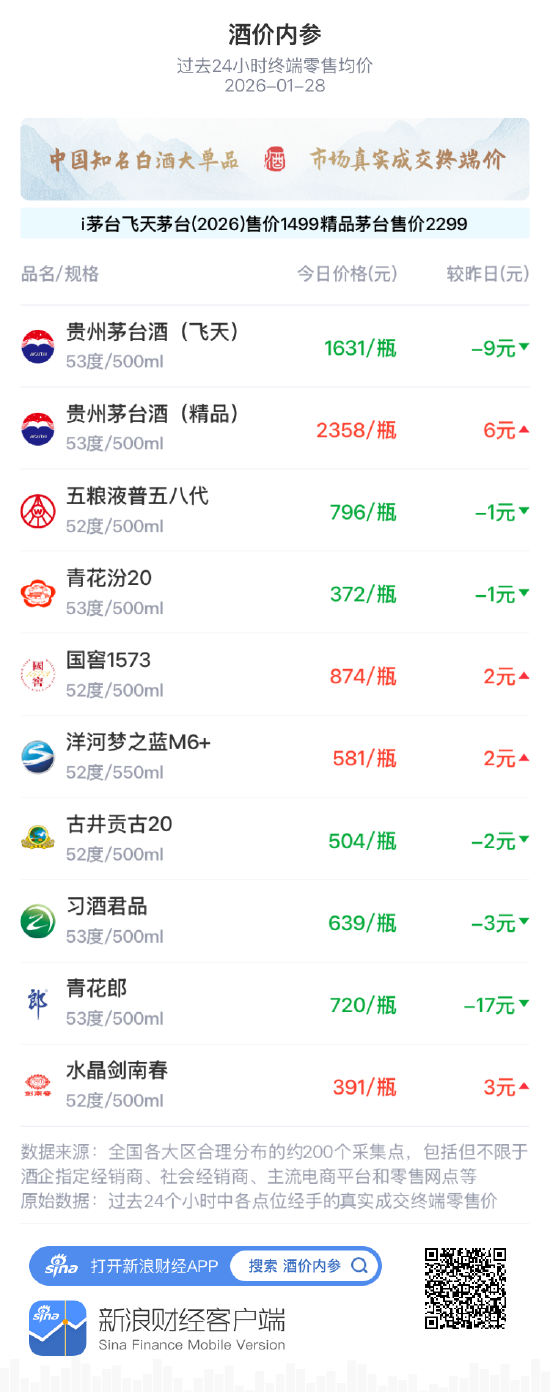
新浪财经"酒价内参"重磅上线 知名白酒真实市场价尽在掌握 新浪财经"酒价内参"过去24小时收集的数据显示,中国白酒市场十大单品的终端零售均价在1月28日呈 放量分化走势。如果十大单品各取一瓶整体打包售卖,今日总售价为8866元,较昨日下跌20元,创近五 日以来价格新低。今日市场四涨六跌:上涨端,精品茅台领涨6元/瓶;水晶剑南春上涨3元/瓶;国窖 1573和梦之蓝M6+均上涨2元/瓶。下跌端,青花郎显著回调17元/瓶,调整幅度居前,此前该酒品曾五 连涨获利回吐压力日增;飞天茅台终端零售价受i茅台平台常态化供应影响,环比下跌9元/瓶;习酒君 品和古井贡古20分别下跌3元/瓶、2元/瓶;青花汾20和五粮液均微跌1元/瓶,走势相对平稳。 | 2 | 习酒君品 | 639/瓶 | -3元' | | --- | --- | --- | --- | | | 53度/500ml | | | | 北 | 青花郎 | 720/瓶 | -17元▼ | | | 53度/500ml | | | | 100 | 水晶剑南春 | 391/瓶 | 3元 ▲ | | | 52度/500ml | | | 新浪财经"酒价内参"重磅上线 知名白酒真 ...
酒价内参1月28日价格发布 精品茅台领涨6元/瓶
Xin Lang Cai Jing· 2026-01-28 01:17
Core Viewpoint - The "Wine Price Reference" by Sina Finance has launched, providing real-time data on the retail prices of major Chinese liquor brands, indicating a mixed market trend with a slight overall decline in prices [1][5]. Price Trends - The average retail price of the top ten liquor products in China on January 28 was 8,866 yuan, down 20 yuan from the previous day, marking a new low in the past five days [1][7]. - The market showed four price increases and six decreases: - Increases: Premium Moutai up 6 yuan/bottle, Crystal Jian Nan Chun up 3 yuan/bottle, Guojiao 1573 and Dream Blue M6+ each up 2 yuan/bottle [1][7]. - Decreases: Qinghua Lang down 17 yuan/bottle, Feitian Moutai down 9 yuan/bottle, Xijiu Junpin down 3 yuan/bottle, and Gu Qingong Gu 20 down 2 yuan/bottle [1][7]. Market Analysis - The A-share liquor sector has seen a decline, with the China Securities Liquor Index dropping to 8,293.16 points, the lowest since September 19, 2024, and marking six consecutive years of annual declines [5][9]. - Among 20 stocks in the liquor sector, the average decline over the past 11 trading days was approximately 8.5%, with a median decline of 6.6% [5][9]. - Six stocks experienced declines of over 10%, accounting for nearly 30% of the sector, including Shanxi Fenjiu, Yanghe Brewery, and Gujing Gongjiu [5][9]. Financing Activity - Despite the market downturn, there has been an increase in financing activity, with Guizhou Moutai seeing a net purchase of 3.166 billion yuan over the past ten trading days, reaching a financing balance not seen in a year and a half [5][9]. - Shanxi Fenjiu and Wuliangye also saw net increases of 250 million yuan and 120 million yuan, respectively [5][9].
一杯中国酿,与诗词共振的白酒行业新表达
Zhong Guo Xin Wen Wang· 2026-01-27 13:40
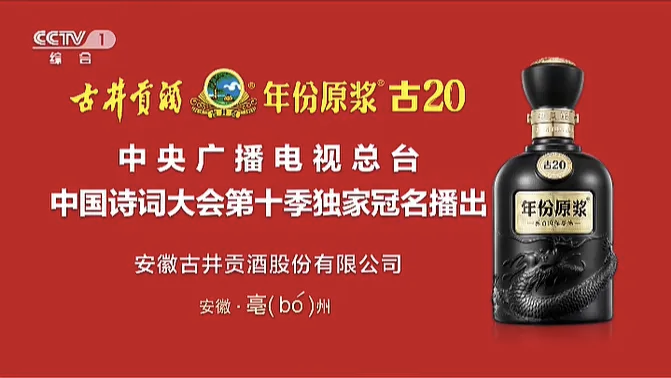
Core Insights - The collaboration between Gujinggongjiu and the "Chinese Poetry Conference" represents a strategic integration of culture and brand, enhancing the brand's value in the high-end market [3][12] - Gujinggongjiu's long-term commitment to cultural investment has established a strong recognition of "cultural liquor" among consumers [10][12] - The white liquor industry is evolving beyond mere quality competition, with cultural connotation becoming a core competitive advantage [12][13] Group 1 - Gujinggongjiu's partnership with the "Chinese Poetry Conference" has transformed from a simple cultural collaboration to an immersive cultural expression, enhancing audience engagement [9][10] - The program's innovative elements, such as the "Challenge Champion Group" and the "Poetry Train," connect poetry, liquor, and everyday life, making culture more accessible [9][10] - The brand's essence is deeply rooted in the historical and cultural significance of liquor, as highlighted by its connection to ancient traditions and modern cultural expressions [4][13] Group 2 - The recent season of the "Chinese Poetry Conference" achieved significant viewership, with over 100 million viewers and a peak rating of 4.61%, showcasing the enduring appeal of traditional Chinese culture [12][13] - Gujinggongjiu's strategy of linking its brand with poetry has created a unique cultural moat in the competitive high-end liquor market [12] - The recognition of the liquor industry as a "historical classic industry" by the state underscores the cultural value embedded in white liquor, further validating Gujinggongjiu's strategic direction [12]
时隔6年首次易主!白酒股均价遭半导体反超,3成标的近期回撤超一成
Xin Lang Cai Jing· 2026-01-27 09:29
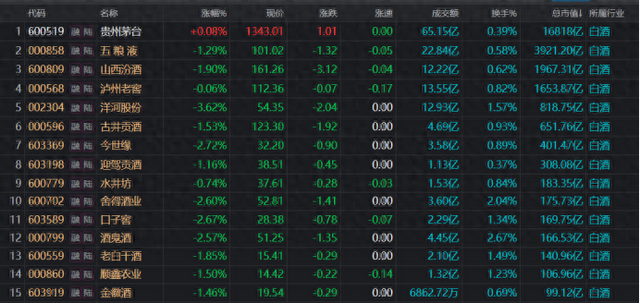
Core Viewpoint - The liquor sector, particularly the baijiu segment, has experienced a significant decline, with most stocks falling, while only Kweichow Moutai showed a slight increase [1][4]. Group 1: Market Performance - As of January 27, the baijiu sector saw a collective drop, with 20 constituent stocks, where only Kweichow Moutai managed a slight gain, while major stocks like Yanghe and Wuliangye fell by approximately 3.6% and over 1% respectively [1][4]. - The China Securities Baijiu Index has retreated nearly 8.21% over the past 11 trading days, reaching a low of 8293.16 points, which is close to its previous low of 8251.41 points recorded on September 18, 2024 [4][5]. - Year-to-date, the baijiu sector has declined by approximately 5.03%, marking a continuous annual decline for six consecutive years from 2021 to 2026 [4][5]. Group 2: Individual Stock Performance - Among the 20 baijiu stocks, the average decline over the past 11 trading days was about 8.5%, with a median drop of 6.6%. Six stocks experienced declines exceeding 10%, accounting for nearly 30% of the sector [4][5]. - Kweichow Moutai, the largest stock by market capitalization, saw a financing net purchase of 3.166 billion yuan, while Shanxi Fenjiu and Wuliangye had net purchases of 251 million yuan and 117 million yuan respectively [5][6]. Group 3: Financing and Valuation - The baijiu sector has seen some stocks increase in financing balance, particularly the top three weighted stocks, with Kweichow Moutai reaching its highest financing balance since September 2024 [5][6]. - The average price of baijiu stocks is currently around 111.58 yuan, which has been surpassed by the semiconductor sector's average price of 112.12 yuan for the first time in six years [8][11]. - Only semiconductor, baijiu, and medical beauty sectors have an average stock price above 100 yuan, with baijiu stocks maintaining a significant presence in the high-price stock category [8][11].
白酒周期启示录
雪球· 2026-01-27 08:57
Core Viewpoint - The article emphasizes the importance of industry cycles over individual company performance in the Chinese liquor market, particularly during periods of economic downturns, where even strong companies face significant declines due to systemic pressures [7][11][35]. Group 1: Industry Performance Overview - The period from 2013 to 2021 was characterized as a "golden era" for the liquor industry, with major brands like Kweichow Moutai increasing by 1297%, Shanxi Fenjiu by 1090%, and Wuliangye by 860% [13][15]. - In contrast, the period from 2022 to 2026 is described as a "deep adjustment period," where major brands have seen significant declines, with Luzhou Laojiao down 49%, Wuliangye down 46%, and Kweichow Moutai down 26% [20][22]. Group 2: Investment Strategy - Investors are advised to focus on industry cycles when selecting stocks, prioritizing companies with strong demand resilience during downturns, such as Kweichow Moutai, or those with low valuations, like Gujing Gongjiu B [29][30]. - The article warns against relying on company-specific factors (alpha) to counteract industry-wide trends (beta), as strong financials or management integrity may not protect against systemic downturns [31][32]. Group 3: Historical Context and Lessons - The article highlights that past star stocks, such as Yanghe and Shui Jing Fang, which performed well during the boom, have suffered even greater declines in the current downturn, illustrating that past performance does not guarantee future resilience [33][34]. - The cyclical nature of the industry is underscored, with the assertion that understanding the primary conflict between industry cycles and individual company performance is crucial for avoiding investment pitfalls [35].


白酒板块1月27日跌0.56%,*ST岩石领跌,主力资金净流出3.86亿元
Zheng Xing Xing Ye Ri Bao· 2026-01-27 08:49
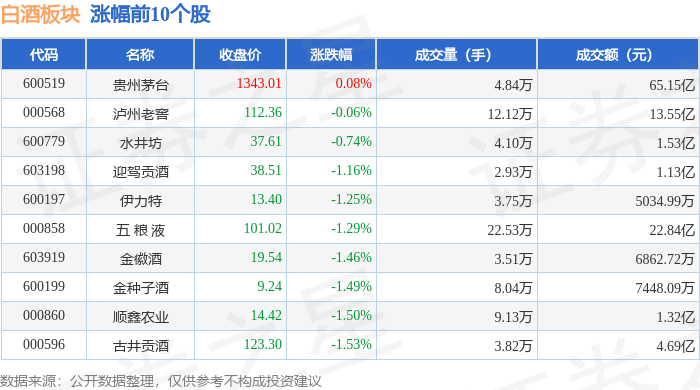
Core Viewpoint - The liquor sector experienced a decline of 0.56% on January 27, with *ST Rock leading the drop, while the Shanghai Composite Index rose by 0.18% and the Shenzhen Component Index increased by 0.09% [1]. Group 1: Liquor Sector Performance - The closing prices and performance of key liquor stocks showed mixed results, with Kweichow Moutai slightly up by 0.08% at 1343.01, while several others like Wuliangye and Luzhou Laojiao saw declines of 1.29% and 0.06% respectively [1]. - The total trading volume for Kweichow Moutai was 48,400 hands, with a transaction value of 6.515 billion yuan, while Wuliangye had a trading volume of 225,300 hands and a transaction value of 2.284 billion yuan [1]. Group 2: Capital Flow Analysis - The liquor sector saw a net outflow of 386 million yuan from institutional investors and 289 million yuan from retail investors, while retail investors had a net inflow of 675 million yuan [2]. - Specific stocks like Kweichow Moutai experienced a net inflow of 39.8 million yuan from institutional investors, while *ST Rock had a net outflow of 68,400 yuan [3]. Group 3: ETF Performance - The Food and Beverage ETF (product code: 515170) tracked the sub-index of the food and beverage industry, showing a decline of 2.01% over the past five days, with a price-to-earnings ratio of 19.31 times [5]. - The Consumer ETF (product code: 510630) tracked the main consumer industry index, with a decline of 1.52% over the past five days and a price-to-earnings ratio of 20.22 times [6].


2025“企业家之夜”盛典将启,与千年古井,共赴新征程!
Xin Lang Cai Jing· 2026-01-27 08:49
Group 1 - The event "Entrepreneur Night" is set to take place on January 29, 2025, organized by Sina Finance, First Finance, and Gujing Gongjiu, focusing on the theme "Paying Tribute to the Driving Forces of the New Era" [1][6] - The "China Economic News Figures" IP evaluates outstanding entrepreneurs based on five dimensions: innovation, disruption, foresight, growth, and newness, becoming an important window for observing China's economic development [2][7] - Gujing Gongjiu, as one of China's eight famous liquor brands, has maintained a growth trajectory in sync with China's economic development, emphasizing quality through traditional brewing methods that have been preserved for over 1800 years [2][7] Group 2 - Gujing Gongjiu has innovatively addressed the challenges of traditional manufacturing transformation with its "1+1" production model, integrating advanced technologies like 5G and big data to create the industry's first fully connected transparent factory [3][8] - The company has launched products like the light ancient 20 and "Gujing Light Health Society" to align with modern consumer trends, promoting health and youthfulness in the liquor industry [3][8] - Gujing Gongjiu actively practices social responsibility through its "Three Quality Project," which aims to enhance quality, virtue, and brand beauty while supporting rural revitalization through order-based planting [3][8] Group 3 - The 11th edition of the "Entrepreneur Night" coincides with a critical phase in China's transition to high-quality development, featuring discussions on key topics through speeches and roundtable forums [4][9] - The event has evolved from an industry gathering to a significant platform for recognizing the growth and responsibility of outstanding entrepreneurs, reflecting the ongoing confidence in China's economic development [4][9] - The upcoming event will showcase more leading figures who embody the principles of tradition, innovation, and social responsibility, contributing to a new chapter in high-quality economic development in China [4][9]