GUJING(000596)

Search documents
古井贡酒股价连续5天下跌累计跌幅6.98%,农银汇理基金旗下1只基金持8.11万股,浮亏损失75.02万元
Xin Lang Cai Jing· 2026-01-27 07:22
资料显示,安徽古井贡酒股份有限公司位于安徽省亳州市古井镇古井产业园,成立日期1999年3月5日, 上市日期1996年9月27日,公司主营业务涉及白酒、啤酒、葡萄酒、酿酒设备、包装材料、玻璃瓶,酒 精、饲料、油脂、饮料,高新技术开发、生物技术开发、农副产品深加工的生产与销售等。主营业务收 入构成为:白酒业务98.27%,其他1.40%,酒店业务0.33%。 1月27日,古井贡酒跌1.53%,截至发稿,报123.30元/股,成交4.69亿元,换手率0.93%,总市值651.76 亿元。古井贡酒股价已经连续5天下跌,区间累计跌幅6.98%。 从基金十大重仓股角度 数据显示,农银汇理基金旗下1只基金重仓古井贡酒。农银消费主题混合(660012)四季度持有股数 8.11万股,占基金净值比例为2.57%,位居第七大重仓股。根据测算,今日浮亏损失约15.57万元。连续 5天下跌期间浮亏损失75.02万元。 农银消费主题混合(660012)成立日期2012年4月24日,最新规模4.18亿。今年以来收益0.98%,同类排 名7690/8861;近一年收益7.07%,同类排名6917/8126;成立以来收益253.92%。 农银 ...

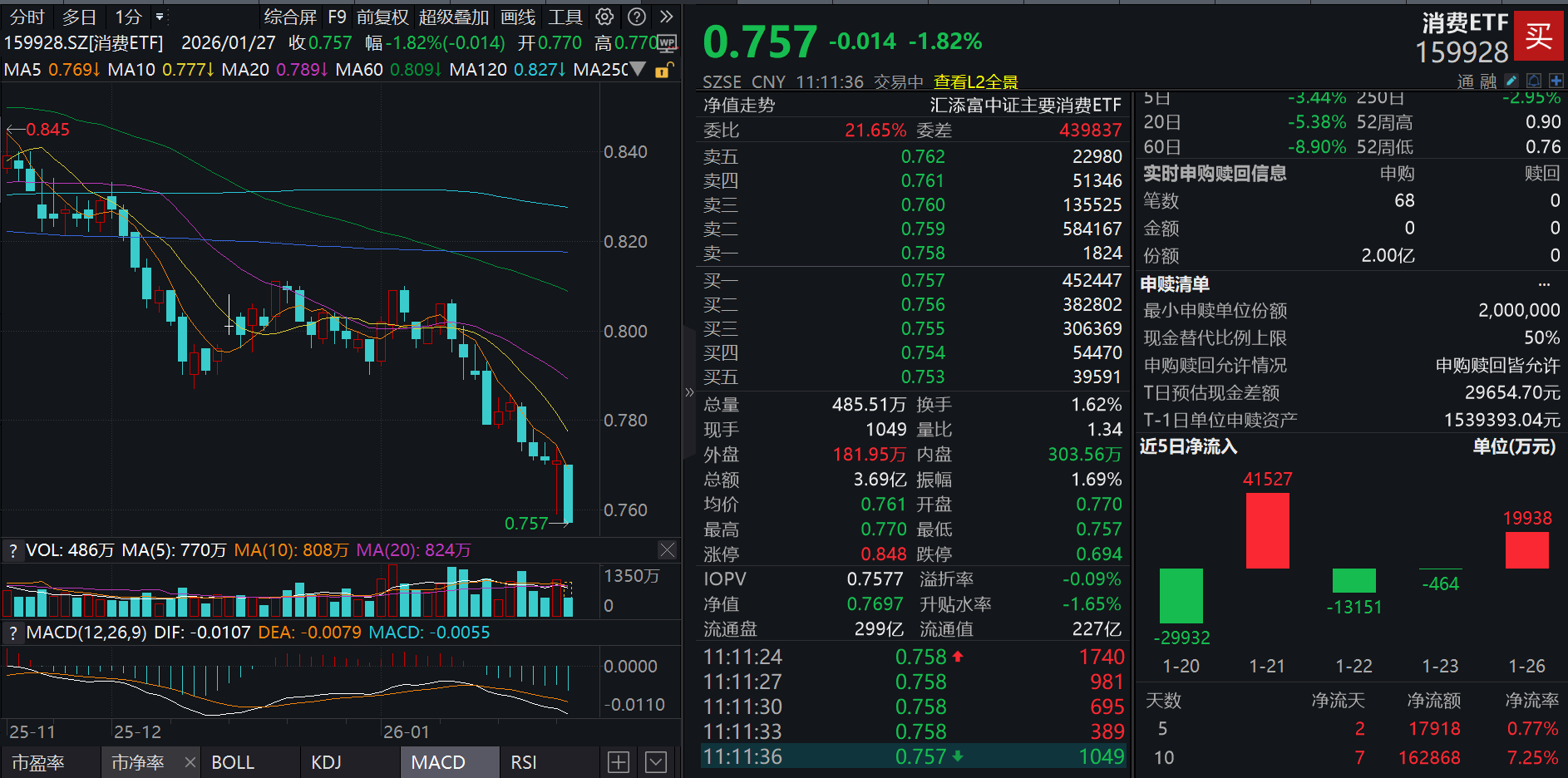
洋河股份净利预降六成,70亿分红承诺告吹,再跌超3%!消费ETF(159928)回调近2%,狂揽2亿份净申购!2026白酒板块如何看?
Xin Lang Cai Jing· 2026-01-27 03:35
Core Viewpoint - The liquor sector is experiencing a downturn, with Yanghe Co. seeing significant declines in stock prices and a bleak profit forecast for 2025, indicating a challenging environment for the industry [1][3]. Group 1: Company Performance - Yanghe Co. has forecasted a net profit decline of 62.18%-68.30% for 2025, estimating a loss of 1.451 billion to 1.859 billion yuan in Q4 2025 [1]. - The company has also retracted its previous commitment to a minimum 7 billion yuan dividend [1]. - Other major liquor companies like Wuliangye, Luzhou Laojiao, and Shanxi Fenjiu have also seen stock price declines, while Kweichow Moutai has shown slight gains [1]. Group 2: Market Trends - The consumption ETF has seen a near 2% drop, with a transaction volume of 400 million yuan, indicating a cautious market sentiment [2]. - The liquor sector is in a phase of inventory reduction and price stabilization, with companies adjusting their strategies in response to external pressures [3][6]. Group 3: Policy and Economic Environment - New policies aimed at boosting consumer spending are expected to be introduced, including measures to expand inbound consumption and promote the replacement of durable goods [1]. - The overall market sentiment is improving, with expectations that the worst period for liquor sales is over, aided by easing consumption restrictions [6]. Group 4: Investment Insights - The liquor sector is currently characterized by low expectations, low valuations, and low public fund holdings, presenting a potential buying opportunity [7]. - High dividend yields from leading liquor companies are expected to attract investors, as they commit to returning at least 100% of their net profits as dividends [7]. - Historical data suggests that high-end liquor stocks like Moutai and Wuliangye may lead the recovery in the sector, similar to past cycles [8].





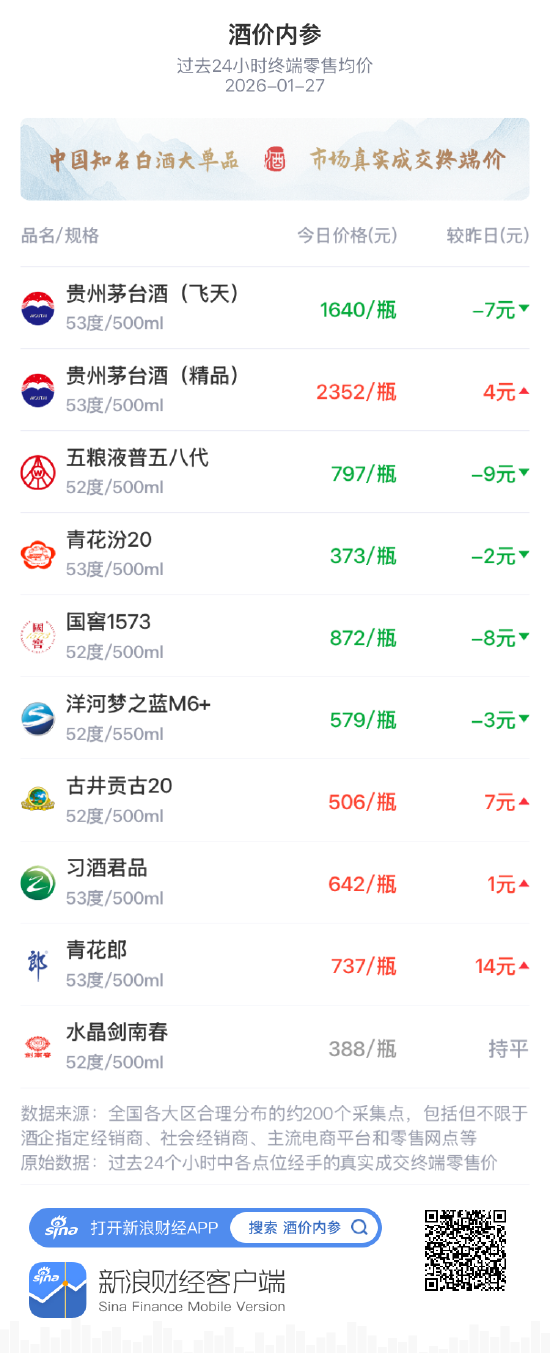
酒价内参1月27日价格发布 青花汾20下跌2元/瓶
Xin Lang Cai Jing· 2026-01-27 01:36
Core Insights - The Chinese liquor market is experiencing a mixed trend in retail prices for its top ten products, with an overall slight decline in total price [1][4] - The market shows signs of stabilization, with some products increasing in price while others decrease [1][4] Price Movements - The total retail price for a package of the top ten liquor products is 8886 yuan, down 3 yuan from the previous day [1] - Four products saw price increases, while five experienced declines, with one remaining stable [1] - The leading price increase was for Qinghua Lang, which rose by 14 yuan per bottle, marking five consecutive days of price growth [1][3] - Other notable increases include Gujing Gonggu 20 and Jingpin Moutai, which rose by 7 yuan and 4 yuan per bottle, respectively [1][2] - On the decline side, Wuliangye dropped by 9 yuan, and Guojiao 1573 fell by 8 yuan per bottle [1][2] Market Context - The data is sourced from approximately 200 collection points across various regions, aiming to provide an objective and traceable overview of the liquor market prices [4] - The introduction of new sales channels for Moutai products has begun to influence market prices, particularly for the Flying Moutai and Premium Moutai [4] - The liquor sector is currently navigating a challenging period, with institutional holdings at historical lows, yet there are signs of potential recovery as Moutai's sales exceed expectations [4]
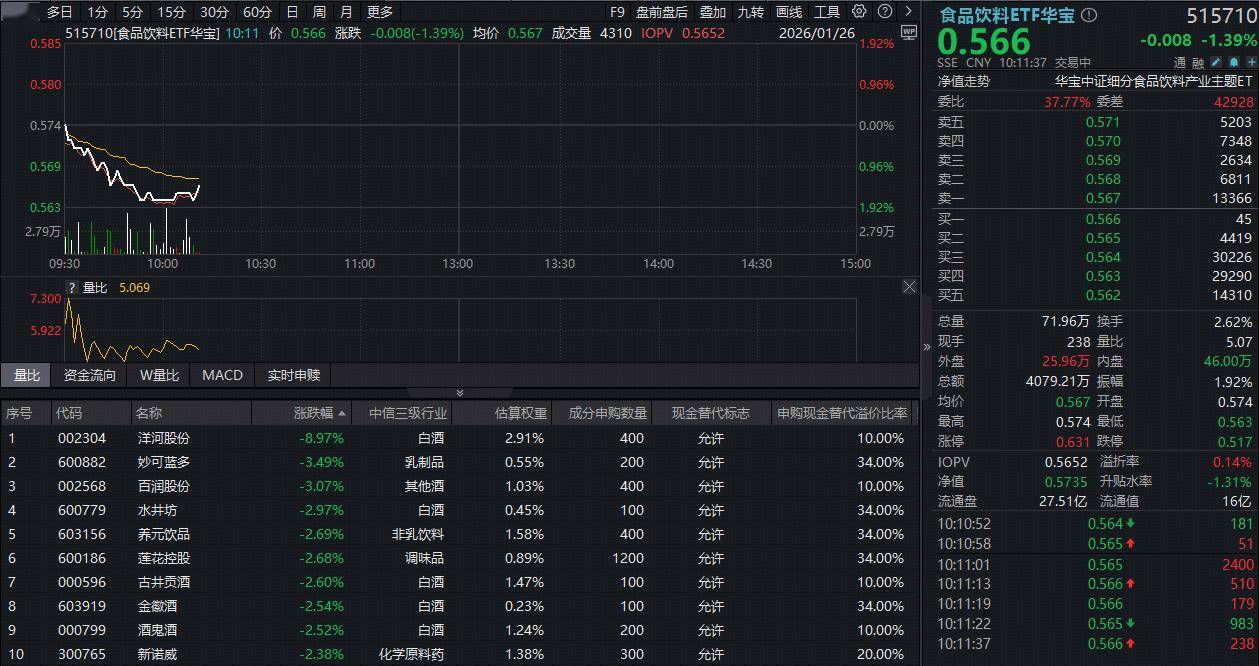
ETF盘中资讯|吃喝板块突遇“闪崩”!食品饮料ETF华宝(515710)跌超1%,估值低位布局正当时?
Sou Hu Cai Jing· 2026-01-26 02:53
Group 1 - The food and beverage sector continues to experience a downturn, with the Huabao Food and Beverage ETF (515710) showing a decline of 1.39% as of the latest report [1][2] - Major stocks in the sector, particularly in the liquor category, have seen significant drops, with Yanghe Distillery falling nearly 9% and other brands like Gujinggongjiu and Shuiwangfang dropping over 2% [1][2] - The recent performance reflects broader market trends, indicating a challenging environment for the food and beverage industry [1][3] Group 2 - The addition of new shipping warehouses in Nanjing and Beijing by "i Moutai" is a strategic response to increased order volumes and winter logistics challenges, enhancing customer experience [3] - The food and beverage sector's valuation is currently at a historical low, with the food index's price-to-earnings ratio at 19.39, suggesting a potential opportunity for investment [3][4] - Analysts predict a market trend where sectors like snacks and dairy are favored due to clear growth prospects, while the liquor sector is expected to stabilize as demand increases with the upcoming Spring Festival [3][4] Group 3 - The Huabao Food and Beverage ETF (515710) is heavily invested in leading high-end and mid-range liquor stocks, with significant allocations to brands like Moutai and Yili [4] - The ETF provides a way for investors to gain exposure to core assets in the food and beverage sector, with a focus on high-quality stocks [4][5] - Recent reports suggest that the liquor industry is showing signs of weak recovery, with potential for valuation improvement as economic conditions gradually enhance [4]


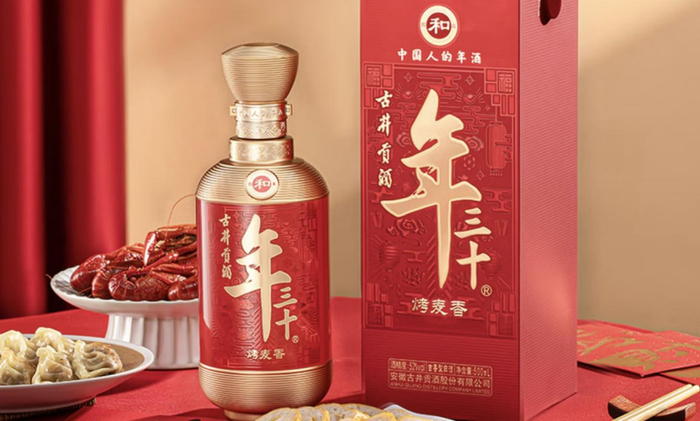
古井贡酒的“年味”答案:从春晚记忆到一杯“年三十”
Xin Lang Cai Jing· 2026-01-26 02:52
Core Viewpoint - Gujinggongjiu has successfully positioned itself as an integral part of the Chinese New Year celebration through its new product "Nian San Shi He," which aims to redefine the family reunion experience with an accessible price point and cultural significance [1][3][5] Group 1: Product Launch and Market Response - The new product "Nian San Shi He" is priced around 220 yuan, targeting a broader audience by making high-quality Chinese New Year liquor accessible for family gatherings [3][6] - The product quickly gained popularity, reaching the top 5 in liquor sales on Douyin on its launch day, with over 10,000 bottles sold within four days [3][6] - The design of the bottle resembles a lantern, symbolizing warmth and celebration, enhancing its appeal as a festive centerpiece [6][10] Group 2: Cultural and Strategic Significance - Gujinggongjiu has been a partner of the CCTV Spring Festival Gala for eleven consecutive years, embedding its brand into the cultural fabric of the holiday [5][13] - The product's name "Nian San Shi" evokes a shared cultural memory among Chinese people, while the suffix "He" emphasizes harmony and family unity, aligning with deep-rooted cultural values [5][8] - The strategic focus on cultural attributes rather than just taste positions Gujinggongjiu uniquely in a competitive market, aiming to resonate with consumers' emotional connections to family and tradition [13] Group 3: Marketing and Consumer Engagement - The pricing strategy of 220 yuan is designed to balance between premium gifting and everyday consumption, targeting families and social gatherings [10][11] - Online marketing initiatives, such as the "Global Spring Couplets Collection" and "Show Your Nian San Shi" campaigns, effectively engage consumers and create a festive atmosphere around the product [11][13] - The brand aims to transform cultural resonance into consumer action, creating a complete festive experience that integrates the product into the New Year celebration [11][13]
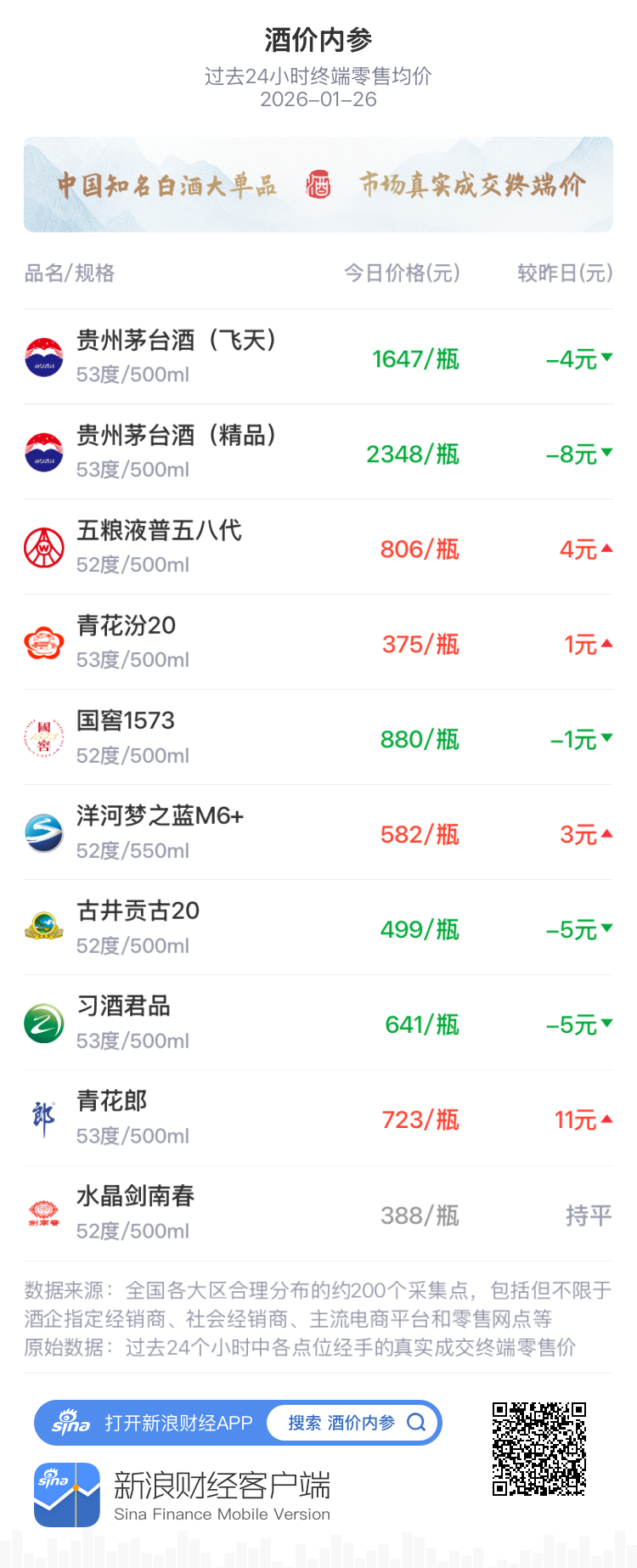
酒价内参1月26日价格发布 十大单品涨跌互现青花郎领涨
Xin Lang Cai Jing· 2026-01-26 01:17
Core Viewpoint - The Chinese liquor market is experiencing a weak price differentiation among the top ten products, with a slight overall decline in retail prices, indicating a phase of market rebalancing [1]. Price Trends - The total retail price for a package of the top ten liquor products is 8,889 yuan, down by 4 yuan from the previous day [1]. - The market shows four products increasing in price, five decreasing, and one remaining stable [1]. Price Increases - Qinghua Lang leads the price increase with an 11 yuan rise per bottle, marking four consecutive days of price growth [1]. - Wuliangye and Mengzhilan M6+ saw increases of 4 yuan and 3 yuan per bottle, respectively, providing support in the mid-range segment [1]. - Qinghua Fen 20 experienced a slight increase of 1 yuan per bottle [1]. Price Decreases - Premium Moutai saw a price drop of 8 yuan per bottle [1]. - Xijiu Junpin and Gujing Gonggu 20 both decreased by 5 yuan per bottle [1]. - Feitian Moutai fell by 4 yuan per bottle due to normalized supply from the iMoutai platform [1]. - Guojiao 1573 experienced a minor decline of 1 yuan per bottle [1]. - Shujin Jianan Spring's price remained unchanged from the previous day [1]. Specific Product Prices - Feitian Moutai: 1,647 yuan per bottle, down 4 yuan [3]. - Premium Moutai: 2,348 yuan per bottle, down 8 yuan [3]. - Wuliangye: 806 yuan per bottle, up 4 yuan [3]. - Qinghua Fen 20: 375 yuan per bottle, unchanged [3]. - Guojiao 1573: 880 yuan per bottle, down 1 yuan [3]. - Mengzhilan M6+: 582 yuan per bottle, up 3 yuan [4]. - Gujing Gonggu 20: 499 yuan per bottle, down 57 yuan [4]. - Xijiu Junpin: 641 yuan per bottle, down 57 yuan [4]. - Qinghua Lang: 723 yuan per bottle, up 11 yuan [4]. - Shujin Jianan Spring: 388 yuan per bottle, unchanged [4].
湖北和广东调研反馈、周观点:啤酒推新蓄力,烘焙旺季稳健-20260125
GOLDEN SUN SECURITIES· 2026-01-25 11:22
Investment Rating - The report maintains an "Accumulate" rating for the food and beverage industry [5] Core Insights - The upcoming Spring Festival is expected to boost sales in the liquor sector, with Moutai leading the industry towards an unexpected improvement. Short-term focus should be on the demand for the Spring Festival, while medium-term investments should target leading brands across various price segments [1] - In the beer segment, new product launches are being prepared, with a focus on high-growth channels and consumer trends towards personalized and diversified consumption [2] - The baking sector is showing stable performance, with companies like Lihigh Foods preparing for the sales peak and benefiting from favorable policies regarding cream products [3] Summary by Relevant Sections Liquor Sector - The Spring Festival is driving demand, with Moutai expected to lead the market. Key short-term stocks include Guizhou Moutai, Guo Jiu Gong Jiu, and others, while medium-term focus should be on Wuliangye and Shanxi Fenjiu [1] Beer Sector - Current beer sales are in a low season, but new product launches and high growth in instant retail channels are promising. Companies like Chongqing Beer are launching new 1L cans to meet consumer preferences [2] Food Sector - Lihigh Foods is preparing for the sales peak with a focus on quality over quantity, while Anqi Yeast is benefiting from declining sugarcane prices, enhancing profit margins [3] - Yizhi Konjac is experiencing rapid demand growth, with a stable supply chain and product innovation driving its market position [4]



食品饮料行业研究:飞天茅台动销逐步起势,关注子版块春节备货催化
SINOLINK SECURITIES· 2026-01-25 07:50
Investment Rating - The report maintains a cautious outlook on the liquor industry, particularly on high-end liquor such as Moutai, with expectations of gradual recovery in sales and pricing stability post-Spring Festival [10][11][12]. Core Insights - The high-end liquor segment, especially Moutai, is experiencing a sales boost as the Spring Festival approaches, with expectations of price recovery due to increased demand driven by wealth effects [10][11]. - The report suggests that the market's concerns about post-festival price drops for Moutai are likely to be unfounded, predicting only minor seasonal fluctuations [10][12]. - The overall sentiment in the liquor industry is shifting from a pessimistic outlook to a more stable one, with expectations of improved sales dynamics as external constraints on consumption ease [11][12]. Summary by Sections Liquor Industry - The report highlights that Moutai's sales are performing better than previously cautious expectations, leading to a price recovery for both Moutai and newer Moutai products [10]. - It is noted that the market is still wary of potential price declines after the Spring Festival, but historical patterns suggest only minor adjustments are likely [10][11]. - The report emphasizes the importance of brand strength and market positioning for high-end liquor companies, recommending investments in brands with strong market presence and growth potential [12]. Beer Industry - The beer sector is seeing a steady recovery in on-premise consumption, with companies diversifying into non-drink channels and soft drinks [12]. - The report suggests that the beer industry's performance is expected to stabilize, with a focus on maintaining competitive pricing and improving dividend yields [12]. Snack Industry - The snack sector is benefiting from pre-Spring Festival stocking and product innovation, with companies like Qiaqia and Ganyuan expected to show significant profit elasticity due to low comparative bases [14]. - The report recommends focusing on leading snack companies that are expanding their store presence and adapting their product offerings [14]. Beverage Industry - The soft drink sector is currently facing challenges due to seasonal demand fluctuations and competition from ready-to-drink tea brands, leading to a slight decline in overall sales growth [14]. - Despite these challenges, leading brands like Dongpeng and Nongfu are expected to maintain double-digit growth through brand strength and market share consolidation [14]. Seasoning Industry - The seasoning sector is stabilizing as restaurant demand begins to recover, with expectations of improved performance in 2026 driven by seasonal effects [15]. - The report highlights companies like Angel Yeast and Qianhe Condiments as having strong growth potential due to favorable market conditions and dividend yields [15].

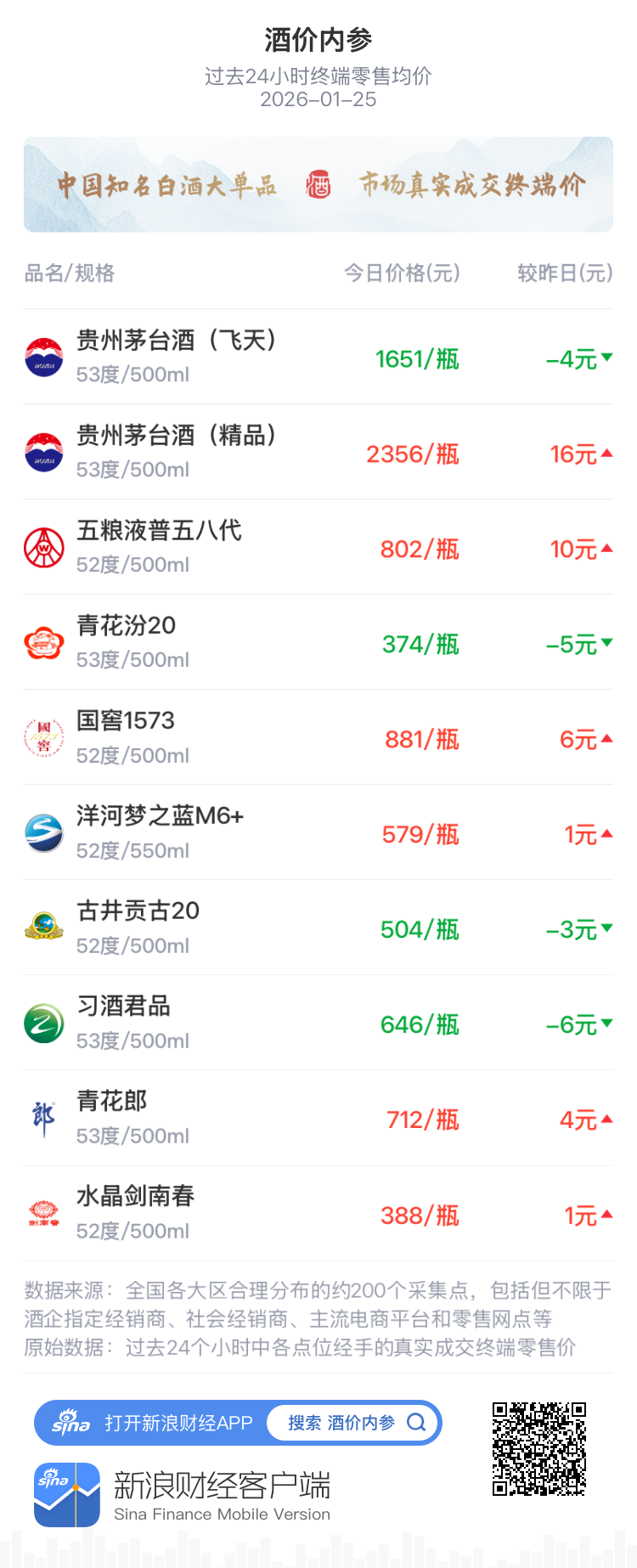
酒价内参1月25日价格发布 十大单品结构性回升精品茅台领涨
Xin Lang Cai Jing· 2026-01-25 01:12
Core Insights - The Chinese white liquor market has experienced a structural rebound in retail prices for the top ten products as of January 25, with an overall average price of 8,893 yuan, an increase of 20 yuan from the previous day, marking a five-day high [1] - The market shows a mixed performance with six products increasing in price and four decreasing, indicating ongoing structural adjustments within the industry [1] Price Movements - The premium Moutai (Jingpin) saw the largest increase, rising by 16 yuan to 2,356 yuan per bottle [3] - Wuliangye (Pu Wu 58) increased by 10 yuan to 802 yuan per bottle, contributing significantly to the average price rise [3] - Other notable increases include Guojiao 1573 (+6 yuan), Qinghua Lang (+4 yuan), and slight increases for Yanghe Dream Blue M6+ and Shuijing Jian Nan Chun (+1 yuan each) [1][4] Declines in Prices - The price of Xijiu Junpin decreased by 6 yuan to 646 yuan per bottle [4] - Qinghua Fen 20 dropped by 5 yuan, while Feitian Moutai faced a slight decline of 4 yuan due to consistent supply from the iMoutai platform [1][4] - Other declines include Gujing Gong Gu 20, which fell by 3 yuan [4]
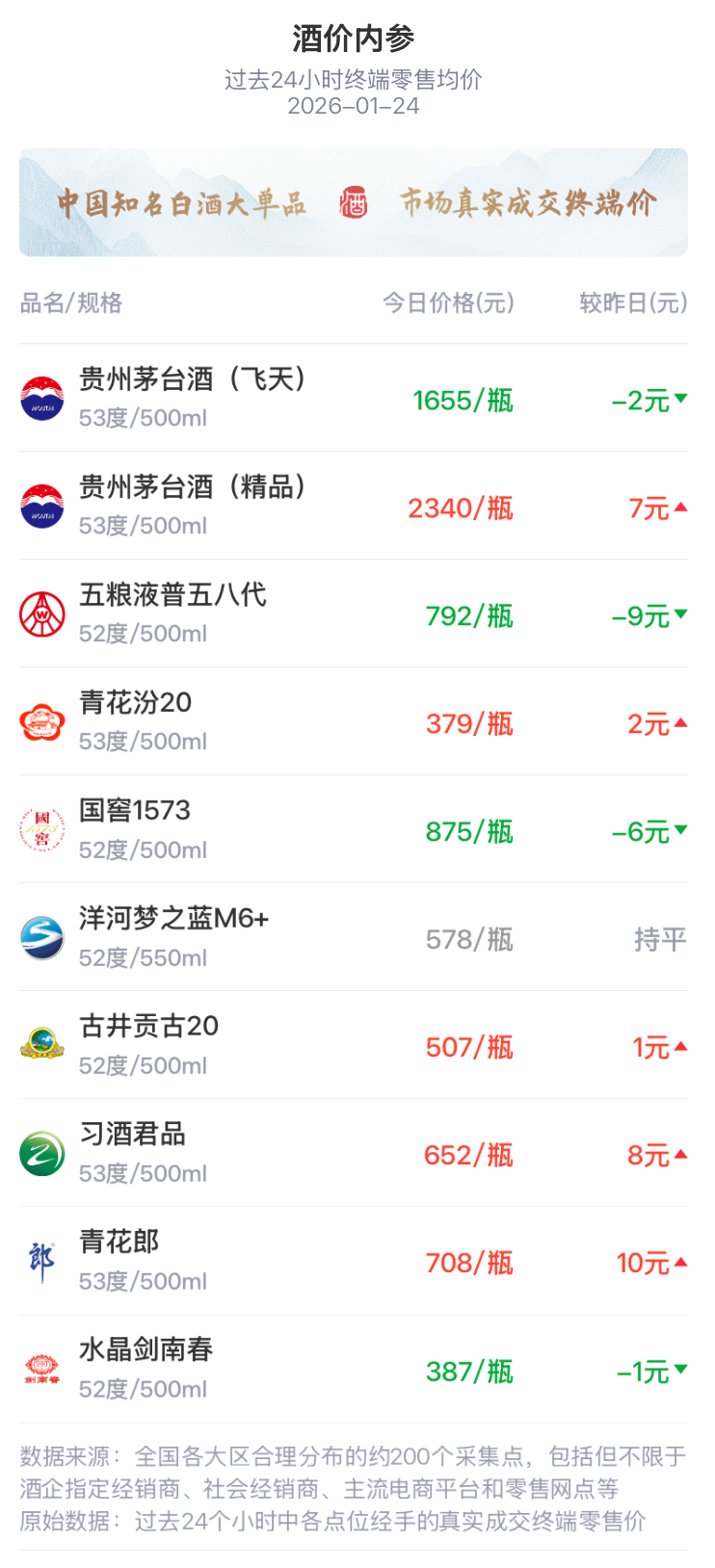
酒价内参1月24日价格发布 价格小幅回暖创四日新高
Xin Lang Cai Jing· 2026-01-24 01:10
Core Viewpoint - The Chinese liquor market shows signs of a slight recovery in retail prices for the top ten products as of January 24, with an overall average price of 8,873 yuan, an increase of 10 yuan from the previous day. However, the market remains cautious with structural fluctuations dominating the short-term outlook [1]. Price Movements - Among the top ten liquor products, five experienced price increases, four saw declines, and one remained stable. The overall average price remained relatively stable [1]. - The leading price increase was observed in Qinghua Lang, which rose by 10 yuan per bottle. Xijiu Junpin followed with an increase of 8 yuan per bottle, while the price of premium Moutai rose by 7 yuan per bottle [1]. - Other products that saw slight increases include Qinghua Fen 20 and Gujing Gong Gu 20, which rose by 2 yuan and 1 yuan per bottle, respectively [1]. Declining Prices - The product with the largest decline was Wuliangye Pu 58th generation, which fell by 9 yuan per bottle. Guojiao 1573 also saw a decrease of 6 yuan per bottle, and Feitian Moutai dropped by 2 yuan per bottle, primarily due to the continued supply of low-priced goods on the iMoutai platform [1][3]. - Additionally, Shuijing Jian Nan Chun experienced a minor decline of 1 yuan per bottle, while Yanghe Dream Blue M6+ remained unchanged at 578 yuan [1][4].