
GREE(000651)

Search documents
董明珠:坚持信念,随时准备“战斗”|我们的四分之一世纪
Jing Ji Guan Cha Wang· 2025-12-26 02:34
Core Viewpoint - The article highlights the journey and philosophy of Dong Mingzhu, the chairwoman of Gree Electric Appliances, emphasizing her commitment to national industry and technological independence as key drivers for the company's success and future direction [3][4][28]. Group 1: Company Development - Gree Electric Appliances transformed from a small air conditioning assembly factory with annual sales of 20 million to a publicly listed company under Dong Mingzhu's leadership [3][7]. - The company was established in 1991, and by 2005, it became the world's largest air conditioning manufacturer, achieving significant milestones in production and sales [8][12]. - In 2012, Gree surpassed Daikin to become the market leader in China's central air conditioning sector, marking a significant achievement for domestic brands [12][14]. Group 2: Technological Independence - Dong Mingzhu emphasized the importance of core technology for the company's survival and growth, leading Gree to invest in research and development, particularly in compressors and motors [11][13]. - Gree's strategic shift towards technological independence included the development of its own CNC machine tools, which are critical for enhancing manufacturing capabilities [14][15]. - The company has also made strides in chip production, with plans to achieve self-sufficiency in chip supply, which is essential for maintaining product quality and competitiveness [17][18]. Group 3: Market Position and Strategy - Gree has chosen not to participate in the ongoing price wars within the home appliance industry, which has resulted in a revenue decline of 6.5% year-on-year in the first three quarters of 2025 [24][26]. - The company maintains a commitment to quality over price, believing that low initial costs can lead to higher long-term expenses for consumers [25][26]. - Dong Mingzhu's leadership style is characterized by a readiness to confront challenges and controversies, reinforcing the company's position as a leader in the industry [27][28].


格力探路“中国智造”新范式——走进格力电器珠海金湾智能工厂
Zheng Quan Ri Bao Zhi Sheng· 2025-12-25 16:41
Core Viewpoint - Gree Electric's Zhuhai Jinwan Factory has been recognized as a "leading intelligent factory" by the Ministry of Industry and Information Technology, showcasing a new paradigm of "Chinese manufacturing" through advanced automation and AI integration [1][2]. Group 1: Intelligent Manufacturing - The factory employs advanced robotic technology that mimics human movements, enhancing efficiency and precision in tasks such as packaging [2]. - Automated welding equipment operates with precise temperature control, allowing robots to adapt welding parameters in real-time based on material specifications, marking a first in the industry [3]. - Quality control is enhanced through a digital system that monitors vacuum processes and visual inspections, ensuring that any impurities lead to automatic halting of production [4]. Group 2: Workforce Transformation - The workforce has been reduced from over 70 to 20, focusing on skilled workers who manage technology rather than performing manual labor [4]. - The company encourages employees to obtain certifications in robotics and programming, providing financial support for training [4]. Group 3: Data Integration and AI - An "industrial brain" integrates data across the entire production process, improving efficiency and reducing errors in production planning [5]. - AI models are deployed at both the device level and cloud level, allowing for real-time processing and coordination across thousands of devices and suppliers [6]. Group 4: Industry Solutions and Collaboration - The factory aims to produce not only air conditioning units but also replicable standards and models for intelligent manufacturing [7]. - Gree Electric connects over 20,000 suppliers through an industrial internet platform, enhancing supply chain efficiency and production capabilities [8]. - The company offers modular solutions for small and medium enterprises to facilitate gradual upgrades in their smart manufacturing processes [8][9]. Group 5: Future Directions - Gree Electric is exploring further advancements in hardware intelligence and software ecosystems to achieve a data-driven transformation in manufacturing [10].
家用电器行业2026年年度策略:积跬步以至千里
Caixin Securities· 2025-12-25 10:16
Group 1 - The home appliance industry has shown a cumulative increase of 8.06% in 2025, underperforming the CSI 300 index by 10.43 percentage points, ranking 21st among 31 sub-industries [11] - The performance of various sub-sectors in the home appliance industry varies significantly, with white goods, black goods, small appliances, kitchen and bathroom appliances, lighting equipment, and appliance components showing respective changes of -1.12%, 12.55%, 9.52%, -0.74%, 11.87%, and 64.69% [11] - The industry is experiencing a high base effect from previous government subsidies, leading to a slowdown in growth rates [11] Group 2 - The home appliance sector's operating performance in 2025 has shown a trend of high performance in the first half of the year followed by a decline, with revenue and net profit growth rates of 7.34% and 10.17% respectively in the first three quarters [17] - The white goods sector remains stable, while the small appliances sector shows signs of stabilization; kitchen and lighting appliances are struggling due to a lack of growth momentum linked to the real estate market [18] - The overall market is witnessing a structural decline in product prices, with increased concentration in the industry as leading brands capture more market share [49][56] Group 3 - The government subsidy policy's marginal effect is diminishing, with retail sales of home appliances showing a year-on-year increase of 20.10% from January to October 2025, but a significant drop to -14.60% in October [37] - The sales of air conditioners and washing machines have shown steady growth, with respective online and offline retail sales growth rates of 10.00% and 8.00% for air conditioners [41] - Emerging categories like cleaning appliances are expected to perform well, with significant growth in sales for products like robotic vacuum cleaners and washing machines [44] Group 4 - The current valuation of the home appliance sector is at a low point, with a PE ratio of 16.09, which is in the 27.20th percentile of the past decade, indicating potential for upward adjustment [25] - The fluctuation in raw material prices has a limited impact on profitability, with the overall gross margin for the industry at 24.28% and net margin at 8.19% as of Q3 2025 [33] - The industry is adapting to rising costs through product structure upgrades and supply chain management, maintaining a strong profitability despite cost pressures [36]




白色家电板块12月25日跌0.02%,澳柯玛领跌,主力资金净流出2.89亿元
Zheng Xing Xing Ye Ri Bao· 2025-12-25 09:08
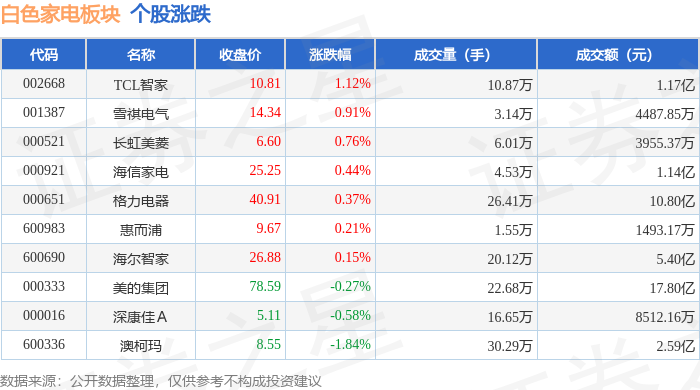
Core Viewpoint - The white goods sector experienced a slight decline of 0.02% on December 25, with Aucma leading the drop, while the Shanghai Composite Index rose by 0.47% and the Shenzhen Component Index increased by 0.33% [1] Group 1: Market Performance - The closing price for TCL Smart Home was 10.81, with an increase of 1.12% and a trading volume of 108,700 shares, amounting to 117 million yuan [1] - Snowball Electric closed at 14.34, up by 0.91%, with a trading volume of 31,400 shares [1] - Changhong Meiling's closing price was 6.60, reflecting a 0.76% increase with a trading volume of 60,100 shares [1] - Hisense Home Appliances closed at 25.25, up by 0.44%, with a trading volume of 45,300 shares [1] - Gree Electric Appliances closed at 40.91, increasing by 0.37% with a trading volume of 264,100 shares [1] - Whirlpool closed at 9.67, up by 0.21%, with a trading volume of 15,500 shares [1] - Haier Smart Home closed at 26.88, reflecting a 0.15% increase with a trading volume of 201,200 shares [1] - Midea Group closed at 78.59, down by 0.27%, with a trading volume of 226,800 shares [1] - Deep Konka A closed at 5.11, down by 0.58%, with a trading volume of 166,500 shares [1] - Aucma closed at 8.55, leading the decline with a drop of 1.84% and a trading volume of 302,900 shares [1] Group 2: Capital Flow - The white goods sector saw a net outflow of 289 million yuan from main funds, while retail investors contributed a net inflow of 228 million yuan [1] - TCL Smart Home experienced a net inflow of 1.38 million yuan from main funds, while retail investors had a net inflow of 589,560 yuan [2] - Changhong Meiling had a net inflow of 4.08 million yuan from main funds, but saw outflows from both retail and speculative funds [2] - Aucma faced a significant net outflow of 33.82 million yuan from main funds, while retail investors contributed a net inflow of 13.64 million yuan [2] - Gree Electric Appliances had a net outflow of 68.64 million yuan from main funds, with retail investors contributing a net inflow of 41.71 million yuan [2]


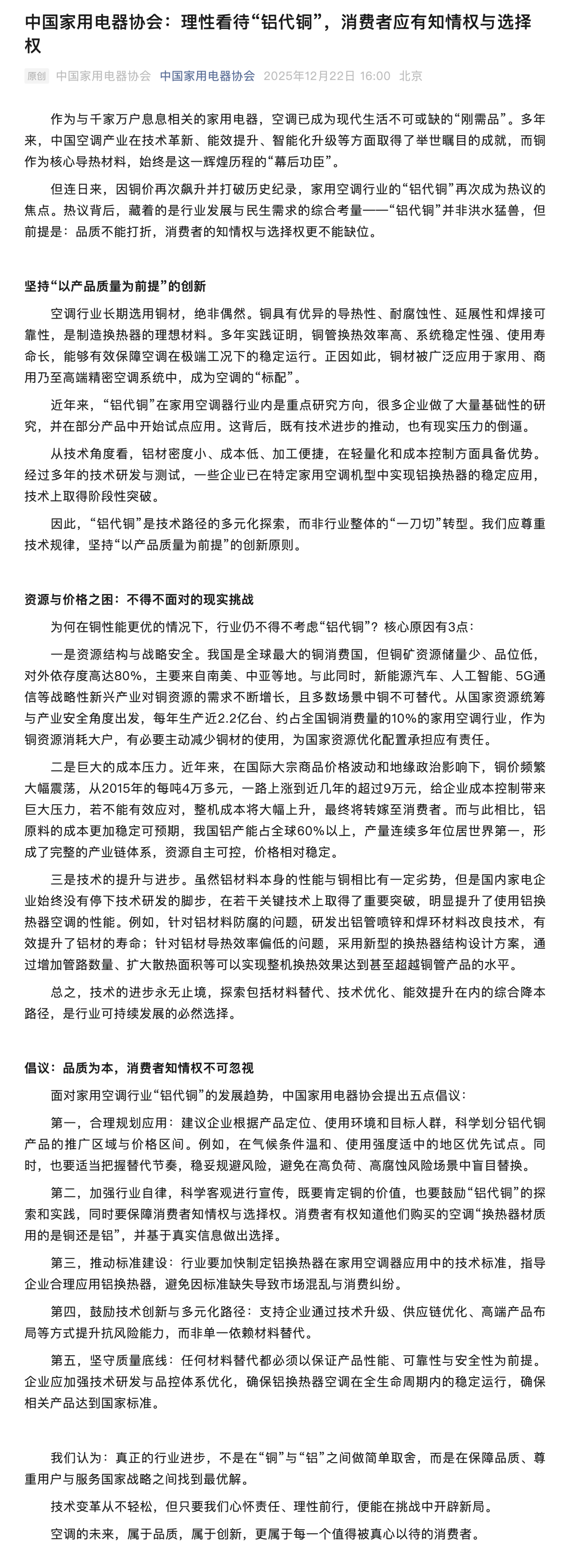
格力称暂无“铝代铜”计划,董明珠曾称“在没有100%的把握前,格力空调绝不使用;此前美的、小米等品牌推动“铝代铜”标准落地引热议
Hang Zhou Ri Bao· 2025-12-24 04:51
Core Viewpoint - The air conditioning industry is actively exploring the use of aluminum as a substitute for copper, but significant technical challenges remain, particularly regarding the performance and reliability of aluminum compared to copper [1][2][3]. Group 1: Company Insights - Gree Electric stated that copper constitutes about 20% of air conditioning costs, and despite aluminum being cheaper, it currently lacks the performance and reliability of copper, leading to no immediate plans for aluminum substitution [1][2]. - Gree's Chairman, Dong Mingzhu, emphasized that while aluminum can technically replace copper, the company will not adopt it until it meets the same technical standards as copper [1][2]. - The rising copper prices, which have exceeded $10,000 per ton, have prompted discussions about aluminum substitution as a cost-reduction strategy in the industry [1][3]. Group 2: Industry Developments - The Chinese home appliance industry is accelerating the development of standards for aluminum substitution, with various companies participating in the formulation of guidelines and standards [2][4]. - A group of leading air conditioning companies, including Haier and Midea, has committed to a self-regulatory agreement to promote responsible communication regarding aluminum heat exchangers [2][4]. - The China Household Electrical Appliances Association has proposed five initiatives to guide the responsible application of aluminum in air conditioning, emphasizing quality assurance and consumer rights [4][5]. Group 3: Technical Challenges - The primary challenges in substituting aluminum for copper include aluminum's inferior thermal conductivity, corrosion resistance, and long-term reliability, which necessitate further technological advancements [2][8]. - The complexity of aluminum welding processes poses additional challenges for manufacturers, requiring enhanced capabilities and skills [2][8]. - Despite the challenges, the industry is making progress in developing aluminum technologies, with some companies achieving breakthroughs in specific applications [7][9]. Group 4: Market Dynamics - China is the largest producer and consumer of air conditioning units, with about 80% of its copper supply imported, while it controls 60% of global aluminum production, making aluminum a more stable resource option [1][8]. - The significant cost pressures from fluctuating copper prices have led the industry to consider aluminum as a viable alternative to maintain competitive pricing [9][10]. - The ongoing technological advancements in aluminum materials aim to enhance their performance, making them a more feasible option for air conditioning applications in the future [9][10].
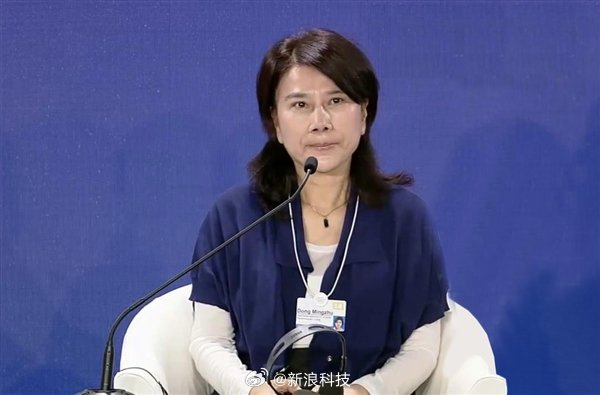
格力电器重申暂不采用铝代铜技术,董明珠强调耐久性稳定性未达标
Xin Lang Ke Ji· 2025-12-24 01:22
Core Viewpoint - Gree Electric Appliances has announced that it currently has no plans to replace copper with aluminum in its products, emphasizing that the technology has not yet reached a standard that the company deems acceptable [1] Group 1 - Gree Electric Appliances stated that even if the entire industry shifts to aluminum, the company will not follow suit due to concerns over the durability and stability of aluminum [1] - Chairman Dong Mingzhu expressed that without complete confidence in the material's performance, Gree will not adopt aluminum as a substitute for copper [1] - The company prioritizes quality and reliability, indicating that it will not compromise on standards for the sake of following industry trends [1]
格力电器称暂无铝代铜计划,铜材性能更可靠
Bei Ke Cai Jing· 2025-12-23 14:23
Core Viewpoint - Gree Electric Appliances has no plans to replace copper with aluminum in its air conditioning products due to the superior performance and reliability of copper as a core material [1] Group 1: Material Comparison - Copper accounts for approximately 20% of the cost of air conditioners [1] - While aluminum costs about 1/12 of copper, its performance in terms of melting point, thermal conductivity, resistivity, corrosion resistance, and long-term reliability is significantly inferior to that of copper [1] Group 2: Future Plans - The company is focusing on research related to aluminum substitution technology and will continue to monitor industry trends [1]
格力电器:格力视产品质量为企业生命,自2021年在行业率先推出内销家用空调十年免费包修政策
Zheng Quan Ri Bao Wang· 2025-12-23 13:44
Core Viewpoint - Gree Electric Appliances emphasizes product quality as vital to its business, having introduced a ten-year free repair policy for domestic air conditioners in 2021, leading the industry in this initiative [1] Group 1: Product Quality and Strategy - The company considers copper as a core raw material for air conditioners, accounting for approximately 20% of the total cost [1] - Although aluminum costs about 1/12 of copper in terms of material price (approximately 1/4 in price and 1/3 in density), the company has no plans to replace copper with aluminum due to significant differences in parameters such as melting point, thermal conductivity, resistivity, corrosion resistance, and long-term reliability [1] - The company is committed to researching aluminum-to-copper technology and will continue to monitor industry trends [1]
格力电器:暂无铝代铜计划 因铜材性能更可靠
Ge Long Hui A P P· 2025-12-23 13:33
Core Viewpoint - Gree Electric Appliances emphasizes that copper is a core raw material for air conditioners, accounting for approximately 20% of the total cost, and currently has no plans to replace copper with aluminum due to performance and reliability concerns [1] Group 1: Material Cost Analysis - Copper constitutes about 20% of the air conditioning cost, while aluminum costs approximately 1/12 of copper [1] - The price of aluminum is around 1/4 that of copper, and its density is about 1/3 of copper [1] Group 2: Performance Comparison - Despite the cost advantages of aluminum, it falls short in several critical parameters such as melting point, thermal conductivity, resistivity, corrosion resistance, and long-term reliability compared to copper [1] Group 3: Future Research and Development - The company is actively researching aluminum substitution technology and will continue to monitor industry trends [1]
格力电器:公司暂时没有铝代铜计划
Xin Lang Cai Jing· 2025-12-23 10:17
Core Viewpoint - Gree Electric Appliances emphasizes that copper is a core raw material for air conditioners, accounting for approximately 20% of the total cost, and currently has no plans to replace copper with aluminum due to performance and reliability concerns [1] Group 1 - Copper is a critical material in air conditioning production, making up about 20% of the cost [1] - Aluminum costs about 1/12 of copper, with a price approximately 1/4 of copper, and a density around 1/3 of copper [1] - Despite the cost advantages of aluminum, its performance in terms of melting point, thermal conductivity, resistivity, corrosion resistance, and long-term reliability is significantly inferior to that of copper [1] Group 2 - The company is actively researching aluminum substitution technology and will continue to monitor industry trends [1]