
GREE(000651)

Search documents
2025年中国除湿机行业政策、发展历程、产业链、发展规模、市场集中度、重点企业及发展趋势研判:随着应用场景的不断拓展,需求不断增加,增长潜力强劲[图]
Chan Ye Xin Xi Wang· 2025-12-22 01:16
Core Viewpoint - The dehumidifier market in China is experiencing significant growth due to increasing awareness of indoor environmental quality, technological advancements, and expanding applications in various sectors such as biomedicine, data centers, and new energy battery production [1][6]. Industry Definition and Classification - Dehumidifiers, also known as moisture removers, consist of components such as compressors, heat exchangers, air duct systems, water tanks, controllers, and casings [2][4]. - They can be categorized based on usage scenarios (household, commercial, industrial), dehumidification methods (refrigeration, wheel, solution), and functionalities (standard, cooling, temperature control, multifunctional) [3][4]. Market Demand and Supply - In 2024, China's dehumidifier production is projected to reach 12.95 million units, with a demand of 1.83 million units and a market size of 2.566 billion yuan; by 2025, production is expected to be 12.09 million units, demand 1.75 million units, and market size 2.407 billion yuan [6][8]. - The household dehumidifier segment dominates the market, accounting for approximately 63.91% in 2024, with commercial and industrial dehumidifiers making up 18.36% and 17.73%, respectively [8]. Industry Development Environment - The Chinese government has implemented various policies to encourage the development of the dehumidifier industry, including measures to promote green and intelligent home appliance consumption [4][5]. Industry Chain - The upstream of the dehumidifier industry includes key raw materials and components such as compressors, fans, heat exchangers, water tanks, and controllers, while the midstream involves manufacturing, and the downstream applications span households, commercial, and industrial sectors [10][11]. Competitive Landscape - The domestic dehumidifier market features a mix of major home appliance companies (e.g., Midea, Gree, Haier) and specialized brands (e.g., Deye, Oujing) [14][15]. - The market is characterized by a "domestic-led + imported high-end coexistence" structure, with domestic brands focusing on mid-to-high-end markets and imported brands targeting high-end segments [14][15]. Key Companies - Deye Technology Co., Ltd. is a leading player in the dehumidifier market, focusing on innovation and high-end industrial dehumidifiers, with a projected total cost of 635 million yuan for its products in 2024 [12][17]. - Oulun Electric Co., Ltd. has established a comprehensive product system covering household, commercial, and industrial dehumidifiers, with dehumidifier revenue accounting for approximately 55.15% of its total revenue in 2024 [19]. Industry Trends - The dehumidifier industry is moving towards smart, energy-efficient, and environmentally friendly solutions, with a focus on enhancing user experience and expanding market demand [20][21]. - There is a trend towards customized products for specific scenarios and the integration of multiple functions, such as dehumidification combined with air purification and temperature control [21][22]. - The industry is expected to see increased concentration, with leading companies leveraging technology and scale to maintain competitive advantages, while niche players may find opportunities in specialized markets [22][23].






家电行业2025W50周报:家空内外销均有所承压,iRobot官宣破产重组-20251221
GUOTAI HAITONG SECURITIES· 2025-12-21 11:36
Investment Rating - The industry investment rating is "Overweight" [5] Core Insights - The home appliance industry is experiencing pressure in both domestic and international sales, with iRobot announcing bankruptcy restructuring, which will be acquired by Chinese manufacturer Shanjun Robotics [2][5] - In November, the retail sales of home appliances and audio-visual equipment reached 100 billion yuan, a year-on-year decline of 19.4%, while the cumulative annual sales reached 1,074.9 billion yuan, with a year-on-year increase of 14.8% [5] - The production and sales data for home air conditioners in November showed a production of 10.577 million units, a year-on-year decrease of 36.7%, and sales of 10.492 million units, a year-on-year decrease of 31.8% [5] Summary by Sections Investment Recommendations - Key drivers for investment include overseas expansion and smart home technology, recommending leading companies in the robotic vacuum sector: Roborock (21.1X 2025 PE) and Ecovacs (21.5X) [5] - Companies with stable performance and upward potential include Ninebot (20.6X), Anfu Technology (41.7X), Hailong Cold Chain (14.6X), and Beiding Co. (30.4X) [5] - For companies with robust operations and high dividends, recommendations include TCL Electronics (12.2X), Hisense Visual (12.9X), Midea Group (13.5X), and Haier Smart Home (12.2X) [5] - Companies diversifying into new sectors include Rongtai Health (18.7X) and Wanlong Magnetic Plastic (18.9X) [5] Market Performance - The retail sales growth rate further narrowed in November, with the total retail sales of consumer goods reaching 43,898 billion yuan, a year-on-year increase of 1.3% [5] - The domestic market faces pressure from the decline in national subsidies and high base effects, while the export market is constrained by high base effects and inventory reduction in some overseas markets [5] Company Developments - iRobot has announced its bankruptcy and will be acquired by Shanjun Robotics, with the restructuring process expected to be completed by February 2026 [5] - The founder of Chasing Technology, Yu Hao, plans to acquire 54.90% of Jiamei Packaging, with a total transaction value of approximately 2.282 billion yuan [5]



野村- 耐用品26年投资策略 - 坚定出海搏增长,关注美洲与新兴市场机遇
野村· 2025-12-21 11:01
Investment Rating - The report maintains a positive investment outlook for companies focusing on overseas markets, particularly in the Americas and emerging markets, despite challenges in domestic sales [4][5]. Core Insights - The report emphasizes the importance of "going abroad" as a key strategy for growth, with expectations for better investment returns from overseas-focused companies in 2026, especially as domestic demand faces pressures from policy and market conditions [4][5]. - It identifies three main factors suppressing domestic sales of durable goods: the depletion of government subsidies, high base effects, and weak housing transaction demand [5][6]. - The report suggests that companies with strong operational performance and low valuations, as well as those benefiting from policy or technological catalysts, are potential investment opportunities [5][6]. Summary by Sections 2025 Review - The report notes that the home appliance and light industry sectors have underperformed compared to the CSI 300 index, primarily due to weakening domestic demand and external tariff disruptions [9][11]. - It highlights that the home appliance sector has faced challenges from declining government subsidies and ongoing tariff issues, leading to a significant drop in export performance [9][10]. 2026 Outlook - The report anticipates that domestic housing demand will continue to decline, with new housing starts and sales expected to drop by 4.8% in 2026 [36][39]. - It predicts that the overseas sales performance of home appliance and furniture companies may improve in the second quarter of 2026, driven by base effects and potential recovery in the U.S. housing market [78][80]. - The report emphasizes that companies with significant exposure to the U.S. and emerging markets are likely to benefit from improving demand conditions [80][81]. Recommended Stocks - The report recommends furniture companies with a presence in the U.S., Latin America, and Europe, such as Kuka Home, which are expected to benefit from a recovery in U.S. housing transactions [7]. - It also suggests consumer electronics and home appliance companies with operations in Latin America, North America, and Southeast Asia, including Anker Innovations and Haier Smart Home, ranked by their exposure to these markets [7]. - Lastly, it highlights export-oriented companies in Europe, such as Ecovacs and Roborock, noting that while growth potential is strong, profitability may be pressured by increased competition [7].




“高息现金牛”策略:分红能力与意愿的双重验证
ZHONGTAI SECURITIES· 2025-12-21 10:13
Group 1: Allocation Demand in Low-Interest Rate Environment - The demand for dividend-related assets is expected to continue increasing, driven by the need for stable cash returns in a low-interest rate and asset scarcity environment [4][9]. - As of December 17, 2025, the tracking scale of dividend index ETFs approached 200 billion, while cash flow-related products reached 24.8 billion since their issuance in February of the same year [9]. Group 2: Comparison of Dividend and Free Cash Flow Indices - The report outlines the selection rules for the CSI Dividend Index and the National Index Free Cash Flow, emphasizing liquidity and consistent dividend payments over the past three years [12]. - The performance comparison shows that both dividend and cash flow indices outperformed the overall market during periods of market downturns, indicating their defensive characteristics [15]. Group 3: Relationship Between Dividend Capability and Willingness - There is a significant positive correlation between dividend yield and free cash flow, indicating that companies with high cash flow are more willing to distribute dividends [51]. - The analysis shows that companies with a history of consistent dividends and strong cash flow tend to have more stable and superior long-term stock price performance [59]. Group 4: "High-Yield Cash Cow" Strategy Construction - The "High-Yield Cash Cow" strategy involves selecting stocks based on high free cash flow rates and consistent dividend payments, excluding financial and real estate sectors [59]. - The strategy has shown strong performance, with the "Cash Cow 50 High Yield 30" combination achieving an annualized return of 25.9% since 2014, outperforming the CSI Dividend Index by 13.5% [62].




家用电器:iRobot被收购利好国内头部品牌,白电内销高基数承压
Huafu Securities· 2025-12-20 13:46
Investment Rating - The report maintains a rating of "Outperform" for the industry [6] Core Insights - The acquisition of iRobot is beneficial for leading domestic brands, while the white goods domestic sales are under pressure due to high base effects [3][4] - Major home appliance categories have seen a decline in domestic sales due to the high base from last year's national subsidies and previous consumption pull-forward [3][11] - In November, the sales revenue for air conditioners, refrigerators, and washing machines decreased by -34.5%, -34.4%, and -19.2% year-on-year, respectively [3][11] - The sales volume for these categories also dropped significantly, with air conditioners and refrigerators down by -30.65% and -30.79% year-on-year [3][11] - The acquisition of iRobot, which has filed for bankruptcy, may allow brands like Roborock and Ecovacs to capture more market share in North America [4][18] Summary by Sections Domestic Sales Performance - Domestic sales of major home appliance categories are declining due to high base effects from last year's national subsidies [3][11] - November data shows significant year-on-year declines in sales revenue and volume across key categories [3][11] Brand Performance - In November, the market shares for Gree, Midea, and Haier in domestic sales were 32.1%, 29.6%, and 19.7%, respectively, with Haier showing significant growth [4][16] - Midea's export share increased to 40.4%, while Gree's share slightly decreased [4][16] Market Trends - The overall home appliance sector saw a slight increase of +0.2% this week, with white goods and small appliances showing mixed performance [5][19] - The report highlights the impact of raw material prices, with LME copper and aluminum showing fluctuations [5][19] Industry News - The report discusses the implications of iRobot's bankruptcy and acquisition on the competitive landscape in North America [4][18] - It also notes the ongoing trends in ESG ratings among leading home appliance companies, emphasizing their focus on green transformation [39]
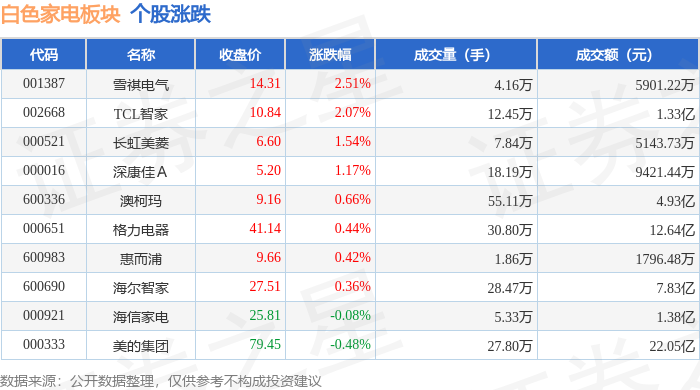
白色家电板块12月19日跌0.05%,美的集团领跌,主力资金净流出7821.56万元
Zheng Xing Xing Ye Ri Bao· 2025-12-19 09:02
Market Overview - The white goods sector experienced a slight decline of 0.05% on December 19, with Midea Group leading the drop [1] - The Shanghai Composite Index closed at 3890.45, up 0.36%, while the Shenzhen Component Index closed at 13140.22, up 0.66% [1] Stock Performance - Notable gainers in the white goods sector included: - Xueqi Electric (14.31, +2.51%, 41,600 shares, 59.01 million CNY) - TCL Smart Home (10.84, +2.07%, 124,500 shares, 133 million CNY) - Changhong Meiling (6.60, +1.54%, 78,400 shares, 51.44 million CNY) [1] - Midea Group's stock closed at 79.45, down 0.48%, with a trading volume of 278,000 shares and a transaction value of 2.205 billion CNY [1] Capital Flow - The white goods sector saw a net outflow of 78.22 million CNY from institutional investors and 78.94 million CNY from retail investors, while retail investors had a net inflow of 157 million CNY [1] - Specific stock capital flows included: - Gree Electric: -24.78 million CNY from institutional investors, -21.92 million CNY from retail investors, and -2.87 million CNY from individual investors [2] - TCL Smart Home: +15.61 million CNY from institutional investors, -12.50 million CNY from retail investors, and -3.10 million CNY from individual investors [2] - Midea Group: -69.72 million CNY from institutional investors, -53.02 million CNY from retail investors, and +123 million CNY from individual investors [2]


格力电器:对于入门级产品,现阶段则更侧重于保障核心性能与耐用性
Zheng Quan Ri Bao Wang· 2025-12-19 08:17
Core Insights - Gree Electric Appliances has integrated smart networking and voice control features into some of its mid-to-high-end models, including circulating fans, cooling fans, and tower fans [1] - The company is currently focusing on ensuring core performance and durability for its entry-level products [1]
格力电器:公司已掌握了冷板式液冷系统、相变冷却系统等关键技术
Zheng Quan Ri Bao· 2025-12-19 08:13
Core Viewpoint - Gree Electric has developed key technologies for cooling systems and launched a comprehensive cooling solution for data centers, aiming to meet energy efficiency targets [2] Group 1: Technology Development - The company has mastered critical technologies such as cold plate liquid cooling systems and phase change cooling systems [2] - Gree Electric has introduced a full-stack cooling solution and liquid cooling equipment that can satisfy the heat dissipation needs of high power density data rooms [2] Group 2: Project Delivery - In recent years, the company has successfully delivered projects for major clients including China Unicom's Yangtze River Delta Intelligent Computing Center and various AI computing centers [2] Group 3: Future Focus - The company plans to concentrate on the iteration of comprehensive liquid cooling solutions and core components [2] - Gree Electric aims to enhance modular and standardized delivery while strengthening partnerships with leading internet companies to expand its presence in AI computing centers and intelligent computing center markets [2]
格力创新推出智能制造协同模式
Zhong Guo Jing Ji Wang· 2025-12-19 08:12
Core Insights - Gree's intelligent manufacturing factory in Zhuhai has achieved a 200% increase in production efficiency and 100% digital coverage through the integration of an "industrial brain" that consolidates data across the entire value chain [1] - The factory has been recognized as a national leading intelligent factory, showcasing Gree's innovative "Gree Collaborative House" model for smart manufacturing [1] Group 1: Intelligent Manufacturing - The "Gree Collaborative House" model is based on a "one main, multiple cores, multi-level network" architecture, leveraging an industrial internet platform, data middle platform, and AI algorithms to enhance operational efficiency [1] - This model facilitates end-to-end data-driven and dynamic optimization from consumer demand insights to product lifecycle delivery, significantly improving the efficiency of the entire value chain [1] Group 2: Industry Impact - The "Collaborative House" model offers a replicable and scalable paradigm for the intelligent transformation of industries such as home appliances, electronics, and automotive [1] - Gree's industrial internet platform connects over 20,000 upstream suppliers, midstream factories, downstream distributors, and end customers, breaking down information silos across the supply chain [1] - The ecosystem formed promotes "demand-driven—technology sharing—capacity collaboration," allowing suppliers to view production plans in real-time, factories to produce based on distributor orders, and customers to track the entire production and shipping process [1] Group 3: Intelligent Equipment Business - Gree's intelligent equipment business encompasses research and development, production, sales, and service, covering four major areas: industrial robots, CNC machine tools, intelligent logistics warehousing, and industrial automation [2]
格力电器:继续用扎实技术与可靠产品服务中国制造
Zheng Quan Ri Bao· 2025-12-19 08:08
证券日报网讯 12月18日,格力电器在互动平台回答投资者提问时表示,在机床领域,德国与日本品牌 长期深耕,积累了深厚的技术底蕴与品牌声誉,是全球市场的重要参与者与标杆。格力电器自2013年开 始围绕自身发展需求,布局数控机床和机器人产业,服务于公司制造升级,通过长期的技术攻关,不断 积累技术优势。例如:基于格力直线电机、电主轴等核心部件技术优势,在行业内首次推出高速直驱多 通道立式加工中心,并成功研发高速直驱五轴龙门加工中心;面向新能源汽车车身一体化压铸的行业发 展趋势,成功研发高速直驱双五轴龙门加工中心,打破国外垄断,并实现电主轴、五轴摆头和直线电机 等关键核心部件的自主化。公司会继续用扎实技术与可靠产品服务中国制造。 (文章来源:证券日报) ...