
Meinian Onehealth(002044)

Search documents
AI医疗概念拉升 华人健康、塞力医疗等涨停
Zheng Quan Shi Bao Wang· 2025-12-18 03:46
消息面上,蚂蚁集团旗下AI健康应用"蚂蚁阿福"于12月15日发布后下载量猛增,16日冲上苹果应用榜总 榜第三位。据悉,"蚂蚁阿福"App月活用户规模已超1500万,每天回答用户500多万个健康提问。 据悉,AI医疗是通过机器学习、自然语言处理、计算机视觉等先进技术,对复杂的医疗数据进行深度 分析,辅助临床决策、优化诊疗流程、提升医疗效率的新型医疗体系,具备智能化、高效化、便捷化的 特征,应用前景广阔。根据甲子光年《2024年中国AI医疗产业研究报告》,2023年中国AI医疗行业规 模为973亿元,预计将在2028年达到1598亿元,2022—2028年间的年复合增长率为10.5%。细分市场 中,AI医学影像和AI制药增长较快。机构表示,随着生成式大模型等AI技术的不断发展,AI医疗将逐 步融入覆盖医疗产业各环节。 AI医疗概念18日盘中强势拉升,截至发稿,华人健康20%涨停,美年健康、塞力医疗亦涨停,嘉和美康 涨超9%。 ...


“AI+医疗”概念股应声上涨,板块行情受蚂蚁新产品“阿福”拉动
Jin Rong Jie· 2025-12-18 03:41
Core Viewpoint - The healthcare sector experienced a broad rally, with several stocks showing significant activity, driven by the launch of Ant Group's AI health application "Antifufu" which has over 15 million monthly active users and ranked second on the Apple App Store download list [1] Group 1: Stock Performance - Meian Health surged over 10% [1] - Weining Health increased by 8.65% [1] - Industry leader Alibaba Health rose by 2.47% [1] - Yuyue Medical saw a slight increase of 0.76% [1] Group 2: Market Sentiment - The integration of AI technology with health management is expected to open new growth opportunities, positively impacting overall market sentiment in the healthcare sector [1]



ETF盘中资讯 | AH医药逆市表现!美年健康两连板,全市场最大医疗ETF突破年线!港股通创新药继续回暖,520880直线拉升
Sou Hu Cai Jing· 2025-12-18 03:02
Core Viewpoint - The pharmaceutical sector is showing resilience in the current market, with significant activity in both A-shares and Hong Kong stocks, particularly in the medical and innovative drug segments, indicating a potential opportunity for investment in medical assets [1][3][4]. Group 1: A-share Market Insights - The medical sector in the A-share market continues to rebound strongly, with the largest medical ETF (512170) rising over 1% and surpassing the annual line [1]. - Private hospitals and AI medical-related stocks are leading the gains, with Meinian Health achieving two consecutive trading limits and Weining Health rising over 7% [1]. - The pharmaceutical sector shows mixed performance, with traditional Chinese medicine leader Pian Zai Huang increasing over 1%, while innovative drug stocks such as Gan Li Pharmaceutical and Hai Si Ke fell by 1% [1]. - The medical ETF (512170) has seen a significant inflow of over 93 million yuan in the last 10 days, indicating strong buying interest [1]. Group 2: Hong Kong Market Insights - The Hong Kong pharmaceutical market is performing well, with the Hang Seng Index and Hang Seng Tech Index both in the red, while leading innovative drug stocks like BeiGene and CSPC Pharmaceutical are up by over 1% and 3%, respectively [3]. - The Hong Kong Innovation Drug ETF (520880) has experienced continuous net subscriptions for eight days, with its fund size reaching a record high of 4.176 billion shares [3]. - The medical theme sector in Hong Kong is also seeing significant gains, particularly in AI medical and medical device stocks, with MicroPort Medical rising by 8% [3]. Group 3: Industry Trends and Opportunities - Recent developments in the innovative drug sector include significant overseas collaborations, such as Heng Rui Pharmaceutical's partnership with Kailera for clinical research and a $90 million upfront payment deal between Heptares Therapeutics and BMS [4][5]. - The CXO (Contract Research Organization) sector is showing clear upward momentum, with increasing orders and performance indicators suggesting a positive trend [4]. - The innovative medical device sector is gaining attention from major global companies, indicating a potential for growth and value realization similar to the previous year's innovative drug sector [5]. Group 4: Investment Strategies - Various ETFs are available for investment in the pharmaceutical sector, including the Hong Kong Innovation Drug ETF (520880) and the A-share medical ETF (512170), which are positioned to capture growth in innovative drugs and medical services [6]. - The Hong Kong medical ETF (159137) is currently being launched, providing additional investment options in the medical theme sector [3][6].


AH医药逆市表现!美年健康两连板,全市场最大医疗ETF突破年线!港股通创新药继续回暖,520880直线拉升
Xin Lang Cai Jing· 2025-12-18 02:44
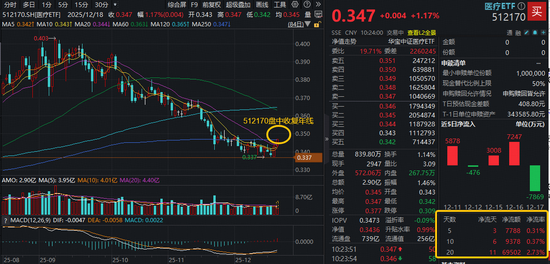
Core Viewpoint - The pharmaceutical sector in both A-shares and Hong Kong stocks is showing resilience amid market fluctuations, with significant activity in medical assets indicating defensive strength [1][9]. Group 1: A-share Market Performance - The medical sector in the A-share market continues to rebound strongly, with the largest medical ETF (512170) rising over 1% and surpassing the annual line [1][9]. - Private hospitals and AI medical-related stocks are leading the gains, with Meinian Health achieving two consecutive trading limits and Weining Health rising over 7% [1][9]. - The pharmaceutical sector shows mixed performance, with traditional Chinese medicine leader Pian Zai Huang increasing over 1%, while innovative drug stocks like Gan Li Pharmaceutical and Hai Si Ke fell by 1% [1][9]. - The medical ETF (512170) displayed a "one bullish engulfing two bearish" pattern, signaling a potential trend reversal if it closes above the annual line [1][9]. - Recent capital inflow into the medical ETF has exceeded 93 million yuan over the past 10 days, indicating investor interest [1][9]. Group 2: Hong Kong Market Performance - The Hong Kong pharmaceutical sector is performing well, with the Hang Seng Index and Hang Seng Tech Index both in the red, while leading innovative drug stocks like BeiGene and CSPC Pharmaceutical are up by over 1% and 3%, respectively [3][11]. - The Hong Kong Stock Connect innovative drug ETF (520880) has seen continuous net subscriptions for eight consecutive days, with the latest fund size reaching 4.176 billion shares, a record high since its launch [3][11]. - The medical theme index in Hong Kong is showing broad gains, particularly in AI medical and medical device-related stocks, with MicroPort Medical rising by 8% and other related stocks also seeing significant increases [3][11]. Group 3: Investment Opportunities - Analysts suggest that the current environment presents a favorable opportunity for allocating to pharmaceutical assets, with positive developments across various fields [4][12]. - In the innovative drug sector, there are ongoing advancements, such as Heng Rui Pharmaceutical's overseas collaborations and significant transactions involving new drug acquisitions [4][12]. - The CXO sector is experiencing upward momentum, with increasing orders and performance indicators suggesting a positive trend [5][13]. - Recent partnerships in innovative medical devices, such as the collaboration between Xian Rui Da Medical and Boston Scientific, highlight growing interest from international pharmaceutical companies in Chinese innovations [5][13]. Group 4: ETF Investment Options - For investors looking to enter the pharmaceutical sector, various ETFs are available, including the Hong Kong Stock Connect Innovative Drug ETF (520880) and the A-share Medical ETF (562050) [6][14]. - The Hong Kong medical ETF (159137) is currently being launched, providing additional options for investors [6][14]. - The investment strategies differ, with some ETFs focusing solely on innovative drugs while others include a mix of traditional and innovative pharmaceutical assets [6][14].
AH医药资产午后逆转!医疗ETF低位阳包阴,多空转换?资金大举“抄底”港股通创新药,520880份额迭创新高
Xin Lang Ji Jin· 2025-12-17 11:56
Group 1 - A-shares and Hong Kong stocks experienced a significant rebound, with the Shanghai Composite Index rising by 1.19% and the Hang Seng Index increasing by 0.92% [1] - The largest medical ETF in the market (512170) and the only drug ETF (562050) both rose over 1%, indicating a broad recovery in the medical sector [1] - The medical ETF (512170) showed a strong technical signal with a "bullish engulfing" pattern, suggesting a potential trend reversal [1] Group 2 - The pharmaceutical sector in A-shares also saw a surge, with the drug ETF (562050) rising by 1.19%, driven by contributions from innovative and traditional Chinese medicine stocks [3] - The drug ETF (562050) has approximately 25% weight in traditional Chinese medicine, which helps mitigate the volatility of the overall pharmaceutical index [3] Group 3 - The Hong Kong innovation drug sector is showing signs of recovery, with the Hong Kong innovation drug ETF (520880) successfully closing in the green, attracting "bottom-fishing" funds [5] - The fund size of the Hong Kong innovation drug ETF (520880) reached a new high of 4.172 billion shares, reflecting strong investor interest [5] Group 4 - The A+H pharmaceutical sector has been in a correction phase for three months, and analysts suggest that this may be an opportune time for medium to long-term investments in pharmaceutical assets [8] - Recent positive developments in the pharmaceutical industry include overseas collaborations and increasing demand for CXO services, indicating a favorable outlook for the sector [9] Group 5 - The fund manager of the Hong Kong innovation drug ETF (520880) maintains a balanced allocation strategy, highlighting the potential for recovery in the innovative drug industry and related sectors [10] - New investment tools, such as the Hong Kong medical ETF (159137), are being launched to track the medical innovation theme, covering various core leaders in the medical field [7]





12月17日深港通医疗(港币)(983036)指数涨1.67%,成份股美年健康(002044)领涨
Sou Hu Cai Jing· 2025-12-17 11:24
Group 1 - The core index of the Shenzhen-Hong Kong Stock Connect Medical Index closed at 4335.79 points, with a gain of 1.67% on December 17, and a trading volume of 9.968 billion HKD, resulting in a turnover rate of 1.15% [1] - Among the constituent stocks, 42 companies experienced an increase, with Meian Health leading the rise at 10.06%, while 14 companies saw a decline, with Ark Health leading the drop at 6.23% [1] Group 2 - The net inflow of main funds into the Shenzhen-Hong Kong Stock Connect Medical Index constituents totaled 456 million HKD, while speculative funds saw a net outflow of 249 million HKD, and retail investors had a net outflow of 207 million HKD [2]

12月17日深港通医疗(983035)指数涨1.7%,成份股美年健康(002044)领涨
Sou Hu Cai Jing· 2025-12-17 11:24
资金流向方面,深港通医疗(983035)指数成份股当日主力资金净流入合计4.56亿元,游资资金净流出 合计2.49亿元,散户资金净流出合计2.07亿元。成份股资金流向详情见下表: 证券之星消息,12月17日,深港通医疗(983035)指数报收于4414.3点,涨1.7%,成交90.28亿元,换 手率1.15%。当日该指数成份股中,上涨的有42家,美年健康以10.06%的涨幅领涨,下跌的有14家,方 舟健客以6.23%的跌幅领跌。 深港通医疗(983035)指数十大成份股详情如下: 以上内容为证券之星据公开信息整理,由AI算法生成(网信算备310104345710301240019号),不构成 投资建议。 ...
中国AI 50概念上涨3.18% 12股主力资金净流入超亿元
Zheng Quan Shi Bao Wang· 2025-12-17 09:43
截至12月17日收盘,中国AI 50概念上涨3.18%,位居概念板块涨幅第5,板块内,46股上涨,美年健 康、英维克等涨停,金盘科技、新易盛、麦格米特等涨幅居前,分别上涨9.64%、9.55%、8.22%。跌幅 居前的有中国移动、恒立液压、中国电信等,分别下跌0.66%、0.53%、0.30%。 今日涨跌幅居前的概念板块 | 概念 | 今日涨跌幅(%) | 概念 | 今日涨跌幅(%) | | --- | --- | --- | --- | | 共封装光学(CPO) | 3.76 | 海南自贸区 | -2.09 | | 铜缆高速连接 | 3.55 | 赛马概念 | -1.08 | | 液冷服务器 | 3.35 | 网约车 | -0.90 | | 金属铅 | 3.20 | 自由贸易港 | -0.90 | | 中国AI 50 | 3.18 | 军工信息化 | -0.70 | | AI PC | 3.11 | 转基因 | -0.65 | | 同花顺果指数 | 3.08 | 租售同权 | -0.64 | | 光纤概念 | 2.99 | 粮食概念 | -0.60 | | PET铜箔 | 2.73 | 生态农业 | -0. ...


AI明星新股创造历史!AI产业链涨停热度大涨
Mei Ri Jing Ji Xin Wen· 2025-12-17 09:19
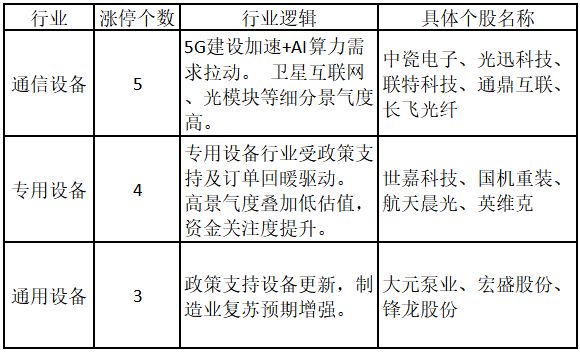
Market Overview and Sector Characteristics - The Shanghai Composite Index closed up by 1.19%, while the Shenzhen Component Index fell by 2.40%, with the median change in A-shares being an increase of 0.61% [1] - A total of 49 stocks hit the daily limit up, an increase of 7 from the previous day, while 19 stocks hit the limit down, an increase of 4 [2] Industry Characteristics - The sectors with the most limit-up stocks today were communication equipment, specialized equipment, and general equipment [3] - In the communication equipment sector, 5 stocks reached the limit up, driven by accelerated 5G construction and AI computing demand [4] - The specialized equipment sector saw 4 stocks limit up, supported by policy backing and recovering orders [4] - The general equipment sector had 3 stocks limit up, boosted by policy support for equipment upgrades and enhanced manufacturing recovery expectations [4] Concept Characteristics - The most represented concepts among limit-up stocks were optical communication, liquid cooling servers, and consumer sectors [5] - In the optical communication concept, 7 stocks hit the limit up, benefiting from the explosive demand for AI computing and the acceleration of 800G optical module shipments [5] - The liquid cooling server concept also had 7 stocks limit up, as liquid cooling technology becomes the mainstream solution for heat dissipation due to AI computing demand [5] - The consumer sector had 6 stocks limit up, supported by policy stimulus and the year-end consumption peak, with strong expectations for consumer potential [5] Limit-Up Stock List - Among the limit-up stocks, 3 reached historical highs, including Yingweike, Ping An Electric, and Huanxu Electronics [6] - 10 stocks reached near one-year highs, including Shengtong Energy, Jiamei Packaging, and others [7][8] Main Capital Flow - The top 5 stocks with the highest net inflow of main capital among limit-up stocks were Yingweike, Guojiji Heavy Industry, Guangxun Technology, ShenNan Circuit, and Meinian Health [9][10] - The stocks with the highest net inflow as a percentage of market value included Wangzi New Materials, Nanjing Business Travel, and others [10] Continuous Limit-Up Situation - There were 41 first-limit stocks today, with 5 stocks achieving a second limit up and 3 stocks achieving three or more consecutive limit ups [11] - The top 5 stocks with the most consecutive limit ups included Baida Group, Shengtong Energy, and others [11]





医疗服务板块12月17日涨2.1%,美年健康领涨,主力资金净流入6.21亿元
Zheng Xing Xing Ye Ri Bao· 2025-12-17 09:05
从资金流向上来看,当日医疗服务板块主力资金净流入6.21亿元,游资资金净流出4.01亿元,散户资金 净流出2.2亿元。医疗服务板块个股资金流向见下表: 证券之星消息,12月17日医疗服务板块较上一交易日上涨2.1%,美年健康领涨。当日上证指数报收于 3870.28,上涨1.19%。深证成指报收于13224.51,上涨2.4%。医疗服务板块个股涨跌见下表: 以上内容为证券之星据公开信息整理,由AI算法生成(网信算备310104345710301240019号),不构成投资建议。 ...