WMM(002149)

Search documents
商业航天行业深度系列(一):以第一性原理推演中国商业航天降本革命
Shanghai Aijian Securities· 2026-01-21 10:19
Investment Rating - The report rates the industry as "stronger than the market" [1] Core Insights - The report concludes that 2026 will mark a turning point for China's commercial aerospace industry, with a shift from state-driven missions to market-driven profitability, driven by the deployment of low-orbit satellite constellations and advancements in reusable rocket technology [1][6] - The commercial rocket launch service market in China is projected to grow from 10.26 billion yuan in 2025 to 47.39 billion yuan by 2030, with a CAGR of approximately 35.8% [1][12] - The report emphasizes that the core components of rocket launch services are engines (54%) and structural components (24%), which together account for 78% of the value in the launch service segment [1][12] Summary by Sections Industry Overview - The commercial aerospace industry is defined as activities that provide aerospace products and services through social capital investment under national policy guidance, including the R&D, manufacturing, launch, and operation of spacecraft and rockets [6][7] - The global aerospace economy is expected to reach $612 billion by 2024, with commercial aerospace revenues accounting for approximately $480 billion, representing about 78% of the total [6][7] Market Dynamics - The demand for satellite launches is expected to surge as China enters a concentrated deployment phase for low-orbit satellite constellations, with over 200,000 satellites planned for deployment [18][19] - The report highlights that the competition for low-orbit frequency resources is intensifying, necessitating faster deployment of satellite constellations [19][21] Cost Structure and Efficiency - The report breaks down the cost structure of rockets, indicating that engines and structural components dominate the value chain [1][12] - It outlines a pathway for reducing launch costs, projecting that the unit cost of launching payloads could decrease significantly as technology advances [1][12] Investment Recommendations - The report suggests focusing on companies involved in key segments such as propulsion systems, satellite communication systems, materials and structural components, and testing and validation services [2][4] - Specific companies to watch include 应流股份 (603308), 斯瑞新材 (688102), and 上海瀚讯 (300762), among others [2][4]


机构:商业航天有望迎来“政策+技术+资本”三重共振
Zheng Quan Shi Bao Wang· 2026-01-21 08:59
Group 1 - The core viewpoint is that China's commercial space industry is experiencing rapid development, with projections for 2025 indicating 50 launches, accounting for 54% of the total national space launches [1] - In 2025, commercial rockets are expected to complete 25 launches, and the Hainan commercial space launch site will have conducted 9 launches, totaling 10 since its establishment [1] - A total of 311 commercial satellites are projected to be placed into orbit, representing 84% of the total satellites launched in China [1] Group 2 - The commercial space industry is entering a golden era driven by both demand and supply, with recommendations to focus on structural component suppliers such as Aerospace Power, Srey New Materials, and others [1] - In satellite manufacturing, the focus is on low Earth orbit satellites and related infrastructure, with suggested companies including China Satellite and Aerospace Electronics [1] - The upstream and midstream sectors, particularly subsystems and materials supporting satellite mass production, are expected to benefit first, with companies like Zhenlei Technology and Guangwei Composites highlighted [1] Group 3 - In 2026, the domestic commercial space sector is anticipated to experience a "triple resonance" of policy, technology, and capital, making it highly promising [2] - Beneficiary companies in the rocket industry chain include Aerospace Power, Western Materials, and others [2] - In the satellite industry and space computing, recommended companies include Zhongke Xingtou, Aerospace Hongtu, and several others [2]




西部材料1月20日龙虎榜数据
Zheng Quan Shi Bao Wang· 2026-01-20 09:23
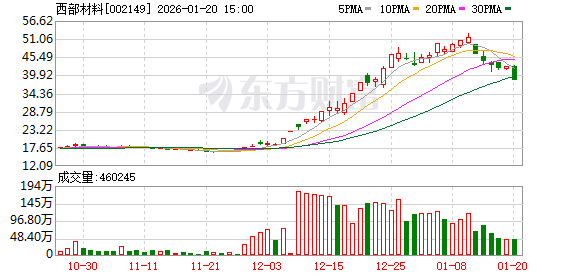
Group 1 - The stock of Xibu Materials experienced a limit down today, with a turnover rate of 9.43% and a trading volume of 1.82 billion yuan, showing a fluctuation of 12.04% [2] - The stock was listed on the Dragon and Tiger list due to a daily decline deviation of -9.17%, with net selling from the Shenzhen Stock Connect amounting to 24.05 million yuan [2] - The top five trading departments on the Dragon and Tiger list had a total transaction amount of 305 million yuan, with a net selling of 106 million yuan [2] Group 2 - The stock's main funds saw a net outflow of 351 million yuan today, with large orders contributing to a net outflow of 324 million yuan [2] - Over the past five days, the main funds have experienced a net outflow of 613 million yuan [2] - The stock has been listed on the Dragon and Tiger list 13 times in the past six months, with an average price increase of 1.75% the day after being listed and an average increase of 12.85% over the following five days [2] Group 3 - As of January 19, the margin trading balance for the stock was 1.445 billion yuan, with a financing balance of 1.441 billion yuan and a securities lending balance of 3.35 million yuan [3] - In the past five days, the financing balance has decreased by 174 million yuan, a decline of 10.77%, while the securities lending balance has decreased by 893,800 yuan, a decline of 21.04% [3] - The top buying and selling departments on January 20 included various securities firms, with significant buy amounts from Shenwan Hongyuan and Guosen Securities [3][4]

小金属板块1月20日跌1.75%,西部材料领跌,主力资金净流出26.55亿元
Zheng Xing Xing Ye Ri Bao· 2026-01-20 08:51
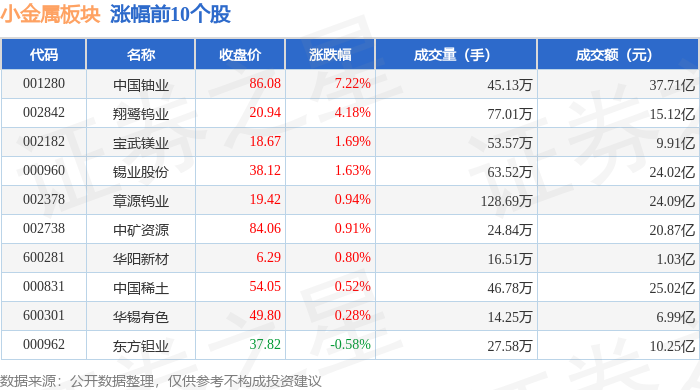
证券之星消息,1月20日小金属板块较上一交易日下跌1.75%,西部材料领跌。当日上证指数报收于 4113.65,下跌0.01%。深证成指报收于14155.63,下跌0.97%。小金属板块个股涨跌见下表: | 代码 | 名称 | 收盘价 | 涨跌幅 | 成交量(手) | 成交额(元) | | | --- | --- | --- | --- | --- | --- | --- | | 001280 | 中国舞业 | 86.08 | 7.22% | 45.13万 | | 37.71亿 | | 002842 | 翔鹭钨业 | 20.94 | 4.18% | 77.01万 | | 15.12亿 | | 002182 | 宝武镁业 | 18.67 | 1.69% | 53.57万 | | 9.91亿 | | 000960 | 锡业股份 | 38.12 | 1.63% | 63.52万 | | 24.02亿 | | 002378 | 章源钨业 | 19.42 | 0.94% | 128.69万 | | 24.09亿 | | 002738 | 中矿资源 | 84.06 | 0.91% | 24.84万 | | 20.87亿 ...
商业航天上演过山车行情,板块加速“去伪存真”
Di Yi Cai Jing· 2026-01-20 08:48
Core Viewpoint - The commercial aerospace sector experienced a significant downturn on January 20, with many stocks hitting their daily limit down, marking the end of a month-long rally. The sector's volatility is attributed to a combination of policy changes, clarifications of business relevance, and recent launch failures [1][2][3]. Market Performance - As of January 20, the commercial aerospace sector index (BK0963) fell over 3.2%, with individual stocks like Xice Testing (301306.SZ) and Aerospace Hongtu (688066.SH) dropping more than 11%. A total of 11 stocks hit their daily limit down, while others like Aerospace Huanyu (688523.SH) and Shenglu Communication (002446.SZ) saw declines exceeding 8% [2][3]. - The index has decreased from above 3100 points on January 12 to around 2790 points, ending a rapid rise that began in late November 2025, during which at least 10 stocks doubled in price [2][3]. Factors Influencing Market Changes - The recent market cooling is attributed to multiple factors, including over 20 companies issuing risk warnings or clarifications about their lack of substantial involvement in commercial aerospace. For instance, Aerospace Hongtu stated that its strategic cooperation with a space technology company has not led to any significant business collaboration [3][6]. - The sector faced setbacks with launch failures, including the Long March 3B rocket and the private commercial rocket from Star River Power, which both experienced mission failures [3][4]. Policy and Industry Developments - The previous surge in the sector was driven by favorable policies, such as China's application for 203,000 new satellites, the largest in recent years, and the Shanghai Stock Exchange's announcement allowing commercial rocket companies to apply for IPOs under specific standards [4][5]. - Recent developments indicate that several companies with core technology capabilities are in the IPO preparation stage, although many have not yet gone public [6][7]. Financial Challenges - Financial data reveals significant challenges for companies in the sector. For example, Blue Arrow Aerospace reported net losses of 8.21 billion yuan in 2022, 12.16 billion yuan in 2023, and 9.16 billion yuan in 2024, with a total loss exceeding 35 billion yuan over three and a half years [7][8]. - The commercial viability of these companies is hindered by their early-stage development and the high costs associated with rocket technology, which still lag behind international competitors [8]. Future Outlook - Despite the recent downturn, long-term prospects for the commercial aerospace sector remain positive, with industry experts suggesting that the current market correction may help identify companies with genuine technological capabilities and commercial potential [9]. - Analysts believe that the sector may experience a recovery similar to the renewable energy market, driven by ongoing policy support and potential improvements in profitability [9].


核电板块震荡走弱,博菲电气等多股跌停
Xin Lang Cai Jing· 2026-01-20 05:46
核电板块震荡走弱,博菲电气、华菱线缆、西部材料跌停,高澜股份、弘讯科技、再升科技、斯瑞新 材、理工光科、方大炭素等跟跌。 ...
有色金属板块震荡走弱



Jin Rong Jie· 2026-01-20 02:18
Group 1 - The non-ferrous metal sector is experiencing a downturn, with West Materials falling over 9% [1] - Companies such as China Tungsten High-Tech, Xiamen Tungsten, Zhangyuan Tungsten, and Xianglu Tungsten are among those with significant declines [1]
有色金属板块震荡走弱,西部材料跌超9%
Mei Ri Jing Ji Xin Wen· 2026-01-20 02:10
Group 1 - The non-ferrous metal sector experienced a downturn, with West Materials falling over 9% [1] - Companies such as Zhongtung High-tech, Xiamen Tungsten, Zhangyuan Tungsten, and Xianglu Tungsten also saw significant declines [1]
可控核聚变迎利好 融资客买入这些概念股
Xin Lang Cai Jing· 2026-01-20 00:29
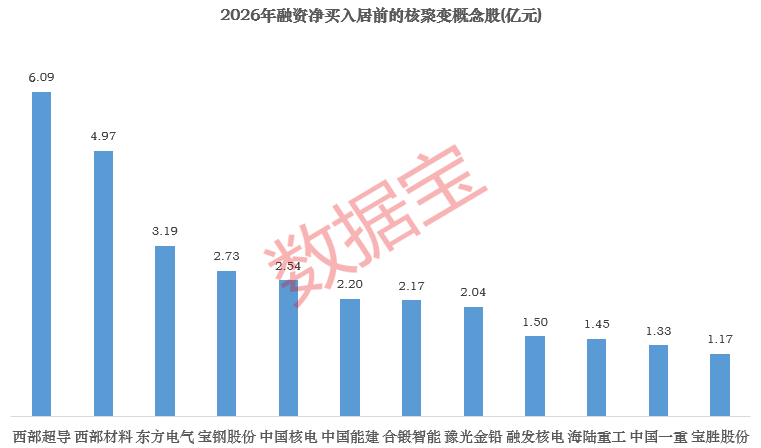
Core Insights - The controlled nuclear fusion industry is experiencing positive developments with significant breakthroughs reported by Energy Singularity, which achieved a stable long-pulse plasma operation for 335 seconds during its 5609th experiment [1] - Energy Singularity, established in 2021, is recognized as the first commercial fusion energy company in China [1] - A series of cooperation agreements were signed at the 2026 Nuclear Fusion Energy Technology and Industry Conference, involving Hefei Comprehensive National Science Center and several leading enterprises and research institutions to establish joint laboratories focused on key nuclear fusion technologies [1] Investment Opportunities - Since the beginning of 2026, there have been 12 nuclear fusion concept stocks that have seen net inflows exceeding 100 million yuan, with Western Superconducting, Western Materials, and Dongfang Electric leading the rankings, each exceeding 300 million yuan in investment [1]

可控核聚变迎利好,融资客抢筹这些概念股
Zheng Quan Shi Bao Wang· 2026-01-19 23:44
Group 1 - The controllable nuclear fusion industry is experiencing positive developments, with significant breakthroughs in high-temperature superconducting tokamak technology [1] - The global nuclear fusion market is projected to approach $500 billion by 2030, driven by substantial advancements in engineering and collaboration among key industry players [2][3] - The Chinese government has elevated controllable nuclear fusion to a national strategic priority, encouraging research and technological development in this field [2] Group 2 - Major investments are being made in nuclear fusion concept stocks, with significant net purchases recorded since the beginning of 2026 [4] - Companies like Western Superconducting and Western Materials are actively involved in producing superconducting materials for international fusion projects, enhancing their market influence [6] - A number of nuclear fusion concept stocks are expected to see substantial profit growth in 2025, with predictions indicating significant increases for companies like Yongding Co. and Guoguang Electric [7][8]