
LUXSHARE-ICT(002475)

Search documents
中国股票策略-发布《中国最佳商业模式 2.0》-China Equity Strategy-Launching China Best Business Models Version 2
2026-04-01 09:59
Summary of China Best Business Models Version 2 Conference Call Industry Overview - The conference focuses on the **China Equity Strategy**, specifically the launch of **China Best Business Models Version 2** by Morgan Stanley, which identifies 26 companies in China with sustainable competitive advantages [1][2]. Core Insights and Arguments - **Identification of Best Business Models**: The framework aims to identify publicly listed Chinese companies with superior return on equity (ROE) and valuation premiums, which are expected to generate sustainable medium-term alpha despite market volatility [3]. - **Performance Metrics**: The identified stocks offer an ROE that is **1.5 times higher** than the benchmark, with a back-tested **3-year Sharpe Ratio of 1.2** [1][8]. - **Portfolio Construction**: The portfolio consists of **26 high-quality companies** across **16 industry groups**, designed to deliver superior risk-adjusted returns and profitability [5][40]. - **Historical Performance**: The portfolio has demonstrated a **101% total return since 2023**, outperforming the MSCI China index by **83%** over the same period [8][33]. Methodology Enhancements - **AI Adaptability**: The framework incorporates AI exposure as a key stock selection criterion, focusing on companies that are AI enablers or adopters while avoiding those at risk from AI disruption [4]. - **Global Thematic Alignment**: The portfolio aligns with four global themes: **AI & Tech Diffusion, Future of Energy, Multipolar World, and Societal Shifts** [4]. - **Sector Allocation**: A proactive approach to sector allocation emphasizes long-term growth trajectories and policy support, resulting in a higher representation of **Materials, Industrials, and Information Technology** compared to the MSCI China index [4]. Key Statistics - **Portfolio Composition**: The portfolio includes a **19% weight** in Information Technology, **19% in Industrials**, and **12% in Materials** [8]. - **Valuation Metrics**: The portfolio exhibits a forward P/E of **14.4x** and a price-to-book ratio of **2.5x**, indicating attractive valuation metrics [8]. - **Market Capitalization**: The median market capitalization of the companies in the portfolio is **US$26 billion**, with a range from **US$587 billion** (Tencent Holdings Ltd.) to **US$4 billion** (Insilico Medicine) [40]. Additional Insights - **Analyst Ratings**: Of the 26 companies, **24 are rated Overweight** and **2 are rated Equal-weight** relative to their industry coverage, indicating strong analyst confidence in these selections [40]. - **Upside Potential**: On average, there is a **37.9% upside** to Morgan Stanley analysts' price targets, with a median upside of **36.7%** [40]. - **Risk-Adjusted Returns**: The portfolio is designed to generate sustainable earnings growth with resilience across market cycles, supported by superior risk-adjusted returns [8]. This summary encapsulates the key points from the conference call regarding the China Best Business Models Version 2, highlighting the strategic focus on quality, profitability, and valuation metrics in the context of the evolving Chinese equity market.






2026年投资风向标,看睿远基金三位基金经理划重点
市值风云· 2026-03-30 10:09
Core Viewpoint - The article discusses the significant changes in the hidden heavy positions of fund manager Fu Pengbo and the overall performance and strategies of Ruifeng Fund, particularly in the context of the latest annual reports of public funds [3][8]. Group 1: Fund Management Overview - Ruifeng Fund currently manages a total of 653.2 billion yuan across 11 funds, with experienced managers like Fu Pengbo and Zhao Feng overseeing over 100 billion yuan each [4][6]. - The three main funds managed by Fu Pengbo, Zhao Feng, and Rao Gang have a combined scale of 371.8 billion yuan [6]. Group 2: Portfolio Composition - As of the end of the fourth quarter, key stocks in the portfolios include Ningde Times, Tencent Holdings, and Luxshare Precision, indicating a consensus among the fund managers [8]. - Fu Pengbo's portfolio is characterized by a strong focus on electric equipment and technology, while Zhao Feng and Rao Gang maintain a more balanced approach with significant allocations in non-bank financials, media, electric equipment, and electronics [8]. Group 3: Stock Performance and Changes - Fu Pengbo's hidden heavy positions have seen substantial changes, with new entries including Siquan New Materials, Sensata Technologies, and Shannon Semiconductor, alongside three pharmaceutical stocks [12]. - The article highlights the performance of the three main funds, with varying returns over different time frames, indicating a competitive positioning against the market [9]. Group 4: Future Outlook and Investment Strategy - Fu Pengbo emphasizes increasing allocations in AI and chip industries, predicting a potential divergence in the AI sector by 2026, while reducing exposure to coal and traditional chemicals [13][14]. - The article notes that the return expectations for equity assets in 2026 may see a moderate decline compared to 2025, but structural opportunities remain [16]. - Rao Gang points out that capital expenditures in non-financial A-shares have reached historical lows, suggesting a potential price rebound in the midstream manufacturing sector [17].



超2800只个股上涨
第一财经· 2026-03-30 07:37
Market Overview - On March 30, the four major indices closed mixed, with the Shanghai Composite Index rising by 0.24% to 3923.29 points, while the Shenzhen Component Index fell by 0.25% to 13726.19 points, the ChiNext Index decreased by 0.68% to 3273.36 points, and the Sci-Tech Innovation Index dropped by 0.18% to 1659.74 points [2][3]. Sector Performance - The precious metals, industrial metals, agriculture, and pharmaceutical commercial sectors saw significant gains, while the power, photovoltaic equipment, and oil and gas sectors experienced declines [2]. - The industrial metals sector witnessed a surge, with multiple stocks hitting the daily limit, including Liyuan Co., Minfa Aluminum, Chang Aluminum, and Nanshan Aluminum, all achieving gains of around 10% [2][4]. Notable Stocks - Top gainers in the industrial metals sector included: - Liyuan Co. (+10.27% to 2.04) - Minfa Aluminum (+10.08% to 4.26) - Chang Aluminum (+10.02% to 5.49) - Nanshan Aluminum (+10.00% to 6.49) [4]. - Conversely, the power sector faced significant declines, with stocks such as Jinkong Power and Huadian Liaoning Energy hitting the daily limit down, both falling by approximately 10% [5]. Trading Volume - The total trading volume in the Shanghai and Shenzhen markets reached 1.92 trillion yuan, an increase of 626 billion yuan compared to the previous trading day, with over 2800 stocks rising across the market [5]. Capital Flow - Main capital inflows were observed in the telecommunications, pharmaceutical, and agriculture sectors, while there were outflows from public utilities, electrical equipment, and oil and petrochemical sectors [8]. - Specific stocks with notable net inflows included Pingtan Development, Hengtong Optic-Electric, and Yongding Co., with inflows of 1.789 billion yuan, 936 million yuan, and 747 million yuan, respectively [9]. - Stocks experiencing significant net outflows included Sunshine Power, Luxshare Precision, and Ganfeng Lithium, with outflows of 1.713 billion yuan, 1.305 billion yuan, and 1.249 billion yuan, respectively [10]. Analyst Insights - Zhongtai Securities emphasized the defensive attributes of dividend assets and suggested positioning in recovery varieties following the reduction of geopolitical risks [11]. - CITIC Securities expressed optimism regarding investment opportunities in the aluminum sector due to ongoing supply disruptions [12]. - CITIC Jinpu highlighted the high growth in fiber demand driven by overseas telecommunications networks, AI, and drones, indicating that the industry is in a high prosperity cycle and continues to recommend the fiber sector [12].




晓数点丨一周个股动向:最牛股周涨超50% 赣锋锂业获主力加仓居首
Di Yi Cai Jing· 2026-03-29 13:55
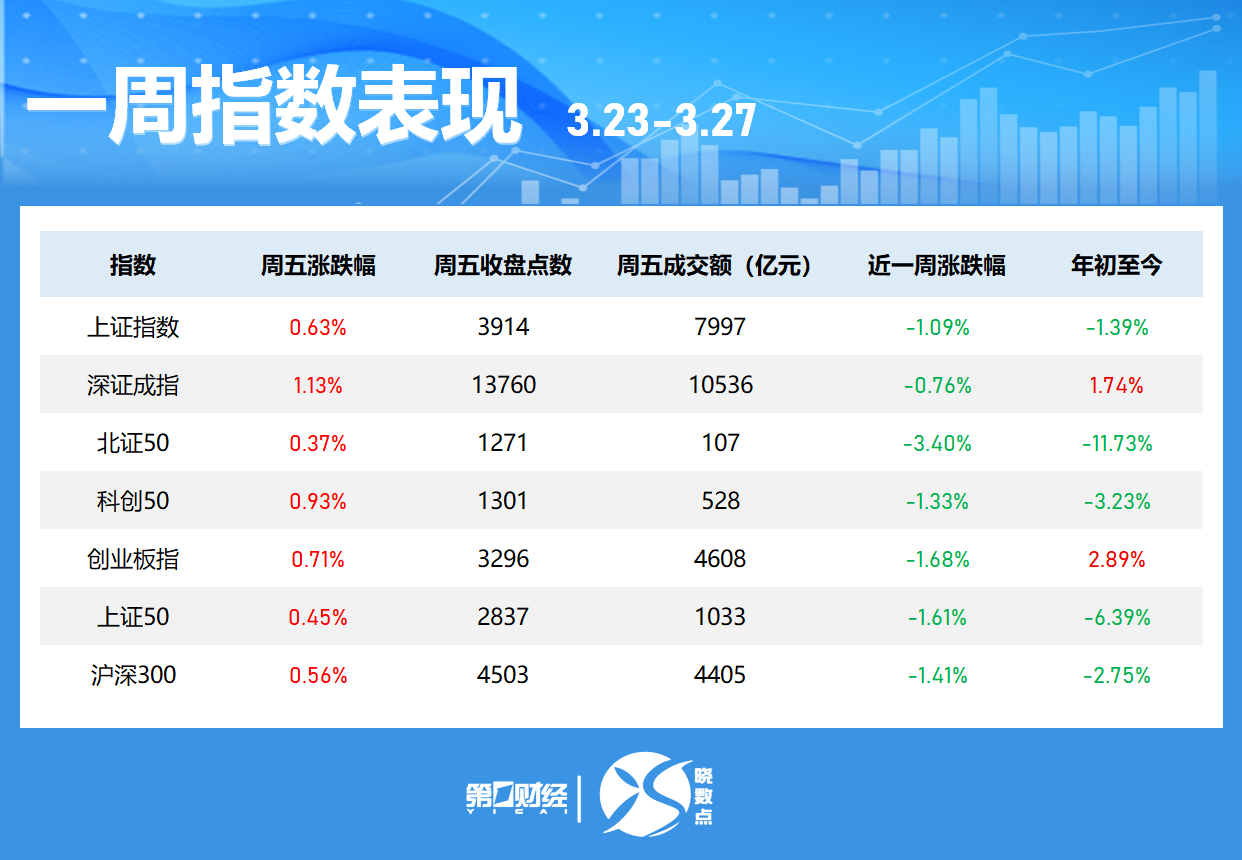
Market Overview - The A-share indices collectively declined during the week from March 23 to March 27, with the Shanghai Composite Index down by 1.09%, the Shenzhen Component Index down by 0.76%, the ChiNext Index down by 1.68%, and the Sci-Tech Innovation Index down by 0.43% [1][2]. Stock Performance - A total of 7 stocks saw gains exceeding 40%, with Haike Xinyuan leading at a weekly increase of 51.02%. Other notable gainers included Lianxiang Co. (48.26%), Rongjie Co. (46.95%), and Huadian Liaoning Energy (43.61%) [3][4]. - Conversely, 30 stocks experienced declines over 20%, with Huada Technology leading the drop at 32.34%, followed by Zhonghuan Hailu (29.59%) and Shenhua Fa A (28.03%) [3][4]. Trading Activity - 47 stocks had a turnover rate exceeding 100%, with Shouhang New Energy at the top with a turnover rate of 236.08%, followed by Nabichuan (199.27%) and Jiuzhou Group (177.88%) [5][6]. - The majority of stocks with high turnover rates were from the electric equipment, public utilities, and basic chemicals sectors [5]. Capital Flow - The sectors that attracted significant capital inflow included non-ferrous metals, basic chemicals, and building materials, while the electronics sector faced a net outflow exceeding 250 billion yuan [8]. - Ganfeng Lithium received the highest net inflow of 27.20 billion yuan, with a weekly increase of 18.15%. Other stocks with notable inflows included Demingli (15.88 billion yuan) and Yunnan Zhiye (14.20 billion yuan) [8][9]. Margin Trading - A total of 1399 stocks received net margin purchases, with 582 stocks having net purchases exceeding 10 million yuan. Luxshare Precision topped the list with a net purchase of 10.94 billion yuan, while NIO and Zijin Mining faced significant net sell-offs [10][11]. Institutional Research - During the week, 163 listed companies were researched by institutions, with Sanhua Intelligent Control receiving the most attention from 284 institutions. Other companies like Yuanjie Technology and Yuntianhua also attracted significant institutional interest [12][14]. Analyst Ratings - Several companies received new ratings from analysts, including Kaige Precision Machinery with a "Buy" rating and a target price of 207.84 yuan, and Daqin Railway with an "Overweight" rating and a target price of 5.95 yuan [15][16].



智能汽车ETF易方达(516590)开盘跌0.48%,重仓股宁德时代涨0.90%,比亚迪涨0.82%
Xin Lang Cai Jing· 2026-03-27 01:40
Group 1 - The smart car ETF E Fund (516590) opened down 0.48% at 1.247 yuan on March 27 [1][2] - Major holdings in the ETF include CATL, which rose 0.90%, and BYD, which increased by 0.82%. However, other stocks like Luxshare Precision fell by 4.00% and others also experienced declines [1][2] - The ETF's performance benchmark is the CSI Smart Electric Vehicle Index return, managed by E Fund Management Co., Ltd., with a return of 25.35% since its inception on April 29, 2021, and a recent one-month return of -2.71% [1][2]


大湾区ETF平安(512970)开盘涨1.73%,重仓股中国平安跌0.02%,立讯精密涨1.45%
Xin Lang Cai Jing· 2026-03-26 01:32
Group 1 - The Dawan District ETF Ping An (512970) opened with a gain of 1.73%, priced at 1.472 yuan [1][2] - Major holdings of the ETF include China Ping An, Luxshare Precision, BYD, and others, with mixed performance among these stocks [1] - The ETF's performance benchmark is the CSI Guangdong-Hong Kong-Macao Greater Bay Area Development Theme Index, managed by Ping An Fund Management Co., Ltd. [2] Group 2 - Since its establishment on September 23, 2019, the ETF has achieved a return of 44.66%, while the return over the past month has been -5.61% [2] - A MACD golden cross signal has formed, indicating potential upward momentum for certain stocks [3]

中小100ETF华夏(159902)开盘涨0.39%,重仓股立讯精密涨2.24%,比亚迪涨0.08%
Xin Lang Cai Jing· 2026-03-25 01:32
Group 1 - The core point of the news is the performance of the 中小100ETF华夏 (159902), which opened with a gain of 0.39% at a price of 4.365 yuan [1][2] - The ETF's major holdings include companies like 立讯精密 (up 2.24%), 比亚迪 (up 0.08%), and 北方华创 (up 1.33%), while 牧原股份 saw a decline of 0.87% [1][2] - The 中小100ETF华夏 has a performance benchmark of the 中小企业100 index, managed by 华夏基金管理有限公司, with a fund manager named 严筱娴 [1][2] Group 2 - Since its establishment on June 8, 2006, the 中小100ETF华夏 has achieved a return of 356.07%, but it has experienced a decline of 5.64% over the past month [1][2]


电子行业点评报告:OpenClaw热潮加速端侧Agent渗透,推理算力需求激增
KAIYUAN SECURITIES· 2026-03-16 06:24
Investment Rating - The industry investment rating is "Positive" (maintained) [1] Core Insights - OpenClaw, an open-source AI agent framework, has gained significant popularity since its release, becoming the most popular open-source project on GitHub as of February 2026. It offers capabilities such as local-first operation, autonomous tool invocation, cross-application execution, multi-IM access, and continuous online operation, making it highly appealing to users [4] - The demand for inference computing power is expected to grow exponentially due to the characteristics of Agent AI, which include autonomous task execution and multi-agent concurrency. The daily token consumption in China surged from 100 billion in early 2024 to over 30 trillion by mid-2025, reflecting a growth of over 300 times in just one and a half years [5] - OpenClaw is set to transform AI from a conversational role to an execution role, enabling more intelligent personal AI assistants and digital employees. Major companies like Xiaomi and Huawei are adapting OpenClaw for various devices, indicating a shift in the capabilities of edge AI [5] Summary by Sections OpenClaw Development - OpenClaw was initially released on November 24, 2025, and saw a surge in adoption in February 2026, with major domestic companies launching products based on its code. Notable implementations include Tencent's WorkBuddy and Zhizhu's AutoClaw, which offer seamless integration with existing communication tools [4] Token Consumption and Demand - The introduction of Agent AI has led to a shift in token consumption patterns, with tasks now consuming tens of thousands to millions of tokens per execution. Predictions indicate that by 2030, the global active AI agents will reach 2.216 billion, with annual token consumption skyrocketing from 0.0005 Peta Tokens in 2025 to 15.2 million Peta Tokens [5] Investment Recommendations - The report suggests focusing on the AI inference computing power supply chain, including segments like chips, complete machines, liquid cooling, and power supplies. Recommended stocks include Haiguang Information, Lingyi Technology, and Dongshan Precision, among others [6]




行业点评报告:OpenClaw热潮加速端侧Agent渗透,推理算力需求激增
KAIYUAN SECURITIES· 2026-03-16 06:15
Investment Rating - The industry investment rating is "Positive" (maintained) [1] Core Insights - OpenClaw, an open-source AI agent framework, has gained significant popularity since its release, becoming the most popular open-source project on GitHub as of February 2026. It offers capabilities such as local-first operation, autonomous tool invocation, cross-application execution, and continuous online operation, making it highly appealing to users [4] - The demand for inference computing power is expected to grow exponentially due to the characteristics of Agent AI, which include autonomous task execution and multi-agent concurrency. The daily token consumption in China surged from 100 billion in early 2024 to over 30 trillion by June 2025, reflecting a growth of over 300 times in just one and a half years [5] - OpenClaw is penetrating various devices, including PCs, smartphones, and wearables, transforming the role of AI from a conversational agent to an executor. This shift is expected to create new application scenarios and product categories in the end-side AI market [6] Summary by Sections OpenClaw Development - OpenClaw has seen rapid adoption among major domestic companies, with multiple products and solutions being released based on its code. Notable companies include Tencent, Huawei, Alibaba, and Xiaomi, which are integrating OpenClaw into their cloud services and applications [4] Token Consumption and Inference Demand - The workflow of "plan-execute-feedback-replan" in Agent AI has led to a shift from linear to exponential growth in token consumption. A single task can consume tens of thousands to millions of tokens, indicating a significant increase in demand for inference capabilities [5] End-Side AI Transformation - The modular architecture of OpenClaw allows for comprehensive session management and memory systems, enabling it to autonomously manage various software applications. This evolution is expected to redefine the capabilities of end-side AI and lead to the development of more intelligent personal AI assistants [6] Investment Recommendations - The report suggests focusing on the AI inference computing power supply chain, including segments like chips, complete machines, liquid cooling, and power supplies. Recommended stocks include Haiguang Information, Lingyi Technology, and Dongshan Precision, among others [7]
2026年新消费行业年度策略:新消费三大引擎,AI+消费、情绪经济、新质零售
Shanghai Securities· 2026-03-12 12:17
Core Insights - The report identifies three main engines driving the transformation of the new consumption sector: AI + consumption, emotional economy, and new quality retail [2][3][4] AI + Consumption - AI technology is seen as a catalyst for consumption, with the potential to become a market hotspot. By the first half of 2025, the user base for generative AI products in China is expected to reach 515 million, a growth of 266 million from December 2024, with a penetration rate of 36.5% [2] - AI technologies such as large models, chips, embodied intelligence, and digital innovations are expected to comprehensively upgrade consumer goods across production, supply chain, and operational selection [2] Emotional Economy - Changes in economic demographics are giving rise to an emotional consumption market projected to reach 4.5 trillion yuan. The emotional consumption market in China is expected to grow from 1.63 trillion yuan in 2022 to 2.72 trillion yuan in 2025 and exceed 4.5 trillion yuan by 2029 [3] - Emotional consumption scenarios are rapidly expanding, with trends in collectibles, shopping, cultural tourism, pets, technology, and dining gaining traction among younger consumers [3] New Quality Retail - The shift from traditional retail to new quality retail focuses on enhancing consumer experience and value reconstruction. New quality retail includes aspects like quality-price ratio consumption and instant retail, optimizing supply-side offerings [4] - For instance, Sam's Club in China is projected to achieve sales of over 140 billion yuan by 2025, with online business accounting for about 50% of its sales [4] Investment Opportunities - Key companies to watch in the AI + consumption sector include Luxshare Precision, Goertek, DJI, and Xiaomi in various AI product categories [5] - In the emotional consumption space, companies like Laopuhuangjin and Chaohongji are highlighted, along with brands in outdoor sports and beauty sectors [5] Market Overview - The overall consumption industry in 2025 is expected to show structural changes, with a focus on upgrading consumption quality and enhancing consumer experiences [19][29] - The report emphasizes the importance of policies aimed at boosting domestic demand and consumption, which are expected to continue into 2026 [28][29] Economic Context - The contribution of final consumption expenditure to GDP growth in China is projected to remain significant, with a contribution rate of 53.5% in the first three quarters of 2025, reflecting a 9 percentage point increase from the previous year [18][36] - The report notes that the consumer market in China still has substantial growth potential, with the final consumption expenditure expected to rise from approximately 57% to 60% of GDP by the end of the 14th Five-Year Plan [28][36] Demographic Trends - The report highlights the aging population and declining birth rates in China, with the Z generation gradually becoming the main consumer force. This demographic shift is expected to drive new consumption patterns focused on emotional value and sustainability [40][41] Future Outlook - The report anticipates that 2026 will be a pivotal year for the integration of AI technology into the consumption sector, creating new market opportunities and innovative products [45][46] - The AI + consumption landscape is expected to evolve with advancements in AI-powered products, including smart home devices and wearables, which are projected to reshape consumer lifestyles [62][63]


