
BYD(002594)

Search documents
比亚迪起诉“龙哥讲电车”等账号案一审获赔200万
Xin Lang Cai Jing· 2025-12-25 03:02
来源:@比亚迪法务部 @比亚迪法务部 12月25日消息,近期,就比亚迪起诉"龙哥讲电车"、"满格电新能源"等账号一案,该公 司收到法院一审判决,法院认定被告使用前述账号编造、传播有关比亚迪公司的虚假信息,损害比亚迪 品牌声誉,判令被告停止侵权、消除影响,并向比亚迪公司赔偿200万元。 比亚迪法务部表示,我们始终尊重并接受社会各界的建议和监督,但网络不是法外之地,对于任何形式 的侮辱、造谣、抹黑等侵权行为,我们将持续以法律手段维护企业的合法权益。 ...
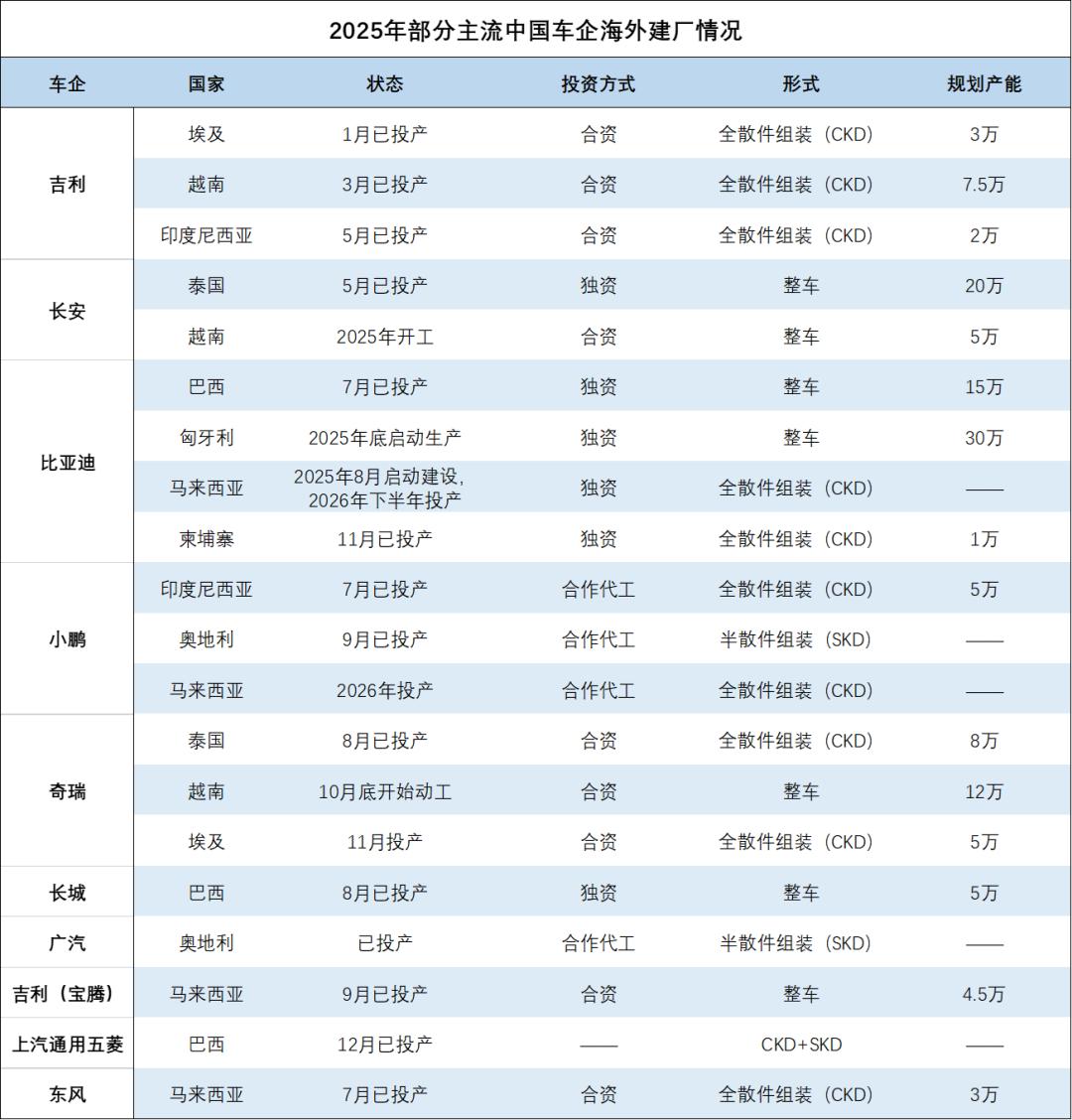
占比超一半,海外快成中国车企的主战场了
3 6 Ke· 2025-12-25 02:56
Core Insights - China's goods trade surplus reached a milestone of $1.08 trillion in the first 11 months of this year, marking a significant achievement in both Chinese foreign trade history and globally [1] - The automotive export sector is one of the fastest-growing segments, with predictions indicating that China's oil vehicle exports will surpass Japan's, solidifying its position as the world's largest automotive exporter [2][3] Automotive Export Growth - In the first 11 months of this year, the overall sales of China's passenger car market grew by 6.1%, while exports surged by 17.2%, significantly outpacing the domestic market [2] - Companies like BYD and Great Wall Motors reported record overseas sales, with BYD's overseas monthly sales exceeding 130,000 units in November, a 297% year-on-year increase, and accounting for nearly 30% of its total sales [3] Overseas Market Strategy - Chinese automakers are increasingly focusing on overseas markets as their primary battleground, with many companies planning to establish local production facilities abroad [4][5] - By 2025, the planned production capacity of overseas factories established by major Chinese automakers is expected to exceed 1.2 million units, contrasting sharply with the overcapacity situation in the domestic market [4] Production Capacity and Investment - A detailed overview of various Chinese automakers' overseas production plans reveals significant investments in local manufacturing, with companies like Geely, BYD, and Changan actively expanding their global footprint [5][6][7] - The shift from exporting complete vehicles to establishing full-process production bases abroad allows companies to better utilize local resources and mitigate tariff impacts [6] Profitability in Overseas Markets - Chinese automakers are experiencing higher profit margins in overseas markets compared to domestic sales, with BYD's overseas gross margin at 27.3%, significantly higher than its domestic margin of 17.7% [12][13] - The trend of higher pricing and lower competition in international markets is driving the profitability of Chinese brands, making overseas expansion a lucrative opportunity [12][13] Market Penetration and Competition - Chinese brands are increasingly gaining market share in traditional automotive strongholds like Europe, with their presence doubling in the first ten months of this year despite tariff challenges [14] - The recent announcement of increased tariffs on Chinese vehicles by Mexico poses a significant challenge, as Mexico has become the largest destination for Chinese automotive exports [15][16]


比亚迪起诉“龙哥讲电车”一审胜诉,获赔200万元
Feng Huang Wang· 2025-12-25 02:42
Core Viewpoint - BYD has won a court ruling against social media accounts for spreading false information that harmed its brand reputation, resulting in a compensation of 2 million RMB [1] Group 1: Legal Action - BYD's legal department announced the court's first-instance judgment against the accounts "Long Ge Talks Electric Cars" and "Full Charge New Energy" for fabricating and disseminating false information [1] - The court ordered the defendants to cease infringement, eliminate the negative impact, and compensate BYD 2 million RMB [1] Group 2: Company Response - BYD executive Li Yunfei expressed that the company is open to objective criticism or misunderstandings but will take legal action against malicious defamation from "black public relations" and "black media" [1] - The legal department emphasized that the internet is not a lawless territory and that the company will continue to protect its legal rights through legal means [1] Group 3: Background of the Case - The case originated from a statement issued by BYD's online reporting center on October 30 of the previous year, accusing the mentioned accounts of long-term dissemination of false statements that defamed BYD's brand and products [1]

比亚迪李云飞:如果有媒体就客观事实进行报道批评,都没问题!对于黑公关、黑媒体绝不容忍
Ge Long Hui· 2025-12-25 02:40
格隆汇12月25日|比亚迪(002594)李云飞微博称:比亚迪到了现在的位置和体量,如果有媒体就客观事 实进行报道批评,都没问题!有些媒体不了解情况,有些误解性的发布,我们也能接受!但对于黑公 关、黑媒体,为了黑而黑,长期针对比亚迪,诋毁比亚迪,我们绝不容忍! ...
比亚迪起诉“龙哥讲电车”一审胜诉获赔200万元 李云飞:长期针对比亚迪诋毁比亚迪,我们绝不容忍
Xin Lang Cai Jing· 2025-12-25 02:40
12月25日消息,比亚迪法务部发微博称,近期,就比亚迪起诉"龙哥讲电车"、"满格电新能源"等账号一 案,我司收到法院一审判决,法院认定被告使用前述账号编造、传播有关比亚迪公司的虚假信息,损害 比亚迪品牌声誉,判令被告停止侵权、消除影响,并向比亚迪公司赔偿200万元。 对此,比亚迪集团-品牌及公关处 总经理李云飞转发该微博表示,比亚迪到了现在的位置和体量,如果 有媒体就客观事实进行报道批评,都没问题!有些媒体不了解情况,有些误解性的发布,我们也能接 受!但对于黑公关、黑媒体,为了黑而黑,长期针对比亚迪,诋毁比亚迪,我们绝不容忍! 责任编辑:李思阳 对此,比亚迪集团-品牌及公关处 总经理李云飞转发该微博表示,比亚迪到了现在的位置和体量,如果 有媒体就客观事实进行报道批评,都没问题!有些媒体不了解情况,有些误解性的发布,我们也能接 受!但对于黑公关、黑媒体,为了黑而黑,长期针对比亚迪,诋毁比亚迪,我们绝不容忍! 责任编辑:李思阳 12月25日消息,比亚迪法务部发微博称,近期,就比亚迪起诉"龙哥讲电车"、"满格电新能源"等账号一 案,我司收到法院一审判决,法院认定被告使用前述账号编造、传播有关比亚迪公司的虚假信息,损 ...
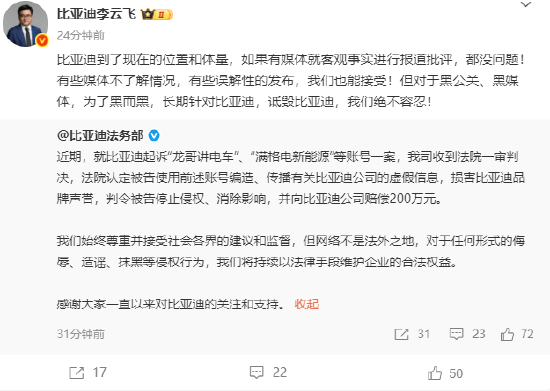
比亚迪李云飞:长期针对比亚迪,诋毁比亚迪,我们绝不容忍
Xin Lang Ke Ji· 2025-12-25 02:39
Core Viewpoint - BYD has won a court ruling against accounts spreading false information about the company, emphasizing its commitment to protecting its brand reputation and addressing malicious attacks [1] Group 1: Legal Action - BYD's legal department announced a court's first-instance judgment that found the defendants guilty of fabricating and disseminating false information, harming BYD's brand reputation [1] - The court ordered the defendants to cease infringement, eliminate the negative impact, and compensate BYD with 2 million yuan [1] Group 2: Company Response - BYD's General Manager of Brand and Public Relations, Li Yunfei, expressed that while the company welcomes objective criticism from media, it will not tolerate malicious attacks or black public relations targeting BYD [1]
海内外全面开花,储能迈向市场化新阶段|2025中国经济年报
Hua Xia Shi Bao· 2025-12-25 02:20
Core Insights - The cancellation of mandatory energy storage requirements has not hindered the growth momentum of the energy storage industry, with both domestic and international markets experiencing unexpected growth in the second half of the year [2][4] - Energy storage is increasingly recognized for its economic value and importance in the consumption of green electricity, beyond just its role in energy transition [2] Industry Growth - The share of energy storage batteries in the lithium battery market has grown significantly, surpassing 25% in the first half of the year and reaching 28% in November [2] - Global lithium battery production reached 2058.44 GWh in the first 11 months of the year, a year-on-year increase of 48.59%, while cumulative production of energy storage batteries was 535.98 GWh, up 64.14% year-on-year [2] - The expected installed capacity of lithium energy storage in China for 2025 is projected to reach 157 GWh, representing an 82.9% year-on-year increase [2][4] Market Dynamics - The energy storage industry is transitioning from policy-driven growth to market-driven growth, with global lithium energy storage installations expected to reach 181 GWh in 2024, an 88% increase year-on-year [4] - China, Europe, and the United States account for approximately 90% of the energy storage market, with China holding a 50%-60% market share [4][5] - The European market is expected to see a significant increase in energy storage installations, with a projected growth rate of 92% and an addition of 48 GWh [4] Supply Chain and Production - Global energy storage cell shipments reached 410.45 GWh in the first three quarters of 2025, a year-on-year increase of 98.5%, with a record quarterly shipment of 170.24 GWh [5][6] - Chinese companies dominate the global energy storage cell market, with the top ten companies holding a market share of 89.9% [6] - The global energy storage battery market is expected to see a shipment volume of 746 GWh in 2026, with a year-on-year growth rate of 39% [6] International Expansion - Chinese companies are increasingly expanding into overseas markets, with significant growth in revenue from international operations, exemplified by CATL's overseas revenue rising from 0.59% to 30.48% of total revenue from 2015 to 2024 [7][8] - The overseas energy storage market is characterized by higher marketization and profitability due to significant price differentials between peak and off-peak electricity [8] - As of October 2025, 47 Chinese companies have signed or completed over 45 overseas strategic cooperation agreements, with a total scale of approximately 69 GWh [8]





比亚迪李云飞:对于黑公关、黑媒体绝不容忍
Xin Lang Cai Jing· 2025-12-25 02:20
比亚迪李云飞 微博称:比亚迪到了现在的位置和体量,如果有媒体就客观事实进行报道批评,都没问 题!有些媒体不了解情况,有些误解性的发布,我们也能接受!但对于黑公关、黑媒体,为了黑而黑, 长期针对比亚迪,诋毁比亚迪,我们绝不容忍! ...
海内外全面开花,储能迈向市场化新阶段
Zhong Guo Neng Yuan Wang· 2025-12-25 02:20
Core Insights - The cancellation of mandatory energy storage requirements has not hindered the growth momentum of the energy storage industry, with significant market expansion observed in both domestic and international markets in the second half of the year [1][2] - Energy storage is increasingly recognized for its economic value and importance in renewable energy consumption, with a notable rise in its share within the lithium battery market [1] Market Growth - The global lithium battery production reached 2058.44 GWh in the first 11 months of the year, marking a year-on-year increase of 48.59%, while the cumulative production of energy storage batteries was 535.98 GWh, up 64.14% year-on-year [1] - The energy storage battery's share of total lithium battery production exceeded 25% in the first half of the year and increased to 26% over the first 11 months, with November alone reaching 28% [1] - The expected installed capacity of lithium energy storage in China for 2025 is projected to reach 157 GWh, representing an 82.9% year-on-year growth [1] Regional Insights - China, Europe, and the United States account for approximately 90% of the energy storage market, with China holding a market share of 50%-60% [2] - The European market is expected to see a significant growth rate of 92%, with an anticipated addition of 48 GWh of installed capacity [2] - The U.S. market has experienced a slowdown in growth due to tariff fluctuations and lengthy project approval times, while the Middle East is emerging as a rapidly growing market driven by energy transition and decarbonization demands [3] Supply Chain Dynamics - In the first three quarters of 2025, global energy storage cell shipments reached 410.45 GWh, a year-on-year increase of 98.5%, with the third quarter setting a new record for quarterly shipments at 170.24 GWh [3] - Chinese companies dominate the global energy storage cell market, with the top ten companies holding a market share of 89.9% [4][5] Future Projections - The global energy storage battery shipment is expected to reach 746 GWh in 2026, with a year-on-year growth rate of 39% [5] - The global energy storage market is projected to have significant growth potential, with estimates suggesting that the peak annual installed capacity could exceed 1.5 TWh by 2035, indicating an 8.6 times growth potential from current levels [5] International Expansion - Chinese companies are increasingly expanding into overseas markets, with significant growth in international revenue observed, particularly for companies like CATL [6] - The overseas energy storage market is characterized by higher marketization levels and greater profit margins due to more pronounced peak-valley price differences [6] - As of October 2025, 47 Chinese companies have signed or completed overseas strategic collaborations and projects totaling approximately 69 GWh [6] Pricing Trends - The rising prices of energy storage cells reflect strong downstream demand, with major lithium battery material companies operating at full capacity [7] - Long-term contract negotiations for 2026 have already been completed, with price increases of 0.02-0.04 CNY per watt-hour compared to 2025 levels [7]
比亚迪法务部:近期,就比亚迪起诉“龙哥讲电车”、“满格电新能源”等账号一案,我司收到法院一审判决
Xin Lang Cai Jing· 2025-12-25 02:15
法院认定被告使用前述账号编造、传播有关 比亚迪 公司的虚假信息,损害比亚迪商业信誉及商品声 誉,判令被告停止侵权、消除影响,并向比亚迪公司赔偿200万元。我们始终尊重并接受社会各界的建 议和监督,但网络不是法外之地,对于任何形式的侮辱、造谣、抹黑等侵权行为,我们将持续以法律手 段维护企业的合法权益。感谢大家一直以来对比亚迪的关注和支持。 ...