
Muyuan Foods (002714)

Search documents
牧原股份:港股发行主要目的是推进全球化战略,借助香港全球金融中心地位打造国际化资本运作平台
Jin Rong Jie· 2026-01-26 15:32
有投资者在互动平台向牧原股份提问:"董秘,您好!股价的连跌已经明确:现在在港股增发绝不是好 的融资策略。目前内地的贷款利率如此之低,为什么偏要通过高成本(稀释股权价值且提升治理成本和 分红)和难以控制节奏的融资方式呢?强烈建议,退出港股增发计划,安心做好本职工作,降低单位成 本、提高市场占有规模、拓展逆周期的产品,可以做的事情很多,莫在无价值的工作上死磕。谢谢。" 声明:市场有风险,投资需谨慎。本文为AI基于第三方数据生成,仅供参考,不构成个人投资建议。 本文源自:市场资讯 作者:公告君 针对上述提问,牧原股份回应称:"您好,本次港股发行最主要的目的是推进全球化战略,公司希望借 助香港全球金融中心地位,打造国际化资本运作平台,丰富融资渠道和工具,推进公司国际化战略布 局、提升企业形象及国际知名度,招揽更多国际人才,加速海外团队建设,加强与境外资本市场对接。 同时,公司也将借助本次在国际资本市场的亮相,传递公司在新发展阶段的投资价值,塑造良好的资本 市场形象,引入更多国际化、长期投资者,进一步优化股东结构,提升公司治理水平。感谢您的关 注!" ...

牧原股份:公司已完成大规模的产能建设,进入稳健发展时期
Zheng Quan Ri Bao Zhi Sheng· 2026-01-26 13:48
Group 1 - The company has completed large-scale capacity construction and has entered a stable development phase, with existing capacity sufficient to meet production and operational needs [1] - The company will continue to focus on production management, aiming to reduce breeding costs and enhance profitability [1]
牧原股份:公司会加强与资本市场投资者的沟通,增强信息披露质量和透明度
Zheng Quan Ri Bao· 2026-01-26 13:16
(文章来源:证券日报) 证券日报网讯 1月26日,牧原股份在互动平台回答投资者提问时表示,目前公司生产经营一切正常,各 项业务稳健运营,并严格按照证监会、深交所的相关规定,真实、准确、完整、及时进行信息披露。公 司会聚焦主业,持续做好经营管理,提升生产效率与盈利能力,保证公司高质量稳定发展,更好地为股 东创造回报。同时,公司会加强与资本市场投资者的沟通,增强信息披露质量和透明度,根据发展阶段 及实际情况,综合运用多种方式稳定投资者信心,推动公司投资价值合理反映公司经营质量。 ...

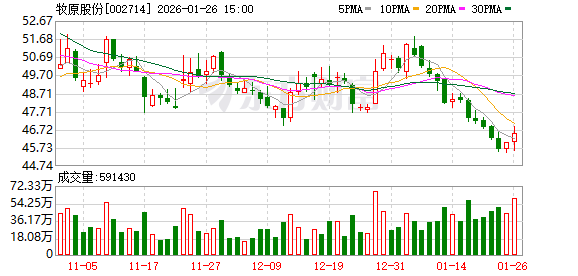
牧原股份:目前公司生产经营一切正常,各项业务稳健运营
Zheng Quan Ri Bao Zhi Sheng· 2026-01-26 13:11
Core Viewpoint - The company emphasizes that its stock price in the secondary market is influenced by various factors, but its production and operations are currently stable and normal [1] Group 1: Company Operations - The company is focusing on its core business and is committed to improving operational management [1] - The company aims to enhance production efficiency and profitability to ensure high-quality and stable development [1] - The company is dedicated to creating better returns for its shareholders [1]
牧原股份:当前公司现金流安全稳定
Zheng Quan Ri Bao Wang· 2026-01-26 12:40
Core Viewpoint - The company, Muyuan Foods (002714), has confirmed that its cash flow is currently safe and stable, and it will manage cash flow based on external conditions and operational circumstances [1] Group 1: Financial Performance - The company reported a net inflow of cash flow from operating activities due to current pig prices [1] - The complete cost of pig farming for the company is approximately 11.6 yuan/kg by December 2025 [1] - Non-cash costs, such as depreciation and amortization, account for about 10% of the cost structure [1] Group 2: Operational Strategy - The company has completed large-scale capacity construction and is entering a period of steady development [1] - Future capital expenditures are expected to decline, leading to a gradual increase in free cash flow levels [1]
牧原股份据报最早周四起接受香港上市申购
Ge Long Hui· 2026-01-26 12:14
Core Viewpoint - Muyuan Foods (002714.SZ), a pig farming company listed in Shenzhen, plans to begin accepting investor subscriptions for its Hong Kong listing, aiming to raise $1.5 billion (approximately HKD 11.7 billion) [1] Group 1: Company Overview - Muyuan Foods has adopted a vertically integrated business model covering the entire industry chain, including pig breeding, pig farming, feed production, slaughtering, and sales of pigs and meat products [1] - The company received approval for its listing from the Hong Kong Stock Exchange on January 16 [1] Group 2: Fund Utilization - The proceeds from the listing will be used to explore overseas opportunities to expand the business footprint [1] - Funds will also be allocated for research and development to drive technological innovation across the entire industry chain over the next three years [1] - Remaining funds will be used for working capital and general corporate purposes [1] Group 3: Underwriters - Morgan Stanley, CITIC Securities, and Goldman Sachs are serving as joint sponsors for the listing [1]
专访牧原股份董秘秦军:专注经营管理,不把精力放在研判未来
Nan Fang Du Shi Bao· 2026-01-26 05:43
Core Viewpoint - The article discusses the transformation of the pig farming industry in China, emphasizing the integration of technology and management innovations to enhance efficiency and reduce costs, while also addressing the company's strategic plans for 2026 in response to market dynamics and policy changes. Group 1: Company Development - In 2025, the company achieved a pig output of 77.981 million heads and sales revenue of 132.811 billion yuan, with a breeding cost of 11.3 yuan/kg, leading to a projected net profit of 15.1 to 16.1 billion yuan for 2026, providing a solid foundation for stable operations [2][3] - The average breeding cost decreased by 2 yuan/kg year-on-year, reaching approximately 12 yuan/kg, attributed to continuous technological investments and management innovations [2] Group 2: Strategic Shifts - The company is transitioning from a single focus on commercial pig farming to a dual-driven model that includes commercial piglets, aiming to enhance operational efficiency and provide value to clients while promoting industry specialization and sustainability [3] - The piglet strategy allows clients to lock in prices, reducing risks and improving profitability, while also addressing the challenges faced by small farmers under traditional breeding models [3] Group 3: Technological Innovation - The company plans to increase the coverage and stability of smart equipment across over 1,000 farms, focusing on AI inspection, precise feeding, and environmental control to reduce reliance on personnel [4] - Ongoing research in feed formulation and alternative protein sources aims to further lower breeding costs, with a focus on optimizing nutritional needs for different pig breeds [5][6] Group 4: Industry Layout - The company's slaughtering and meat processing business is expanding in three key areas: increasing slaughter capacity, optimizing product offerings, and enhancing operational capabilities through digital management and cost control [7] - A joint venture in the biopharmaceutical sector aims to maximize the value of pigs by producing heparin sodium and other products, with plans for further collaboration in the industry [8] Group 5: International Expansion - The company is advancing its international strategy, particularly in Vietnam, with plans to replicate domestic technological and management successes in high-growth overseas markets [9] - Initial international efforts will focus on light-asset models, with future considerations for establishing production capacities and targeted acquisitions [9] Group 6: Industry Trends - The company acknowledges the dual challenges of strong policy regulation and weak market cycles in 2026, focusing on operational management and innovation to maintain stability and efficiency [10][12] - Strategies to stabilize raw material supply chains and mitigate cost fluctuations include partnerships with grain suppliers and flexible procurement approaches [12][13] Group 7: Ecosystem Development - The company aims to empower upstream and downstream partners through an "industry interconnection" model, enhancing collaboration and sharing resources to drive mutual growth [14]
全指现金流ETF鹏华(512130)涨近2%,有色石油领涨市场
Xin Lang Cai Jing· 2026-01-26 05:29
Group 1 - The core viewpoint of the articles highlights the strong performance of the non-ferrous metals and oil sectors, driven by rising commodity prices and geopolitical tensions [1] - Spot gold has reached a historical high of $5080.60 per ounce, with a 2% increase, while spot silver briefly surpassed $108 per ounce, showing a daily increase of over 4.6% [1] - The cash flow index's focus on "strong cyclical resources" like non-ferrous metals and chemicals reflects its structural advantages and precise value in the market [1] Group 2 - The CSI All-Share Free Cash Flow Index (932365) has risen by 0.81%, with significant gains in constituent stocks such as silver non-ferrous (up 10.03%), Nanshan Aluminum (up 7.08%), and China National Offshore Oil Corporation (up 5.86%) [1] - The CSI All-Share Free Cash Flow ETF (512130) has increased by 1.84%, marking its sixth consecutive rise, with the latest price at 1.33 yuan [1] - As of December 31, 2025, the top ten weighted stocks in the CSI All-Share Free Cash Flow Index include China National Offshore Oil Corporation, SAIC Motor, and Gree Electric Appliances, collectively accounting for 53.78% of the index [2]




中国消费行业:2026 年 GCC 会议要点 -估值仍具吸引力,消费复苏迹象显现-China Consumer Sector_ 2026 GCC takeaways_ Sector valuation remains attractive with signs of consumption recovery
2026-01-26 02:50
Summary of Key Points from the Conference Call Industry Overview - **Sector**: China Consumer Sector - **Key Insights**: The sector shows signs of consumption recovery despite a near-term property market downturn. Valuation remains attractive, approximately 1 standard deviation below 10-year averages, indicating that a consumption recovery is not yet priced in [2][21]. Consumer Staples - **Baijiu**: Anticipated demand support for mid-end baijiu due to easing alcohol bans and private consumption growth. Companies are expected to accelerate channel transformations for sustainable EPS growth [3][8]. - **Beer**: Premiumization continues through product diversification and in-home channel expansion, despite on-trade softness. CR Beer expects low-single-digit volume growth in 2025, with Heineken volumes projected to grow by 20% YoY [3][8]. - **Dairy**: Liquid milk sales are expected to recover modestly in 2026, driven by marketing and innovation, despite a weak 2025. Fresh milk shows resilience with double-digit growth [3][8]. - **Freshly-Made Beverages (FMB)**: Guming is expected to maintain steady SSSG in 2026 through category expansion and dine-in growth, despite the phase-out of delivery subsidies [3][8][19]. - **Condiments**: Sequentially improving demand is expected, with Haitian focusing on multi-product categories and Jonjee anticipating a cleaner 2026 after a weak 4Q25 [3][8]. Consumer Discretionary - **Home Appliances**: Companies like Midea and Haier expect higher overseas growth compared to domestic markets in 2026. Strategies include price hikes and operational efficiencies [4][10]. - **Jewelry**: Brands with unique designs may consolidate post-VAT reform. Laopu is expected to achieve strong sales growth due to increased focus on value-added services [4][10]. - **Restaurants**: Intense competition leads to divergent strategies, with some companies lowering prices while others upgrade offerings. DPC Dash is on track for expansion despite market uncertainties [4][10]. Stock Implications - **Most Preferred Stocks**: CR Beer, Guming, MIXUE, China Foods, YUM China, among others, are highlighted as preferred investments due to their growth potential [5]. - **Least Preferred Stocks**: Companies like Swellfun, Nongfu, and Gree are noted as less favorable due to various challenges [5]. Key Risks - Risks include demand recovery uncertainties, cost inflation or deflation, and changes in the competitive landscape. These factors could significantly impact the consumer sector's performance [21]. Additional Insights - **Pet Food**: The industry is shifting towards online sales, with over 85% of sales occurring digitally. Competition is intensifying, pushing brands towards innovation and product differentiation [13]. - **Snack Sector**: Rapid category diversification and channel restructuring are creating growth opportunities, particularly through snack discounters [9][12]. This summary encapsulates the essential insights and projections from the conference call, providing a comprehensive overview of the current state and future outlook of the China consumer sector.





生猪-如何看待春节前后猪价
2026-01-26 02:49
Summary of Conference Call on Swine Industry Industry Overview - The swine industry is currently experiencing a supply-demand imbalance, with prices expected to fluctuate between 5.5-6 RMB/kg after the Spring Festival due to delayed market supply from secondary fattening practices [1][3][6] - The overall consumption remains weak, impacting price stability despite some alleviation in supply pressure [1][3] Key Insights and Arguments - **Supply Pressure and Price Forecast**: After the Spring Festival, supply pressure is expected to ease, with prices likely to remain within the 5.5-6 RMB/kg range. The primary reason for this is the postponement of slaughtering due to secondary fattening practices [1][3][6] - **Production Capacity Decrease**: The reduction in production capacity is slow, primarily influenced by disease outbreaks and financial losses. Current piglet costs have decreased, but large-scale farms can still operate profitably, indicating insufficient conditions for significant capacity reduction [4][7] - **Market Dynamics**: Some larger farming enterprises are replacing smaller farms to meet market demand, particularly for heavier pigs during the winter consumption peak [5] - **Raw Material Price Uncertainty**: There is uncertainty regarding raw material prices, such as corn and soybean meal, which may rebound and increase costs for the farming industry that relies on low-priced raw materials [9] - **Future Supply Trends**: The number of piglets is expected to peak in October 2026, followed by a slight decline. By March or April 2027, piglet spot prices are anticipated to bottom out, indicating a potential decrease in future supply [10] Additional Important Points - **Slaughterhouse Profitability**: Slaughterhouses are facing profitability challenges, with leading companies using low-price strategies and subsidies to capture market share, making it difficult for smaller slaughterhouses to compete [11][13][14] - **Impact of Secondary Fattening**: Secondary fattening practices are common, with some farmers planning to sell pigs after the Spring Festival, which may help stabilize market prices but also create short-term supply mismatches [6] - **Long-term Disease Risks**: The industry may face significant disease risks in the next two years, as major diseases tend to occur approximately every ten years, which could impact production capacity [7] - **2026 Production Expectations**: The expected increase in swine output for 2026 is around 5%, primarily driven by an increase in commercial pig output, despite some large enterprises reducing capacity [15] - **Price Predictions**: The average price for 2026 is projected to be around 12.5 RMB/kg, slightly lower than the previous year's average due to increased supply and lower costs in the latter half of the year [16][17]