
Muyuan Foods (002714)

Search documents
传东鹏饮料、牧原股份拟最快本周开始香港上市前推介
Zhi Tong Cai Jing· 2026-01-13 11:21
Group 1: Dongpeng Beverage - Dongpeng Beverage plans to raise approximately $1 billion (around 7.8 billion HKD) through its upcoming Hong Kong IPO, with book building expected to start in the week of January 26 [1] - Dongpeng is recognized as the leading functional beverage company in China, with the highest revenue growth among the top 20 listed soft drink companies globally [1] - According to a report by Frost & Sullivan, Dongpeng has maintained its position as the number one functional beverage brand in China for four consecutive years since 2021, increasing its market share from 15.0% in 2021 to 26.3% in 2024 [1] - By retail value, Dongpeng is projected to be the second-largest functional beverage company in 2024, holding a market share of 23.0% [1] Group 2: Muyuan Foods - Muyuan Foods is a technology-driven leader in the pork industry, recognized as a pioneer in smart pig farming [2] - The company employs a vertically integrated business model that encompasses the entire pork supply chain, including breeding, farming, feed production, and meat processing [2] - Revenue from the sale of commercial pigs constitutes a significant portion of Muyuan's total income, accounting for 92.8%, 96.5%, 95.2%, 93.0%, and 92.7% of total revenue for the years 2022, 2023, 2024, and the six months ending June 30, 2024, and 2025, respectively [2]


新股消息 | 传东鹏饮料(605499.SH)、牧原股份(002714.SZ)拟最快本周开始香港上市前推介
智通财经网· 2026-01-13 11:19
Group 1: Dongpeng Beverage - Dongpeng Beverage plans to raise approximately $1 billion (around 7.8 billion HKD) through its upcoming Hong Kong IPO, with book building expected to start in the week of January 26 [1] - Dongpeng is the leading functional beverage company in China, with the highest revenue growth among the top 20 listed soft drink companies globally [1] - According to a report by Frost & Sullivan, Dongpeng has ranked first in the Chinese functional beverage market by sales for four consecutive years since 2021, with market share increasing from 15.0% in 2021 to 26.3% in 2024 [1] - By retail revenue, Dongpeng is projected to be the second-largest functional beverage company in 2024, holding a market share of 23.0% [1] Group 2: Muyuan Foods - Muyuan Foods is a technology-driven leader in the pork industry, recognized as a pioneer in smart pig farming [2] - The company employs a vertically integrated business model that covers the entire pork industry chain, including breeding, farming, feed production, and slaughtering [2] - Revenue from the sale of commercial pigs constitutes a significant portion of Muyuan's total income, accounting for 92.8%, 96.5%, 95.2%, 93.0%, and 92.7% for the years 2022, 2023, 2024, and the six months ending June 30, 2024, and 2025, respectively [2]
新股消息 | 传东鹏饮料、牧原股份拟最快本周开始香港上市前推介
Zhi Tong Cai Jing· 2026-01-13 11:19
Group 1: Dongpeng Beverage - Dongpeng Beverage plans to raise approximately $1 billion (around 7.8 billion HKD) through its upcoming Hong Kong IPO, with book building expected to start in the week of January 26 [1] - Dongpeng is the leading functional beverage company in China, ranking first in revenue growth among the top 20 publicly listed soft drink companies globally [1] - According to a report by Frost & Sullivan, Dongpeng has maintained its position as the number one functional beverage brand in China for four consecutive years since 2021, with market share increasing from 15.0% in 2021 to 26.3% in 2024 [1] - By retail revenue, Dongpeng is projected to be the second-largest functional beverage company in 2024, holding a market share of 23.0% [1] Group 2: Muyuan Foods - Muyuan Foods is a technology-driven leader in the pork industry, recognized as a pioneer in smart pig farming [2] - The company employs a vertically integrated business model that encompasses the entire pork supply chain, including breeding, farming, feed production, and meat processing [2] - Revenue from the sale of commercial pigs constitutes a significant portion of Muyuan's total income, accounting for 92.8%, 96.5%, 95.2%, 93.0%, and 92.7% of total revenue for the years 2022, 2023, 2024, and the six months ending June 30, 2024, and 2025, respectively [2]
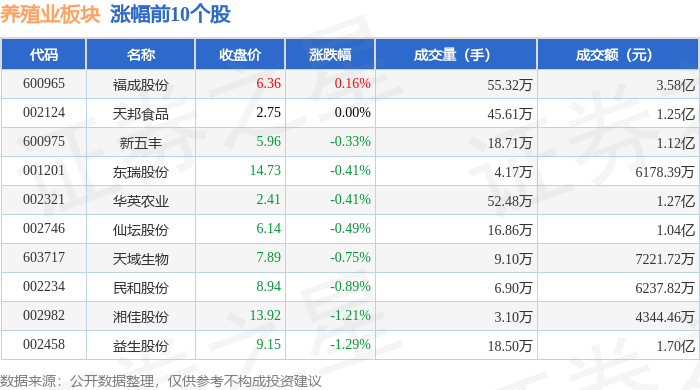
养殖业板块1月13日跌1.9%,京基智农领跌,主力资金净流出8.83亿元
Zheng Xing Xing Ye Ri Bao· 2026-01-13 08:57
Core Viewpoint - The aquaculture sector experienced a decline of 1.9% on January 13, with Jingji Zhino leading the drop. The Shanghai Composite Index closed at 4138.76, down 0.64%, while the Shenzhen Component Index closed at 14169.4, down 1.37% [1]. Group 1: Market Performance - The aquaculture sector's stocks showed mixed performance, with notable declines in several key companies. For instance, Jingji Zhino fell by 4.62% to a closing price of 15.06, while other companies like Luoniushan and Zhengbang Technology also saw declines of 2.72% and 2.44%, respectively [2]. - The total net outflow of main funds from the aquaculture sector was 8.83 billion yuan, while retail investors saw a net inflow of 5.44 billion yuan [2][3]. Group 2: Individual Stock Performance - Specific stock performances included: - Fucheng Co. closed at 6.36 with a slight increase of 0.16% and a trading volume of 553,200 shares, amounting to a transaction value of 358 million yuan [1]. - Xinfeng Co. had a closing price of 5.96, down 0.33%, with a trading volume of 187,100 shares [1]. - Other notable declines included Minhe Agriculture at 8.94, down 0.89%, and Yisheng Co. at 9.15, down 1.29% [1]. Group 3: Fund Flow Analysis - The fund flow analysis indicated that: - New Wufeng had a main fund net inflow of 2.92 million yuan, while retail investors contributed a net inflow of 1.24 million yuan [3]. - In contrast, Dongrui Co. experienced a main fund net outflow of 3.08 million yuan, with retail investors contributing a net inflow of 6.36 million yuan [3]. - The overall trend showed that while main funds were exiting the sector, retail investors were actively buying into certain stocks [2][3].


牧原股份跌2.01%,成交额17.76亿元,主力资金净流出2.95亿元
Xin Lang Cai Jing· 2026-01-13 06:31
Core Viewpoint - The stock price of Muyuan Foods Co., Ltd. has experienced a decline, with a current trading price of 48.36 yuan per share, reflecting a year-to-date drop of 4.39% and a 5-day drop of 5.88% [1] Group 1: Stock Performance - As of January 13, the stock price of Muyuan Foods fell by 2.01%, with a trading volume of 1.776 billion yuan and a turnover rate of 0.95% [1] - The company has seen a net outflow of 295 million yuan in principal funds, with significant selling pressure observed [1] - The stock has declined by 4.39% year-to-date, 5.88% over the last five trading days, and 4.46% over the last 60 days [1] Group 2: Financial Performance - For the period from January to September 2025, Muyuan Foods reported a revenue of 111.79 billion yuan, representing a year-on-year growth of 15.52% [2] - The net profit attributable to shareholders for the same period was 14.779 billion yuan, showing a year-on-year increase of 41.01% [2] Group 3: Shareholder Information - As of September 30, 2025, the number of shareholders for Muyuan Foods was 185,600, a decrease of 11.19% from the previous period [2] - The average number of circulating shares per shareholder increased by 12.60% to 20,534 shares [2] - The company has distributed a total of 26.576 billion yuan in dividends since its A-share listing, with 16.594 billion yuan distributed in the last three years [3]
上市猪企产能“越去越多”:A股养猪“四巨头”新增出栏超2200万头
Zhong Guo Jing Ying Bao· 2026-01-13 03:11
Core Insights - The leading pig farming companies in China have not achieved significant results in reducing production capacity despite calls for it over the past year or two. In 2025, major listed pig companies reported a total pig sales volume of 144.54 million heads, an increase of 22.08 million heads compared to 2024 [1][2]. Group 1: Sales Data and Growth - In 2025, Muyuan Foods sold 77.98 million pigs, an increase of 6.38 million heads from 2024. Wens Foodstuff Group sold 40.48 million pigs, with a notable growth of 34.11%, exceeding its annual operational plan of 33-35 million heads [1]. - New Hope reported a pig sales volume of 17.55 million heads, aligning with its previous operational targets, while Zhengbang Technology sold 8.54 million heads, marking a 105.87% year-on-year increase [2]. Group 2: Industry Trends and Price Dynamics - The overall pig output from 19 listed companies in 2025 is projected to reach 198.67 million heads, reflecting a year-on-year growth of 24.9%. Companies like Zhengbang Technology and Dongrui Co. saw output growth exceeding 60% [2]. - The increase in supply has led to a decline in pig prices, with the average price dropping to 12.17 yuan/kg by January 2026, a decrease of 1.78% week-on-week and 23.51% year-on-year [3]. Group 3: Capacity Management and Industry Recommendations - The "China Pig Industry High-Quality Development White Paper" indicates that the overcapacity issue stems from rapid expansion by large enterprises seeking scale effects. It suggests that market share for individual groups should not exceed 10%, and the top three companies should not exceed 30% [4]. - The report emphasizes the need for leading companies to stabilize the market by actively reducing production during periods of oversupply and releasing capacity in times of shortage [4]. Group 4: Structural Changes and Future Outlook - The current structure of pig farming is shifting towards larger enterprises, with only Muyuan Foods maintaining a market share around 10%. Analysts suggest a balanced development involving family-run farms, which currently account for about 30% of output [6]. - The number of breeding sows is crucial for determining pig output, and adjustments to the target breeding sow population are recommended to align with market conditions [7][8].


温氏股份增量不增利归母净利降40亿 股价萎靡市值比牧原股份少1562亿
Chang Jiang Shang Bao· 2026-01-13 03:04
2025年度,温氏股份经营业绩再度承压。近日,温氏股份发布2025年度业绩预告,公司预计全年实现归 母净利润50亿元—55亿元,较上年同期下降40.73%—46.12%;预计实现扣非净利润48亿元—53亿元, 较上年同期下降44.64%—49.86%。 2025年前三季度,温氏股份的经营业绩就表现出下滑趋势,当期营业收入约为758亿元,与上年同期基 本持平,但归母净利润下降约18%,为52.56亿元。 对比发现,业绩大滑坡出现在第四季度,如果最终经审计的归母净利润为预计数的下限,那么,2025年 第四季度,公司会出现亏损。 长江商报消息●长江商报记者 沈右荣 养殖巨头温氏股份(300498.SZ)抵御行业周期波动依旧乏力。 温氏股份的产品销量是增长的。2025年,公司销售生猪4047.69万头、肉鸡13.03亿只,分别较上年同期 增加逾千万头、上亿只。 增量不增利,核心因素是产品销售价格下降。2025年,公司的生猪和肉鸡销售价格同比均出现了下降。 过去一年,温氏股份股价表现萎靡,截至1月12日市值为1134亿元,较"猪茅"牧原股份少1562亿元。 增量不增利再现 养殖行业首份年度业绩预告出炉。温氏股份的业绩再 ...
牧原股份成功发行5亿元科技创新债券
Zheng Quan Ri Bao Wang· 2026-01-13 02:13
Group 1 - The company, Muyuan Foods Co., Ltd. (牧原股份), successfully issued the first phase of its 2026 technology innovation bonds [1] - The bond issuance took place on January 7, with a total scale of 500 million RMB, and the funds were fully received by January 9 [1] - The bond, named "26 Muyuan Foods MTN001 (科技创新债)", has a term of 2 years, with an interest rate of 2.23% and a face value price of 100 RMB per 100 RMB [1] Group 2 - The main underwriter for the bond issuance was CITIC Bank, with joint lead underwriters being China Merchants Bank and Industrial Bank [1]
温氏股份增量不增利 归母净利大降40亿 股价萎靡市值比牧原股份少1562亿
Chang Jiang Shang Bao· 2026-01-13 00:01
Core Viewpoint - The company, Wens Foodstuff Group, is facing significant pressure on its operating performance for the fiscal year 2025, with expected net profit declines of 40.73% to 46.12% compared to the previous year [1][4]. Financial Performance - For 2025, Wens expects a net profit of 5 billion to 5.5 billion yuan, down from 9.28 billion yuan in the previous year, indicating a decrease of approximately 42.8 billion to 37.8 billion yuan [4]. - In the first three quarters of 2025, the company reported revenue of approximately 758 billion yuan, which is nearly flat year-on-year, but net profit fell by about 18% to 5.256 billion yuan [1][4]. - The fourth quarter is projected to be particularly challenging, with a potential net loss if the lower end of the profit forecast is realized [5][6]. Sales and Pricing - Despite an increase in product sales, with 40.4769 million pigs and 1.303 billion chickens sold in 2025, the company is experiencing a decline in net profit due to falling sales prices [6][7]. - The average selling price for pigs decreased by 17.95% to 13.71 yuan per kilogram, while the average price for chickens fell by 9.80% to 11.78 yuan per kilogram [6]. Industry Context - The livestock industry is characterized by significant cyclical fluctuations, and Wens has struggled to mitigate these cycles effectively [8]. - The company has been implementing cost-cutting measures, but the reduction in sales prices has led to a decline in profitability despite lower production costs [9][10]. Competitive Landscape - Wens Foodstuff Group's market performance has lagged behind its competitor, Muyuan Foods, which reported a net profit of 14.779 billion yuan in the first three quarters of 2025, a 41.01% increase year-on-year [11][13]. - The gap in market capitalization between Wens and Muyuan has widened, with Wens's market value at 113.4 billion yuan, which is 156.2 billion yuan less than Muyuan's [3][13].
温氏股份增量不增利归母净利大降40亿 股价萎靡市值比牧原股份少1562亿
Chang Jiang Shang Bao· 2026-01-12 23:44
养殖巨头温氏股份(300498)(300498.SZ)抵御行业周期波动依旧乏力。 2025年度,温氏股份经营业绩再度承压。近日,温氏股份发布2025年度业绩预告,公司预计全年实现归 母净利润50亿元—55亿元,较上年同期下降40.73%—46.12%;预计实现扣非净利润48亿元—53亿元, 较上年同期下降44.64%—49.86%。 2025年前三季度,温氏股份的经营业绩就表现出下滑趋势,当期营业收入约为758亿元,与上年同期基 本持平,但归母净利润下降约18%,为52.56亿元。 对比发现,业绩大滑坡出现在第四季度,如果最终经审计的归母净利润为预计数的下限,那么,2025年 第四季度,公司会出现亏损。 如果温氏股份最终实现的归母净利润为预计数的下限,那么,公司第四季度将出现亏损。 温氏股份的产品销量是增长的。2025年,公司销售生猪4047.69万头、肉鸡13.03亿只,分别较上年同期 增加逾千万头、上亿只。 增量不增利,核心因素是产品销售价格下降。2025年,公司的生猪和肉鸡销售价格同比均出现了下降。 过去一年,温氏股份股价表现萎靡,截至1月12日市值为1134亿元,较"猪茅"牧原股份(002714)少 ...