Muyuan Foods (002714)

Search documents
牧原股份(002714) - 2025 Q4 - 年度业绩预告
2026-01-15 10:35
| 证券代码:002714 | 证券简称:牧原股份 | 公告编号:2026-006 | | --- | --- | --- | | 债券代码:127045 | 债券简称:牧原转债 | | 牧原食品股份有限公司 2025 年度业绩预告 本公司及董事会全体成员保证信息披露内容的真实、准确、完整,没有虚假记载、 误导性陈述或重大遗漏。 一、本期业绩预计情况 1、业绩预告期间:2025 年 1 月 1 日—2025 年 12 月 31 日 2、本次业绩预告未经注册会计师审计。 三 、业绩变动原因说明 2025 年,公司持续做好生猪的健康管理与生产管理,提高精细化管理水平, 提升养殖生产成绩,生猪养殖成本较上年同期下降。同时,受生猪市场行情波动 影响,全年商品猪销售均价约 13.5 元/公斤,同比下降约 17.3%,使得公司整体 盈利水平较上年同期有所下滑。 四、风险提示 1、生猪市场价格的大幅波动(下降或上升),都可能会对公司的经营业绩 产生重大影响。如果未来生猪市场价格出现大幅下滑,仍然可能造成公司的业绩 下滑。敬请广大投资者审慎决策,注意投资风险。 2、生猪市场价格变动的风险是整个生猪生产行业的系统风险,对任何一 ...

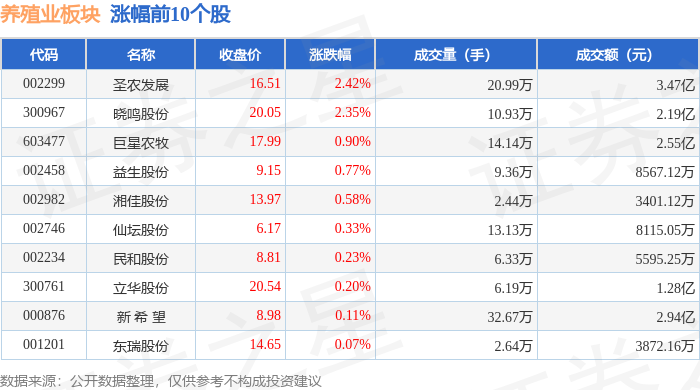
养殖业板块1月15日跌0.28%,*ST天山领跌,主力资金净流出4.55万元
Zheng Xing Xing Ye Ri Bao· 2026-01-15 08:53
证券之星消息,1月15日养殖业板块较上一交易日下跌0.28%,*ST天山领跌。当日上证指数报收于 4112.6,下跌0.33%。深证成指报收于14306.73,上涨0.41%。养殖业板块个股涨跌见下表: 从资金流向上来看,当日养殖业板块主力资金净流出4.55万元,游资资金净流出4309.47万元,散户资金 净流入4314.02万元。养殖业板块个股资金流向见下表: | 代码 | 名称 | 主力净流入 (元) | 主力净占比 游资净流入(元) | | 游资净占比 散户净流入(元) | | 散户净占比 | | --- | --- | --- | --- | --- | --- | --- | --- | | 002714 | 牧原股份 | -5881.48万 | 3.38% | -1873.42万 | -1.08% | -4008.06万 | -2.31% | | 300498 | 温氏股份 | 2532.99万 | 3.12% | -1954.54万 | -2.41% | -578.46万 | -0.71% | | 300967 | 晓鸣股份 | 2512.54万 | 11.45% | -478.94万 | -2 ...


中国消费板块 2026 展望:消费信心复苏是否已开启?-China Consumer Sector_ 2026 Outlook_ are we at the beginning of consumer confidence recovery_
2026-01-15 06:33
Summary of the Conference Call Transcript Industry Overview - **Industry**: China Consumer Sector - **Outlook**: The sector is believed to be in the early stage of a multi-year recovery cycle that began in Q3 2024, with expectations for gradual improvement in consumer sentiment and spending through 2026E [2][11][12] Key Insights - **Valuation**: MSCI China Consumer Discretionary and Staples are trading at 17x and 15x 12-month forward PE, approximately one standard deviation below the 10-year averages, indicating that current valuations do not reflect a potential consumption recovery [2][9] - **Consumer Confidence**: The China Consumer Confidence Index has been trending upwards since September 2024, suggesting a gradual restoration of consumer confidence despite ongoing challenges in the property market [12][19] - **K-shaped Recovery**: The recovery is characterized by a K-shaped trend, where mid- to high-income consumers in tier-1 cities are expected to lead spending, while lower-tier city consumers remain focused on value for money [3][48] Consumer Behavior Trends - **Shifting Preferences**: A UBS Evidence Lab survey indicates a divergence in consumer behavior, with over 50% of mid- to high-income consumers reporting investment gains and showing strong spending intentions, particularly in premium and experiential categories [3][37] - **Spending Intentions**: The strongest spending intentions are noted in beauty and skincare (41%) and tourism (37%), reflecting a shift towards experiential and premium spending [51] - **Investment Gains**: 64-74% of mid- to high-income consumers reported increased investment returns, with many planning to reinvest or spend on travel, health services, and consumer electronics [40][41] Stock Implications - **Company Ratings**: - Upgrades to Neutral for Fenjiu due to expected benefits from non-business baijiu consumption - Buy ratings maintained for companies like MIXUE, Guming, China Foods, CR Beer, and YUM China, among others [4] - **Dividend Payouts**: Premium baijiu companies are noted for their >75% dividend payout, which is expected to protect share prices from downside risks [4] Structural Growth Opportunities - **Emerging Themes**: Key investment themes for 2026E include changing consumer preferences, corporate restructuring, and industry consolidation, particularly in sectors like home appliances and mass-market consumption [14][50] - **Corporate Restructuring**: Companies are expected to adapt their business models to align with changing consumer behaviors, which may lead to sustainable long-term earnings growth [4][50] Risks and Challenges - **Property Market Downturn**: The ongoing downturn in the property market is anticipated to weigh on household balance sheets, potentially impacting consumer spending [13][48] - **Policy Support**: The pace of recovery is contingent on stabilizing the property market and effective policy implementation to boost consumption [13][48] Conclusion - The China consumer sector is poised for a recovery, driven by improving consumer confidence and shifting spending patterns. However, the recovery will be uneven across different income groups and city tiers, necessitating a nuanced investment approach to capture emerging opportunities while being mindful of potential risks associated with the property market downturn.



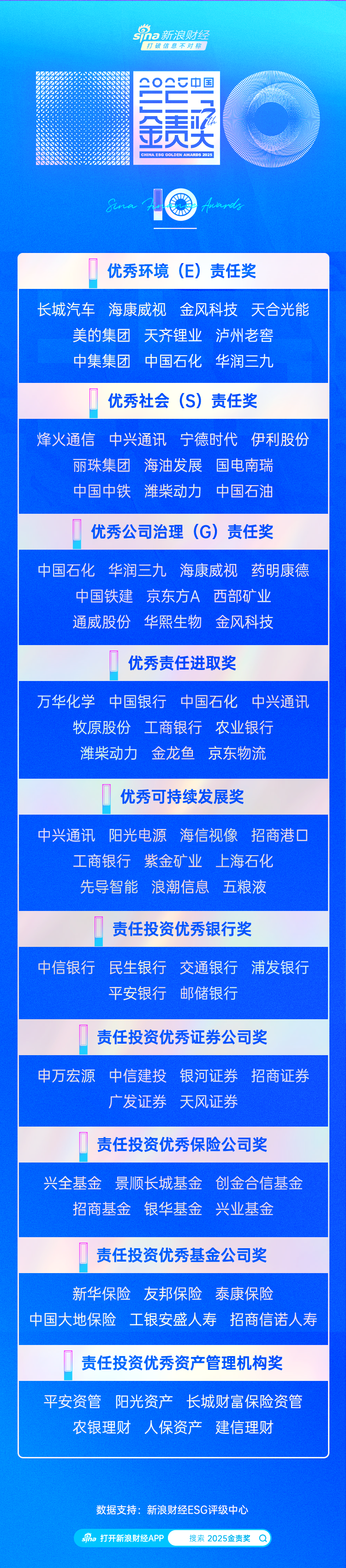
2025中国企业ESG“金责奖”优秀奖评选结果揭晓


Xin Lang Cai Jing· 2026-01-15 03:45
Core Viewpoint - The 2025 China Enterprise ESG "Golden Responsibility Award" aims to recognize companies and institutions that have made significant contributions to ESG initiatives in China, reflecting a shift from voluntary practices to compliance requirements in ESG performance [1][12]. Group 1: ESG Development and Awards Overview - By 2025, China's ESG development has transitioned from "setting standards" to "strengthening regulations," with a comprehensive disclosure standard system being established [1][12]. - The award selection attracted over 5,000 companies, with results based on ESG performance, online voting, and professional evaluations [2][12]. Group 2: Award Categories and Winners - The award categories include Excellent Environmental Responsibility Award, Excellent Social Responsibility Award, Excellent Corporate Governance Responsibility Award, Excellent Responsibility Initiative Award, Excellent Sustainable Development Award, and various responsibility investment awards [1][12]. - Notable winners of the Excellent Environmental Responsibility Award include Great Wall Motors, Hikvision, and China Petroleum [7][24]. - The Excellent Social Responsibility Award was awarded to companies such as YF Communication, ZTE, and Ningde Times [7][24]. - Winners of the Excellent Corporate Governance Responsibility Award include China Petroleum, Hikvision, and WuXi AppTec [7][24]. - The Excellent Responsibility Initiative Award was given to companies like ZTE, Sunlight Power, and Industrial and Commercial Bank of China [7][24]. - The Excellent Sustainable Development Award included companies such as WanHua Chemical, China Bank, and China Petroleum [7][24]. Group 3: Responsibility Investment Awards - The Responsibility Investment Excellent Bank Award was given to institutions like CITIC Bank and Minsheng Bank [5][21]. - The Responsibility Investment Excellent Securities Company Award included firms such as Shenwan Hongyuan and CITIC Securities [5][22]. - The Responsibility Investment Excellent Insurance Company Award recognized companies like New China Life and AIA [5][26]. - The Responsibility Investment Excellent Fund Company Award included firms such as Xinhua Fund and Harvest Fund [5][27]. - The Responsibility Investment Excellent Asset Management Institution Award recognized institutions like Ping An Asset Management and Sunshine Asset Management [5][28]. Group 4: Call to Action and Future Directions - The award committee encourages more Chinese enterprises to integrate ESG principles into their operations and strategic planning, emphasizing the importance of balancing commercial and social values [10][29].
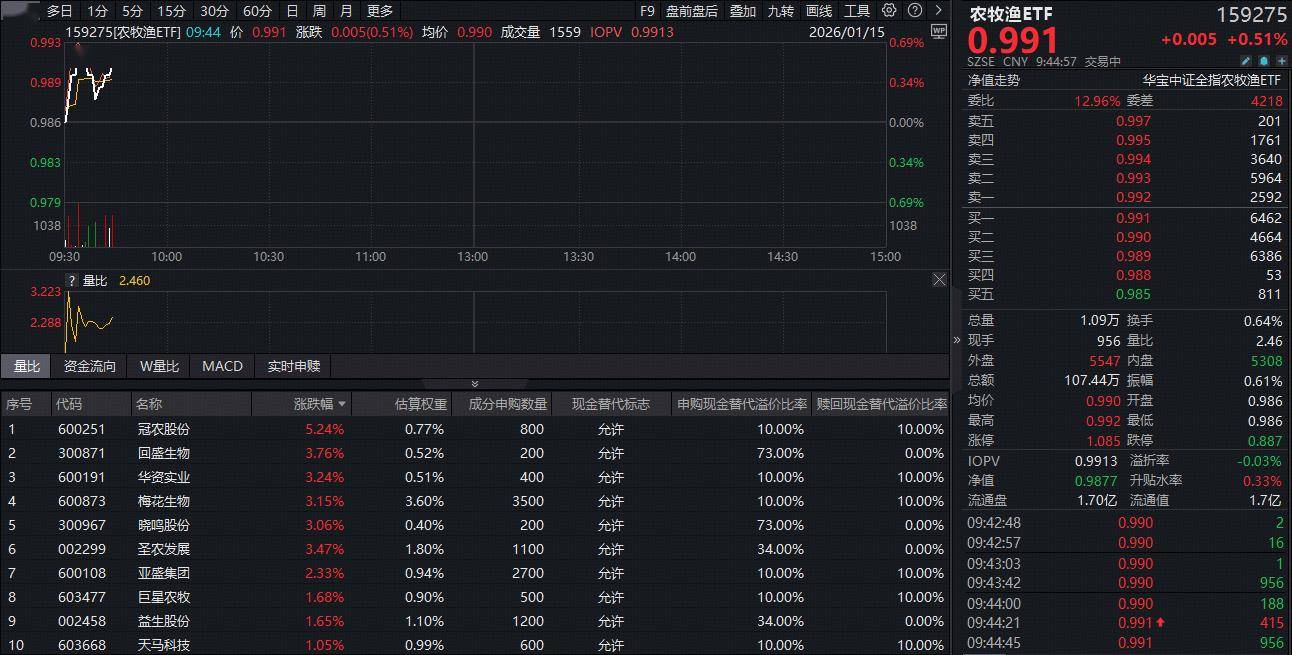
ETF盘中咨询|猪企龙头强强对话,全市场唯一农牧渔ETF(159275)开盘走高!机构:行业基本面和估值有望修复
Sou Hu Cai Jing· 2026-01-15 02:15
Core Viewpoint - The agricultural, animal husbandry, and fishery sector is experiencing a positive trend, with the highest "pig content" ETF (159275) showing a 0.51% increase in price as of the latest report, indicating a recovery in the market [1][3]. Group 1: Market Performance - The agricultural, animal husbandry, and fishery ETF (159275) opened with a continuous upward trend, rising by 0.51% [1]. - Key stocks in the sector, such as Guan Nong Biological, have seen significant gains, with some stocks increasing by over 5% [1][3]. - The ETF's underlying index, the CSI Agricultural, Animal Husbandry, and Fishery Index, has a price-to-book ratio of 2.53, which is at a low point compared to the past five years [3]. Group 2: Industry Insights - The feed industry is showing signs of recovery, with upstream raw material prices at a cyclical low and structural recovery in downstream breeding [3]. - The pig farming industry has entered a loss phase again, but market and policy factors are accelerating capacity reduction, leading to a decrease in the number of breeding sows [3]. - The pet food industry is highlighted for its growth potential, shifting competition from marketing to research and supply chain [3]. Group 3: Future Outlook - Analysts are optimistic about the pig farming sector, expecting a turning point in pig prices by Q2 2026 due to policy and market forces driving capacity reduction [3]. - The agricultural, animal husbandry, and fishery ETF (159275) is positioned as a strategic investment opportunity, covering major players in the pig farming industry and related sectors [4][6].
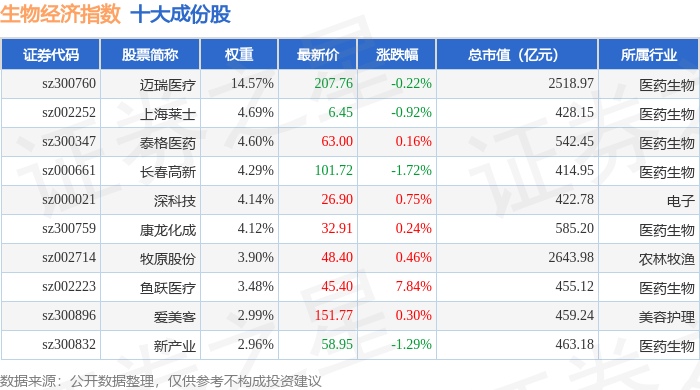
1月14日生物经济(970038)指数涨0.43%,成份股英科医疗(300677)领涨
Sou Hu Cai Jing· 2026-01-14 10:23
Group 1 - The Biotech Index (970038) closed at 2322.86 points, up 0.43%, with a total transaction volume of 50.71 billion yuan and a turnover rate of 3.77% [1] - Among the index constituents, 23 stocks rose, with Yingke Medical leading at an 8.37% increase, while 27 stocks fell, with Dabo Medical leading the decline at 3.28% [1] - The top ten constituents of the Biotech Index include major companies such as Mindray Medical, which has a weight of 14.57% and a market capitalization of 251.90 billion yuan, and Yuyue Medical, which has a weight of 3.48% and a market capitalization of 45.51 billion yuan [1] Group 2 - The net outflow of main funds from the Biotech Index constituents totaled 643 million yuan, while retail investors saw a net inflow of 771 million yuan [1] - Detailed fund flow data indicates that Yuyue Medical had a net inflow of 35.6 million yuan from main funds, while it experienced a net outflow of 66.06 million yuan from retail investors [2] - Mindray Medical saw a net inflow of 13.7 million yuan from main funds, with retail investors experiencing a net outflow of 36.97 million yuan [2]



养殖业板块1月14日涨0.09%,*ST天山领涨,主力资金净流出2.23亿元
Zheng Xing Xing Ye Ri Bao· 2026-01-14 08:44
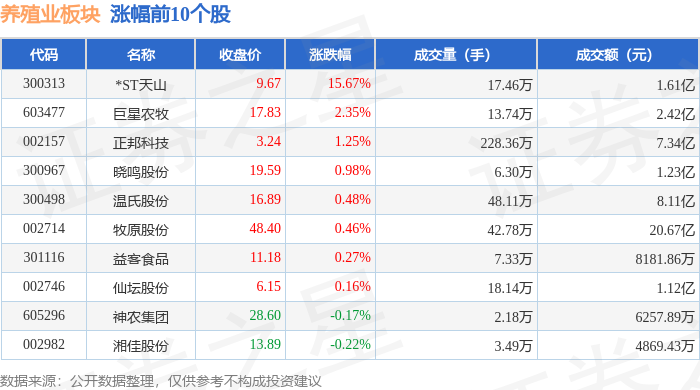
Core Viewpoint - The aquaculture sector experienced a slight increase of 0.09% on January 14, with *ST Tianshan leading the gains, while the overall market showed mixed results with the Shanghai Composite Index down by 0.31% and the Shenzhen Component Index up by 0.56% [1]. Group 1: Stock Performance - *ST Tianshan closed at 9.67, up by 15.67%, with a trading volume of 174,600 shares and a transaction value of 161 million yuan [1]. - Other notable performers included Juxing Agriculture (up 2.35% to 17.83), Zhengbang Technology (up 1.25% to 3.24), and Xiaoming Co. (up 0.98% to 19.59) [1]. - Major stocks like Wens Foodstuff and Muyuan Foods saw minor increases of 0.48% and 0.46%, respectively, with closing prices of 16.89 and 48.40 [1]. Group 2: Capital Flow - The aquaculture sector saw a net outflow of 223 million yuan from institutional investors, while retail investors contributed a net inflow of 77.57 million yuan [2]. - Notable stocks with significant capital flow included Zhengbang Technology, which experienced a net outflow of 37.67 million yuan from institutional investors [3]. - Muyuan Foods had a net inflow of 37.65 million yuan from institutional investors, indicating a positive sentiment towards this stock [3].

2025猪市在成本与效率中重塑,微利时代寻求新平衡
Qi Huo Ri Bao· 2026-01-14 06:41
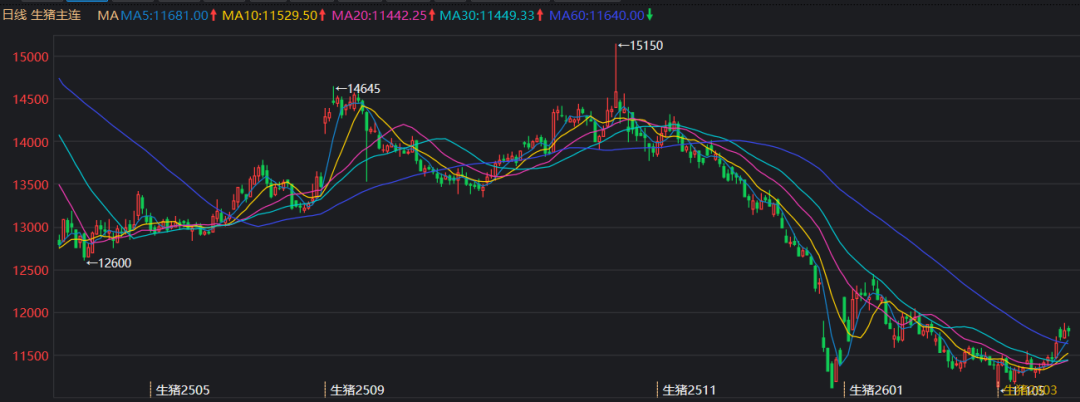
Core Viewpoint - The domestic pig market in 2025 is experiencing significant adjustments due to abundant supply and weak demand, leading to a decline in average prices and creating challenges for producers [1][2]. Group 1: Market Trends - The average price of pigs in 2025 is approximately 13.80 yuan/kg, significantly lower than in 2024, with prices fluctuating from around 16 yuan/kg at the beginning of the year to below 11 yuan/kg by late October [1][2]. - The supply of pigs is robust, driven by a high number of breeding sows and increased production efficiency, resulting in actual pork supply exceeding market expectations [2][5]. - Demand for pork is weakening, with traditional consumption peaks failing to stimulate demand, leading to a situation where price increases do not correspond with demand growth [2][6]. Group 2: Cost Management and Industry Dynamics - In response to declining prices, pig farming companies are undergoing an "efficiency revolution," focusing on cost reduction to survive, with leading companies like Muyuan Foods reducing their breeding costs from approximately 13 yuan/kg to 11.3 yuan/kg [5][6]. - The cost reduction is attributed to improved production efficiency and utilization rates, with leading firms achieving a PSY (pigs weaned per sow per year) of over 28, indicating fewer sows are needed for the same amount of pork production [5][6]. - The competition in the pig farming sector is intensifying, with a shift towards "cost reduction and efficiency enhancement," leading to increased pressure on smaller farms and a trend towards larger, more efficient operations [5][6]. Group 3: Future Outlook - For 2026, there is cautious optimism, with expectations of continued supply pressure in the first half but potential improvements in the second half as production capacity decreases and seasonal demand increases [6][7]. - The average price for pigs in 2026 is projected to be between 12 and 13 yuan/kg, with a potential for prices to rise later in the year [7]. - Policy interventions are expected to play a crucial role in stabilizing prices, with ongoing regulatory measures aimed at restoring prices to reasonable levels [7][8]. Group 4: Risk Management Strategies - The industry is evolving towards a new paradigm characterized by "policy guidance, market adjustment, and efficiency supremacy," necessitating an upgrade in survival strategies for pig farmers [8]. - Recommendations for pig farmers include maintaining biosecurity, enhancing efficiency, managing production capacity, and utilizing futures and derivatives for risk management [8][9]. - The trading volume of pig futures in 2025 reached 17.993 million contracts, indicating increased market liquidity and the growing importance of risk management tools among producers [9].
当政策红利遇上消费刚需 中证主要消费指数如何成为行业压舱石?
Sou Hu Cai Jing· 2026-01-14 06:27
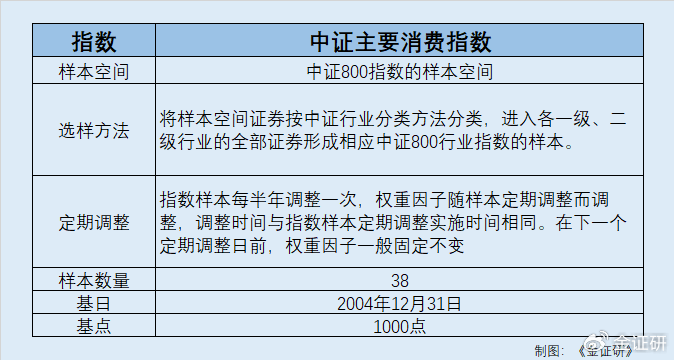
Group 1 - The core viewpoint of the article emphasizes the importance of policies aimed at boosting consumption, highlighting the collaboration between business and financial sectors to enhance consumer spending [1][2] - The China Securities Major Consumption Index, which focuses on the consumption sector, has an average free float market capitalization exceeding 600 billion yuan, reflecting the overall performance of major consumption stocks in the A-share market [2][3] - The index includes 38 sample stocks, with a free float market capitalization ranging from 36.47 billion yuan to 8,885.48 billion yuan, indicating significant growth potential in the consumption sector [2][4] Group 2 - The index is heavily concentrated in the food and beverage sector, with a weight of 67.62%, and agriculture, forestry, animal husbandry, and fishery at 28.42%, together covering over 96% of the index's weight [4][5] - The top ten stocks in the index are supported by leading companies such as Kweichow Moutai, Yili, and Wuliangye, which have strong brand recognition and stable cash flows [5][6] - The ongoing policy support for consumption is expected to enhance the long-term value and growth potential of the consumption sector, making the China Securities Major Consumption Index a quality benchmark for investing in core consumption assets [7]



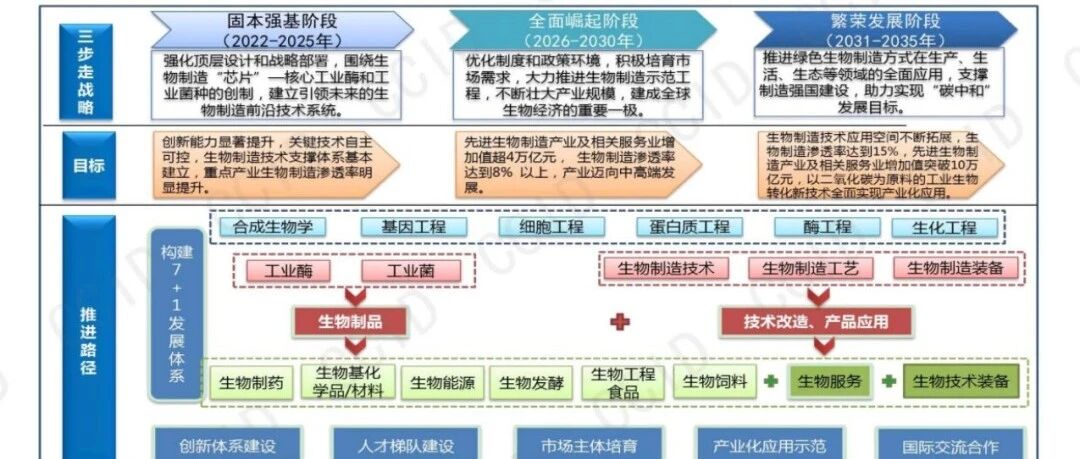
生物制造的底层逻辑与产业链分析(附100佳核心企业)
材料汇· 2026-01-13 11:56
Core Viewpoint - Biomanufacturing is identified as a key future industry in China's 14th Five-Year Plan, expected to create a market worth trillions in the next decade, driven by advancements in technology and policy support [2][5]. Group 1: Industry Overview - The biomanufacturing industry in China is nearing a total scale of 1 trillion yuan, with fermentation capacity accounting for over 70% of the global total [2][4]. - Shenzhen has become a hub for biomanufacturing, with 40% of newly established companies in this sector located there in the past three years, showcasing a significant industry clustering effect [4]. - The industry is supported by a comprehensive system of policy, funding, and technological advancements as outlined in the 14th Five-Year Plan [5]. Group 2: Key Enterprises - The article identifies 100 core enterprises in biomanufacturing, spanning the entire industry chain from upstream technology development to downstream commercial applications [7]. - Notable companies include: - Huada Technology, a leader in gene sequencing technology [17]. - Kaisa Biotech, which has achieved over 80% market share in the global long-chain dicarboxylic acid market [21]. - WuXi Biologics, representing China's capabilities in the global biopharmaceutical industry [27]. Group 3: Upstream Innovations - The upstream sector focuses on providing essential tools and technologies for research and production, with a shift towards domestic innovation and smart integration [16]. - Key trends include the localization of critical tools and the rise of AI-driven platform companies that enhance research efficiency [16][17]. - Over 75% of the 20 identified upstream enterprises are private, indicating a vibrant innovation landscape [16]. Group 4: Midstream Developments - The midstream sector is characterized by a dual structure of "upgraders" and "disruptors," with companies like Meihua Biotech and Chuaning Biotech leading in traditional fermentation while others like Kaisa Biotech innovate with new bioproducts [20][21]. - This segment contains the highest number of enterprises, with 40 out of the 100 identified companies, emphasizing the importance of production capacity and cost control [20]. Group 5: Downstream Applications - The downstream sector serves as a critical market for biomanufacturing, focusing on medical, consumer, and agricultural applications [25]. - Companies like Muyuan Foods exemplify the cost-saving potential of biomanufacturing in agriculture, while WuXi Biologics and Kelaiying represent the pharmaceutical sector's output capabilities [26][27]. - Future trends indicate a broadening of applications into new areas such as biobased textiles and environmental remediation [27].