
WANDA FILM(002739)

Search documents
千亿谷子市场破局,还得靠动画电影?
3 6 Ke· 2025-11-20 12:26
Core Insights - The animation film industry in China is experiencing a resurgence, shifting focus from creating standalone works to developing intellectual properties (IPs) that can generate multiple revenue streams [2][3][22] Industry Trends - Domestic animation films have a clear advantage in the IP sector due to their broad audience appeal and reduced risks associated with geopolitical tensions, particularly with Japan [3] - Despite a generally sluggish film market, animation has shown strong performance, with titles like "Nezha: Birth of the Demon Child" and "Boonie Bears" achieving significant box office success [3][6] Company Strategies - Companies like Light Chaser Animation have pivoted towards IP management, with successful franchises like "Nezha" leading to extensive merchandise development, covering over 30 categories and 500 products, with potential total sales reaching hundreds of billions [5] - Shanghai Film has also capitalized on IPs, with "Wandering Earth" contributing to a 101.6% year-on-year revenue increase in Q3, amounting to 3.61 billion yuan [6] - Wanda Film, leveraging its strong distribution channels, has expanded into gaming and merchandise, creating over 60 types of products related to "White Snake: The Legend" [11] Future Developments - Light Chaser is advancing multiple projects, including sequels and new IPs, while also exploring merchandise opportunities in various sectors, including gaming and theme parks [7] - Shanghai Film is actively developing its own products and collaborating with over 40 brands, with expectations for derivative sales to exceed 2.5 billion yuan by year-end [9] - Companies like Maoyan Entertainment are entering the animation space with new brands and IP collaborations, indicating a growing trend in the industry [19][20] Market Dynamics - The industry is witnessing a shift towards non-box office revenue, with companies aiming to replicate the successful revenue models seen in Hollywood, where box office and non-box office income are more balanced [22] - The current wave of IP and derivative product development reflects a strategic response to market trends, with companies diversifying their offerings beyond traditional film revenue streams [22]



影视院线板块11月20日跌1.67%,幸福蓝海领跌,主力资金净流出4.05亿元
Zheng Xing Xing Ye Ri Bao· 2025-11-20 09:16
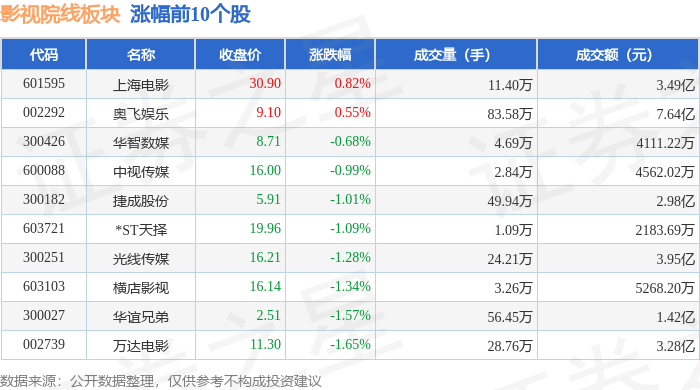
Market Overview - The film and theater sector declined by 1.67% on November 20, with Happiness Blue Sea leading the drop [1] - The Shanghai Composite Index closed at 3931.05, down 0.4%, while the Shenzhen Component Index closed at 12980.82, down 0.76% [1] Stock Performance - Shanghai Film (601595) closed at 30.90, up 0.82% with a trading volume of 114,000 shares and a turnover of 349 million [1] - AoFei Entertainment (002292) closed at 9.10, up 0.55% with a trading volume of 835,800 shares and a turnover of 764 million [1] - Happiness Blue Sea (300528) led the decline, closing at 21.15, down 5.58% with a trading volume of 241,300 shares and a turnover of 519 million [2] - China Film (600977) closed at 16.41, down 2.78% with a trading volume of 480,500 shares and a turnover of 797 million [2] Capital Flow - The film and theater sector experienced a net outflow of 405 million from institutional investors, while retail investors saw a net inflow of 468 million [2] - The data indicates that retail investors are more active in the sector despite the overall decline [2] Individual Stock Capital Flow - AoFei Entertainment had a net inflow of 48.85 million from institutional investors, while retail investors had a net outflow of 88.64 million [3] - Happiness Blue Sea saw a significant net outflow of 14.14 million from institutional investors, indicating weaker institutional interest [3] - Shanghai Film experienced a net outflow of 7.86 million from institutional investors, suggesting a cautious stance among larger investors [3]


《疯狂动物城2》被寄予厚望 国内院线、联名商等有望受益
Zheng Quan Ri Bao Zhi Sheng· 2025-11-19 16:05
Group 1 - The core viewpoint of the articles highlights the high expectations and potential success of Disney's animated film "Zootopia 2," which is set to be released on November 26 in mainland China and North America, with pre-sales already exceeding 600 million yuan in China as of November 19 [1][2] - The first installment, "Zootopia," achieved a box office of 1.54 billion yuan in China, holding the record for the highest-grossing imported animated film for nine years, indicating strong brand loyalty and fan base for the franchise [1][2] - Industry experts believe "Zootopia 2" has the potential to become another blockbuster, with many predicting it could surpass the 1 billion yuan mark in box office revenue, and some even suggesting it may exceed the performance of its predecessor [1][2] Group 2 - The film's distribution in China is managed by China Film Group and Huaxia Film Distribution, which will share the box office revenue with Disney, indicating a collaborative financial model [2] - Initial screening data shows that "Zootopia 2" has a high initial release ratio of 96.8% in theaters, with major cinema chains like Wanda and China Film leading in ticket sales [2] - The film has already generated significant brand collaborations, with over 40 partnerships across various sectors, including toys, beverages, and apparel, showcasing its commercial potential even before release [3] Group 3 - Disney has leveraged the film's release to enhance its theme park offerings, with the Shanghai Disney Resort hosting a global celebration for "Zootopia 2," which includes the only "Zootopia" themed area in the world, aimed at attracting more visitors [4] - The licensing business related to "Zootopia" in the Greater China region has reportedly tripled since December 2023, with expectations to launch over 2,000 licensed products by the end of 2025, reflecting the strong market demand for related merchandise [3]


不需要那么多影院了,万达电影“收权”、上海电影“扩网”⋯⋯独家对话:解密龙头公司存量战
3 6 Ke· 2025-11-19 12:31
Core Insights - The cinema industry is facing significant challenges, with a decline in annual box office revenue per screen dropping below 500,000 yuan, leading to over 15 cinema closures in just half a month [1] - Major cinema chains like Wanda Film and Shanghai Film are adapting their strategies, with Wanda shifting focus from franchise models to direct management, while Shanghai continues to expand its franchise network [1][3] - The competition in the cinema industry is increasingly shifting towards non-box office revenue streams, which will play a crucial role in determining the industry's future landscape [1] Group 1: Industry Challenges - The number of cinema screens is approaching 100,000, but the average annual box office per screen has decreased significantly [1] - The market is experiencing a "window period" after the popularity of films like "Nezha: Birth of the Demon Child" has waned, highlighting the need for strategic adjustments [1] - The structural challenges faced by leading cinema chains reflect the broader transformation challenges within the industry [1] Group 2: Strategic Shifts - Wanda Film has halted new franchise agreements, focusing instead on direct management of its cinemas, which account for approximately 15% of its total box office revenue [5] - The shift in strategy is linked to Wanda's recent transition to an independent publicly listed company, moving away from the Wanda Group's previous operational model [5] - Shanghai Film continues to open franchise opportunities, indicating a divergence in strategic approaches among leading cinema chains [1][3] Group 3: Non-Box Office Revenue - The competition for non-box office revenue is expected to intensify, with cinema operators exploring diverse business models to enhance profitability [1] - Wanda Film has successfully integrated gaming and other entertainment experiences into its cinema offerings, generating significant additional revenue [12] - Shanghai Film is also pursuing a comprehensive approach to IP management, demonstrating the potential for substantial non-box office income through merchandise and brand collaborations [13][15]
不需要那么多影院了!万达电影“收权”、上海电影“扩网”⋯⋯独家对话:解密龙头公司存量战
Mei Ri Jing Ji Xin Wen· 2025-11-19 10:40
Core Insights - The cinema industry is facing significant challenges, with a decline in annual box office revenue per screen dropping below 500,000 yuan, leading to over 15 cinema closures in just half a month [1] - Major cinema chains like Wanda Film and Shanghai Film are adapting their strategies, with Wanda shifting focus from franchise models to direct management [1][5] - The industry is transitioning from a growth phase to a focus on optimizing existing assets and enhancing quality, with an emphasis on non-box office revenue streams [10][12] Group 1: Industry Challenges - The number of cinema screens is approaching 100,000, but the average annual box office per screen is decreasing, indicating a saturated market [1] - The market is experiencing a "window period" after the popularity of films like "Nezha: Birth of the Demon Child" has waned, highlighting the need for strategic shifts among cinema operators [1] - The competitive landscape is intensifying as cinema chains must innovate beyond traditional box office revenue to survive [1][10] Group 2: Strategic Shifts - Wanda Film has halted new franchise agreements, focusing instead on direct management of its cinemas, which account for approximately 17% of the industry’s total box office [5][6] - The shift to a direct management model is a response to the company's recent independence from the Wanda Group, allowing for a more focused operational strategy [5][6] - Shanghai Film continues to open franchise opportunities, indicating a divergence in strategy among leading cinema chains [1][5] Group 3: Non-Box Office Revenue - The cinema industry is increasingly looking to enhance non-box office revenue through diversified offerings, such as partnerships with gaming and merchandise [12][13] - Wanda Film has successfully integrated gaming experiences into its cinemas, generating significant additional revenue [12][13] - The focus on creating unique consumer experiences and leveraging intellectual property (IP) is seen as essential for future growth and sustainability in the cinema sector [10][12][15]
不需要那么多影院了!万达电影“收权”、上海电影“扩网”独家对话:解密龙头公司存量战
Mei Ri Jing Ji Xin Wen· 2025-11-19 10:39
Core Insights - The cinema industry is facing significant challenges, with a decline in annual box office revenue per screen dropping below 500,000 yuan, leading to over 15 cinema closures in just half a month [2] - Major cinema chains like Wanda Film and Shanghai Film are adapting their strategies in response to market pressures, focusing on direct management rather than franchise models [4][6] Industry Overview - The number of cinema screens in China is approaching 100,000, yet the market is experiencing a structural downturn, prompting leading cinema investment companies to rethink their operational strategies [2] - The shift from a franchise model to a focus on direct management is evident, with Wanda Film halting new franchise agreements while Shanghai Film continues to expand its franchise network [2][4] Strategic Adjustments - Wanda Film's management has emphasized a strategic pivot towards direct operations, which currently account for approximately 15% of its total box office revenue, as opposed to the 2% from franchise operations [6] - The company is undergoing a transition following its acquisition by Ru Yi Film, moving away from the Wanda Group's influence and focusing on long-term operational sustainability [6][7] Market Trends - The cinema industry is entering a phase of optimization, where the focus is shifting from expansion to enhancing operational efficiency and customer experience [9] - The competition is expected to intensify in non-box office revenue streams, with companies exploring diverse business models to attract audiences beyond traditional film screenings [11][12] Revenue Diversification - Companies are increasingly looking to enhance non-box office revenues through collaborations with popular IPs and gaming, as seen with Wanda Film's partnerships that have generated significant additional revenue [11][12] - The success of films like "Wang Wang Mountain Little Monster" demonstrates the potential for substantial non-box office income, with the IP generating over 2.5 billion yuan in merchandise sales [13]
影视院线板块11月17日涨0.89%,上海电影领涨,主力资金净流出669.8万元
Zheng Xing Xing Ye Ri Bao· 2025-11-17 09:00
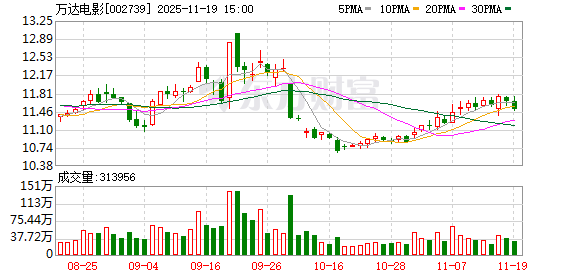
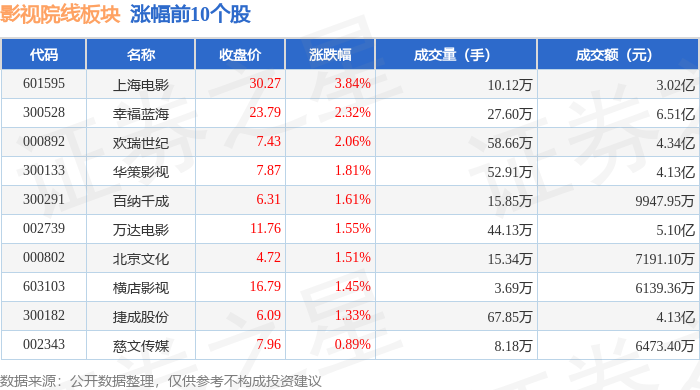
Group 1 - The film and theater sector saw a rise of 0.89% on November 17, with Shanghai Film leading the gains [1] - The Shanghai Composite Index closed at 3972.03, down 0.46%, while the Shenzhen Component Index closed at 13202.0, down 0.11% [1] - Key stocks in the film and theater sector showed various performance metrics, with Shanghai Film closing at 30.27, up 3.84% [1] Group 2 - The main capital flow in the film and theater sector indicated a net outflow of 6.698 million yuan from institutional investors, while retail investors saw a net inflow of 20.1 million yuan [3][4] - Shanghai Film had a net inflow of 47.1935 million yuan from institutional investors, despite a net outflow from retail investors [4] - The overall trading volume and turnover for key stocks in the sector were significant, with Shanghai Film achieving a turnover of 302 million yuan [1][4]


万达电影(002739):院线龙头地位持续夯实,非票业务注入新增长动能
Changjiang Securities· 2025-11-17 01:45
Investment Rating - The investment rating for the company is "Buy" and is maintained [6]. Core Views - The company reported a revenue of 3.098 billion yuan for Q3 2025, a year-on-year decrease of 14.63%, while the net profit attributable to shareholders was 173 million yuan, an increase of 212.04% year-on-year. The non-recurring net profit was 131 million yuan. The company's leading position in the cinema industry continues to be solidified, and there is optimism regarding the new growth momentum injected by the "super entertainment space" and non-ticket business initiatives [2][4]. Summary by Sections Financial Performance - As of October 30, 2025, the total box office revenue in China reached 44.5 billion yuan, surpassing the total for the entire year of 2024. The company achieved a total revenue of 9.786 billion yuan in the first three quarters, a slight decrease of 0.61% year-on-year. The net profit attributable to shareholders was 708 million yuan, a significant increase of 319.92% year-on-year, with a non-recurring net profit of 611 million yuan, up 641.09% year-on-year [11]. Market Position - In Q3 2025, the national box office reached 12.72 billion yuan (including service fees), representing a year-on-year growth of 17.2%. The number of moviegoers was 340 million, an increase of 29.8% year-on-year. The company's domestic cinemas achieved a box office of 1.88 billion yuan (including service fees), with 45.048 million moviegoers, and a market share of 14.8% from July to September, showing steady improvement from the first half of the year [11]. Strategic Initiatives - The company has implemented the "super entertainment space" strategy, upgrading its "1+2+5" framework to explore diverse growth paths. Activities such as the "super entertainment animation market" during the summer season have integrated IP, scenes, and users, enhancing cinema efficiency and member engagement. Collaborations with popular IPs have driven both non-ticket revenue and box office growth [11]. Future Outlook - The company is expected to continue transforming cinemas from single viewing venues into multi-functional cultural consumption spaces, reshaping the growth logic of cinema operations. Projections for net profit attributable to shareholders are 1.077 billion yuan, 1.279 billion yuan, and 1.447 billion yuan for 2025, 2026, and 2027, respectively, with corresponding PE ratios of 22.71, 19.12, and 16.90 [11].
万达电影(002739):万达电影(002739):院线龙头地位持续夯实,非票业务注入新增长动能
Changjiang Securities· 2025-11-16 23:30
Investment Rating - The investment rating for the company is "Buy" and is maintained [6]. Core Views - The company reported a revenue of 3.098 billion (down 14.63% year-on-year) and a net profit attributable to shareholders of 173 million (up 212.04% year-on-year) for Q3 2025. The non-recurring net profit was 131 million. The company's leading position in the cinema industry continues to be solidified, benefiting from steady growth in box office revenues in the first three quarters. The report expresses optimism about the company's "Super Entertainment Space" and non-ticket business initiatives driving new growth momentum for its performance [2][4]. Summary by Sections Financial Performance - For Q3 2025, the company achieved a revenue of 3.098 billion (down 14.63% year-on-year) and a net profit of 173 million (up 212.04% year-on-year). The non-recurring net profit was 131 million. The total box office in China reached 44.5 billion by October 30, 2025, surpassing the total for 2024. The company's revenue for the first three quarters was 9.786 billion (down 0.61% year-on-year), with a net profit of 708 million (up 319.92% year-on-year) [10]. Market Position - The company maintains a market share of 14.8% in the domestic cinema sector, with box office revenues of 1.88 billion (including service fees) and 45.048 million viewers in Q3 2025. The report highlights the company's strong industry leadership and the effectiveness of its financial structure optimization, with sales, management, and financial expenses decreasing by 25.70%, 7.22%, and 16.72% respectively [10]. Strategic Initiatives - The "Super Entertainment Space" strategy has begun to show results, with the company exploring diverse growth paths. Activities such as the "Super Entertainment Animation Market" have integrated IP, scenes, and users, enhancing cinema efficiency and member engagement. The report notes successful sales of IP derivative products during the National Day holiday and collaborations with gaming IPs to attract new users [10]. Future Outlook - The company is expected to continue driving growth through its "Super Entertainment Space" strategy, transforming cinemas into multi-functional cultural consumption spaces. Projections for net profit attributable to shareholders are 1.077 billion, 1.279 billion, and 1.447 billion for 2025, 2026, and 2027 respectively, with corresponding PE ratios of 22.71, 19.12, and 16.90 [10].
传媒行业周报:2026年布局已开启-20251116
Huaxin Securities· 2025-11-16 10:03
Group 1 - The report highlights that the media industry is entering a new phase in 2026, with companies actively exploring new products and business models driven by AI technology [4][16][18] - The report emphasizes the dual attributes of the media sector, combining technology applications and discretionary consumption, which presents new opportunities due to generational changes in user content demands [4][18] - The report recommends focusing on state-owned enterprises leveraging AI for cultural development, as well as major companies enhancing AI applications in consumer-facing sectors [4][16] Group 2 - The report provides a list of recommended stocks in the media sector, including Oriental Pearl (600637), BlueFocus (300058), Mango Excellent Media (300413), and Wanda Film (002739), highlighting their potential for growth driven by AI [5][9] - The report notes that Bilibili (9626.HK) is expected to see continued improvement in its commercial capabilities, with a projected revenue increase of 5% year-on-year [15] - The report indicates that Tencent's international gaming revenue has surpassed 20 billion, with a significant year-on-year growth of 43% in the international market [24] Group 3 - The report states that the film market is projected to exceed 45 billion in box office revenue for 2025, with several popular IP films set to release soon [30] - The report mentions that the micro-short drama market has seen a user base of 662 million, with a market size surpassing 50 billion, indicating a shift in content consumption trends [31] - The report highlights that the gaming sector is experiencing robust growth, with Tencent's gaming revenue reaching 636 billion, a 24% increase year-on-year [24]


