CHOW TAI SENG Jewellery Company Limited(002867)

Search documents
饰品板块1月27日跌1.06%,潮宏基领跌,主力资金净流出2.05亿元
Zheng Xing Xing Ye Ri Bao· 2026-01-27 08:49
Market Overview - The jewelry sector experienced a decline of 1.06% on January 27, with Chao Hong Ji leading the drop [1] - The Shanghai Composite Index closed at 4139.9, up 0.18%, while the Shenzhen Component Index closed at 14329.91, up 0.09% [1] Individual Stock Performance - China Gold (600916) saw a significant increase of 9.96%, closing at 11.15 with a trading volume of 2.4225 million shares and a turnover of 2.658 billion [1] - Other notable performers included Man Ka Long (300945) with a rise of 1.88% and a turnover of 1.07 billion, while several stocks like ST Xin Hua Jin (600735) and Ming Pai Jewelry (002574) experienced declines of 1.32% and 1.34% respectively [1] - Chao Hong Mu (002345) led the declines in the sector with a drop of 4.88%, closing at 14.03 with a turnover of 407 million [2] Capital Flow Analysis - The jewelry sector saw a net outflow of 205 million from main funds, while retail investors contributed a net inflow of 1.95 billion [2] - The main funds showed a negative net flow in several stocks, including Chao Hong Mu and Jin Yi Culture, indicating a shift in investor sentiment [3] - Retail investors were more active in stocks like Fei Ya Da (000026) and Jin Yi Culture (002721), with significant net inflows [3]




饰品板块1月26日涨4.13%,曼卡龙领涨,主力资金净流入2.6亿元
Zheng Xing Xing Ye Ri Bao· 2026-01-26 09:37
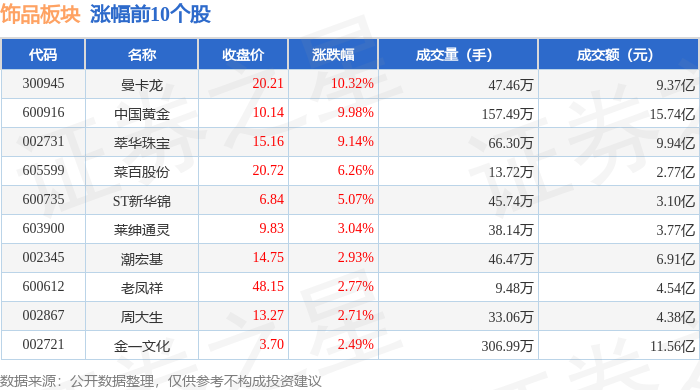
Group 1 - The jewelry sector experienced a significant increase of 4.13% on January 26, with Mankalon leading the gains [1] - The Shanghai Composite Index closed at 4132.61, down 0.09%, while the Shenzhen Component Index closed at 14316.64, down 0.85% [1] - Mankalon's stock price rose by 10.32% to 20.21, with a trading volume of 474,600 shares [1] Group 2 - Major stocks in the jewelry sector included China Gold, which increased by 9.98% to 10.14, and Benhua Jewelry, which rose by 9.14% to 15.16 [1] - The total net inflow of main funds in the jewelry sector was 260 million yuan, while retail investors saw a net outflow of 319 million yuan [2] - The stock of Jinyi Culture had a trading volume of 3,069,900 shares, closing at 3.70 with a 2.49% increase [2][3] Group 3 - Mankalon had a net inflow of 11.1 million yuan from main funds, while retail investors experienced a net outflow of 113 million yuan [3] - The stock of Chaohongji saw a net inflow of 66.25 million yuan from main funds, with a net outflow of 45.75 million yuan from retail investors [3] - The stock of Laisen Tongling had a net inflow of 22.76 million yuan from main funds, while retail investors faced a net outflow of 41.77 million yuan [3]


周大生(002867) - 2026年1月26日投资者关系活动记录表
2026-01-26 08:46
周大生珠宝股份有限公司 投资者关系活动记录表 投资者关系活动类别 ☑ 特定对象调研 □分析师会议 □媒体采访 □业绩说明会 □新闻发布会 □路演活动 □现场参观 □其他(电话会议) 参与单位名称 及人员姓名 共计 1 位投资者(排名不分先后): 长城证券:郭庆龙 时 间 2026 年 1 月 26 日 地 点 总部会议室 上市公司接待人员 姓名 董事会秘书及副总经理:何小林 证券事务代表:荣欢 投资者关系活动 主要内容介绍 一、 问答环节: 投资者主要就行业情况、公司商业模式、产品结构及毛利率情况等 进行了交流,并参观了公司展厅,可参阅前次活动记录表之问答和已披 露公告。 接待过程中,公司严格按照《信息披露管理制度》等规定,保证信 息披露的真实、准确、完整、及时、公平,没有出现未公开重大信息泄 露等情况。同时,现场调研的投资者已按深交所要求签署承诺函。 附件清单(如有) 无 日期 2026 年 1 月 26 日 代码:002867 证券简称:周大生 编号:2026-004 ...
1月22日周大生黄金价格报1498元/克 较昨日保持不变
Jin Tou Wang· 2026-01-23 01:17
Core Insights - The price of Zhou Dasheng gold remains stable at 1498 CNY per gram as of January 22, showing no change from the previous day and an increase of 141 CNY per gram compared to the beginning of the month, reflecting a growth rate of 10.39% [1][2] Price Statistics - Daily price on January 22 is 1498 CNY per gram [2] - Daily price change is 0% [2] - The highest price recorded this month is 1498 CNY per gram [2] - The lowest price recorded this month is 1357 CNY per gram [2] - The difference from the highest price is 0 CNY per gram [2] - The difference from the lowest price is 141 CNY per gram [2] - The average price for the month is 1415 CNY per gram [2]
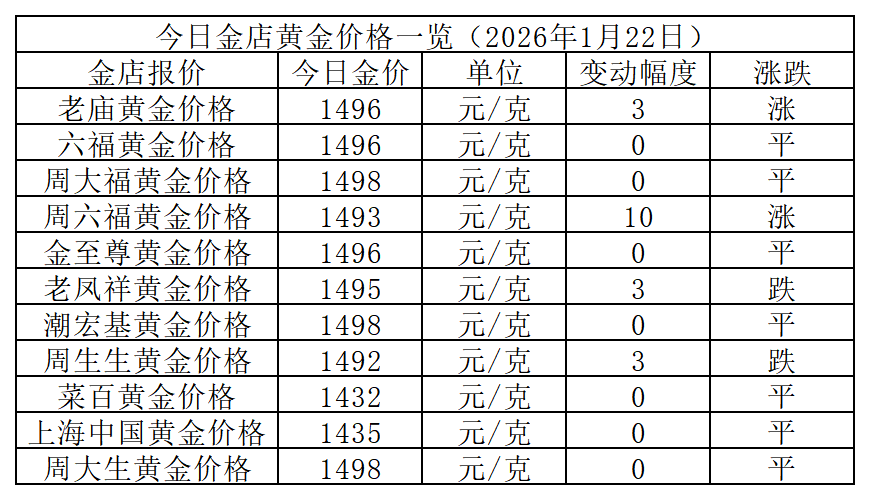
金价大涨后趋稳!2026年1月22日国内金店报价速递
Sou Hu Cai Jing· 2026-01-22 08:03
在昨日全线上攻之后,今日国内品牌金价整体趋于平稳,仅个别品牌有所波动。目前市场最高价仍维持在1498元/克(周大 福、潮宏基、周大生),菜百黄金价格未变,继续保持1432元/克的最低价位。今日金店高低价差仍为66元/克,与前一日报 价持平。 以下是各大品牌金店详细报价: | | | 今日金店黄金价格一览(2026年1月22日) | | | | --- | --- | --- | --- | --- | | 金店报价 | 今日金价 | 单位 | 变动幅度 | 涨跌 | | 老庙黄金价格 | 1496 | 元/克 | 3 | 涨 | | 六福黄金价格 | 1496 | 元/克 | 0 | ਜ | | 周大福黄金价格 | 1498 | 元/克 | 0 | 27 | | 周六福黄金价格 | 1493 | 元/克 | 10 | 涨 | | 金至尊黄金价格 | 1496 | 元/克 | 0 | 27 | | 老凤祥黄金价格 | 1495 | 元/克 | 3 | 缺 | | 潮宏基黄金价格 | 1498 | 元/克 | 0 | 27 | | 周生生黄金价格 | 1492 | 元/克 | 3 | 跌 | | 菜百黄金价格 | ...
周大生:目前公司已推出面向年轻消费群体的轻量化、个性化黄金产品系列以及多款IP联名产品
Zheng Quan Ri Bao Zhi Sheng· 2026-01-21 13:37
Core Viewpoint - The company has launched a series of lightweight and personalized gold products aimed at young consumers, along with several IP collaboration products, such as the international art jewelry series "Monet's Garden" and "Fiery Van Gogh" [1] Product Development - The company plans to continue developing more products that align with the aesthetics and needs of the young consumer demographic [1]
调研速递|周大生接待富国基金等1家机构调研 聚焦行业情况与战略布局
Xin Lang Cai Jing· 2026-01-21 09:04
Group 1 - The core viewpoint of the article is that Zhou Dasheng Jewelry Co., Ltd. conducted a specific institutional research meeting with a representative from the fund, focusing on industry conditions, company strategy, brand matrix, and product development [1] - The meeting was attended by one investor from the fund, and the company was represented by its securities affairs representative [1] - Zhou Dasheng ensured compliance with information disclosure regulations, maintaining the authenticity, accuracy, completeness, timeliness, and fairness of the disclosed information [1] Group 2 - The company indicated that the content of the discussions could be referenced in the previous investor relations activity record and disclosed announcements [1] - The investor present signed a commitment letter as required by the Shenzhen Stock Exchange [1]
周大生:坚持产品创新研发,推动高品质产品线发展
2 1 Shi Ji Jing Ji Bao Dao· 2026-01-21 08:05
南财智讯1月21日电,周大生在投资者关系活动中表示,公司高度重视产品研发与创新,持续加大设计 投入,结合消费者偏好与市场潮流推出多样化、个性化产品,推动高品质产品线的发展,增强产品的附 加值和市场竞争力。 ...
周大生(002867) - 2026年1月21日投资者关系活动记录表
2026-01-21 07:54
Group 1: Investor Relations Activity - The investor relations activity was categorized as a specific object survey [2] - The meeting took place on January 21, 2026, at the headquarters [2] - Only one investor, from the Fuqua Fund, participated in the meeting [2] Group 2: Discussion Topics - The investor engaged in discussions regarding industry conditions, company strategy, brand matrix, and product development [2] - The company adhered to its information disclosure management system, ensuring the information shared was true, accurate, complete, timely, and fair [2] - No significant undisclosed information was leaked during the meeting [2] Group 3: Compliance and Documentation - The participating investor signed a commitment letter as required by the Shenzhen Stock Exchange [2] - No attachments were provided for this meeting [2]
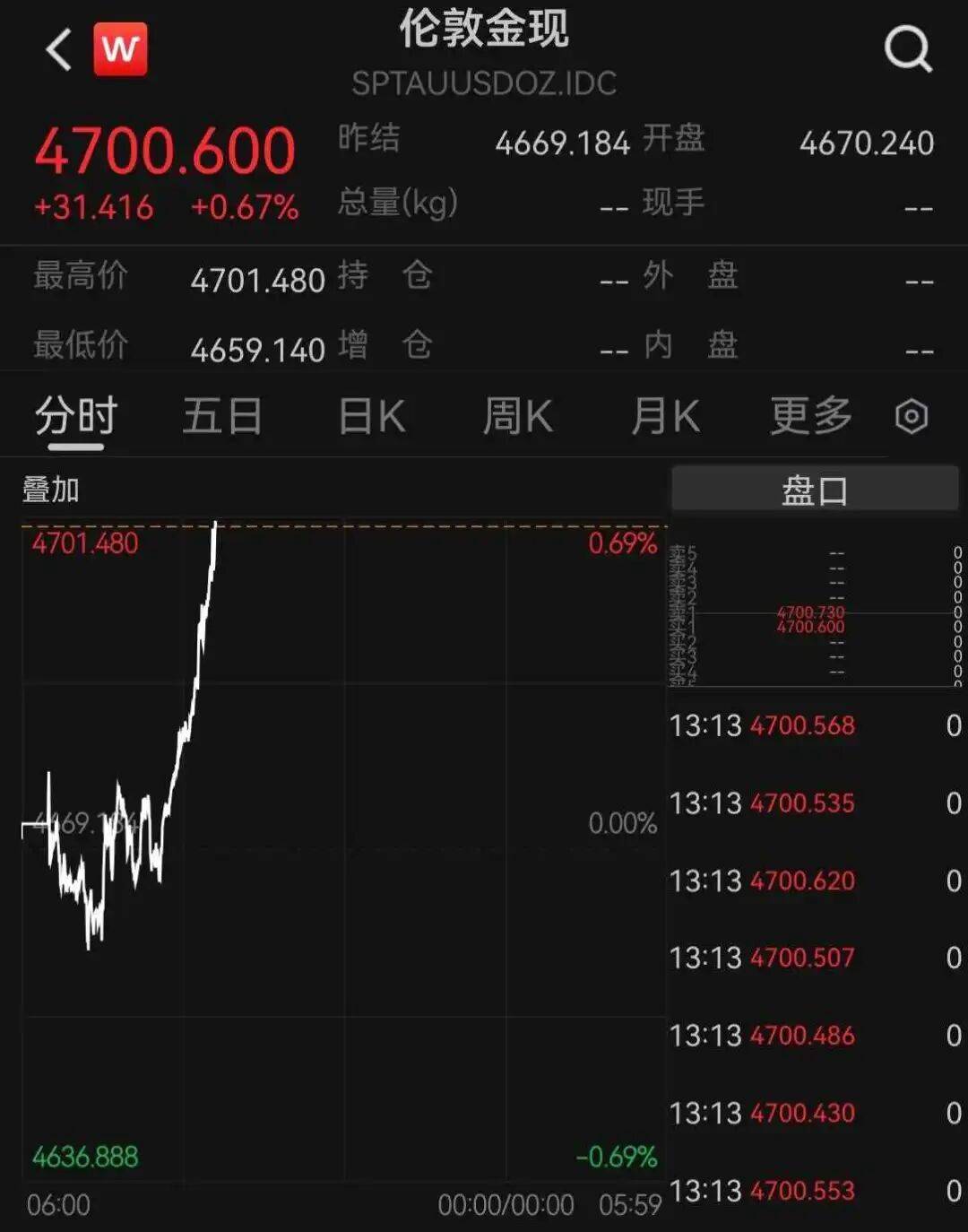
现货黄金,突破4700美元(黄金股梳理)
Sou Hu Cai Jing· 2026-01-20 09:39
Group 1: Gold Market Overview - In the first month of the new year, spot gold has increased by over 8%, rising more than $380 [1] - Major gold mining companies include Zijin Mining, Shandong Gold, and Zhongjin Gold, all of which have strong resource reserves and cost control capabilities [3] - Shandong Gold is noted for its high correlation with gold prices, indicating significant earnings elasticity [3] Group 2: Silver Market Overview - Silver resources are led by companies like Silver Mountain Mining, which has a silver reserve of 8,382 tons, ranking first in Asia [4] - Shengda Resources focuses on silver mining and refining, with 92% of its business in silver, showcasing strong profitability linked to silver prices [5] - Hunan Silver is the only listed company in China primarily focused on silver, with a full industry chain from mining to refining [7] Group 3: Platinum Group Metals - Companies like Zhongxin Metal and Guoyuan Platinum are involved in the recovery and production of platinum group metals, with significant future production expected [7] - The demand for palladium is anticipated to rise due to its use in automotive emissions control, benefiting companies that produce it as a byproduct [7] - GreenMei is a leader in the recycling of electronic and automotive waste, with a substantial capacity for recovering precious metals [7]