
China Express(002928)

Search documents
航空机场板块11月20日跌0.8%,吉祥航空领跌,主力资金净流出1.23亿元
Zheng Xing Xing Ye Ri Bao· 2025-11-20 09:04
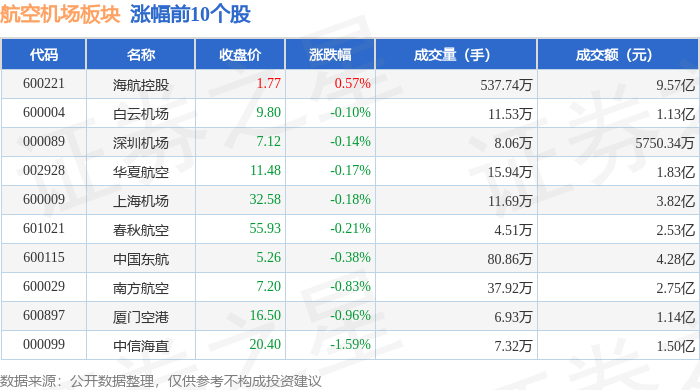
Core Viewpoint - The aviation and airport sector experienced a decline of 0.8% on November 20, with China Southern Airlines leading the losses. The Shanghai Composite Index closed at 3931.05, down 0.4%, while the Shenzhen Component Index closed at 12980.82, down 0.76% [1]. Summary by Category Stock Performance - The following stocks in the aviation and airport sector showed notable performance: - Hainan Airlines (600221) closed at 1.77, up 0.57% with a trading volume of 5.3774 million shares and a transaction value of 9.57 billion yuan [1]. - China Eastern Airlines (600115) closed at 5.26, down 0.38% with a trading volume of 808.6 thousand shares and a transaction value of 4.28 billion yuan [2]. - Xiamen Airport (600897) closed at 16.50, down 0.96% with a trading volume of 69.3 thousand shares and a transaction value of 1.14 billion yuan [2]. Capital Flow - The aviation and airport sector saw a net outflow of 123 million yuan from institutional investors, while retail investors contributed a net inflow of 162 million yuan [2]. - The capital flow for specific stocks included: - Shanghai Airport (600009) had a net inflow of 45.5255 million yuan from institutional investors, but a net outflow of 47.5760 million yuan from retail investors [3]. - Hainan Airlines (600221) experienced a net outflow of 5.8716 million yuan from institutional investors, while retail investors had a net inflow of 22.9749 million yuan [3].






航空机场板块11月19日跌0.62%,厦门空港领跌,主力资金净流出2.74亿元
Zheng Xing Xing Ye Ri Bao· 2025-11-19 08:52
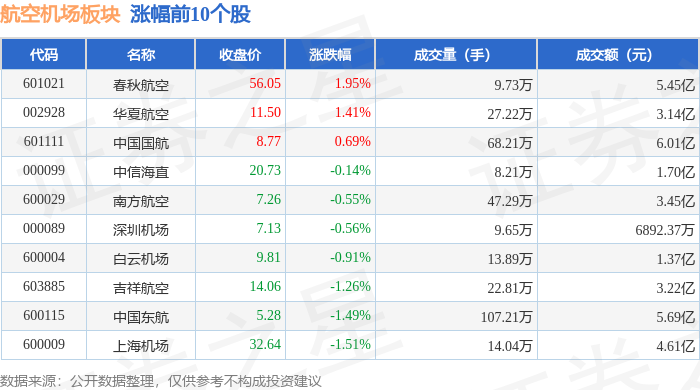
Core Insights - The aviation and airport sector experienced a decline of 0.62% on November 19, with Xiamen Airport leading the drop [1] - The Shanghai Composite Index closed at 3946.74, up 0.18%, while the Shenzhen Component Index closed at 13080.09, unchanged [1] Stock Performance - Spring Airlines (601021) closed at 56.05, up 1.95% with a trading volume of 97,300 shares and a transaction value of 54.5 million [1] - China National Aviation (601111) closed at 8.77, up 0.69% with a trading volume of 682,100 shares and a transaction value of 601 million [1] - Xiamen Airport (600897) closed at 16.66, down 3.25% with a trading volume of 96,500 shares and a transaction value of 162 million [2] Capital Flow - The aviation and airport sector saw a net outflow of 274 million from institutional investors and 175 million from retail investors, while retail investors had a net inflow of 449 million [2] - Major stocks like Spring Airlines and China National Aviation experienced mixed capital flows, with Spring Airlines seeing a net inflow of 42.9 million from institutional investors [3] Individual Stock Analysis - Xiamen Airport had a significant net outflow of 21.74 million from institutional investors, while retail investors contributed a net inflow of 28.31 million [3] - China Eastern Airlines (600115) faced a net outflow of 4.71 million from institutional investors but saw a net inflow of 51.1 million from retail investors [3]



华夏航空涨2.20%,成交额3240.90万元,主力资金净流出21.59万元
Xin Lang Zheng Quan· 2025-11-19 01:47
Core Viewpoint - Huaxia Airlines has experienced a significant stock price increase of 49.36% year-to-date, despite a recent decline of 2.77% over the past five trading days [2] Company Overview - Huaxia Airlines, established on April 18, 2006, and listed on March 2, 2018, is based in Chongqing and primarily engages in domestic and international air passenger and cargo transportation [2] - The company's revenue composition is predominantly from passenger transport (98.46%), with minimal contributions from other services (1.27%) and cargo transport (0.27%) [2] - As of September 30, 2025, the company had 21,100 shareholders, a decrease of 4.88% from the previous period, with an average of 60,533 circulating shares per shareholder, an increase of 5.13% [2] Financial Performance - For the period from January to September 2025, Huaxia Airlines reported a revenue of 5.734 billion yuan, reflecting a year-on-year growth of 11.25% [2] - The net profit attributable to the parent company was 620 million yuan, showing a substantial year-on-year increase of 102.17% [2] - The company has distributed a total of 209 million yuan in dividends since its A-share listing, with no dividends paid in the last three years [2] Stock Performance - As of November 19, Huaxia Airlines' stock price was 11.59 yuan per share, with a market capitalization of 14.815 billion yuan [1] - The stock has seen a trading volume of 32.409 million yuan, with a turnover rate of 0.22% [1] - Recent trading activity indicates a net outflow of 215,900 yuan in principal funds, with large orders accounting for 10.41% of purchases and 11.07% of sales [1] Institutional Holdings - As of September 30, 2025, the top ten circulating shareholders include several funds, with notable changes in holdings, such as Zhonggeng Value Pioneer Stock reducing its stake by 13.2656 million shares [3] - Other funds, such as GF Value Leading Mixed A, maintained their holdings, while GF Ruiyi Leading Mixed A also saw a reduction in shares [3]

航空行业10月数据点评:国庆假期带动出行需求增长,航司客座率再攀升
Shenwan Hongyuan Securities· 2025-11-18 12:44
Investment Rating - The investment rating for the airline industry is "Overweight" indicating a positive outlook for the sector [2][5]. Core Insights - The October National Day holiday has driven an increase in travel demand, with passenger transport volume reaching approximately 68.41 million, a year-on-year growth of 6.7% compared to 2024 [2]. - Domestic capacity increased by 2.1% year-on-year, while domestic passenger flow grew by 4.5% [2]. - The average aircraft utilization rate in October was 7.99 hours per day, reflecting a 1.4% increase year-on-year [2]. - Airlines are increasing capacity, with passenger turnover growth outpacing capacity growth. For instance, China Eastern Airlines and China Southern Airlines both saw a 7% increase in ASK (Available Seat Kilometers) compared to 2024 [2][3]. - The international market has shown recovery, with international flights reaching approximately 60,000, recovering to 90% of the levels seen in 2019 [2]. - The report highlights a significant increase in international capacity for airlines like China Eastern Airlines and Spring Airlines, with year-on-year ASK growth of 14% and 153% respectively compared to 2019 [2][3]. - The report suggests that the airline industry is at a turning point, with potential for significant improvement in airline profitability due to rising demand and constrained supply [2]. Summary by Sections Domestic Market - Overall demand growth is outpacing capacity growth, with Spring Airlines showing significant increases in both capacity and volume [2]. - ASK and RPK for major airlines like China Southern and China Eastern have shown positive growth compared to 2024 and 2019 [3]. International Market - Major airlines have exceeded 2019 levels in international operations, with significant year-on-year growth in ASK and RPK for airlines like China Eastern and Spring Airlines [2][3]. Regional Market - Capacity and volume recovery is uneven across regions, with China Southern and China Eastern showing strong recovery compared to 2019 [2][3]. Investment Analysis - The report emphasizes the unprecedented challenges in the aircraft manufacturing chain and the aging fleet, predicting a continued supply constraint over the next 5-10 years [2]. - The report recommends focusing on the airline sector, highlighting strong supply logic and elastic demand, with specific recommendations for airlines such as China Eastern, China Southern, and Spring Airlines [2][5].
看好景气改善向票价提升传导
HTSC· 2025-11-18 01:59
Investment Rating - The report maintains an "Overweight" rating for the airline transportation industry [1] Core Viewpoints - The improvement in industry conditions is expected to lead to an increase in ticket prices, supported by higher passenger load factors and operational efficiency [7][8] - The three major airlines (Air China, China Eastern Airlines, and China Southern Airlines) have shown strong performance in passenger load factors, reaching historical highs for domestic routes [5] - The overall industry supply growth is projected to slow down, which may further support price increases in the future [7] Summary by Sections Industry Overview - The airline industry is experiencing a recovery, with a notable increase in passenger load factors and operational metrics [5][8] - The average aircraft utilization rate has improved, contributing to a more favorable supply-demand balance [7] Company Recommendations - **Spring Airlines (601021 CH)**: Target price of 75.50, rated "Buy" due to its leading position in the low-cost segment and expected revenue growth [4][26] - **China National Aviation (753 HK)**: Target price of 7.90, rated "Buy" as it is expected to benefit from improved industry conditions and operational efficiencies [4][26] - **China Southern Airlines (600029 CH)**: Target price of 8.70, rated "Buy" based on anticipated revenue recovery and cost management [4][26] - **China Eastern Airlines (600115 CH)**: Target price of 6.35, rated "Buy" due to strong passenger load factors and cost reduction expectations [4][26] - **Juneyao Airlines (603885 CH)**: Target price of 16.20, rated "Buy" as it is expected to recover from operational challenges and benefit from improved pricing [4][26] Performance Metrics - In October 2025, the three major airlines reported a 6.2% increase in available seat kilometers (ASK) and an 86.9% passenger load factor, reflecting strong demand recovery [5][10] - Spring Airlines achieved a 93.2% passenger load factor, with significant growth in both domestic and international routes [6][10] - The overall industry is expected to see a continued upward trend in ticket prices, supported by improved load factors and operational efficiencies [8][10]
交通运输行业周报:原油运价先跌后涨,“双11”旺季快递业务量再创新高-20251118
Bank of China Securities· 2025-11-18 01:06
Investment Rating - The report rates the transportation industry as "Outperform" [1] Core Insights - Crude oil freight rates initially declined but then increased, with a divergence in container shipping rates on long-distance routes. The China Import Crude Oil Composite Index (CTFI) rose to 2231.96 points, up 9.5% from November 6 [2][13] - Volant Aviation completed a multi-hundred million yuan Series B financing round, and the C919 aircraft made its debut at the Dubai Airshow [2][15] - Jitu Express reported over 100 million packages on "Double Eleven," marking a 9% year-on-year increase, with an average daily package volume of 94.59 million during the peak season [2][23] Summary by Sections Industry Hot Events - Crude oil freight rates fluctuated, with the CTFI at 2231.96 points, a 9.5% increase from November 6. The VLCC market is optimistic about future rates due to tight vessel availability [2][13] - Volant Aviation's Series B financing was led by Huaying Capital, with existing shareholders also increasing their investments. The C919 aircraft is set to showcase its capabilities at the 2025 Dubai Airshow [2][15] - Jitu Express achieved a record-breaking package volume during "Double Eleven," with a total of 1.3938 billion packages collected nationwide from October 21 to November 11, reflecting a 17.8% increase in daily average volume [2][25] High-Frequency Dynamic Data Tracking - The Baltic Air Freight Price Index increased month-on-month but decreased year-on-year. The Shanghai outbound air freight price index was 5356.00 points, down 2.5% year-on-year [27][28] - Domestic freight flights increased by 0.32% year-on-year, while international flights rose by 11.12% [28] - The SCFI index reported a decrease of 2.92% week-on-week, while the CCFI index increased by 3.39% week-on-week [35] Investment Recommendations - Focus on the equipment and manufacturing industrial products export chain, recommending companies like COSCO Shipping Specialized, China Merchants Energy Shipping, and Huamao Logistics [4] - Attention to the transportation demand increase driven by the construction of hydropower stations in the Yarlung Tsangpo River downstream [4] - Investment opportunities in the low-altitude economy, with a recommendation for CITIC Offshore Helicopter [4] - Recommendations for highway and railway sectors, including Gansu Expressway and Beijing-Shanghai High-Speed Railway [4] - Opportunities in the cruise and ferry sectors, recommending Bohai Ferry and Straits Shares [4] - E-commerce and express delivery investment opportunities, recommending SF Express, Jitu Express, and Yunda [4] - Investment opportunities in the aviation sector, recommending China National Aviation, Southern Airlines, and Spring Airlines [4]





中泰证券:航司供需格局持续改善 预计四季度行业有望大幅减亏
智通财经网· 2025-11-17 07:37
Core Viewpoint - The aviation industry is experiencing a continuous digestion of existing supply, with aircraft utilization rates exceeding 2019 levels during peak season, indicating a potential slowdown in supply growth in the future. The significant increase in international routes and limited domestic capacity growth suggest an optimization of the domestic competitive landscape, with high passenger load factors likely to improve ticket prices. Favorable oil prices and exchange rates are expected to lead to a "not-so-slow" trend in Q4, with a significant reduction in losses anticipated for the aviation industry by Q4 2025 and a release of profit elasticity in 2026 [1]. Group 1: Flight and Passenger Volume - Flight and passenger volume growth: In Q3 2025, overall, domestic, international, and regional flight volumes increased by 3%/2%/12%/7% year-on-year, while overall, domestic, international, and regional passenger volumes grew by 3.90%/2.84%/15.31%/-2.37% year-on-year [1]. - Airlines' capacity deployment: Except for Juneyao Airlines, overall capacity investment increased, focusing on international routes. In Q3 2025, ASK (Available Seat Kilometers) for major airlines showed year-on-year growth of 1.9%/5.7%/6.0%/4.4%/14.1%/-1.4% [2]. - Passenger turnover growth outpaced available seat kilometers growth, with load factors remaining high. In Q3 2025, passenger turnover for major airlines increased by 3.6%/6.2%/8.9%/4.2%/14.0%/-0.4% year-on-year, with industry load factors for July to September averaging 84.5%/87.5%/86.3%, up 0.5/0.6/2.4 percentage points year-on-year [2]. Group 2: Revenue and Cost Analysis - Revenue growth driven by capacity increase and passenger volume: In Q3 2025, total operating revenue for major airlines grew by 0.9%/3.0%/3.1%/1.8%/6.0%/-1.9% year-on-year [3]. - Decrease in oil prices alleviated fuel costs, while capacity investment diluted fixed costs, although variable costs increased. In Q3 2025, operating costs for major airlines increased by 0.07%/1.63%/1.51%/-1.43%/8.74%/-0.46% year-on-year [3]. - Revenue per available seat kilometer decreased, but the decline in costs was generally greater than the decline in revenue. In Q3 2025, revenue per available seat kilometer for major airlines decreased by 1.03%/2.55%/2.72%/2.41%/7.09%/0.47%/5.28%, while costs decreased by 1.84%/3.86%/4.26%/5.54%/4.70%/8.21% [3]. Group 3: Profitability and Market Outlook - Favorable oil prices and exchange rates positively impacted net profits. In Q3 2025, the average price of aviation kerosene was 5593 RMB/ton, down 11.05% year-on-year, and the USD/CNY exchange rate decreased by 0.74%, affecting net profits of major airlines [4]. - Slightly better-than-expected net profits for China Southern Airlines and China Eastern Airlines. In Q3 2025, net profits for major airlines were 36.76/38.40/35.34/27.88/11.67/5.84/3.69 billion RMB, with year-on-year growth rates of -11.31%/+20.26%/34.37%/-0.75%/-6.17%/-25.29%/+31.60% [4]. Group 4: Investment Recommendations - Investment themes include performance elasticity from ticket price increases, recommending major airlines with larger fleets and strong cyclical attributes, as well as Hainan Airlines benefiting from policy advantages and Juneyao Airlines with optimal route networks among private carriers [5]. - Emphasis on the certainty of operational performance, recommending airlines with stable subsidies like China Express Airlines and those with clear cost advantages and neutral exchange rate exposure like Spring Airlines [5].

华夏航空跌2.10%,成交额9102.88万元,主力资金净流入477.09万元
Xin Lang Cai Jing· 2025-11-17 02:38
Core Viewpoint - Huaxia Airlines experienced a stock price decline of 2.10% on November 17, with a current price of 11.66 CNY per share and a total market capitalization of 14.904 billion CNY [1] Financial Performance - For the period from January to September 2025, Huaxia Airlines achieved a revenue of 5.734 billion CNY, representing a year-on-year growth of 11.25% [2] - The net profit attributable to shareholders for the same period was 620 million CNY, showing a significant increase of 102.17% year-on-year [2] - Cumulative cash dividends since the A-share listing amount to 209 million CNY, with no dividends distributed in the past three years [2] Stock Market Activity - As of November 17, Huaxia Airlines' stock has increased by 50.26% year-to-date, with a slight decline of 0.09% over the last five trading days [1] - The stock has seen a 3.28% increase over the last 20 days and a 31.31% increase over the last 60 days [1] - The stock's trading volume on November 17 was 91.0288 million CNY, with a turnover rate of 0.61% [1] Shareholder Information - As of September 30, 2025, the number of shareholders for Huaxia Airlines was 21,100, a decrease of 4.88% from the previous period [2] - The average number of circulating shares per shareholder increased by 5.13% to 60,533 shares [2] - The top ten circulating shareholders include various funds, with notable changes in holdings among some of them [2]
航空上市公司Q3经营表现总结:供需格局持续改善,航空向上周期开启
ZHONGTAI SECURITIES· 2025-11-16 12:40
Investment Rating - The industry investment rating is "Overweight (Maintain)" [2] Core Viewpoints - The supply-demand pattern continues to improve, signaling the start of an upward cycle for the aviation industry. In Q3 2025, the industry's existing supply is being continuously digested, with peak season aircraft utilization exceeding that of 2019, indicating a potential slowdown in future supply growth. Additionally, significant investment in international routes and limited growth in domestic capacity suggest an optimization of the domestic competitive landscape, with high passenger load factors likely leading to improved ticket prices. Currently, favorable oil prices and exchange rates are expected to create a "not-so-slow" trend in Q4, with the industry likely to significantly reduce losses and release profit elasticity in 2026 [3][45]. Summary by Sections Industry Performance - In Q3 2025, overall flight volume increased by 3% year-on-year, with domestic and international flight volumes growing by 2% and 12%, respectively. Passenger volume also rose by 3.90% overall, with domestic and international passenger volumes increasing by 2.84% and 15.31% [3][12][19]. - The aircraft utilization rate has improved year-on-year, with the industry achieving an average utilization of 10 hours in July and August, exceeding the same period in 2019 by 3% and 4% [3][26]. Financial Performance - In Q3 2025, the total operating revenue for major airlines increased year-on-year, with China Southern Airlines, China Eastern Airlines, and others showing growth rates of 3.0%, 3.1%, and 1.8%, respectively. However, the operating costs for most airlines also increased, with China Southern and China Eastern slightly exceeding expectations [3][35][41]. - The average price of aviation kerosene in Q3 2025 was 5593 RMB/ton, a decrease of 11.05% year-on-year, contributing to lower operational costs for airlines [3][41]. Investment Recommendations - The investment focus is on two main lines: 1. The performance elasticity brought by rising ticket prices, recommending major airlines with larger fleets and strong cyclical attributes, as well as Hainan Airlines benefiting from specific policies, and the privately-owned airline with the best route network, Juneyao Airlines [3][45]. 2. The certainty of operational performance, recommending Huaxia Airlines with stable subsidies and Spring Airlines, which has clear cost advantages and neutral exchange rate exposure [3][45].
海外航空市场25Q3景气度跟踪:全球航空业需求稳步回暖,供应链约束仍存
Shenwan Hongyuan Securities· 2025-11-15 07:18
Investment Rating - The report recommends a "Buy" rating for the aviation sector, highlighting strong supply logic and elastic demand, with specific recommendations for several airlines and global aircraft leasing companies [4][104][105]. Core Insights - The global aviation market is experiencing steady recovery, with passenger turnover (RPK) increasing by 4.8% year-on-year in the first three quarters of 2025, driven by international routes [4][7]. - The report emphasizes the ongoing constraints in the aircraft manufacturing supply chain, predicting that the trend of aging aircraft will continue for the next 5-10 years, leading to significant supply limitations [4][104]. - Airlines are expected to see substantial improvements in profitability as they approach a pivotal moment in the industry, with a notable increase in international passenger traffic anticipated [4][104]. Summary by Sections Global Aviation Market Overview - The global aviation market is stabilizing, with RPK growth of 4.8% and ASK growth of 4.7% in the first three quarters of 2025, resulting in an overall passenger load factor increase to 83.5% [4][7]. - The Asia-Pacific region leads in RPK growth at 7.7%, while North America shows minimal growth [4][13]. U.S. Aviation Market Tracking - In Q3 2025, U.S. airline ticket sales saw a rebound with domestic passenger volume up by 7.4% and average ticket prices increasing by 4.1% [4][43]. - The report notes a divergence in performance among major U.S. airlines, with Delta Airlines showing significant profit growth while American Airlines reported losses [4][61][69]. European Aviation Market Tracking - The European aviation market has shown steady recovery, with passenger volumes returning to pre-pandemic levels and ticket prices experiencing slight increases [4][74][83]. - Lufthansa reported a 4% increase in revenue for Q3 2025, driven by strong demand for leisure travel [4][83]. Asian Aviation Market Tracking - Major airports in Southeast Asia and Japan are experiencing continued growth, with passenger volumes surpassing pre-pandemic levels [4][88][94]. - The report highlights the strong recovery in passenger traffic at key transit airports, benefiting from robust demand [4][94]. Investment Analysis - The report suggests that the aviation sector is at a turning point, with airlines likely to experience a "golden era" of profitability due to increasing international travel and effective capacity management [4][104]. - Specific airline recommendations include China Eastern Airlines, China Southern Airlines, and Spring Airlines, among others, with a focus on companies showing continuous improvement in performance [4][104][105].
