
China Express(002928)

Search documents
航空机场板块1月20日涨2.53%,南方航空领涨,主力资金净流入1.37亿元
Zheng Xing Xing Ye Ri Bao· 2026-01-20 08:51
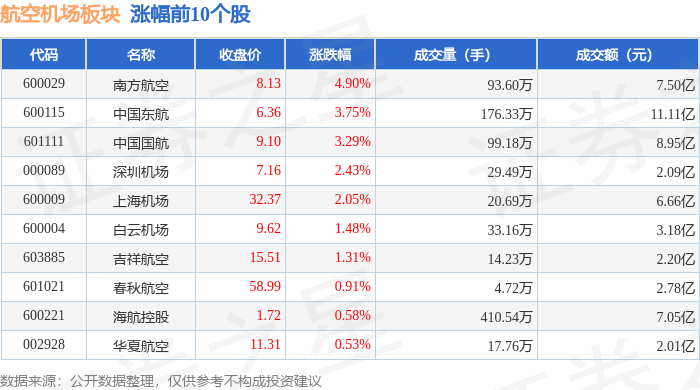
Core Viewpoint - The aviation and airport sector experienced a notable increase of 2.53% on January 20, with Southern Airlines leading the gains, while the overall stock market indices showed slight declines [1]. Group 1: Market Performance - The Shanghai Composite Index closed at 4113.65, down 0.01%, and the Shenzhen Component Index closed at 14155.63, down 0.97% [1]. - Southern Airlines saw a closing price of 8.13, with a rise of 4.90%, and a trading volume of 936,000 shares, resulting in a transaction value of 750 million yuan [1]. - China Eastern Airlines closed at 6.36, up 3.75%, with a trading volume of 1,763,300 shares and a transaction value of 1.111 billion yuan [1]. Group 2: Individual Stock Performance - China National Aviation Holdings closed at 9.10, increasing by 3.29%, with a trading volume of 991,800 shares and a transaction value of 895 million yuan [1]. - Shenzhen Airport's closing price was 7.16, up 2.43%, with a trading volume of 294,900 shares and a transaction value of 209 million yuan [1]. - Shanghai Airport closed at 32.37, rising by 2.05%, with a trading volume of 206,900 shares and a transaction value of 666 million yuan [1]. Group 3: Capital Flow - The aviation and airport sector saw a net inflow of 137 million yuan from main funds, while retail investors experienced a net outflow of 1.22 billion yuan [2]. - Southern Airlines had a net outflow of 57.22 million yuan from main funds, with retail investors also showing a net outflow of 38.10 million yuan [3]. - Shanghai Airport recorded a net inflow of 45.37 million yuan from main funds, while retail investors had a net outflow of 34.33 million yuan [3].






航空迎来黄金时代系列报告:航空“反内卷”初见成效
Shenwan Hongyuan Securities· 2026-01-20 07:37
Investment Rating - The report maintains a positive outlook on the aviation industry, indicating it is entering a "golden era" with an investment rating of "Overweight" [2][3]. Core Insights - The National Civil Aviation Work Conference emphasized "quality improvement and efficiency enhancement," with initial signs of reducing "involution" in the industry. The 2026 targets include a total transport turnover of 1,750 billion ton-kilometers, 810 million passenger transport, and 10.7 million tons of cargo, representing year-on-year growth of 6.7%, 5.2%, and 5.2% respectively [3]. - The global aircraft supply chain remains unhealed, with an aging fleet exacerbating supply constraints. Airbus plans to deliver 793 aircraft in 2025, while Boeing aims for 600, both below pre-pandemic levels. The backlog exceeds 15,000 aircraft, and the delivery cycle has extended to 6.8 years, leading to prolonged service of older models [3]. - Demand is bolstered by visa exemption policies, driving an increase in inbound travelers. The proportion of foreign visitors entering China under visa exemptions has stabilized above 70%. The upcoming Spring Festival is expected to see a daily average of 5.3% growth in passenger volume, with ticket prices projected to rise by 20% compared to the previous year [3]. - The report recommends continued investment in the aviation sector, highlighting the unprecedented constraints in aircraft manufacturing, high passenger load factors, and the growth of inbound and outbound travel. Key companies recommended include China Eastern Airlines, China Southern Airlines, Air China, Spring Airlines, Huaxia Airlines, and Juneyao Airlines [3]. Summary by Sections Supply Side - The global aircraft supply chain is still recovering, with significant delivery delays and an aging fleet leading to supply constraints. The total number of passenger aircraft in China is projected to grow by only 4% in 2025, with a peak in retirements expected by 2030 [3]. Demand Side - The implementation of visa exemption policies is expected to significantly increase the number of inbound travelers, with international routes becoming the main driver of demand growth in 2026. The Spring Festival is anticipated to show a notable increase in both volume and pricing [3]. Investment Recommendations - The report suggests a strong investment in the aviation sector, citing the current supply constraints and the potential for significant improvements in airline profitability. Specific airlines and global aircraft leasing companies are highlighted as key investment opportunities [3][4].



航空机场板块1月19日涨3.36%,中国东航领涨,主力资金净流入2710.67万元
Zheng Xing Xing Ye Ri Bao· 2026-01-19 08:56
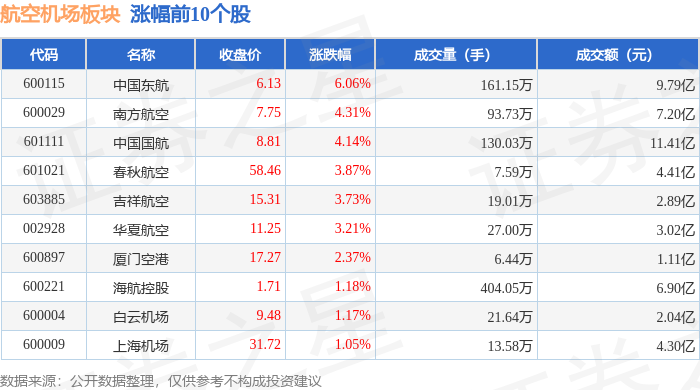
Core Insights - The aviation and airport sector experienced a significant increase of 3.36% on January 19, with China Eastern Airlines leading the gains [1] - The Shanghai Composite Index closed at 4114.0, up 0.29%, while the Shenzhen Component Index closed at 14294.05, up 0.09% [1] Stock Performance - China Eastern Airlines (600115) closed at 6.13, up 6.06%, with a trading volume of 1.6115 million shares and a transaction value of 979 million [1] - Southern Airlines (600029) closed at 7.75, up 4.31%, with a trading volume of 937,300 shares and a transaction value of 720 million [1] - Air China (601111) closed at 8.81, up 4.14%, with a trading volume of 1.3003 million shares and a transaction value of 1.141 billion [1] - Spring Airlines (601021) closed at 58.46, up 3.87%, with a trading volume of 75,900 shares and a transaction value of 441 million [1] - Other notable performances include Xiamen Airport (600897) at 17.27, up 2.37%, and Shanghai Airport (600009) at 31.72, up 1.05% [1] Capital Flow - The aviation and airport sector saw a net inflow of 27.1067 million in main funds, while retail funds experienced a net inflow of 54.5283 million [2] - The sector's overall capital flow indicates a mixed sentiment, with main funds showing a net outflow in some stocks while retail investors contributed positively [2][3] Individual Stock Capital Flow - Hainan Airlines (600221) had a main fund net outflow of 56.1893 million, while retail investors showed a net outflow of 28.2785 million [3] - Shanghai Airport (600009) recorded a main fund net inflow of 41.0025 million, but retail investors had a net outflow of 50.1886 million [3] - Southern Airlines (600029) saw a main fund net inflow of 23.9450 million, with retail investors also showing a net outflow of 13.4306 million [3] - Other stocks like Xiamen Airport (600897) and Shenzhen Airport (000089) also reflected varied capital flows, indicating differing investor sentiments across the sector [3]
华夏航空1月16日获融资买入989.02万元,融资余额1.75亿元
Xin Lang Zheng Quan· 2026-01-19 01:20
Summary of Key Points Core Viewpoint - 华夏航空 has shown a significant increase in revenue and net profit, indicating strong financial performance in the recent period [2]. Group 1: Financial Performance - For the period from January to September 2025, 华夏航空 achieved operating revenue of 5.734 billion yuan, representing a year-on-year growth of 11.25% [2]. - The net profit attributable to shareholders for the same period was 620 million yuan, reflecting a substantial year-on-year increase of 102.17% [2]. - The company has cumulatively distributed dividends of 209 million yuan since its A-share listing, with no dividends distributed in the last three years [2]. Group 2: Shareholder and Market Activity - As of September 30, 2025, the number of shareholders in 华夏航空 was 21,100, a decrease of 4.88% from the previous period [2]. - The average number of circulating shares per shareholder increased by 5.13% to 60,533 shares [2]. - On January 16, 2025, 华夏航空's stock price rose by 2.06%, with a trading volume of 239 million yuan [1]. Group 3: Financing and Margin Trading - On January 16, 2025, 华夏航空 had a financing buy-in amount of 9.8902 million yuan, with a net financing outflow of 502.08 thousand yuan [1]. - The total margin trading balance for 华夏航空 was 176 million yuan, with the financing balance accounting for 1.25% of the circulating market value, indicating a high level of activity [1]. - The company had a margin balance of 1.49 million yuan, with a short selling volume of 900 shares on January 16, 2025 [1].
航空机场板块1月16日跌0.78%,中信海直领跌,主力资金净流出4.77亿元
Zheng Xing Xing Ye Ri Bao· 2026-01-16 08:56
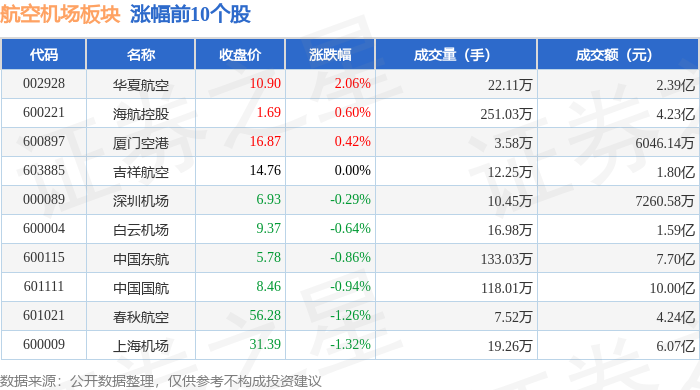
Market Overview - The aviation and airport sector declined by 0.78% on January 16, with CITIC Hainan Airlines leading the drop [1] - The Shanghai Composite Index closed at 4101.91, down 0.26%, while the Shenzhen Component Index closed at 14281.08, down 0.18% [1] Stock Performance - Notable stock performances included: - Huaxia Airlines (002928) increased by 2.06% to close at 10.90 with a trading volume of 221,100 shares and a turnover of 239 million yuan [1] - Hainan Airlines (600221) rose by 0.60% to 69.1 with a trading volume of 2.51 million shares and a turnover of 423 million yuan [1] - Xiamen Airport (600897) increased by 0.42% to 16.87 with a trading volume of 35,800 shares and a turnover of 60.46 million yuan [1] - China Eastern Airlines (600115) decreased by 0.86% to 5.78 with a trading volume of 1.33 million shares and a turnover of 770 million yuan [1] - China Southern Airlines (600029) fell by 1.46% to 7.43 with a trading volume of 795,100 shares and a turnover of 594 million yuan [2] Capital Flow - The aviation and airport sector experienced a net outflow of 477 million yuan from institutional investors, while retail investors saw a net inflow of 257 million yuan [2] - The capital flow for individual stocks showed: - Xiamen Airport had a net inflow of 121.82 million yuan from retail investors, despite a net outflow of 341.39 million yuan from institutional investors [3] - CITIC Hainan Airlines faced a significant net outflow of 75.42 million yuan from institutional investors, while retail investors contributed a net inflow of 57.25 million yuan [3] - China Eastern Airlines had a net outflow of 73.70 million yuan from institutional investors, with retail investors contributing a net inflow of 45.21 million yuan [3]


空中客车预测:未来20年中国将成全球最大航空售后服务市场
Bei Jing Shang Bao· 2026-01-15 13:42
Group 1 - The core viewpoint of the article is that the aviation aftermarket services market is shifting towards Asia, with China projected to become the largest market, growing from $24.8 billion in 2025 to $63.8 billion by 2044 [1] - Over the next 20 years, China is expected to receive approximately 9,570 new aircraft, reinforcing the demand for various services throughout the aircraft lifecycle [3] - Several Chinese airlines have recently announced new aircraft orders with Airbus, including Air China ordering 60 A320neo aircraft, with a total catalog price of approximately $9.53 billion [4] Group 2 - The maintenance and training market is expanding, becoming a critical component for fleet operation as Airbus secures more aircraft orders in China [5] - The Off-Wing Maintenance market is projected to grow from $17 billion in 2025 to $44.8 billion by 2044, while the On-Wing Maintenance market is expected to increase from $3 billion to $6.8 billion in the same period [6] - The digital and connected market is anticipated to be the fastest-growing segment, expanding from $1.4 billion in 2025 to $5.1 billion by 2044, focusing on smarter operations and predictive maintenance [6] Group 3 - The aviation maintenance market in China is expected to grow rapidly due to the increasing fleet size and aging aircraft, with maintenance costs for engines surpassing their purchase costs [7] - Chinese airlines are accelerating their digital transformation, with over 9,000 aircraft expected to have onboard connectivity, potentially saving over $2.2 billion in operational costs and an additional $5.7 billion through reduced fuel costs [7]

华夏航空:2026年第一次临时股东会决议公告
Zheng Quan Ri Bao· 2026-01-15 12:42
Group 1 - The company announced the approval of two significant proposals during its first extraordinary shareholders' meeting in 2026, including the signing of an A320 series aircraft procurement agreement and the revision of the board's remuneration management system [2]
华夏航空(002928) - 北京市金杜律师事务所关于华夏航空股份有限公司2026年第一次临时股东会的法律意见书
2026-01-15 10:00
北京市金杜律师事务所 关于华夏航空股份有限公司 2026 年第一次临时股东会 的法律意见书 致:华夏航空股份有限公司 北京市金杜律师事务所(以下简称本所)接受华夏航空股份有限公司(以下 简称公司)委托,根据《中华人民共和国证券法》(以下简称《证券法》)、《中华 人民共和国公司法》(以下简称《公司法》)、中国证券监督管理委员会《上市公 司股东会规则》(以下简称《股东会规则》)等中华人民共和国境内(以下简称中 国境内,为本法律意见书之目的,不包括中国香港特别行政区、中国澳门特别行 政区和中国台湾省)现行有效的法律、行政法规、规章和规范性文件和现行有效 的《华夏航空股份有限公司章程》(以下简称《公司章程》)有关规定,指派律师 出席了公司于 2026 年 1 月 15 日召开的 2026 年第一次临时股东会(以下简称 本次股东会),并就本次股东会相关事项出具本法律意见书。 为出具本法律意见书,本所律师审查了公司提供的以下文件,包括但不限于: 1. 经公司 2025 年第二次临时股东大会审议通过的《公司章程》; 2. 公司于 2025 年 12 月 30 日刊登于巨潮资讯网及深圳证券交易所网站的 《华夏航空股份有限公司 ...
华夏航空(002928) - 2026年第一次临时股东会决议公告
2026-01-15 10:00
1、本次股东会未出现否决提案的情形。 2、本次股东会不涉及变更以往股东会已通过的决议。 华夏航空股份有限公司 2026 年第一次临时股东会决议公告 本公司及董事会全体成员保证信息披露的内容真实、准确、完整,没有 虚假记载、误导性陈述或重大遗漏。 特别提示: 证券代码:002928 证券简称:华夏航空 公告编号:2026-005 一、会议召开和出席情况 1、会议召开情况: (1)会议召开时间:2026 年 01 月 15 日(星期四) 1)现场会议时间:2026 年 01 月 15 日(星期四)14:30 深圳证券交易所互联网投票系统投票时间:2026 年 01 月 15 日 09:15~15:00。 (2)会议召开地点:重庆市渝北区江北国际机场航安路 30 号华夏航空新办 公楼 524 会议室 (3)会议召开方式:现场表决与网络投票相结合 2)网络投票时间: (4)会议召集人:公司董事会 深圳证券交易所交易系统投票时间:2026 年 01 月 15 日 09:15~09:25, 09:30~11:30,13:00~15:00; 本次会议的召开符合《中华人民共和国公司法》等有关法律、行政法规、部 门规章、规范性 ...
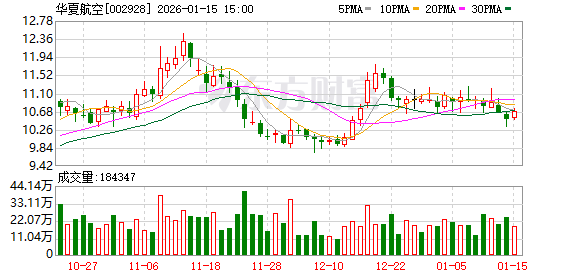
华夏航空(002928)披露获得政府补助,1月15日股价上涨1.71%
Sou Hu Cai Jing· 2026-01-15 09:50
Core Viewpoint - Huaxia Airlines (002928) has received a government subsidy of 525.90 million yuan, which is 196.25% of the company's audited net profit attributable to shareholders for the fiscal year 2024 [1] Group 1: Stock Performance - As of January 15, 2026, Huaxia Airlines closed at 10.68 yuan, up 1.71% from the previous trading day [1] - The stock opened at 10.52 yuan, reached a high of 10.76 yuan, and a low of 10.48 yuan, with a trading volume of 1.97 billion yuan and a turnover rate of 1.44% [1] Group 2: Government Subsidy - The company announced that it has received notification from the Ministry of Finance regarding a subsidy from the 2025 Civil Aviation Development Fund, amounting to 525.90 million yuan [1] - This subsidy is related to the company's regular operating activities and will be recorded under "other income" [1] - For the fiscal year 2024, the company has already accrued 525.90 million yuan, with a minor difference of 0.22 million yuan to be included in the 2025 fiscal year results [1]