EASTMONEY(300059)

Search documents
东方财富(300059.SZ):子公司东方财富证券股份有限公司2024年度第十七期短期融资券兑付完成
Ge Long Hui A P P· 2025-12-17 15:20
Core Viewpoint - Dongfang Caifu (300059.SZ) announced the successful issuance of its 17th short-term financing bond by its subsidiary, Dongfang Caifu Securities, on December 16, 2024, with a total amount of RMB 2.82 billion and a coupon rate of 1.71% [1] Group 1 - The total issuance amount of the short-term financing bond is RMB 2.82 billion [1] - The coupon rate for the bond is set at 1.71% [1] - The bond has a maturity period of 365 days, with a repayment date scheduled for December 17, 2025 [1] Group 2 - On December 17, 2025, Dongfang Caifu Securities will complete the principal and interest repayment for the 24th short-term financing bond, identified as 24 Dongcai Securities CP017 [1]
东方财富:子公司东方财富证券股份有限公司2024年度第十七期短期融资券兑付完成
Ge Long Hui· 2025-12-17 15:06
Group 1 - The company, Dongfang Caifu, announced that its subsidiary, Dongfang Caifu Securities, successfully issued the 17th phase of short-term financing bonds for the year 2024 on December 16, 2024, with an issuance amount of RMB 2.82 billion [1] - The bonds have a coupon rate of 1.71% and a maturity period of 365 days, with the repayment date set for December 17, 2025 [1] - On December 17, 2025, Dongfang Caifu Securities completed the principal and interest repayment for the 24th short-term financing bond, identified as Dongcai CP017 [1]
东方财富:子公司28.20亿元短期融资券兑付完成
Xin Lang Cai Jing· 2025-12-17 10:56
东方财富公告称,子公司东方财富证券于2024年12月16日发行"24东财证券CP017",发行金额28.20亿 元,票面利率1.71%。2025年12月17日,东方财富证券完成该短期融资券本息兑付工作。 ...
东方财富(300059) - 东方财富信息股份有限公司关于子公司东方财富证券股份有限公司2024年度第十七期短期融资券兑付完成的公告
2025-12-17 10:47
本公司及董事会全体成员保证信息披露内容的真实、准确和完整,没有虚假记载、误 导性陈述或重大遗漏。 东方财富信息股份有限公司(以下简称"公司")子公司东方财富证券股份 有限公司(以下简称"东方财富证券")于 2024 年 12 月 16 日成功发行了东方财 富证券股份有限公司 2024 年度第十七期短期融资券(以下简称"24 东财证券 CP017"),发行金额为人民币 28.20 亿元,票面利率为 1.71%,期限为 365 天, 兑付日期为 2025 年 12 月 17 日。详情见公司于 2024 年 12 月 18 日在深圳证券交 易所网站和符合中国证监会规定条件的信息披露媒体披露的相关公告。 2025 年 12 月 17 日,东方财富证券完成了 24 东财证券 CP017 的本息兑付工 作。 特此公告。 证券代码:300059 证券简称:东方财富 公告编号:2025-098 东方财富信息股份有限公司 关于子公司东方财富证券股份有限公司 2024 年度第十七期 短期融资券兑付完成的公告 东方财富信息股份有限公司董事会 二〇二五年十二月十八日 ...
四方达:接受东方财富、中信资管调研

Mei Ri Jing Ji Xin Wen· 2025-12-17 10:39
Group 1 - The core viewpoint of the article highlights that Sifangda (SZ 300179) will hold a research meeting on December 17, 2025, with participation from key company executives to address investor inquiries [1] - For the first half of 2025, Sifangda's revenue composition is reported to be 100% from the manufacturing sector [1] - As of the time of reporting, Sifangda's market capitalization stands at 7 billion yuan [1] Group 2 - The article also mentions a significant milestone in the industry with the successful launch of China's first private spacecraft, indicating a growing trend in the private space sector [1] - The founder of the company behind the spacecraft is actively developing low-cost products for medium cargo transport [1]
东方财富董监高“换血”!董秘升任总经理,组织架构调整
Xin Lang Cai Jing· 2025-12-17 09:10
Core Viewpoint - The recent announcements from Dongfang Caifu (300059.SZ) signal a significant governance and organizational transformation, with key personnel changes aimed at enhancing operational efficiency and addressing market challenges [2][34]. Group 1: Leadership Changes - Huang Jianhai has been appointed as the new General Manager and Vice Chairman, taking over from Zheng Likun, who remains as Chairman of Dongfang Caifu Securities [3][35]. - Huang Jianhai, a female executive with a strong financial background, holds 500,000 shares in the company and will receive a pre-tax salary of 3.32 million yuan in 2024 [3][34]. - The company has appointed two new Vice Presidents, Cheng Lei and Yang Hao, and hired Cheng Hui as the Chief Financial Officer [6][36]. Group 2: Organizational Restructuring - The organizational structure has been restructured, eliminating the supervisory board and integrating compliance and legal functions into a new legal compliance department [9][40]. - The board of directors has been reconstituted, now consisting of six members, including three non-independent directors and two independent directors [7][37]. Group 3: Financial Performance - Dongfang Caifu reported strong financial growth in the first three quarters, with total revenue of 11.59 billion yuan, a year-on-year increase of 58.67%, and a net profit of 9.10 billion yuan, up 50.57% [13][44]. - The company’s total assets reached 380.26 billion yuan, reflecting a 24.12% increase from the previous year [13][44]. - The net profit margin stands at 78.5%, significantly higher than traditional brokers, attributed to its light-asset internet platform model [15][46]. Group 4: Business Segments and Challenges - The company’s business is divided into three main segments: securities brokerage, financial e-commerce services through Tian Tian Fund, and financial data services via the Choice platform [12][43]. - Despite strong growth in securities brokerage, challenges remain in the Tian Tian Fund segment, which is facing performance difficulties and competition [34][49]. - The investment income growth has slowed, with a 3.15% increase, and self-operated business income has declined by approximately 18% due to decreased fixed income returns [15][47]. Group 5: Market Position and Competition - Dongfang Caifu is recognized as a leading internet financial service platform in China, holding a full securities license and benefiting from a closed-loop ecosystem [12][43]. - The company faces competition from peers like Tonghuashun and Dazhihui, with the latter having a higher user engagement rate [19][50]. - The stock performance has been under pressure, with a year-to-date decline of 12.17%, ranking 47th among 50 A-share listed brokers [29][60].


A股午后大爆发!AI产业链股强势 锂矿概念爆发
Zheng Quan Shi Bao· 2025-12-17 08:47
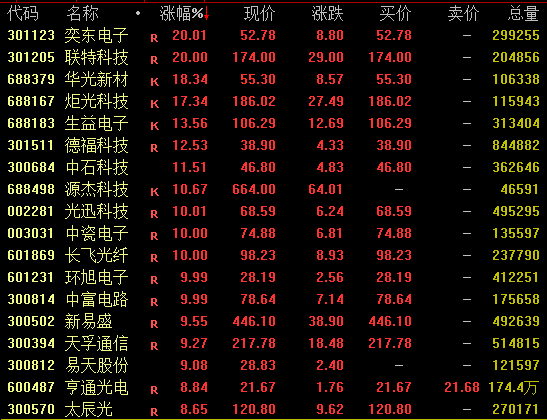
Market Overview - A-shares experienced a significant rally in the afternoon session, with the Shanghai Composite Index rising over 1% and the ChiNext Index soaring over 3% [1] - The total trading volume in the Shanghai and Shenzhen markets reached 1.8345 trillion yuan, an increase of approximately 86 billion yuan compared to the previous day [1] Insurance and Brokerage Sector - The insurance sector saw strong gains, led by China Pacific Insurance, with major companies like China Life and China Property & Casualty Insurance also rising over 3% [2] - Analysts suggest that the insurance industry may undergo valuation recovery due to the adjustment of preset interest rates and the development of floating income products [2] - The brokerage sector also performed well, with Huatai Securities hitting a near-limit increase and closing up about 6% [2] AI Industry Chain - Stocks related to the AI industry chain, particularly CPO concepts, saw significant increases, with companies like Yidong Electronics and Lian Te Technology hitting the 20% limit up [3] - The global AI industry is at a pivotal point of capability leap and accelerated commercialization, with leading firms in the US and China dominating the large model landscape [3][5] Lithium Mining Sector - The lithium mining sector experienced a substantial rise, with Tianhua New Energy increasing over 14% and several other companies reaching their daily limit [6] - The price of lithium carbonate futures surged over 8%, reaching a new high since June 2024, driven by supply disruptions and rising demand expectations [8] - Analysts noted that the price of lithium carbonate has increased over 70% from its low point earlier in the year, indicating strong supply and demand dynamics [8]




A股,午后大爆发!
证券时报· 2025-12-17 08:30
Market Overview - A-shares experienced a significant rally on the afternoon of the 17th, with the Shanghai Composite Index rising over 1% and the ChiNext Index soaring over 3% [1] - The total trading volume in the Shanghai and Shenzhen markets reached 18,345 billion yuan, an increase of approximately 860 billion yuan compared to the previous day [1] Insurance and Brokerage Sector - The insurance sector saw strong gains, led by China Pacific Insurance, with China Life and China Property & Casualty both rising over 3% [3] - Analysts suggest that the insurance industry may experience valuation recovery due to the adjustment of preset interest rates and the development of floating income products [3] - The brokerage sector also performed well, with Huatai Securities hitting a near-limit up and closing up about 6% [4] - Factors such as government policies aimed at stabilizing growth and the capital market, along with a favorable liquidity environment, are expected to boost the brokerage sector's performance [4] AI Industry Chain - Stocks in the AI industry chain surged, with companies like Yidong Electronics and Lian Te Technology hitting the 20% limit up [7] - The demand for computing power in AI is expected to grow significantly, driven by advancements in model architecture and multi-modal generation [9] Lithium Mining Sector - The lithium mining sector saw substantial gains, with Tianhua New Energy rising over 14% and several other companies hitting their daily limit up [11] - The price of lithium carbonate futures surged over 8%, reaching a new high since June 2024, with prices increasing over 70% from the year's low [13] - Analysts indicate that supply disruptions and rising external prices are contributing to the bullish trend in lithium prices, with expectations of strong demand continuing into the end of the year [13]






ETF盘中资讯 | 突然爆发!“旗手”冲锋,华泰证券飙升逾9%,顶流券商ETF(512000)冲击3%收复半年线!
Sou Hu Cai Jing· 2025-12-17 06:55
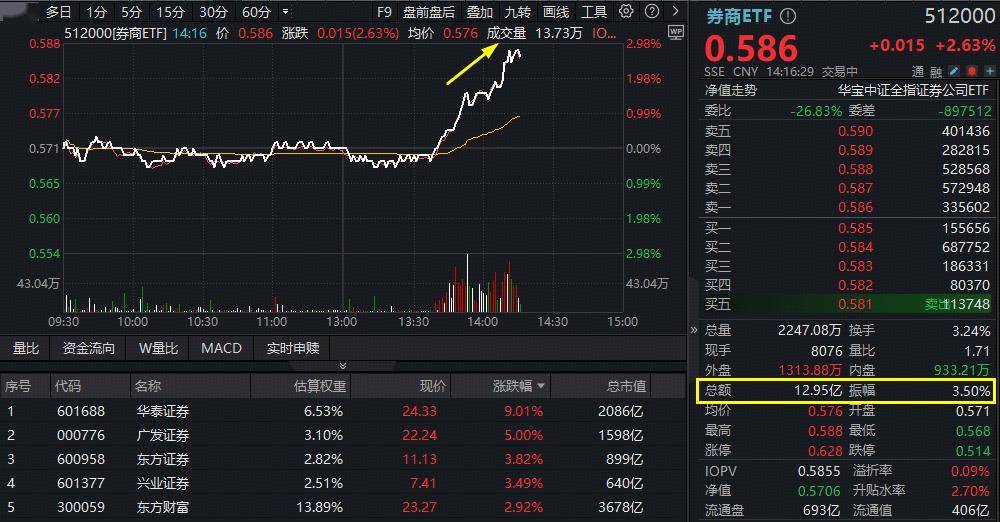
Core Viewpoint - The recent surge in the broker ETF (512000) indicates a positive outlook for the brokerage sector, driven by ongoing reforms in the capital market and improved fundamentals for brokerage firms [1][2]. Group 1: Market Performance - The broker ETF (512000) experienced a significant increase, with a peak rise of nearly 3%, recovering its six-month moving average and achieving a trading volume of nearly 1.3 billion yuan, significantly surpassing the previous day's total [1]. - The current average daily trading volume for the broker ETF in 2023 has exceeded 1 billion yuan, highlighting its status as a leading investment tool in the A-share market [2]. Group 2: Industry Outlook - The Central Economic Work Conference emphasized the need for continuous deepening of capital market reforms, positioning brokerages as key service providers for direct financing and important gatekeepers of the capital market [1]. - Analysts suggest that the brokerage sector is poised for continued performance recovery, with the price-to-book (PB) ratio of the sector falling to a near ten-year low, indicating a high potential for investment [2]. Group 3: Investment Tools - The broker ETF (512000) passively tracks the CSI All Share Securities Companies Index, encompassing 49 listed brokerage stocks, making it an efficient investment tool for both leading and smaller brokerages [2]. - The broker ETF has a current fund size exceeding 39.5 billion yuan, reinforcing its position as a top-tier ETF in terms of scale and liquidity within the A-share market [2].
机构称三大核心利好有望带动板块,证券ETF龙头(159993)涨超2.2%
Xin Lang Cai Jing· 2025-12-17 06:49
Group 1 - The core viewpoint of the articles highlights a positive outlook for the securities industry, driven by policy support and market reforms aimed at enhancing capital market functions [1][2] - The National Securities Leading Index (399437) has shown a strong increase of 2.46%, with key stocks like Huatai Securities (601688) rising by 6.77% and GF Securities (000776) by 3.49%, indicating robust market performance [1] - The Central Economic Work Conference emphasized the need for continuous deepening of capital market reforms, positioning brokerages as essential service providers for direct financing and wealth management [1] Group 2 - According to CITIC Securities research, the securities sector is expected to enter a new growth cycle in 2025, with performance driven by favorable policies and market conditions [2] - The report identifies three core positive drivers: service to new productive forces, long-term capital inflow, and internationalization opportunities for brokerages, which are not yet fully priced into the market [2] - As of November 28, 2025, the top ten weighted stocks in the National Securities Leading Index account for 79.05% of the index, indicating a concentrated market structure [2]