
Green Pine(300132)

Search documents
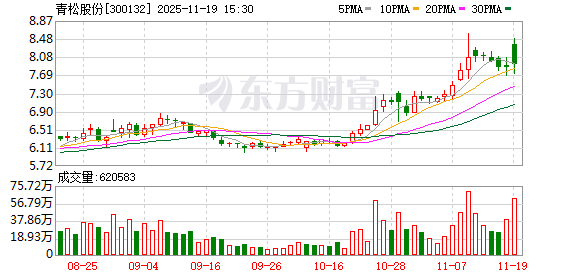
青松股份:公司目前主营业务为化妆品ODM业务
Zheng Quan Ri Bao· 2025-11-19 13:38
Group 1 - The company, Qingsong Co., is primarily engaged in the ODM (Original Design Manufacturer) business for cosmetics [2] - The company's registered location is in Jianyang District, Nanping City, Fujian Province, China [2] - The main operational area of the company is in Zhongshan City, Guangdong Province [2]


化妆品板块11月19日涨1.72%,科思股份领涨,主力资金净流入2.01亿元
Zheng Xing Xing Ye Ri Bao· 2025-11-19 08:58
Market Overview - The cosmetics sector increased by 1.72% on November 19, with Keshare leading the gains [1] - The Shanghai Composite Index closed at 3946.74, up 0.18%, while the Shenzhen Component Index closed at 13080.09, unchanged [1] Key Performers - Keshare (300856) closed at 15.29, up 7.98% with a trading volume of 315,500 shares and a turnover of 475 million yuan [1] - Bavi (920123) closed at 19.72, up 4.89% with a trading volume of 118,600 shares and a turnover of 229 million yuan [1] - Lafang (603630) closed at 24.60, up 4.15% with a trading volume of 145,700 shares and a turnover of 353 million yuan [1] - Other notable performers include Shuiyang (300740) and Tian Cai Ya (603605), with increases of 3.28% and 2.55% respectively [1] Fund Flow Analysis - The cosmetics sector saw a net inflow of 201 million yuan from institutional investors, while retail investors experienced a net outflow of 252 million yuan [2] - Keshare had a net inflow of 63.71 million yuan from institutional investors, while retail investors had a net outflow of 47.79 million yuan [3] - Other companies like Shuiyang and Furuida also experienced significant net inflows from institutional investors, indicating strong interest in the sector [3]



化妆品行业跟踪报告:大盘平稳,国货领先、高端改善
Haitong Securities International· 2025-11-17 06:05
Investment Rating - The report suggests a positive investment outlook for the cosmetics industry, highlighting strong growth potential for specific companies [29]. Core Insights - The 2025 Double 11 event showed steady double-digit growth, with total GMV reaching RMB 1.695 trillion, a 14% increase from 2024. Instant retail demonstrated significant growth, with comprehensive e-commerce and community group buying also contributing positively [29][4]. - The beauty category maintained robust growth across multiple platforms, with skincare and makeup categories achieving growth rates between 5-15%. Domestic brands like PROYA and Winona performed particularly well, with PROYA maintaining the top position in Tmall's beauty rankings [29][14][17]. - The report emphasizes the trend of full-chain integration and one-stop services across platforms, with Tmall achieving its best growth in four years, driven by high-value user contributions from 88VIP [29][8]. Summary by Sections Double 11 Performance - The 2025 Double 11 event recorded a total GMV of RMB 1.695 trillion, marking a 14% increase from the previous year. Instant retail grew significantly, with GMV for comprehensive e-commerce at RMB 1.6191 trillion, and community group buying at RMB 90 billion [4][29]. - Tmall's performance was highlighted as the best in four years, with significant contributions from 88VIP and other platforms like JD.com and Douyin also showing strong growth [11][12]. Brand Performance - Companies such as Guangzhou Ruoyuchen Technology Co., Ltd. and Shanghai Chicmax Cosmetic Co., Ltd. reported impressive growth during Double 11, with Zhenjia's GMV increasing by 80% year-on-year and Feicui's GMV growing 35 times [25][29]. - The report notes that domestic brands excelled in the beauty category, with PROYA and other brands maintaining strong positions in the market [22][29]. Investment Recommendations - The report recommends focusing on high-growth brands such as Ruoyuchen, Chicmax, and Mao Geping, as well as companies with stable fundamentals like Dentium and Shanghai Jahwa United. It also identifies companies expected to bottom out, such as PROYA and Lafang [29][38].


化妆品板块11月14日跌1.06%,芭薇股份领跌,主力资金净流出7529.05万元
Zheng Xing Xing Ye Ri Bao· 2025-11-14 08:58
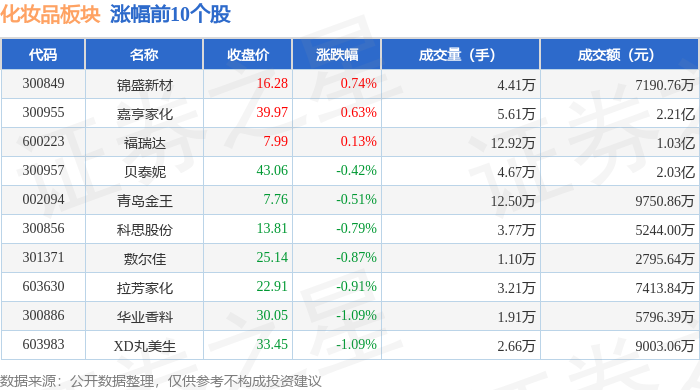
Market Overview - The cosmetics sector experienced a decline of 1.06% on November 14, with Bawei Co. leading the drop [1] - The Shanghai Composite Index closed at 3990.49, down 0.97%, while the Shenzhen Component Index closed at 13216.03, down 1.93% [1] Individual Stock Performance - Notable performers included: - Jinsong New Material (300849) with a closing price of 16.28, up 0.74% [1] - Jiahen Home Care (300955) at 39.97, up 0.63% [1] - Furuida (600223) at 7.99, up 0.13% [1] - Stocks that declined included: - Bawei Co. (920123) at 17.68, down 3.49% [2] - Shuiyang Co. (300740) at 21.02, down 2.28% [2] - Shanghai Jahwa (600315) at 24.20, down 1.63% [2] Capital Flow Analysis - The cosmetics sector saw a net outflow of 75.29 million yuan from institutional investors, while retail investors had a net inflow of 58.41 million yuan [2] - The overall capital flow for individual stocks showed mixed results, with some stocks experiencing significant outflows from institutional investors [3] Detailed Capital Flow for Selected Stocks - Tian Cai Ya (603605) had a net inflow of over 10.27 million yuan from institutional investors, while it faced a net outflow of 20.13 million yuan from retail investors [3] - Jinsong New Material (300849) saw a net inflow of 4.11 million yuan from institutional investors but a net outflow of 4.36 million yuan from retail investors [3] - Jiahen Home Care (300955) experienced a net outflow of 3.05 million yuan from institutional investors, with a significant net inflow of 16.17 million yuan from retail investors [3]
化妆品板块11月13日涨0.2%,锦盛新材领涨,主力资金净流出5656.82万元
Zheng Xing Xing Ye Ri Bao· 2025-11-13 08:51
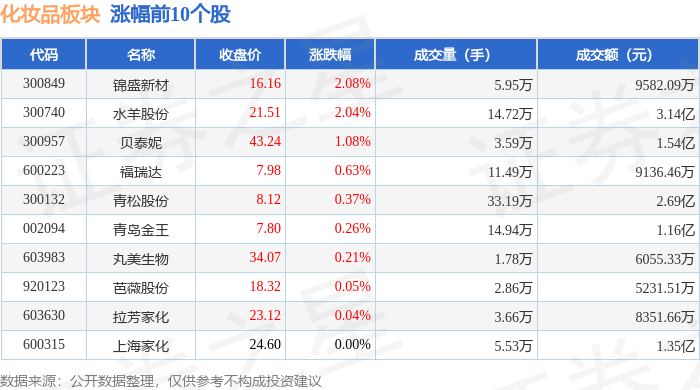
Market Overview - The cosmetics sector increased by 0.2% on November 13, with Jinsheng New Materials leading the gains [1] - The Shanghai Composite Index closed at 4029.5, up 0.73%, while the Shenzhen Component Index closed at 13476.52, up 1.78% [1] Individual Stock Performance - Jinsheng New Materials (300849) closed at 16.16, up 2.08% with a trading volume of 59,500 shares and a transaction value of 95.82 million yuan [1] - Shuiyang Co. (300740) closed at 21.51, up 2.04% with a trading volume of 147,200 shares and a transaction value of 314 million yuan [1] - Beitaini (300957) closed at 43.24, up 1.08% with a trading volume of 35,900 shares and a transaction value of 154 million yuan [1] - Other notable stocks include Furuida (600223) at 7.98 (+0.63%), Qingsong Co. (300132) at 8.12 (+0.37%), and Qingdao Kingway (002094) at 7.80 (+0.26%) [1] Capital Flow Analysis - The cosmetics sector experienced a net outflow of 56.57 million yuan from institutional investors and 32.11 million yuan from retail investors, while individual investors saw a net inflow of 88.67 million yuan [2] - The capital flow for individual stocks shows that Shuiyang Co. had a net inflow of 21.64 million yuan from institutional investors, while other stocks like Huaye Fragrance (300886) and Kesheng Co. (300856) faced net outflows [3]
青松股份(300132):收入回暖,盈利大幅改善
Haitong Securities International· 2025-11-12 09:34
Investment Rating - The report maintains an "Outperform" rating for the company, with a target price of RMB 10.50 based on a target PE of 35x for 2026 [4][13]. Core Insights - The company has turned around after four years of adjustments, entering a growth phase with improved revenue and profit [4][14]. - For the first three quarters of 2025, revenue, net profit attributable to shareholders, and recurring net profit were RMB 1.55 billion, RMB 111 million, and RMB 75 million, representing year-on-year increases of 12.00%, 246.98%, and 146.48% respectively [4][14]. - The mask category has shown significant growth, leading the overall revenue increase, while the company is expected to gain market share as the industry recovers from a downturn [4][16]. Financial Summary - Revenue projections for 2025-2027 are RMB 2.185 billion, RMB 2.446 billion, and RMB 2.689 billion, with respective growth rates of 12.6%, 11.9%, and 9.9% [3][5]. - Net profit attributable to shareholders is forecasted to be RMB 142 million, RMB 154 million, and RMB 203 million for 2025-2027, with growth rates of 160.0%, 8.5%, and 31.4% [3][5]. - The company's gross profit margin for Q3 2025 was 21.77%, up 2.83% year-on-year, indicating improved operational efficiency [4][14]. Product Category Performance - In H1 2025, revenue from masks, skincare, and wipes was RMB 450 million, RMB 323 million, and RMB 125 million, with year-on-year growth of 21%, 7%, and a decline of 9% respectively [4][15]. - The gross profit margins for masks, skincare, and wipes were 19.01%, 16.67%, and 13.45%, reflecting improvements due to increased capacity utilization and revenue growth [4][15]. Industry Outlook - The cosmetics industry has faced a downturn since 2022, leading to intensified competition and the exit of smaller players, which is expected to benefit leading companies like the report's subject [4][16]. - The company's subsidiary, North Bell, is positioned to attract quality brands and gain market share due to its scale advantages and ongoing R&D investments [4][16].
国泰海通晨报-20251112
GUOTAI HAITONG SECURITIES· 2025-11-12 09:09
Group 1: Non-Metallic Building Materials - The building materials industry shows signs of structural growth that gradually outweigh environmental impacts, with Q3 2025 reports indicating a recovery in revenue and profitability for several companies [2][25] - The cement sector continues to perform well overseas, particularly in Africa, while domestic demand and prices have weakened, suggesting a potential bottoming out in 2024 [4][26] - In the consumer building materials sector, revenue growth disparities among sub-industries are widening, driven by the impacts of real estate and local debt [5][27] Group 2: Biopharmaceuticals - Huadong Medicine's industrial segment maintains steady growth, with Q3 2025 revenue of 37.28 billion yuan, up 14.95% year-on-year, and net profit of 8.94 billion yuan, up 18.43% [7][8] - The medical aesthetics business faces short-term pressure due to economic factors, with a decline in revenue for both domestic and overseas operations [8] - The company is advancing its innovative pipeline, with several clinical trials ongoing for various cancer treatments [9][33] Group 3: Power Equipment and New Energy - Haibo Sichuang, a leader in energy storage, is expected to benefit from high industry demand, with Q3 2025 revenue reaching 3.39 billion yuan, a year-on-year increase of 124.4% [10][11] - The company's profitability has improved significantly, with a gross margin of 18.64% and a net margin of 9.05% in Q3 2025 [11] - The global energy storage market is projected to grow by 40%-50% in 2026, with significant contributions from both domestic and international markets [13] Group 4: Financial Engineering - The report highlights various asset allocation strategies, with the macro-factor-based strategy yielding a return of 4.23% in 2025, outperforming other strategies [14][15] - The performance of domestic asset strategies shows a positive trend, with October returns indicating a stable investment environment [15][16] - The overall economic outlook remains cautious, with manufacturing PMI indicating a contraction, while service sector activity shows slight improvement [16]



化妆品板块11月10日涨3.13%,拉芳家化领涨,主力资金净流入1.52亿元
Zheng Xing Xing Ye Ri Bao· 2025-11-10 08:49
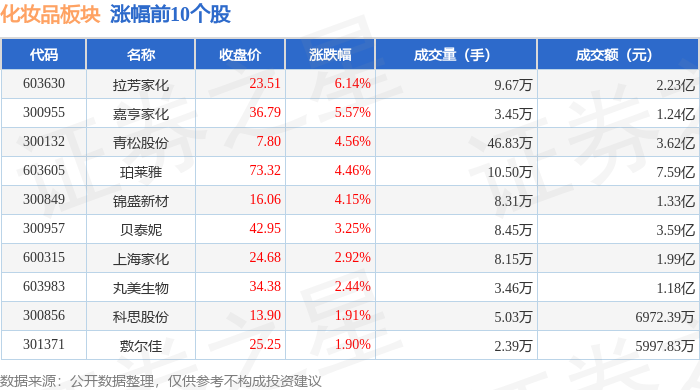
Core Viewpoint - The cosmetics sector experienced a notable increase of 3.13% on November 10, with Lafang Jiahua leading the gains [1] Group 1: Market Performance - The Shanghai Composite Index closed at 4018.6, up 0.53%, while the Shenzhen Component Index closed at 13427.61, up 0.18% [1] - Lafang Jiahua's stock price rose by 6.14% to 23.51, with a trading volume of 96,700 shares and a transaction value of 223 million [1] - Other notable performers included: - Jiahen Jiahua: 5.57% increase, closing at 36.79 with a transaction value of 124 million [1] - Qingsong Co.: 4.56% increase, closing at 7.80 with a transaction value of 362 million [1] - Proya: 4.46% increase, closing at 73.32 with a transaction value of 759 million [1] Group 2: Fund Flow Analysis - The cosmetics sector saw a net inflow of 152 million from institutional investors, while retail investors experienced a net outflow of 179 million [1] - Key fund flows for selected companies included: - Lafang Jiahua: 22.32 million net inflow from institutional investors, with a net outflow of 11.42 million from retail investors [2] - Beitaini: 34.32 million net inflow from institutional investors, with a net outflow of 13.48 million from retail investors [2] - Shanghai Jahwa: 24.72 million net inflow from institutional investors, with a net outflow of 30.62 million from retail investors [2]

化妆品板块11月6日跌1.21%,贝泰妮领跌,主力资金净流出8263.52万元
Zheng Xing Xing Ye Ri Bao· 2025-11-06 08:50
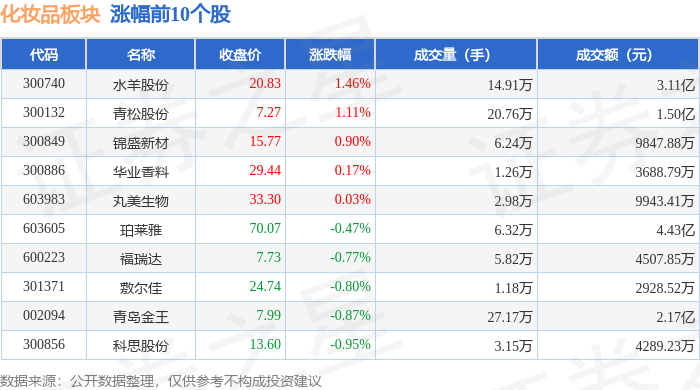
Market Overview - The cosmetics sector experienced a decline of 1.21% on November 6, with Betaini leading the drop [1] - The Shanghai Composite Index closed at 4007.76, up 0.97%, while the Shenzhen Component Index closed at 13452.42, up 1.73% [1] Individual Stock Performance - Notable gainers included: - Shuiyang Co., Ltd. (300740) with a closing price of 20.83, up 1.46% [1] - Qingsong Co., Ltd. (300132) with a closing price of 7.27, up 1.11% [1] - Significant decliners included: - Betaini (300957) with a closing price of 42.22, down 4.89% [2] - Jiahen Home Care (300955) with a closing price of 36.68, down 3.47% [2] Trading Volume and Capital Flow - The cosmetics sector saw a net outflow of 82.6352 million yuan from institutional investors, while retail investors had a net inflow of 58.2199 million yuan [2] - The trading volume for Shuiyang Co., Ltd. was 149,100 shares, with a transaction value of 311 million yuan [1] Capital Flow Analysis - Major net inflows were observed in: - Shuiyang Co., Ltd. with a net inflow of 23.1839 million yuan [3] - Qingsong Co., Ltd. with a net inflow of 7.1227 million yuan [3] - Major net outflows were noted in: - Betaini with a net outflow of 90.237 million yuan [3] - Shanghai Jahwa (600315) with a net outflow of 90.237 million yuan [3]
格局生变,优选成长
Haitong Securities International· 2025-11-04 09:08
Group 1: Industry Overview - The cosmetics retail sales in China grew by 3.9% year-on-year from January to September 2025, slightly underperforming the overall retail market by 0.6 percentage points, indicating a stable demand environment [4][14]. - Online platforms like Tmall and Douyin are experiencing a shift, with Tmall showing signs of recovery due to flash sales and member subsidies, while Douyin's growth has slightly slowed down [17][20]. - The demand for high-end and cost-effective products is increasing, while the mid-range segment is facing pressure due to a more conservative consumer environment [5][41]. Group 2: Competitive Landscape - The trend of domestic brands replacing foreign ones is slowing down, with leading foreign brands like L'Oréal and Estée Lauder showing signs of recovery in the Chinese market [23][24]. - The growth of domestic brands is becoming more differentiated, with some brands like Proya and Shiseido experiencing declines, while others like Youngor and Shanghai Jahwa continue to grow [23][24]. - The industry is witnessing an acceleration in the multi-brand matrix among leading companies, which is expected to increase market concentration [27][28]. Group 3: Key Companies - The report highlights several companies with strong growth potential, including Ruya Chen, Shumei Co., and Maogeping, which are expected to benefit from their brand strength and market positioning [3][54]. - Companies like Dekang Oral Care and Shanghai Jahwa are noted for their stable fundamentals and potential for marginal improvement, while others like Jinbo Biological and Huaxi Biological are anticipated to reach turning points [54]. - Ruya Chen's self-owned brand, Zhenjia, has shown significant growth, with a revenue increase of 345% year-on-year in Q3 2025, indicating strong brand development capabilities [60].