COOLTECH POWER(300153)

Search documents
科泰电源:软件系统升级新增运营系统软件
Zheng Quan Ri Bao Wang· 2026-02-12 11:39
Group 1 - The company, KOTAI Power (300153), announced a software system upgrade that includes the addition of operational system software, leading to an increase in the amortization of intangible assets for the year [1]

科泰电源(300153.SZ):目前未涉及太空光伏储能项目
Ge Long Hui· 2026-02-12 07:54
Group 1 - The company, KOTAI Power (300153.SZ), has stated that it is currently not involved in any space photovoltaic energy storage projects [1]
科泰电源:目前未涉及太空光伏储能项目
Ge Long Hui· 2026-02-12 07:54
Group 1 - The company, KOTAI Power (300153.SZ), has stated that it is currently not involved in any space photovoltaic energy storage projects [1]
未知机构:AIDC发电专题报告北美缺电逻辑持续演绎相关投资线索再梳理东吴机-20260210
未知机构· 2026-02-10 02:00
Summary of Conference Call Notes Industry Overview - The report focuses on the North American electricity shortage, driven by the non-linear growth of AI power demand and aging power grid infrastructure [1] - The demand side sees a surge in AIDC projects in the U.S., leading to a significant increase in electricity demand [1] - On the supply side, while total supply is expected to meet short-term demand by 2025, long-term challenges include a decline in stable supply and regional electricity shortages [1] Key Points Supply Challenges - **Decline in Stable Supply**: The aging power grid leads to frequent outages, failing to meet AIDC's requirement for 100% reliable power. The upcoming retirement peak of coal power plants and the instability of wind and solar energy further exacerbate the situation. Only natural gas can currently fill the gap [1][2] - **Regional Electricity Shortages**: By 2024, over 50% of data centers are expected to be located in Texas, California, and Virginia, putting significant pressure on regional power supplies. The fragmented nature of the U.S. power grid and poor interconnections have led to emergency controls due to power imbalances [1] Future Projections - NERC forecasts an average peak gap of over 20 GW in the U.S. from 2027 to 2030, with Texas, the Mid-Atlantic, the Midwest, and California facing significant risks. The DOE predicts an average peak gap of 20-40 GW by 2030 [1] Technology Solutions - **Gas Turbines**: Considered the optimal solution for AIDC self-built power, with efficiency exceeding 60% and the lowest cost per kWh. The global installation of gas turbines is accelerating, with major manufacturers like GE, Siemens, and Mitsubishi Heavy Industries having orders scheduled until 2029 [2] - **Gas Internal Combustion Engines**: Slightly lower efficiency than gas turbines but offer rapid deployment. Leading company Wärtsilä saw a 111% year-on-year increase in new orders for Q1-Q3 2025, with deliveries extending to 2028 [2] - **Solid Oxide Fuel Cells (SOFC)**: High efficiency but currently in early commercialization stages, making it less viable in the short term due to cost and capacity constraints [2] - **Diesel Generators**: Optimal for backup power due to quick start-up capabilities, with Cummins reporting a revenue growth of approximately 20% year-on-year for related products in Q1-Q3 2025 [2] Investment Recommendations - Investment opportunities are expanding from gas turbines to gas internal combustion engines and SOFCs, as the current electricity shortage in North America exceeds the total production capacity of various technologies [3] - **Gas Turbines**: Recommended companies include Jerry Holdings, Yingliu Co., Dongfang Electric, Linde Co., and Haomai Technology [3] - **Gas Internal Combustion Engines**: Focus on Linde Co., with additional attention to Weichai Power and Eagle Precision [3] - **SOFC**: Suggested to monitor Weichai Power [3] - **Diesel Generators**: Recommended companies include Linde Co., with additional focus on KOTAI Power, Weichai Power, and Eagle Precision [3] Risk Factors - Potential risks include lower-than-expected investment in AI data centers, international trade tensions, and slower-than-anticipated capacity ramp-up [4]


北美缺电逻辑持续演绎,相关投资线索再梳理
Zhong Guo Neng Yuan Wang· 2026-02-10 01:48
Core Viewpoint - The report from Dongwu Securities highlights significant regional power supply pressures in the U.S. due to the increasing establishment of data centers, particularly in Texas, California, and Virginia, with projections indicating a substantial power gap by 2030 [1][2]. Group 1: Supply and Demand Dynamics - Over 50% of data centers are projected to be built in Texas, California, and Virginia by 2024, leading to considerable regional power supply stress [1][2]. - The North American Electric Reliability Corporation (NERC) anticipates an average peak power gap of over 20 GW from 2027 to 2030, with Texas, the Mid-Atlantic, the Midwest, and California facing significant risks [1][2]. - The U.S. Department of Energy (DOE) forecasts an average peak power gap of 20-40 GW by 2030 [1][2]. Group 2: Supply Challenges - The U.S. power supply is facing long-term challenges, including a decline in stable supply due to aging infrastructure and frequent outages, which cannot meet the 100% reliability demands of AI data centers [2]. - The upcoming retirement of coal power plants and the instability of wind and solar energy further exacerbate the supply issues, necessitating reliance on natural gas for current gaps [2]. Group 3: Technology Solutions - Gas turbines are identified as the optimal solution for self-built power generation in AIDC, with combined cycle gas turbines achieving over 60% efficiency and the lowest cost per kilowatt-hour [3]. - Gas internal combustion engines, while slightly less efficient, offer rapid deployment capabilities, with a significant increase in orders reported by leading companies [3]. - Solid Oxide Fuel Cells (SOFC) have high efficiency but are still in early commercialization stages, making them less viable in the short term [3]. - Diesel generators are noted for their quick start-up advantages, serving as optimal backup power solutions [3]. Group 4: Investment Recommendations - Investment opportunities are shifting from gas turbines to gas internal combustion engines and SOFCs, as the current power deficit in North America exceeds the total production capacity of various technologies [4]. - Recommended companies for gas turbines include Jerry Holdings, Yingliu Co., Dongfang Electric, Linde Co., and Haomai Technology [4]. - For gas internal combustion engines, Linde Co. is recommended, with additional attention to Weichai Power and Weichai Heavy Machinery [4]. - SOFC investments should focus on Weichai Power, while diesel generator investments recommend Linde Co. and other related companies [4].



行业动态点评:北美数据中心缺电持续,关注气体发电机组国产替代、出海机会
Shanxi Securities· 2026-02-09 08:51
Investment Rating - The report maintains an investment rating of "Leading the Market-A" for the general machinery sector [1][10]. Core Insights - The demand for power in North American data centers is increasing, leading to opportunities for domestic gas generator replacements and overseas expansion [1][10]. - The global power consumption of data centers is projected to double from approximately 415 TWh in 2024 to 945 TWh by 2030, indicating a significant growth trajectory [5]. - Caterpillar's revenue reached a historical high of $67.6 billion in 2025, with a 71% year-on-year increase in orders, driven by the surge in demand for data center backup power and gas engines [6][10]. Summary by Sections Market Performance - The general machinery sector has shown strong performance over the past year, with significant growth in the energy and power segment, which achieved a revenue of $9.4 billion, a 23% year-on-year increase [2][6]. Data Center Power Solutions - The increasing reliance on off-grid power solutions in data centers is driven by the mismatch between data center construction cycles and grid expansion timelines, necessitating the use of gas engines as primary power sources [5][8]. - Wärtsilä has secured orders for 507 MW of gas engines for data centers in the U.S., highlighting the growing trend of using gas engines for primary power supply [3][7]. Engine Market Dynamics - The share of gas engines in data center power generation is expected to rise from 28.6% in 2020 to 53.7% by 2024, with projections indicating a further increase to 70.8% by 2030, corresponding to a market size of approximately 101.8 billion RMB [8][10]. - The advantages of medium-speed engines include shorter delivery times, operational reliability in various environments, cost-effectiveness, and compliance with low emissions standards [9]. Investment Opportunities - The imbalance in supply and demand for gas engines in overseas markets presents an opportunity for domestic manufacturers to expand internationally [10][11]. - Key companies to watch include Weichai Heavy Machinery and Weichai Power, which have advantages in the North American market and in the production of gas engines [11].


AIDC发电专题报告:北美缺电逻辑持续演绎,相关投资线索再梳理
Soochow Securities· 2026-02-09 08:24
Investment Rating - The report suggests a positive investment outlook for the North American electricity sector, particularly focusing on gas turbines and related technologies due to the ongoing electricity shortage driven by AI data center demands [2][6][30]. Core Insights - The North American electricity shortage is characterized by a contradiction between the non-linear growth of AI electricity demand and the aging infrastructure of the power grid. The demand side sees a surge in AIDC projects, while the supply side faces challenges with declining stable supply and regional electricity shortages [2][6][24]. - The report highlights that gas turbines are currently the optimal solution for AIDC self-built power generation, with gas internal combustion engines, SOFC, and diesel generation serving as effective supplements [2][37]. - The North American Electric Reliability Corporation (NERC) predicts an average peak electricity gap of over 20GW from 2027 to 2030, with significant risks in Texas, the Mid-Atlantic, the Midwest, and California [2][32]. Summary by Sections Section 1: Current Electricity Shortage in North America - The electricity shortage is driven by the non-linear growth of AI demand and the aging power grid infrastructure. The electricity consumption in the U.S. is expected to reach historical highs in 2025-2026, with data centers' planned installed capacity increasing from 5GW in early 2023 to over 245GW by October 2025 [6][19]. - The average lifespan of power infrastructure in the U.S. is around 35-40 years, leading to frequent outages and an inability to meet the reliability demands of AIDC [15][19]. Section 2: Power Source Selection - Gas turbines are identified as the primary power source, with gas internal combustion engines, SOFC, and diesel generation as supplementary options. The report emphasizes the efficiency and cost-effectiveness of gas turbines, which can achieve over 60% efficiency and have the lowest cost per kilowatt-hour [2][37]. - The report also discusses the expected increase in gas turbine installations, with global new installations projected to approach previous cycle peaks by 2025, driven by the surge in AIDC electricity demand [48][52]. Section 3: Investment Recommendations - The report recommends focusing on various technologies due to the ongoing electricity shortage, suggesting investments in gas turbines, gas internal combustion engines, SOFC, and diesel generation. Specific companies are highlighted for potential investment opportunities, including Jerry Holdings, Yingliu Co., Dongfang Electric, and others [2][37][39].
科泰电源股价涨5.02%,鹏华基金旗下1只基金重仓,持有5.77万股浮盈赚取9.23万元
Xin Lang Ji Jin· 2026-02-09 03:01
Group 1 - The core viewpoint of the news is the performance and market position of KOTAI Power, which saw a stock price increase of 5.02% to 33.49 CNY per share, with a total market capitalization of 10.717 billion CNY [1] - KOTAI Power, established on June 19, 2002, and listed on December 29, 2010, specializes in the development, design, production, and sales of intelligent environmental power supply equipment, providing technical consulting, training, installation, and maintenance services [1] - The main revenue composition of KOTAI Power includes 88.96% from low-noise diesel generator sets, 6.68% from installation and labor services, 2.67% from other renewable energy sales, 1.62% from equipment and factory leasing, and 0.06% from other sources [1] Group 2 - From the perspective of fund holdings, KOTAI Power is a significant investment for Penghua Fund, with the Penghua Anyue One-Year Holding Period Mixed A Fund holding 57,700 shares, unchanged from the previous period, representing 1.25% of the fund's net value [2] - The Penghua Anyue One-Year Holding Period Mixed A Fund, established on February 9, 2021, has a current scale of 130 million CNY, with a year-to-date return of 1.45% and a one-year return of 11.25% [2] - The fund manager, Wang Shiqian, has been in position for 7 years and 321 days, overseeing assets totaling 40.257 billion CNY, with the best fund return during his tenure being 143.15% [3]
科泰电源股价涨5.02%,摩根士丹利基金旗下1只基金位居十大流通股东,持有494.73万股浮盈赚取791.57万元
Xin Lang Cai Jing· 2026-02-09 02:54
Group 1 - The core viewpoint of the news is that KOTAI Power has seen a stock price increase of 5.02%, reaching 33.49 CNY per share, with a trading volume of 277 million CNY and a turnover rate of 2.66%, resulting in a total market capitalization of 10.717 billion CNY [1] - KOTAI Power, established on June 19, 2002, and listed on December 29, 2010, specializes in the development, design, production, and sales of intelligent environmental power supply equipment, providing technical consulting, training, installation, and maintenance services [1] - The main revenue composition of KOTAI Power includes 88.96% from low-noise diesel generator sets, 6.68% from installation and labor services, 2.67% from other renewable energy sales, 1.62% from equipment and factory leasing, and 0.06% from other sources [1] Group 2 - Morgan Stanley Fund holds a position among the top ten circulating shareholders of KOTAI Power, having reduced its holdings by 819,500 shares to 4.9473 million shares, representing 1.55% of the circulating shares [2] - The Morgan Stanley Digital Economy Mixed A Fund (017102) was established on March 2, 2023, with a latest scale of 3.639 billion CNY, achieving a year-to-date return of 0.5% and a one-year return of 86.06% [2] - The fund manager, Lei Zhiyong, has been in position for 6 years and 298 days, with a total fund asset size of 6.443 billion CNY, achieving the best return of 211.92% and the worst return of -0.32% during his tenure [3]
其他电源设备板块2月4日跌0.43%,科华数据领跌,主力资金净流出8.77亿元
Zheng Xing Xing Ye Ri Bao· 2026-02-04 08:56
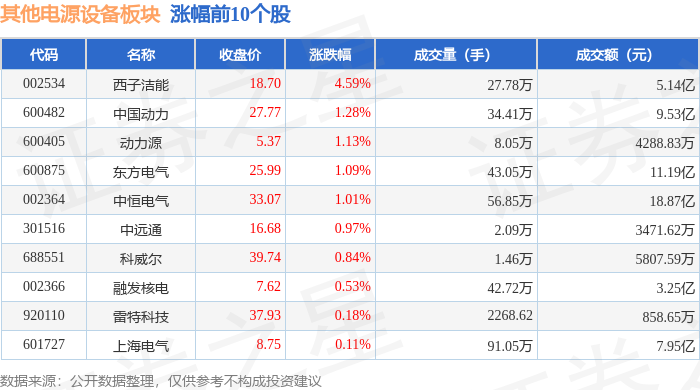
Market Overview - The other power equipment sector experienced a decline of 0.43% on February 4, with Kehua Data leading the drop [1] - The Shanghai Composite Index closed at 4102.2, up 0.85%, while the Shenzhen Component Index closed at 14156.27, up 0.21% [1] Stock Performance - Xizi Clean Energy (002534) saw a closing price of 18.70, with an increase of 4.59% and a trading volume of 277,800 shares, amounting to a transaction value of 514 million [1] - China Power (600482) closed at 27.77, up 1.28%, with a trading volume of 344,100 shares and a transaction value of 953 million [1] - Dongfang Electric (600875) closed at 25.99, up 1.09%, with a trading volume of 430,500 shares and a transaction value of 1.119 billion [1] - Kehua Data (002335) experienced a significant drop of 4.79%, closing at 58.86, with a trading volume of 295,600 shares [2] Capital Flow - The other power equipment sector saw a net outflow of 877 million from institutional investors, while retail investors had a net inflow of 589 million [2] - The sector's overall capital flow indicates a mixed sentiment, with institutional investors pulling back while retail investors increased their positions [2] Individual Stock Capital Flow - Dongfang Electric (600875) had a net inflow of 21.27 million from institutional investors, but a net outflow of 17.43 million from retail investors [3] - Keda Technology (300820) experienced a net inflow of 38.32 million from institutional investors, while retail investors saw a net outflow of 51.47 million [3] - The capital flow data suggests varying levels of confidence among different investor types within the sector [3]