
SUNWODA(300207)

Search documents
动力电池二线厂商求解“活下去”
经济观察报· 2025-07-25 11:34
Core Viewpoint - The lithium battery industry is experiencing intense price competition, leading to a significant decline in profitability across the sector, with the average price of square lithium iron phosphate power cells dropping to 0.32 yuan/Wh [1][6]. Industry Overview - The market is dominated by a few key players, with CATL and BYD holding over 65% market share as of June 2025, while other companies like Contemporary Amperex Technology Co., Ltd. (CATL), Guoxuan High-Tech, and others make up the "second tier" with individual shares between 2% and 8% [3][4]. - The second-tier companies are facing widespread profitability challenges, with companies like XINWANDA reporting a net loss of 1.587 billion yuan in their battery business for 2024 [4][9]. Price Competition and Market Dynamics - The price war has led to a situation where 65 out of 104 listed lithium battery companies in A-shares reported a decline in net profits in 2024, with over 60 companies experiencing a drop in gross margins [6][8]. - The average global lithium battery pack price fell to a historical low of $115/kWh in 2025, with China's price at $94/kWh, the lowest globally [6]. Technological and Structural Challenges - The industry is facing structural challenges due to rapid changes in mainstream technology routes, with lithium iron phosphate battery installations increasing by 73% year-on-year, capturing over 81% of the market share, while ternary batteries saw a 10.8% decline [8][9]. - The profitability of leading companies like CATL serves as a benchmark for others, with CATL achieving a net profit of 50.745 billion yuan in 2024, despite the price war [9]. Cost Control Strategies - Companies are focusing on cost control as a primary strategy for survival, with significant emphasis on manufacturing efficiency, design cost reduction, and management optimization [13][14]. - For instance, Bee Nest Energy aims to achieve profitability by 2026, with 80% of the contribution expected from cost reductions [14]. Differentiation and Market Positioning - To break through the competitive landscape, companies are exploring differentiated technology routes, with Bee Nest Energy pursuing a dual strategy of both ternary and lithium iron phosphate batteries [18][20]. - The demand for higher energy density products in specific markets, such as overseas high-end clients, is driving this strategic choice [19][20]. Capital Investment and Future Outlook - Continuous and substantial capital investment is necessary for both cost reduction and differentiation strategies, with companies like Yiyuan Lithium Energy and XINWANDA planning to tap into capital markets for funding [21]. - The competitive landscape is expected to evolve, with companies needing long-term patience and commitment to navigate the challenges of the trillion-dollar market [22].







动力电池二线厂商求解“活下去”
Jing Ji Guan Cha Bao· 2025-07-25 06:05
Core Insights - The core theme of the article revolves around the challenges faced by the battery industry, particularly the price wars and profitability issues that have become prevalent in 2024, impacting companies like蜂巢能源 and others in the second tier of the market [2][3]. Industry Overview - The global battery market is dominated by 宁德时代 and 比亚迪, which together hold over 65% market share, while other companies like 中创新航, 国轩高科, and 蜂巢能源 occupy a smaller share of 2% to 8% each [2]. - The second-tier companies have faced significant profitability challenges in 2024, with companies like 欣旺达 reporting a net loss of 1.587 billion yuan in their battery business [3]. Pricing and Market Dynamics - The price of lithium batteries has reached historical lows, with the average price of square lithium iron phosphate cells dropping to 0.32 yuan/Wh, and global lithium battery pack prices falling to 115 USD/kWh, with China's price at 94 USD/kWh [4][5]. - The market is experiencing overcapacity and homogenization, leading to a decline in profit margins for many companies, with 65 out of 104 listed lithium battery companies in A-shares reporting a drop in net profits in 2024 [5]. Profitability and Cost Control - 宁德时代 remains a benchmark for profitability, achieving a net profit of 50.745 billion yuan in 2024, while second-tier companies struggle with losses and rising debt levels [6]. - 蜂巢能源's CEO emphasizes that 80% of future profitability will come from cost reductions, with a target to achieve profitability by 2026 [9]. Strategic Responses - Companies are focusing on cost control strategies, including improving production efficiency and reducing material costs. 蜂巢能源 has reported a first-pass yield exceeding 90% and a 28% reduction in scrap rates [9]. - Differentiation through technology is also a key strategy, with 蜂巢能源 pursuing a dual strategy of both三元 and iron-lithium batteries to capture higher margins and meet specific market demands [10][11]. Market Trends and Future Outlook - The demand for三元 batteries is expected to grow due to their higher energy density, particularly in hybrid and plug-in hybrid vehicles, while the market for磷酸铁锂 batteries is becoming increasingly competitive [11]. - 蜂巢能源 has successfully supplied over 100,000 battery packs to international clients, indicating a growing presence in overseas markets [12]. - The need for continuous capital investment is critical for second-tier companies to sustain their operations and pursue strategic initiatives, with many seeking to tap into capital markets for funding [13].
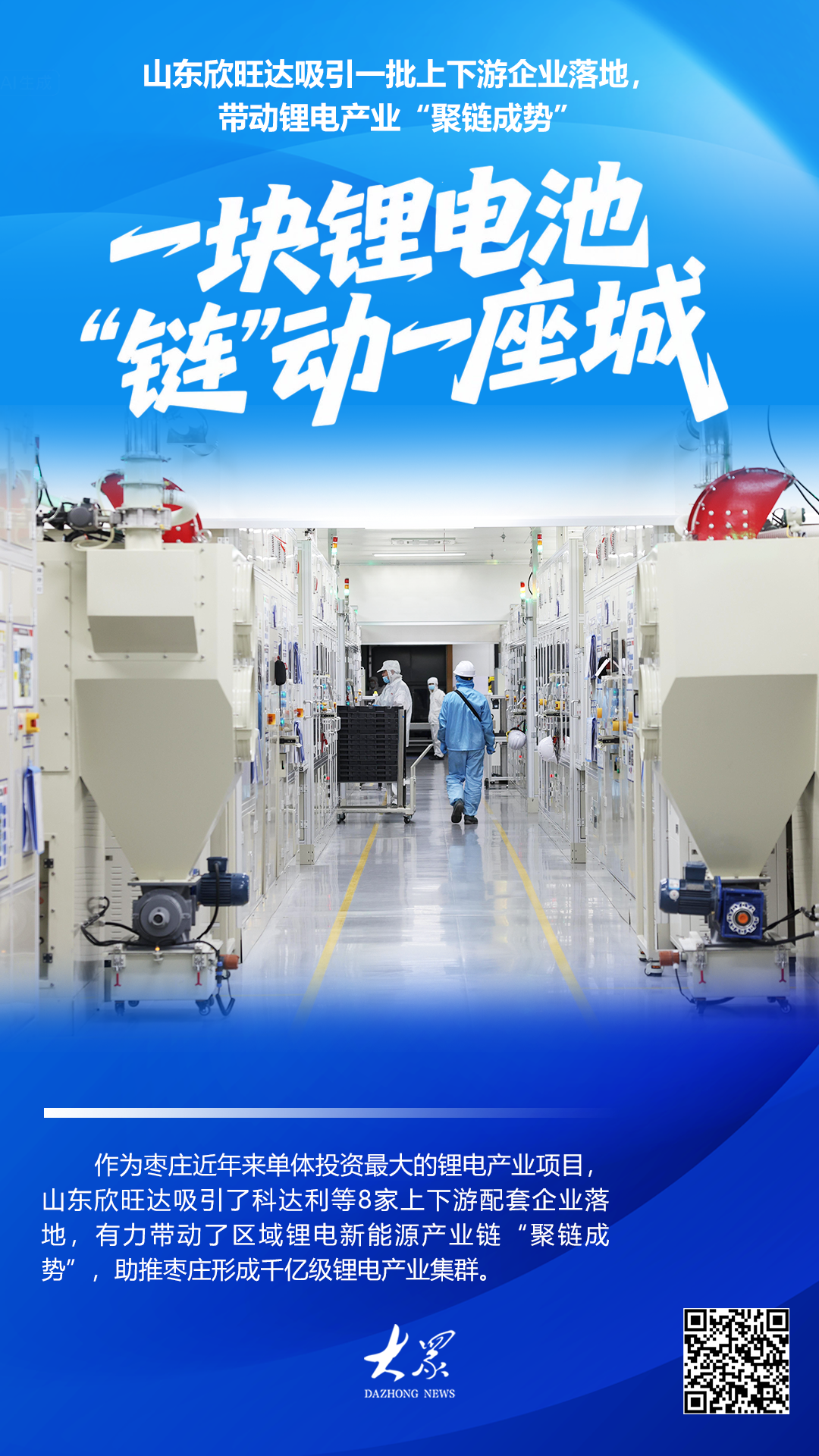
山东欣旺达:一块锂电池,“链”动一座城
Da Zhong Ri Bao· 2025-07-24 22:49
Core Viewpoint - The article highlights the significant advancements and achievements of Shandong Xinwanda New Energy Co., Ltd. in the lithium battery industry, showcasing its role as a "chain master" that attracts upstream and downstream enterprises, thereby enhancing the regional lithium battery industrial chain in Zaozhuang [3][7][9]. Group 1: Company Achievements - Shandong Xinwanda has implemented intelligent upgrades in its production processes, achieving a 95% automation rate in key equipment, a 15% increase in single-line production efficiency, a 20% reduction in product defect rates, and a 28% decrease in overall energy consumption [3][5]. - The company has invested a total of 20 billion yuan in its project, which spans 1,307 acres and is being developed in three phases, with six production lines already completed [5]. - Over the past five years, Shandong Xinwanda has invested more than 13 billion yuan in research and development, focusing on technological innovations that enhance battery performance and safety [5][9]. Group 2: Industry Impact - The establishment of Shandong Xinwanda has attracted eight upstream and downstream supporting enterprises, significantly contributing to the formation of a 100 billion yuan lithium battery industrial cluster in Zaozhuang [7]. - The region now hosts 278 enterprises in the lithium battery sector, with production capacities including 160,000 tons of positive materials, 60,000 tons of negative materials, 260,000 tons of electrolytes, 2.1 billion square meters of separators, and 32 GWh of battery cells [7]. - Recent discussions among leading companies in the industry have focused on addressing key technical standards and quality management issues, aiming to enhance collaboration and resolve bottlenecks in the supply chain [8].
四川德阳这一企业实现储能产业飞跃式发展
Ke Ji Ri Bao· 2025-07-24 13:34
Group 1 - The core viewpoint of the article highlights the rapid growth and development of Deyang XWDA New Energy Co., Ltd., a subsidiary of XWDA Electronics, which has achieved a remarkable output value of 1.29 billion yuan, representing a year-on-year increase of 221% by the first half of 2025 [1][3] - Deyang XWDA's establishment in the Shifang Economic Development Zone in 2022 is part of a larger strategy to capitalize on the booming lithium-ion battery industry and the increasing demand for energy storage [1][3] - The company benefits from favorable conditions including national development trends, regional advantages in Sichuan, and strong government support, which collectively contribute to its rapid growth [3] Group 2 - A key production line being developed by Deyang XWDA in collaboration with leading energy storage integrators is expected to reshape the industry landscape by producing the largest energy storage products currently available [3] - This production line aims to set a benchmark for the next generation of energy storage products, primarily for applications in energy storage containers [3] - The company is currently in the process of testing this production line, with plans to complete validation within the year, laying the groundwork for future capacity release [3]
欣旺达(300207) - 2025年第三次临时股东大会决议公告
2025-07-24 11:32
证券代码:300207 证券简称:欣旺达 公告编号:<欣>2025-056 欣旺达电子股份有限公司 2025 年第三次临时股东大会决议公告 本公司及董事会全体成员保证信息披露内容的真实、准确和完整,没有 虚假记载、误导性陈述或重大遗漏。 特别提示: 一、会议召开和出席情况 欣旺达电子股份有限公司(以下简称"公司"或"欣旺达")于 2025 年 7 月 24 日在公司会议室召开 2025 年第三次临时股东大会。 出席本次股东大会现场会议的股东及股东授权委托的代理人共 8 名,所持有 公司有表决权的股份数为 497,396,486 股,占公司股份总数 1,845,806,346 股的 26.9474%。参加网络投票的股东人数为 1,158 名,代表有表决权的股份为 215,438,640 股,占公司股份总数 1,845,806,346 股的 11.6718%。合计有表决权 的股份数为 712,835,126 股,占公司股份总数 1,845,806,346 股的 38.6192%。 其中中小投资者(除公司的董事、监事、高级管理人员及单独或合计持有公司股 份 5%以外的其他股东)1,161 人,代表有表决权的股份 2 ...
欣旺达(300207) - 广东信达律师事务所关于欣旺达电子股份有限公司2025年第三次临时股东大会的法律意见书
2025-07-24 11:32
股东大会法律意见书 中国 深圳 福田区益田路 6001 号太平金融大厦 11、12 楼 邮政编码:518038 电话:(86 755)88265288 传真:(86 755)88265537 电子邮件:info@sundiallawfirm.com 网址:www.sundiallawfirm.com 广东信达律师事务所 关于欣旺达电子股份有限公司 2025 年第三次临时股东大会的法律意见书 信达会字[2025]第 227 号 致:欣旺达电子股份有限公司 广东信达律师事务所(下称"信达")接受欣旺达电子股份有限公司(下称 "欣旺达"或"公司")的委托,指派信达律师出席欣旺达 2025 年第三次临时股 东大会(下称"本次股东大会"),对欣旺达本次股东大会的合法性进行见证,并 出具本《广东信达律师事务所关于欣旺达电子股份有限公司 2025 年第三次临时 股东大会的法律意见书》(下称"本法律意见书")。 本法律意见书系根据《中华人民共和国公司法》(下称"《公司法》")、《上市 公司股东大会规则》(下称"《股东大会规则》")等法律、法规、规范性文件以及 现行有效的《欣旺达电子股份有限公司章程》(下称"《公司章程》")的 ...
欣旺达(300207.SZ)计划赴港上市,能否带动A股股价上涨?
Sou Hu Cai Jing· 2025-07-24 10:23
Group 1 - The core viewpoint is that the planned Hong Kong listing of XWANDA (300207.SZ) may have a potential positive impact on A-share prices, but it requires careful consideration of valuation restructuring, capital flow, fundamental support, and market sentiment [2][3] Group 2 Potential Positive Factors for A-share Price - Valuation restructuring and price comparison effect: The premium in the Hong Kong market may influence A-shares, as institutional investors focus on long-term value. If XWANDA achieves a high valuation in Hong Kong, it could lead to a re-evaluation of A-share valuations [2] - Current low valuation of A-shares: XWANDA's current PE ratio for 2025 is 17 times, lower than industry leader CATL's over 25 times, indicating that the A-share market may undervalue its global potential and technological reserves [2] - Strengthening fundamentals through financing: The planned issuance of up to 15% of total shares in Hong Kong aims to raise funds for overseas capacity construction and solid-state battery R&D, which could alleviate cash flow pressure and support market confidence [2] - Anticipation of incremental capital inflow: The Hong Kong listing may attract international long-term capital, which could lead to increased inflow into A-shares through the "A+H" arbitrage mechanism [2] - Short-term market sentiment catalyst: Recent policies and rising lithium carbonate prices have boosted sentiment in the battery sector, and XWANDA's IPO progress and solid-state battery R&D may serve as short-term speculative themes [2] Group 3 Risks to A-share Price Increase - Profit pressure reducing valuation elasticity: XWANDA's Q1 2025 net profit margin is only 3.14%, with losses in the power battery business, which may negatively impact A-share performance if the Hong Kong listing underperforms [2] - Urgency of technological catch-up: The company is lagging behind leading firms in solid-state battery production, and if technological progress does not meet expectations post-listing, it may lead to a simultaneous valuation decline in both markets [2] - Concerns over liquidity diversion: Some investors may sell A-shares to invest in H-shares, especially if the H-share offering price is low, potentially exerting downward pressure on A-shares [2] Group 4 Overall Outlook - The Hong Kong listing of XWANDA is seen as a catalyst for A-share price increases but not a decisive factor. Short-term sentiment and valuation recovery are expected, but long-term linkage depends on technological breakthroughs and profit improvements [3] - Short-term (1-3 months): The progress of the Hong Kong listing may stimulate A-share increases, but caution is advised regarding potential pullbacks after positive news [4] - Long-term: The linkage effect will depend on the realization of fundamental factors and the convergence of valuation differences. If the H-shares maintain a premium, A-shares could see a recovery of over 30% [4]
宝安“五虎上将”跻身《财富》中国500强
Nan Fang Du Shi Bao· 2025-07-23 23:08
Core Insights - The annual Fortune China 500 list reveals a shift in competition among top companies from scale to "value" amidst a macroeconomic backdrop seeking new balance, with total revenue slightly adjusted and total profit rising [2] Group 1: Company Performance - SF Express ranked 93rd, leading the Bao'an group, with a remarkable financial performance, achieving a net profit exceeding 10.17 billion yuan for the first time [3] - Luxshare Precision ranked 103rd, transitioning from consumer electronics to the smart automotive sector, with a 50% year-on-year growth in automotive interconnect products [3] - Aoxin Energy, ranked 299th, saw a 107% surge in energy storage system installations, establishing itself as a significant player in the energy storage sector [4] - Grinmei, ranked 411th, is a leader in the global supply of ternary precursor materials for power batteries, converting waste batteries into key materials for electric vehicles [4] - Pengding Holdings, maintaining its position as the largest PCB manufacturer globally, ranked 397th, showcasing steady growth and solidifying its role in high-end manufacturing [4] Group 2: Regional Development - Bao'an's industrial land preparation ranked first in the city over the past three years, supplying 31 plots totaling 934,000 square meters, supporting 35 key enterprises and potentially increasing output by over 200 billion yuan [6] - The "industrial building up" model has opened new avenues for industrial development, enhancing land utilization efficiency [6] - Bao'an has developed a highly collaborative industrial ecosystem in electronics, intelligent equipment, and new materials, enabling efficient manufacturing processes within a one-hour production circle [7] - The district has implemented a "three ones" enterprise service system, achieving a 98.4% completion rate for 2,563 collected enterprise requests and facilitating approximately 47.43 billion yuan in financing [7][8]




2025年H1储能电池市场盘点:上半年出货258GWh,同比增长106%
鑫椤锂电· 2025-07-23 07:04
Core Viewpoint - The global energy storage battery market is experiencing significant growth, with a projected shipment of 258 GWh in the first half of 2025, representing a year-on-year increase of 106% [1]. Group 1: Market Overview - Domestic manufacturers are expected to ship 252 GWh, showing a year-on-year growth of 109%, while overseas manufacturers are projected to ship 6 GWh, with a growth rate of 42.5% [1]. - Leading players such as Hicharge Energy, BYD, and China Innovation Aviation are seeing rapid growth, with their shipment volumes nearing 90% of last year's total in the first half of the year [1]. Group 2: Competitive Landscape - The market is characterized by a dominance of CATL, with strong competition from companies like EVE Energy, Hicharge Energy, and BYD [3]. - Major companies are increasingly adopting integrated development strategies, with a growing share of self-owned energy storage systems, particularly BYD [3]. Group 3: Emerging Markets - Significant acceleration in the delivery of large-scale energy storage projects in emerging markets is noted, including projects like BYD's 12.5 GWh in the Middle East and collaborations in Chile [4]. - Traditional markets are influenced by regulatory changes, such as China's 136 document leading to an early rush for installations, and the U.S. experiencing stockpiling due to the IRA Act [4]. Group 4: User Side Developments - The commercial sector in China is primarily focused on profit from peak-valley price differences, but recent policy changes have led to a cautious market sentiment [6]. - New commercial scenarios, such as solar-storage charging and data centers, are witnessing rapid growth despite traditional market challenges [6]. Group 5: Policy Support in Europe - European commercial and residential storage markets are benefiting from substantial subsidy policies, with the Netherlands allocating €100 million for battery storage projects [7]. - Belgium offers a 40% tax deduction for investments in solar and storage systems, the highest in its history, while Greece's subsidy program supports up to 50% for businesses installing storage systems [8].


电力设备新能源行业点评:固态产业应用加速推进,关注低空经济博览会进展
Guoxin Securities· 2025-07-22 05:23
Investment Rating - The investment rating for the electric equipment and new energy industry is "Outperform the Market" (maintained) [2][6]. Core Viewpoints - The solid-state battery industry is accelerating its development, with several companies planning to launch new products in the coming years. Notable advancements include: 1. XWANDA plans to launch its first-generation all-solid-state battery by 2026, with small-scale production already achieved for products with energy densities of 320Wh/kg and 360Wh/kg [3]. 2. Honeycomb Energy aims to mass-produce its first-generation semi-solid battery with an energy density of 300Wh/kg by 2025 [3]. 3. A new model from SAIC MG, the MG4, is expected to be priced around 100,000 RMB and will feature a semi-solid battery solution [4]. - The 2025 International Low Altitude Economy Expo will take place from July 23 to 26 in Shanghai, showcasing advancements in power systems and industry layouts [5]. Summary by Sections Industry Development - The solid-state battery sector is experiencing rapid advancements, with key players like XWANDA and Honeycomb Energy making significant progress in product development and production timelines [3][4]. - The MG4 model from SAIC is set to utilize a semi-solid battery, indicating a shift towards more efficient battery technologies in the automotive sector [4]. Company Insights - XWANDA has confirmed its plans for future solid-state battery products, building on a decade of experience in the field [4]. - Honeycomb Energy is also progressing with its semi-solid battery technology, targeting higher energy densities in upcoming models [4]. - A total of 400Wh/kg energy density is anticipated for the first-generation sulfide solid-state battery from Funeng Technology, which has established partnerships with major automotive and technology companies [5]. Market Opportunities - Investment suggestions include focusing on core incremental segments of solid-state batteries, such as equipment and lithium sulfide, as well as the short-term impact of semi-solid applications on the supply chain [3]. - Companies like Xiamen Tungsten and Haopeng Technology are highlighted as potential investment opportunities due to their involvement in the solid-state battery supply chain [8].


