NATA OPTO-ELECT(300346)

Search documents
光刻胶概念上涨2.48%,6股主力资金净流入超亿元
Zheng Quan Shi Bao Wang· 2025-12-01 09:05
Core Viewpoint - The photoresist sector has shown a notable increase of 2.48%, ranking as the 9th highest among concept sectors, with significant contributions from several stocks experiencing substantial gains [1][2]. Group 1: Stock Performance - A total of 57 stocks within the photoresist sector saw an increase, with Huarong Chemical hitting the daily limit up of 20% [1]. - Leading gainers included Rongda Photoelectric, Nanda Optoelectronics, and Tongcheng New Materials, which rose by 17.86%, 8.84%, and 7.70% respectively [1]. - Conversely, stocks such as Huasoft Technology, Anda Intelligent, and Jushi Chemical faced declines of 10.01%, 5.79%, and 5.02% respectively [1]. Group 2: Capital Flow - The photoresist sector attracted a net inflow of 2.199 billion yuan, with 46 stocks receiving net inflows, and 6 stocks exceeding 100 million yuan in net inflow [2]. - Rongda Photoelectric led the sector with a net inflow of 467 million yuan, followed by Guofeng New Materials and Nanda Optoelectronics with net inflows of 295 million yuan and 247 million yuan respectively [2]. - In terms of net inflow ratios, Xinyi Co., Guofeng New Materials, and Rongda Photoelectric had the highest ratios at 28.95%, 17.73%, and 17.43% respectively [3].




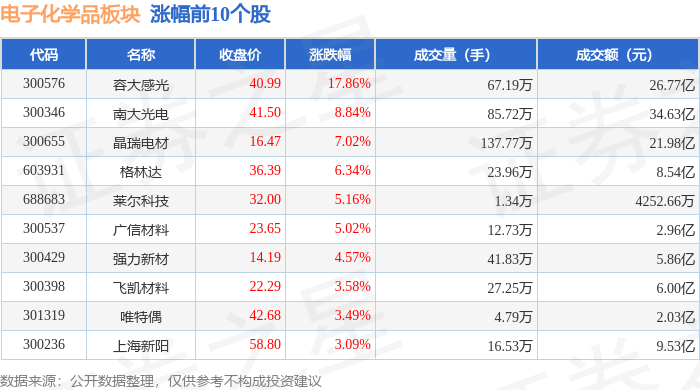
电子化学品板块12月1日涨2.55%,容大感光领涨,主力资金净流入12.09亿元
Zheng Xing Xing Ye Ri Bao· 2025-12-01 09:03
Core Insights - The electronic chemicals sector experienced a 2.55% increase on December 1, with Rongda Photoelectric leading the gains [1] - The Shanghai Composite Index closed at 3914.01, up 0.65%, while the Shenzhen Component Index closed at 13146.72, up 1.25% [1] Stock Performance - Rongda Photoelectric (300576) closed at 40.99, up 17.86%, with a trading volume of 671,900 shares and a transaction value of 2.677 billion [1] - Nanda Optoelectronics (300346) closed at 41.50, up 8.84%, with a trading volume of 857,200 shares and a transaction value of 3.463 billion [1] - Jingrui Electric Materials (300655) closed at 16.47, up 7.02%, with a trading volume of 1,377,700 shares and a transaction value of 2.198 billion [1] - Other notable performers include Grinda (603931) up 6.34% and Lier Technology (688683) up 5.16% [1] Capital Flow - The electronic chemicals sector saw a net inflow of 1.209 billion from institutional investors, while retail investors experienced a net outflow of 755 million [2][3] - Major stocks like Rongda Photoelectric and Nanda Optoelectronics attracted significant institutional investment, with net inflows of 465 million and 255 million respectively [3]


光刻机概念午后崛起 华融化学20%涨停 容大感光等大涨
Zheng Quan Shi Bao Wang· 2025-12-01 07:35
Core Viewpoint - The domestic photolithography machine sector is experiencing significant growth potential, driven by increasing localization efforts and technological advancements in China [1]. Industry Summary - The photolithography machine concept stocks surged, with Huaron Chemical hitting a 20% limit up and other companies like Rongda Photosensitive and Xingye Shares also seeing substantial gains [1]. - According to research from Toubao Institute, the localization rate of photolithography machines in China was less than 1% in 2022, marking it as the segment with the lowest localization among semiconductor equipment [1]. - Under the support of the 02 Special Project and policy guidance, domestic companies in the photolithography machine and component sectors are making continuous progress [1]. Company Summary - In 2016, Shanghai Microelectronics shipped the 90nm ArF photolithography machine SSA600 series, marking a significant milestone in the commercialization of domestic photolithography machines [1]. - In 2020, Huazhuo Precision Technology achieved mass production of a dual-workpiece stage, breaking ASML's long-standing monopoly in this area [1]. - By 2025, Harbin Institute of Technology announced the successful development of a 13.5nm wavelength EUV light source, while the Shanghai Institute of Optics and Fine Mechanics of the Chinese Academy of Sciences achieved breakthroughs in all-solid-state deep ultraviolet light sources, advancing domestic chip process verification capabilities to the theoretical limit of 3nm [1].
光刻机概念异动拉升
Di Yi Cai Jing· 2025-12-01 07:12
Core Viewpoint - The stock prices of several companies in the optical materials sector have experienced significant increases, indicating a positive market sentiment towards these companies [1] Group 1: Company Performance - Rongda Photoelectric (容大感光) saw its stock price rise by over 15% [1] - Guofeng New Materials (国风新材) previously reached its daily limit increase [1] - Other companies such as Nanda Optoelectronics (南大光电), Jinhua New Materials (锦华新材), Gaomeng New Materials (高盟新材), Tongcheng New Materials (彤程新材), and Xingye Co. (兴业股份) also experienced rapid price increases [1]


特斯拉AI5芯片即将完成流片,芯片ETF天弘(159310)跟踪指数冲击6连涨,电子ETF(159997)近10日“吸金”超1800万元
Sou Hu Cai Jing· 2025-12-01 06:16
Group 1: Chip ETF Performance - The Chip ETF Tianhong (159310) has seen a trading volume of 7.4652 million yuan as of December 1, 2025, with the underlying index, the CSI Chip Industry Index (H30007), rising by 1.33%, marking six consecutive days of gains [1] - Over the past week, the Chip ETF Tianhong (159310) has experienced a significant growth of 47.2038 million yuan, and in the last month, it has increased by 2.3 million units [1] - Notable constituent stocks include Beijing Junzheng (300223) up by 14.84%, Huazhong Microelectronics (688396) up by 8.40%, and Nanda Optoelectronics (300346) up by 6.92% [1] Group 2: Electronic ETF Performance - The Electronic ETF (159997) has recorded a trading volume of 28.8619 million yuan, with the CSI Electronic Index (930652) rising by 1.06% [2] - In the last 20 trading days, the Electronic ETF (159997) has attracted a total of 18.2196 million yuan in net inflows over six days [2] - Key stocks in this ETF include Beijing Junzheng (300223) up by 14.84%, Pengding Holdings (002938) up by 9.97%, and Transsion Holdings (688036) up by 8.42% [2] Group 3: Product Highlights - The Chip ETF Tianhong (159310) tracks the CSI Chip Industry Index, reflecting the overall performance of listed companies in the chip industry, providing exposure to core assets in China's "chip" era [3] - The Electronic ETF (159997) passively tracks the CSI Electronic Index, focusing on semiconductor and consumer electronics sectors, including AI chips, automotive electronics, 5G, cloud computing, and printed circuit boards (PCB) [3] Group 4: Recent Events - ByteDance's Doubao team released a technical preview of the Doubao Mobile Assistant on December 1, which is an AI assistant software developed in collaboration with mobile manufacturers [6] - Tesla's CEO Elon Musk announced that the AI5 chip is entering the tape-out phase, with the AI6 chip's early development already underway, aiming for annual production of new AI chips [7] - Dongguan Securities highlighted that AI will continue to drive innovation in the tech sector, with opportunities in semiconductor hardware and domestic substitution processes in computing power, storage, and equipment [7]





A股光刻胶板块拉升,容大感光涨超16%,南大光电涨超9%
Ge Long Hui· 2025-12-01 06:14
Core Viewpoint - The A-share market's photoresist sector experienced a significant surge due to related rumors, indicating heightened investor interest and potential market movements in this industry [1] Company Summaries - Rongda Photoelectric saw its stock price increase by over 16% [1] - Guofeng New Materials and Xingye Co. both hit the 10% daily limit up [1] - Nanda Optoelectronics' stock rose by more than 9% [1] - Other companies such as Tongcheng New Materials, Jiaxian Co., Glinda, Aerospace Zhiguang, Gaomeng New Materials, and Jingsai Technology all experienced stock increases of over 6% [1] - Wavelength Optoelectronics, New Lai Materials, and Woge Optoelectronics saw their stock prices rise by over 5% [1]


突发!昨夜11家上市公司披露减持计划,7家拟减持超1%,包括石油,电子龙头
Sou Hu Cai Jing· 2025-11-29 03:15
Market Overview - The A-share market experienced a volatile session, with the ChiNext Index initially rising by 2.21% before a significant drop in the afternoon, leading to both the ChiNext and Shenzhen Composite Index closing in the red [1] - A total of 11 companies announced shareholder reduction plans, with 7 planning to reduce their holdings by more than 1% [1] Shareholder Reduction Trends - Notable companies involved in the reduction include Zhongman Petroleum and Yidelong, both of which have seen significant stock price increases recently [1] - Yidelong's stock price rebounded from a low of 12.38 yuan to a high of 56.30 yuan, marking a maximum increase of 355%. A major shareholder plans to reduce 3.2 million shares, accounting for 2% of total shares, expecting to cash out approximately 116 million yuan [2] - Zhongman Petroleum's stock price increased from 5.83 yuan to 26.66 yuan over five years, a maximum increase of 357%. However, the company reported a 32.18% decline in net profit for Q3, prompting shareholders to plan a reduction of up to 13.87 million shares, or 3% of total shares, with an expected cash-out of 323 million yuan [3] Broader Market Implications - The trend of shareholder reductions is not isolated, with significant reductions totaling over 380 billion yuan in the first eight months of 2025, and a 62% year-on-year increase in the first two weeks of August alone [3] - The primary drivers of these reductions are not retail investors but rather company insiders, with controlling shareholders and actual controllers accounting for 40.3% of the reductions [3] - Sectors with the highest reduction activity include electronics, pharmaceuticals, and new materials, which collectively account for over 42% of the reductions [3] Sector-Specific Insights - In the technology sector, 106 companies announced major shareholder reduction plans since September, with the electronics industry being the most affected [5] - Notable examples include Lanke Technology, where shareholders announced a reduction of 11.45 million shares, potentially cashing out around 3.29 billion yuan after a 75.18% increase in stock price [5] - Other companies like Zhongji Xuchuang and Anda Intelligent also saw significant shareholder reductions despite their stock price increases, indicating a trend of insiders cashing out at high valuations [5][7] Market Behavior and Patterns - Historical data indicates that stock prices tend to drop following shareholder reduction announcements, with a probability exceeding 50% for declines shortly after such announcements [9] - The timing of reductions shows a clear seasonal pattern, with the highest number of reductions occurring in December, followed by September and November [9] - Venture capital firms have also become significant players in this reduction wave, with over 80 companies involved since August, collectively cashing out over 10 billion yuan [11]





重磅!100大新材料国产替代研究报告(附100+行研报告)
材料汇· 2025-11-28 16:01
Core Insights - The article emphasizes the strategic importance of new materials in the context of global technological competition and industrial chain restructuring, highlighting the need for domestic innovation to reduce reliance on foreign technologies [2][4]. Semiconductor Wafer Manufacturing Materials - The global photoresist market is projected to reach approximately $15 billion by 2030, with a current domestic market size of about 12 billion RMB, indicating significant growth potential [7]. - The domestic photoresist localization rate is around 10%, with high-end products heavily reliant on imports [7]. - Major foreign players in the photoresist market include Tokyo Ohka Kogyo, Dow Chemical, and Sumitomo Chemical, which dominate the market shares [8]. - Domestic companies such as Beijing Kehua and Suzhou Ruihong are making strides in production, but high-end products still face challenges [9]. Advanced Packaging Materials - The global market for high-performance epoxy encapsulants is expected to grow to $3.5 billion by 2030, with a current domestic market size of 4 billion RMB [39]. - The localization rate for epoxy encapsulants is around 30%, with high-end products still dependent on imports [39]. - Key foreign companies include Sumitomo Bakelite and Henkel, while domestic players include Hengshuo Huawai and Jiangsu Zhongpeng New Materials [40]. Semiconductor Components - The global market for electrostatic chucks is projected to reach $2.5 billion by 2030, with a current domestic market size of 2 billion RMB [56]. - The localization rate for electrostatic chucks is approximately 10%, with high-end products largely dominated by foreign manufacturers [56]. - Major foreign companies include Applied Materials and Lam Research, while domestic companies are beginning to emerge [57]. Display Materials - The global OLED materials market is expected to exceed $10 billion by 2030, with a current domestic market size of about 8 billion RMB [64]. - The localization rate for OLED materials is around 20%, with high-end materials still reliant on foreign sources [65].




卡脖子:中国哪些新材料高度依赖日本进口及国外进口?





材料汇· 2025-11-24 15:58
Core Viewpoint - The article highlights the significant dependency of China's high-end manufacturing on Japan for critical strategic new materials, particularly in the semiconductor and advanced manufacturing sectors, emphasizing the risks posed by geopolitical tensions and supply chain vulnerabilities [2][4]. Group 1: Dependency on Japanese Core New Materials - Japan holds a monopolistic position in semiconductor materials, high-end polymers, and electronic chemicals, with China's dependency exceeding 50% in several key categories, and nearly 100% in some high-end areas [4][6]. - The complexity of semiconductor manufacturing processes means that Japan dominates the supply of critical materials like photoresists and silicon wafers, with global market shares consistently above 60% [6][9]. Group 2: Semiconductor Core Materials - **Photoresists**: China has an overall import dependency of about 90%, with high-end photoresists being 100% reliant on Japan. Major suppliers include JSR, Tokyo Ohka, Shin-Etsu Chemical, and Fujifilm, which control 92% of the high-end market [7]. - **12-inch Silicon Wafers**: The import dependency is around 90%, with Japan supplying 58%. Key players like Shin-Etsu Chemical and SUMCO dominate over 60% of the market [9]. - **High-Purity Ruthenium Targets**: The import dependency is 98%, with Japan's JX Metals and TOSOH holding a significant market share. Domestic production is limited to lower purity levels [12]. Group 3: High-End Polymer Materials - Japan leads the high-end market for electronic-grade polyimide films, with an import dependency of 85% for overall polyimide materials, and 90% for high-end applications [19]. - **Optical-grade PET Films**: The import dependency is 75%, with Japan supplying 100% of high-end films used in MLCCs [23]. Group 4: Other Key Materials in Electronics - **Sputtering Targets**: The import dependency is approximately 95%, with Japan's JX Metals and Nippon Mining controlling 60% of the market [27]. - **High-Purity Electronic Gases**: The import dependency is 70%, with Japan's Taiyo Nippon Sanso holding a 40% market share [31]. Group 5: Hydrogen Energy and Fuel Cell Key Materials - **High-End Carbon Carrier Materials**: The overall import dependency is 85%, with Japan's TOSOH dominating the market [35]. - **Fuel Cell Platinum-based Catalysts**: The import dependency is 78%, with significant reliance on European suppliers [107]. Group 6: Aerospace and High-End Manufacturing Key Materials - **High-Temperature Alloys**: The import dependency is 90%, with major suppliers from the US and Europe completely dominating the market [80]. - **Carbon Fiber**: The import dependency is 85%, with Japan and the US leading the high-end market [86]. Group 7: New Energy and Electronics Key Materials - **High-End Lithium-Ion Battery Separators**: The import dependency is 70%, with Japan's Asahi Kasei and Toray leading the market [94]. - **Ultra-Thin Copper Foils**: The import dependency is 80%, with Japan's JX Copper and Mitsui Mining dominating the supply [98].

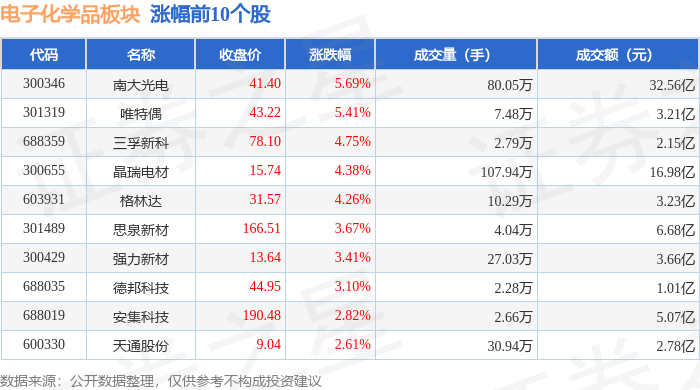
电子化学品板块11月24日涨2.12%,南大光电领涨,主力资金净流入1.86亿元
Zheng Xing Xing Ye Ri Bao· 2025-11-24 09:02
Core Viewpoint - The electronic chemicals sector experienced a 2.12% increase on November 24, with Nanda Optoelectronics leading the gains, while the overall market indices showed modest increases [1]. Group 1: Market Performance - The Shanghai Composite Index closed at 3836.77, up 0.05%, and the Shenzhen Component Index closed at 12585.08, up 0.37% [1]. - The electronic chemicals sector saw significant individual stock movements, with Nanda Optoelectronics closing at 41.40, up 5.69%, and a total trading volume of 800,500 shares [1]. Group 2: Stock Performance - Key stocks in the electronic chemicals sector included: - Nanda Optoelectronics (300346): Closed at 41.40, up 5.69%, with a trading volume of 800,500 shares and a turnover of 3.256 billion [1]. - Weiteou (301319): Closed at 43.22, up 5.41%, with a trading volume of 74,800 shares [1]. - Sanhu Xinke (688389): Closed at 78.10, up 4.75%, with a trading volume of 27,900 shares [1]. - Other notable performers included Jingrui Electric Materials (300655) and Green Da (603931), with increases of 4.38% and 4.26%, respectively [1]. Group 3: Fund Flow Analysis - The electronic chemicals sector saw a net inflow of 186 million in main funds, while retail funds experienced a net outflow of approximately 67.99 million [2]. - Main fund inflows were led by Nanda Optoelectronics with a net inflow of 17.7 million, while retail funds showed significant outflows across various stocks [3].