NATA OPTO-ELECT(300346)

Search documents
电子化学品板块1月14日涨1.2%,天承科技领涨,主力资金净流出6.07亿元
Zheng Xing Xing Ye Ri Bao· 2026-01-14 08:50
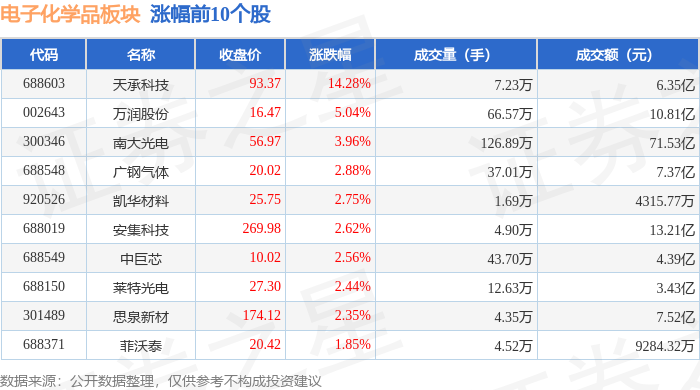
Group 1 - The electronic chemicals sector increased by 1.2% on January 14, with Tiancheng Technology leading the gains [1] - The Shanghai Composite Index closed at 4126.09, down 0.31%, while the Shenzhen Component Index closed at 14248.6, up 0.56% [1] - Key stocks in the electronic chemicals sector showed significant price movements, with Tiancheng Technology rising by 14.28% to a closing price of 93.37 [1] Group 2 - The electronic chemicals sector experienced a net outflow of 607 million yuan from institutional investors, while retail investors saw a net inflow of 674 million yuan [2] - Notable stocks with significant net inflows from retail investors include Wanrun Co., which had a net inflow of 100 million yuan [3] - The overall trading volume and turnover for various stocks in the electronic chemicals sector varied, with Wanrun Co. achieving a turnover of 1.08 billion yuan [1][3]


半导体设备ETF(561980)盘中上涨3.26%!机构:存储周期持续上行,重点关注设备投资机遇
Sou Hu Cai Jing· 2026-01-14 03:50
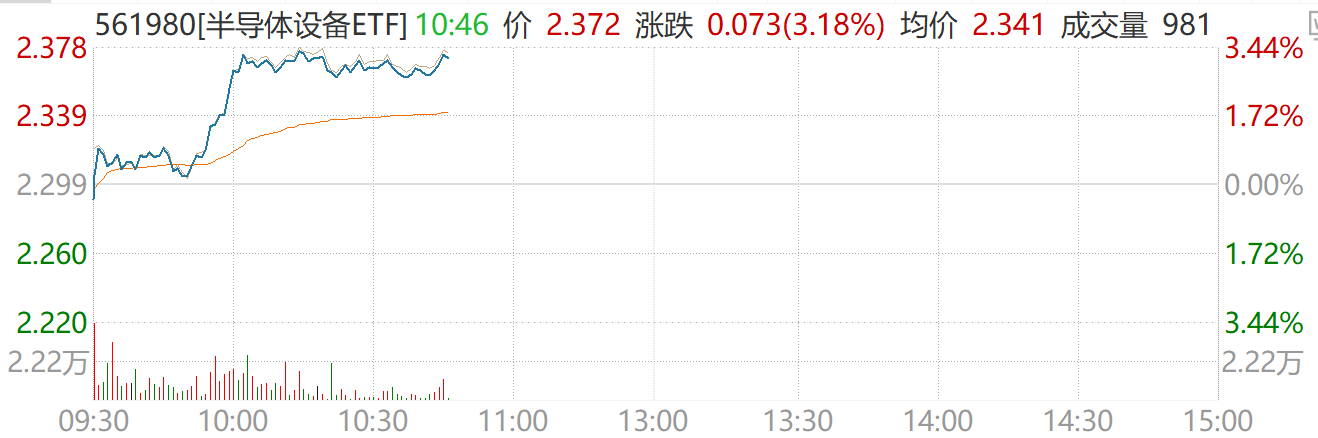
Group 1 - The core viewpoint of the news highlights a resurgence in the storage and semiconductor equipment sectors, driven by a "super cycle" in storage demand, with several storage companies experiencing significant stock price increases [1] - The semiconductor equipment ETF (561980) saw a 3.26% increase, with a trading volume exceeding 1.4 billion yuan, reflecting a recent peak in fund size [1] - The first annual report forecast indicates a substantial net profit growth of 427.19%-520.22% for 2025, boosting market sentiment in the sector [1] Group 2 - From an industry perspective, storage chips represent one of the largest downstream markets in the semiconductor equipment space, with expected price increases for storage products continuing into 2026 [2] - TrendForce forecasts a 55-60% quarter-on-quarter increase in conventional DRAM prices and over 60% for Server DRAM in Q1 2026, alongside a 33-38% increase in NAND Flash prices [4] - The demand for storage is driven by new platforms like NV's Rubin AI, which is expected to significantly increase memory capacity and NAND demand [3] Group 3 - The domestic storage leader is set to receive IPO approval, aiming to raise 29.5 billion yuan for production line upgrades and next-generation technology, which is expected to enhance domestic equipment demand [5] - The localization rate of semiconductor manufacturing equipment in China is currently low, with projections indicating an increase from 25% in 2024 to 30% by 2026 [5] - The semiconductor equipment ETF (561980) focuses on high-tech segments of the semiconductor industry, with a significant concentration in leading companies across various sub-sectors [6]





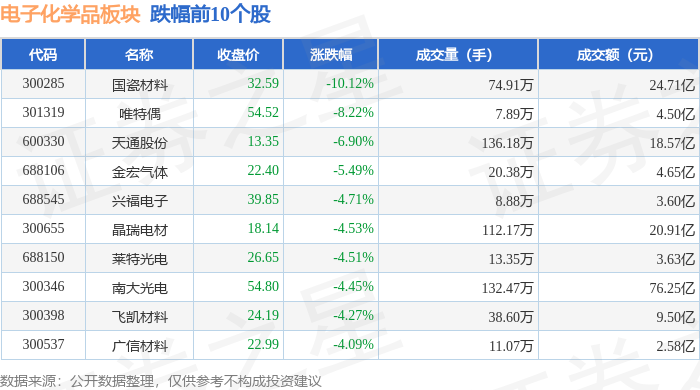
电子化学品板块1月13日跌4.26%,国瓷材料领跌,主力资金净流出23.07亿元
Zheng Xing Xing Ye Ri Bao· 2026-01-13 08:56
Core Viewpoint - The electronic chemicals sector experienced a significant decline of 4.26% on January 13, with Guoci Materials leading the drop [1] Group 1: Market Performance - The Shanghai Composite Index closed at 4138.76, down 0.64%, while the Shenzhen Component Index closed at 14169.4, down 1.37% [1] - Guoci Materials saw a closing price of 32.59, reflecting a decrease of 10.12% with a trading volume of 749,100 shares and a transaction value of 2.471 billion yuan [1] - Other notable declines included Weiteou at -8.22%, Tiantong Co. at -6.90%, and Jinhong Gas at -5.49% [1] Group 2: Capital Flow - The electronic chemicals sector experienced a net outflow of 2.307 billion yuan from institutional investors, while retail investors saw a net inflow of 1.469 billion yuan [1] - Weiteou had a net outflow of 9.3729 million yuan from institutional investors, with a retail net inflow of 35.3413 million yuan [2] - Other companies like Lier Technology and Jianghua Micro reported varying levels of net inflows and outflows, indicating mixed investor sentiment [2]


南大光电深化电子特气业务布局
Zhong Guo Hua Gong Bao· 2026-01-13 03:24
Core Viewpoint - Jiangsu Nanda Optoelectronics Materials Co., Ltd. plans to acquire approximately 16.17% equity in its subsidiary, Nanda Optoelectronics (Ulanqab) Co., Ltd., for a cash consideration of 77.6 million yuan, increasing its ownership from 74.88% to 91.05% [1] Group 1 - The acquisition involves purchasing 13.33% equity held by Suzhou Nansheng No. 3 Enterprise Management Partnership and 2.83% equity held by Suzhou Nansheng No. 4 Enterprise Management Partnership [1] - As of November 30, 2025, the net assets of Ulanqab Nanda are valued at 477.115 million yuan, with the total transaction price set at 77.6 million yuan [1] - This equity acquisition is part of Nanda Optoelectronics' strategic layout for its electronic specialty gas business for 2025 [1] Group 2 - On October 29, 2025, the company announced that it would utilize 92.175 million yuan of unused fundraising for a project to expand the production of 2,000 tons of high-purity electronic-grade nitrogen trifluoride at Ulanqab Nanda [1] - The total investment for this expansion project is approximately 368 million yuan, focusing on 5.5N high-purity product specifications [1] - This project aims to meet the performance enhancement requirements for chips driven by the development of artificial intelligence and the Internet of Things, helping the company to quickly enter the high-end market and open new growth avenues [1]
11月全球半导体销售额创历史新高,半导体设备ETF(561980)连续3日吸金近2亿元
Sou Hu Cai Jing· 2026-01-13 01:44
Group 1 - The semiconductor industry is benefiting from a global upcycle, with significant growth expected through 2026, particularly in semiconductor equipment and materials [1][2] - The Semiconductor Industry Association (SIA) reported that global semiconductor sales reached $75.3 billion in November 2025, marking a 3.5% increase from October and a 29.8% increase year-over-year [1][10] - China's semiconductor sales amounted to $20.23 billion in November 2025, reflecting a year-over-year growth of 22.9% [1][10] Group 2 - The demand for memory products, particularly DRAM and NAND Flash, is on the rise, with contract prices increasing significantly; DRAM contract prices are expected to rise by 55-60% in Q1 2026 [1][7] - Domestic storage testing and packaging factories are experiencing high order volumes, leading to increased capacity utilization and a price hike of approximately 30% [1][2] - The semiconductor materials market is projected to grow to $70 billion globally by 2025, with a 6% year-over-year increase, while China's key materials market is expected to reach 174.1 billion yuan, growing by 21.1% [2][25] Group 3 - The semiconductor equipment ETF (561980) has seen a net inflow of nearly 200 million yuan over the last three trading days, with a one-year index increase of 97.33% [1][3] - The top ten holdings in the semiconductor equipment index focus on leading companies in the sector, with a concentration of nearly 80% [3][19] - The domestic semiconductor industry is expected to accelerate the expansion of production capacity, particularly in storage wafer manufacturing, driven by strong demand from AI applications [2][24]

公司互动丨这些公司披露在医药、PCB等方面最新情况
Di Yi Cai Jing· 2026-01-12 14:26
Pharmaceutical Sector - Renhe Pharmaceutical has products available for consumers to address symptoms related to rhinovirus infections [1] Battery Sector - Haimuxing has engaged in deep research and development of perovskite tandem batteries with leading photovoltaic cell manufacturers [1] Aquaculture Sector - Muyuan Foods is constructing a super healthy breeding platform for pigs, aiming to cultivate high-quality pigs that are better suited for Chinese farming conditions and market demands [1] PCB Sector - Kexiang Technology has achieved small batch supply of 800G optical module PCBs and server PCBs [1] - Kexiang Technology's PCB products are applicable in the aerospace field and have already commenced supply [1] - Tongguang Cable is a major qualified supplier for organizations such as AVIC and China Aerospace Science and Technology Corporation [1] - Shaanxi Huada is deeply involved in aerospace projects like Xingwang and Qianfan, having supplied products for the second phase of Xingwang [1] - Bichuang Technology has products that can be used for spectroscopic diagnostics of high-temperature plasma in nuclear fusion applications [1]



南大光电1月9日获融资买入10.64亿元,融资余额26.76亿元
Xin Lang Cai Jing· 2026-01-12 01:35
Core Viewpoint - Nanda Optoelectronics experienced a 3.53% increase in stock price on January 9, with a trading volume of 8.214 billion yuan, indicating strong market interest and activity [1]. Financing Summary - On January 9, Nanda Optoelectronics had a financing buy-in amount of 1.064 billion yuan and a financing repayment of 0.811 billion yuan, resulting in a net financing buy of 0.253 billion yuan [1]. - As of January 9, the total margin trading balance for Nanda Optoelectronics was 2.701 billion yuan, with a financing balance of 2.676 billion yuan, accounting for 6.64% of the circulating market value, which is above the 90th percentile of the past year [1]. - The company had a securities lending repayment of 49,500 shares and a securities lending sell of 36,600 shares on January 9, with a sell amount of approximately 2.1338 million yuan [1]. Business Overview - Nanda Optoelectronics, established on December 28, 2000, and listed on August 7, 2012, is located in Suzhou Industrial Park, Jiangsu Province. The company specializes in the production, research, and sales of advanced electronic materials, with applications in integrated circuits, flat displays, LEDs, third-generation semiconductors, photovoltaics, and semiconductor lasers [1]. - The revenue composition of the company includes specialty gas products (60.95%), precursor materials (including MO sources) (27.80%), and other products (7.02% and 4.23%) [1]. Financial Performance - As of December 31, the number of shareholders for Nanda Optoelectronics was 120,500, a decrease of 2.20% from the previous period, while the average circulating shares per person increased by 2.25% to 5,441 shares [2]. - For the period from January to September 2025, Nanda Optoelectronics achieved a revenue of 1.884 billion yuan, representing a year-on-year growth of 6.83%, and a net profit attributable to shareholders of 301 million yuan, with a year-on-year increase of 13.24% [2]. Dividend Information - Since its A-share listing, Nanda Optoelectronics has distributed a total of 507 million yuan in dividends, with 293 million yuan distributed over the past three years [3]. Institutional Holdings - As of September 30, 2025, the top ten circulating shareholders of Nanda Optoelectronics included notable ETFs, with E Fund's ChiNext ETF holding 12.5014 million shares, a decrease of 2.1011 million shares from the previous period [3]. - Other significant shareholders included Southern CSI 500 ETF and Guotai CSI Semiconductor Materials and Equipment Theme ETF, with new entries from Hong Kong Central Clearing Limited and others [3].
工业气体行业周度跟踪(2026年1月第2周):液氩均价延续同比上涨趋势;南大光电增持乌兰察布子公司加码电子特气布局-20260111
GUOTAI HAITONG SECURITIES· 2026-01-11 13:15
Investment Rating - The report assigns an "Accumulate" rating for the industrial gas industry [1]. Core Insights - The average price of liquid argon continues to show a year-on-year increase, while rare gases are experiencing low-level fluctuations in weekly prices. Notable events include the opening of Qidong Jinhong and Nanda Optoelectronics' plan to increase its stake in its Ulanqab subsidiary to enhance its electronic specialty gas business [2][4]. Summary by Sections Price Trends - Liquid argon has an average price of 1191 RMB/ton, reflecting a 1.43% decrease week-on-week but a significant 113.84% increase year-on-year. Other gases show varied trends: - Liquid oxygen: 335 RMB/ton, down 3.18% week-on-week, down 8.7% year-on-year - Liquid nitrogen: 363 RMB/ton, down 1% week-on-week, down 5% year-on-year - Rare gases such as high-purity helium and xenon also show declines in price [4][5]. Production Capacity - The average operating load rate for China's industrial gas sector is reported at 66.73%, which is a decrease of 1.88 percentage points week-on-week [6]. Key Events - The opening ceremony of Qidong Jinhong took place on January 10, 2026, aimed at providing high-quality gas products and solutions for key industries in the region. Additionally, Nanda Optoelectronics plans to invest 77.6 million RMB to acquire an additional 16.17% stake in its Ulanqab subsidiary, increasing its ownership to 91.05% [4][5]. Recommended Stocks - The report recommends stocks such as Hangyang Co., Ltd. and Shaangu Power, with related stocks including Zhengfan Technology, Fostar, and Zhongtai Co., Ltd. [4].



反倾销背景下的二氯二氢硅:高科技产业的“隐形关键材料”
材料汇· 2026-01-10 15:49
Core Viewpoint - The Ministry of Commerce announced an anti-dumping investigation into imported dichlorodihydrosilane from Japan, highlighting its strategic importance in China's high-tech industry chain and aiming to create a fair competitive environment for domestic industries [2]. Industry Significance - The anti-dumping investigation is expected to curb unfair trade practices, facilitating technological research and capacity release for domestic companies, thus accelerating the localization process of dichlorodihydrosilane and ensuring supply chain security for high-end industries like semiconductors and photovoltaics [2]. Overview of Dichlorodihydrosilane - Dichlorodihydrosilane, also known as dichlorosilane, is a colorless gas at room temperature and pressure, characterized by high danger and high reactivity. Its hazardous properties include flammability, toxicity, and poor thermal stability, while its high value comes from its use as a silicon source precursor in semiconductor manufacturing [5][6]. Technical Aspects - The production of dichlorodihydrosilane involves various methods, with a focus on achieving high purity to meet the stringent requirements of advanced semiconductor processes. The main methods include disproportionation, reduction, synthesis, and recovery, with disproportionation and recovery being the most widely used due to their advantages [8][9][10]. Applications - Dichlorodihydrosilane is a key material in high-tech industries, particularly in semiconductor manufacturing, where it is used in chemical vapor deposition (CVD) processes and for producing silicon-based precursors. Its applications extend to photovoltaics and the synthesis of special materials [12]. Market Dynamics - The global market for dichlorodihydrosilane is expanding steadily, driven by growth in the semiconductor industry and technological innovations in electronics. The demand is further boosted by developments in renewable energy technologies such as solar photovoltaics and electric vehicles [14][15]. Competitive Landscape - The high-end electronic-grade dichlorodihydrosilane market has been dominated by a few overseas companies, particularly Shinetsu Chemical from Japan, which holds over 50% of the global market share. However, domestic companies like Tangshan Sanfu are making strides in achieving large-scale production and quality validation for their products [17][18][19].



1300+份新材料报告下载:做新材料领域的「攻坚者」
材料汇· 2026-01-09 15:20
Core Viewpoint - The article discusses the rapid growth and investment opportunities in the advanced packaging materials sector, highlighting the potential for domestic companies to replace foreign imports in critical areas of technology [7][8]. Group 1: Market Size and Growth Projections - The global market for advanced packaging materials is projected to reach $2.032 billion by 2028, with the Chinese market expected to grow to 9.67 billion yuan by 2025 [8]. - Specific materials such as Al-X photoresist are forecasted to grow from $2.64 billion in 2022 to $5.93 billion in 2028 [8]. - The conductive adhesive market is anticipated to reach $3 billion by 2026, indicating significant growth potential [8]. Group 2: Key Players and Competitive Landscape - Major international players in the advanced packaging materials market include Fujifilm, Toray, and Dow, while domestic companies such as Dinglong Co., Guofeng New Materials, and SanYue Technology are emerging as strong competitors [8]. - The article lists various domestic companies involved in different segments of the advanced packaging materials market, indicating a robust competitive landscape [8]. Group 3: Investment Strategies - Investment strategies vary by stage, with early-stage companies requiring thorough team and industry assessments due to high risks [10]. - As companies mature, the focus shifts to evaluating sales growth and market share, with later stages presenting lower risks and higher potential returns [10]. - The article emphasizes the importance of understanding the industry landscape and the specific needs of companies at different development stages for effective investment [10].