TRONLY(300429)

Search documents
电子化学品板块1月19日跌0.48%,天承科技领跌,主力资金净流出5.5亿元
Zheng Xing Xing Ye Ri Bao· 2026-01-19 08:52
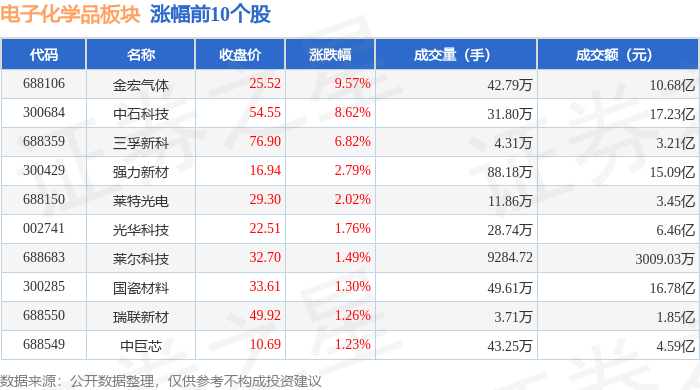
Market Overview - The electronic chemicals sector experienced a decline of 0.48% on January 19, with Tiancheng Technology leading the drop [1] - The Shanghai Composite Index closed at 4114.0, up 0.29%, while the Shenzhen Component Index closed at 14294.05, up 0.09% [1] Stock Performance - Notable gainers in the electronic chemicals sector included: - Jinhong Gas (688106) with a closing price of 25.52, up 9.57%, and a trading volume of 427,900 shares, totaling 1.068 billion yuan [1] - Zhongshi Technology (300684) closed at 54.55, up 8.62%, with a trading volume of 318,000 shares, totaling 1.723 billion yuan [1] - Sanhu Xinke (688389) closed at 76.90, up 6.82%, with a trading volume of 43,100 shares, totaling 321 million yuan [1] Fund Flow Analysis - The electronic chemicals sector saw a net outflow of 550 million yuan from institutional investors, while retail investors contributed a net inflow of 248 million yuan [2] - The top stocks by net inflow from institutional investors included: - Qiangli New Materials (300429) with a net inflow of 86.87 million yuan, accounting for 5.76% of the total [3] - Jinhong Gas (688106) with a net inflow of 83.17 million yuan, accounting for 7.79% of the total [3] - Zhongshi Technology (300684) with a net inflow of 55.72 million yuan, accounting for 3.23% of the total [3]





中东局势不确定性加大,油价短期震荡偏强
Ping An Securities· 2026-01-18 12:08
Investment Rating - The report maintains a "Strong Buy" rating for the oil and petrochemical sector [1]. Core Viewpoints - The uncertainty in the Middle East has increased, leading to a short-term strong fluctuation in oil prices. WTI crude futures closed up by 1.02% and Brent oil futures by 1.87% during the week of January 9 to January 16, 2026 [6]. - Geopolitical tensions, particularly involving Iran and the U.S., are significant factors affecting oil prices. Iran's oil inventory has reached record levels, equivalent to about 50 days of production, due to Western sanctions [6]. - The fluorochemical sector is expected to maintain high prosperity due to supply quota constraints and favorable demand driven by policy support. The production quota for HFCs in 2026 has increased by 5,963 tons year-on-year [6]. Summary by Sections Oil and Petrochemical - The report highlights the increased uncertainty in the Middle East, which is likely to impact oil prices in the short term. The geopolitical situation, including U.S. sanctions and military movements, is a critical factor [6][7]. - The report notes that domestic oil companies are diversifying their oil sources and integrating upstream and downstream operations to mitigate the impact of volatile international oil prices [7]. Fluorochemical - The fluorochemical sector is experiencing a favorable environment due to supply constraints and policy-driven demand. The production quotas for HFCs have been adjusted, with significant increases in specific categories [6][7]. - The report indicates that the demand for refrigerants is expected to grow, supported by national subsidy policies, with production of household air conditioners projected to increase by 11% year-on-year in January 2026 [6]. Semiconductor Materials - The semiconductor materials sector is on an upward cycle, with improving fundamentals and domestic substitution trends. The report suggests that there is potential for further price increases in this sector [7].





1300+份新材料报告下载:做新材料领域的「攻坚者」
材料汇· 2026-01-15 15:38
Core Viewpoint - The article discusses the rapid growth and investment opportunities in the advanced packaging materials sector, highlighting the potential for domestic companies to replace foreign imports in critical areas of technology [7][8]. Market Overview - The global market for advanced packaging materials is projected to reach $2.032 billion by 2028, with the Chinese market expected to grow to 9.67 billion yuan by 2025 [8]. - Specific materials such as PSPI and Al-X photoresist are identified as key growth areas, with PSPI's market size in China estimated at 7.12 billion yuan in 2023 [8]. Investment Opportunities - The article outlines various advanced packaging materials and their projected market sizes, indicating significant growth potential in sectors like conductive adhesives, chip bonding materials, and epoxy encapsulants [8]. - For instance, the conductive adhesive market is expected to reach 3 billion yuan by 2026, while the epoxy encapsulant market is projected to grow to 99 million USD by 2027 [8]. Competitive Landscape - The article lists both domestic and international players in the advanced packaging materials market, emphasizing the competitive dynamics and the potential for domestic companies to capture market share from established foreign firms [8]. - Companies such as 鼎龙股份, 国风新材, and 三月科 are highlighted as key domestic players in the PSPI segment, while international competitors include Fujifilm and Toray [8]. Investment Strategies - Different investment stages in the new materials industry are discussed, with a focus on the varying risk levels and investment strategies appropriate for each stage, from seed funding to pre-IPO [10]. - The article emphasizes the importance of assessing team capabilities, market potential, and product maturity when considering investments in this sector [10].



光刻胶国产替代迎来机会!美国关税倒逼+政策红利护航+头部企业技术破壁,头部企业A+H股上市助力行业加速
Xin Lang Cai Jing· 2026-01-15 14:09
Group 1 - Nanda Optoelectronics is a core enterprise in the semiconductor materials field, focusing on the R&D and mass production of ArF photoresists, having achieved breakthroughs that disrupt the monopoly of Japanese and American companies in the mid-to-high-end photoresist market [1][38][39] - The company has established deep cooperation with foundries in the Yangtze River Delta and has successfully validated its ArF photoresist for 28nm processes, leading to significant order growth and capacity expansion following the introduction of U.S. semiconductor tariffs in 2026 [1][39] - The National Big Fund has provided financial support for its photoresist projects, enhancing its first-mover advantage in the domestic photoresist market [1][39] Group 2 - Tongcheng New Materials, based in Shanghai, is a leading domestic rubber additive company that has entered the photoresist market through the acquisition of Beixu Electronics, focusing on the R&D and production of KrF photoresists [2][40] - The company has established stable partnerships with major domestic foundries, achieving large-scale production of KrF photoresists widely used in memory chips and power devices [2][40] - Plans for an H-share listing in 2026 aim to raise funds for high-end photoresist R&D and capacity expansion, further enhancing its competitive edge in the domestic market [2][40] Group 3 - Dinglong Co., headquartered in Wuhan, is a leader in printing and copying consumables, diversifying into semiconductor materials with a focus on polishing pads and supporting materials for photoresists [3][41] - The company has established close cooperation with major foundries like SMIC, achieving import substitution for its CMP polishing pads, which supports its photoresist business [3][41] - Following the U.S. semiconductor tariffs, there has been a surge in demand for localized supporting materials, leading to increased orders for its photoresist and related products [3][41] Group 4 - Yake Technology, located in Jiangsu, has entered the semiconductor photoresist market through the acquisition of South Korea's UP Chemical, focusing on KrF and ArF photoresists [4][42] - The company has integrated the technical advantages of the Korean team with domestic market resources, positioning itself as a core supplier of mid-to-high-end photoresists in the global semiconductor supply chain [4][42] - The electronic specialty gas business complements its photoresist offerings, providing a one-stop material solution for foundries [4][42] Group 5 - Dongcai Technology, based in Sichuan, specializes in high polymer resin materials for photoresists, leveraging its chemical industry foundation in the Southwest [5][43] - The company has achieved batch supply of resin products for various photoresist models, including G/I line and KrF, validated by multiple domestic photoresist manufacturers [5][43] - The demand for localized raw materials has surged following the U.S. semiconductor tariffs, leading to increased production capacity and a focus on high-end resin materials for ArF photoresists [5][43] Group 6 - Lianhong New Materials, located in Shandong, produces core raw materials such as monomers and solvents for photoresists, achieving low-cost production with quality meeting import standards [6][44] - The company has established long-term partnerships with downstream photoresist manufacturers, enhancing product adaptability and market share [6][44] - The acceleration of domestic substitution due to U.S. tariffs has led to a significant increase in orders for its photoresist raw materials [6][44] Group 7 - Shengquan Group, based in Shandong, focuses on developing phenolic and epoxy resins for photoresists, achieving breakthroughs in green and high-performance materials [7][45] - The company has become a core supplier for downstream photoresist manufacturers, benefiting from the growing demand for upstream resin materials following the U.S. semiconductor tariffs [7][45] - Increased R&D investment aims to develop high-end resin materials for KrF photoresists, further extending its position in the semiconductor materials industry [7][45] Group 8 - Shanghai Xinyang, a leader in semiconductor cleaning liquids, has diversified into the photoresist market, focusing on G/I line and electroplating photoresists [8][46] - The company has achieved large-scale production of G/I line photoresists, becoming a major supplier for domestic packaging applications [8][46] - The introduction of U.S. tariffs has accelerated the domestic adoption of photoresist materials, significantly increasing order volumes for its products [8][46] Group 9 - Jingrui Electric Materials, located in Jiangsu, is a leader in microelectronic materials, with its photoresist business covering multiple models including G/I line and KrF [9][48] - The company has accumulated extensive experience in photoresist R&D and production, with KrF photoresists entering the customer validation phase [9][48] - The U.S. semiconductor tariffs have led to a significant increase in domestic procurement of photoresists, resulting in notable revenue growth for the company [9][48] Group 10 - Huamao Technology, based in Fujian, has entered the photoresist market through the acquisition of XuZhou Bokan, focusing on ArF photoresist R&D [10][49] - The company aims to leverage its technical reserves to achieve breakthroughs in the production of mid-to-high-end photoresists, particularly in automotive semiconductor applications [10][49] - The acceleration of domestic substitution due to U.S. tariffs positions the company favorably in the ArF photoresist market [10][49] Group 11 - Jingfang Technology, headquartered in Jiangsu, specializes in semiconductor packaging and testing, relying on photoresists as a core consumable in its processes [11][50] - The company is enhancing cooperation with domestic photoresist manufacturers to optimize supply chain costs amid the push for domestic substitution [11][50] - The growth in demand from automotive electronics and AIoT sectors is driving the expansion of its packaging business, indirectly benefiting from the photoresist market [11][50] Group 12 - Xinlai Yingcai, based in Jiangsu, is a leader in ultra-pure fluid equipment, providing clean production equipment for photoresist manufacturing [12][51] - The company is expanding its product offerings to include ultra-clean equipment suitable for ArF and EUV photoresist production [12][51] - The demand for clean equipment has surged following the U.S. semiconductor tariffs, leading to significant order growth [12][51] Group 13 - Hubei Yihua, located in Hubei, is a leader in basic chemicals, producing raw materials for photoresists such as chlorobenzene and phosphorus trichloride [13][53] - The company has achieved large-scale production of photoresist raw materials, benefiting from the growing demand for localized supply following U.S. tariffs [13][53] - Its integrated chemical industry advantages help reduce production costs, enhancing its competitiveness in the photoresist supply chain [13][53]


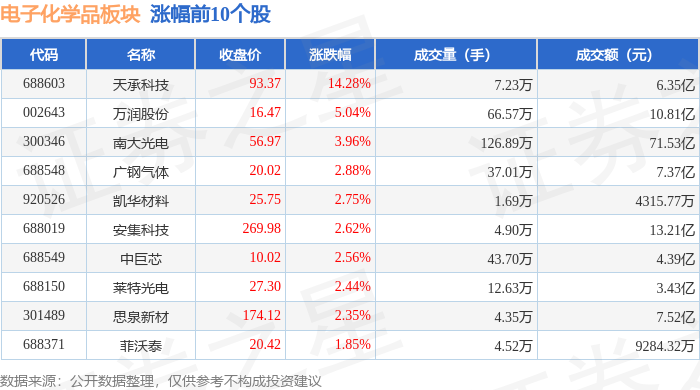
电子化学品板块1月14日涨1.2%,天承科技领涨,主力资金净流出6.07亿元
Zheng Xing Xing Ye Ri Bao· 2026-01-14 08:50
Group 1 - The electronic chemicals sector increased by 1.2% on January 14, with Tiancheng Technology leading the gains [1] - The Shanghai Composite Index closed at 4126.09, down 0.31%, while the Shenzhen Component Index closed at 14248.6, up 0.56% [1] - Key stocks in the electronic chemicals sector showed significant price movements, with Tiancheng Technology rising by 14.28% to a closing price of 93.37 [1] Group 2 - The electronic chemicals sector experienced a net outflow of 607 million yuan from institutional investors, while retail investors saw a net inflow of 674 million yuan [2] - Notable stocks with significant net inflows from retail investors include Wanrun Co., which had a net inflow of 100 million yuan [3] - The overall trading volume and turnover for various stocks in the electronic chemicals sector varied, with Wanrun Co. achieving a turnover of 1.08 billion yuan [1][3]

1300+份新材料报告下载:做新材料领域的「攻坚者」
材料汇· 2026-01-13 11:56
Core Viewpoint - The article discusses the rapid growth and investment opportunities in the advanced packaging materials sector, highlighting the potential for domestic companies to replace foreign imports in critical areas of technology [7][8]. Market Overview - The global market for advanced packaging materials is projected to reach $2.032 billion by 2028, with the Chinese market expected to grow to 9.67 billion yuan by 2025 [8]. - Specific segments such as conductive adhesives are forecasted to reach $3 billion by 2026, while chip bonding materials are estimated to grow from approximately $4.85 billion in 2023 to $6.84 billion by 2029 [8]. Competitive Landscape - Key foreign players in the advanced packaging materials market include Fujifilm, Toray, and Dow, while domestic companies such as 鼎龙股份 (Dinglong Co.), 国风新材 (Guofeng New Materials), and 三月科 (Sanyue Technology) are emerging as significant competitors [8]. - The article lists various advanced packaging materials and their respective market sizes, indicating a competitive landscape where domestic firms are increasingly gaining market share [8]. Investment Strategies - Different investment stages in the new materials industry are outlined, emphasizing the importance of team assessment, industry analysis, and market entry strategies at each phase [10]. - The article suggests that the A-round financing stage presents lower risks and higher returns, as companies at this stage typically have established sales channels and are experiencing rapid growth [10]. Future Trends - The article identifies 14 critical advanced packaging materials that are essential for the semiconductor industry, indicating a significant opportunity for investment and development in these areas [7][8]. - The anticipated growth in the new materials sector is driven by technological advancements and the need for domestic alternatives to imported materials, particularly in high-tech industries [7][8].
强力新材跌2.06%,成交额5.66亿元,主力资金净流出910.08万元
Xin Lang Cai Jing· 2026-01-13 05:55
Core Viewpoint - The stock of Strongly New Materials has experienced fluctuations, with a recent decline of 2.06% and a year-to-date increase of 17.78%, indicating volatility in investor sentiment and market performance [1]. Group 1: Company Overview - Strongly New Materials Co., Ltd. is located in Changzhou, Jiangsu Province, and was established on November 22, 1997. It was listed on March 24, 2015. The company specializes in the research, production, and sales of various electronic chemical products, particularly photoresists [2]. - The main revenue sources for the company include: other photo initiators (27.33%), PCB photoresist photo initiators (18.98%), LCD photoresist photo initiators (17.93%), chemical raw material trading (11.18%), PCB photoresist resin (10.14%), semiconductor photoresist photo initiators (6.96%), and other compounds (6.81%) [2]. Group 2: Financial Performance - For the period from January to September 2025, Strongly New Materials achieved a revenue of 720 million yuan, representing a year-on-year growth of 3.12%. However, the net profit attributable to the parent company was a loss of 24.03 million yuan, which is an increase of 6.20% compared to the previous year [2]. - The company has distributed a total of 205 million yuan in dividends since its A-share listing, with no dividends paid in the last three years [3]. Group 3: Shareholder Information - As of September 30, 2025, the number of shareholders for Strongly New Materials was 54,000, a decrease of 28.22% from the previous period. The average circulating shares per person increased by 39.31% to 7,380 shares [2]. - Among the top ten circulating shareholders, Hong Kong Central Clearing Limited is the third largest, holding 5.9376 million shares, which is an increase of 3.7945 million shares from the previous period [3].
1300+份新材料报告下载:做新材料领域的「攻坚者」
材料汇· 2026-01-12 13:52
Core Viewpoint - The article discusses the rapid growth and investment opportunities in the advanced packaging materials sector, highlighting the potential for domestic companies to replace foreign imports in critical areas of technology [7][8]. Market Overview - The global market for advanced packaging materials is projected to reach $2.032 billion by 2028, with the Chinese market expected to grow to 9.67 billion yuan by 2025 [8]. - Specific materials such as PSPI, epoxy resin, and conductive adhesives are identified as key growth areas, with significant market sizes and growth rates anticipated [8]. Investment Opportunities - The article outlines various advanced packaging materials and their respective market sizes, including: - PSPI: $528 million in 2023, expected to grow significantly [8]. - Conductive adhesives: projected to reach $3 billion by 2026 [8]. - Chip bonding materials: expected to grow from approximately $485 million in 2023 to $684 million by 2029 [8]. - The investment landscape is characterized by a shift towards domestic production, with numerous Chinese companies emerging as competitors to established foreign firms [7][8]. Industry Trends - The article emphasizes the trend of domestic substitution in advanced materials, particularly in sectors heavily reliant on imports from countries like Japan [7][8]. - It highlights the importance of innovation and collaboration among domestic companies to enhance competitiveness in the global market [21]. Strategic Insights - Different investment stages in the new materials industry are discussed, with a focus on the varying risk levels and investment strategies appropriate for each stage, from seed funding to pre-IPO [10]. - The article suggests that the current market conditions present a favorable environment for investment in advanced materials, particularly for companies that can demonstrate strong growth potential and market positioning [10].
1300+份新材料报告下载:做新材料领域的「攻坚者」
材料汇· 2026-01-11 14:59
Core Viewpoint - The article discusses the rapid growth and investment opportunities in the advanced packaging materials sector, highlighting the potential for domestic companies to replace foreign imports in critical areas of technology [7][8]. Market Overview - The global market for advanced packaging materials is projected to reach $2.032 billion by 2028, with the Chinese market expected to grow to 9.67 billion yuan by 2025 [8]. - Specific materials such as PSPI and Al-X photoresist are highlighted, with PSPI's market size in China estimated at 7.12 billion yuan in 2023 [8]. Investment Opportunities - The article identifies 14 key advanced packaging materials that are critical for the semiconductor industry, emphasizing the potential for domestic companies to capture market share from established foreign competitors [7][8]. - Companies like 鼎龙股份, 国风新材, and 三月科 are mentioned as potential leaders in the domestic market for advanced packaging materials [8]. Growth Projections - The market for conductive adhesives is expected to reach 3 billion yuan by 2026, while the chip bonding materials market is projected to grow from approximately $4.85 billion in 2023 to $6.84 billion by 2029 [8]. - The epoxy encapsulation materials market is anticipated to grow to $9.9 billion by 2027, indicating strong demand in the electronics sector [8]. Competitive Landscape - The article outlines the competitive landscape, noting that foreign companies like Fujifilm, Toray, and Dow currently dominate the market, but domestic firms are rapidly advancing [8]. - The need for innovation and investment in R&D is emphasized for domestic companies to successfully compete against established international players [8].
1300+份新材料报告下载:做新材料领域的「攻坚者」
材料汇· 2026-01-10 15:49
Core Viewpoint - The article discusses the rapid growth and investment opportunities in the advanced packaging materials sector, highlighting the potential for domestic companies to replace foreign imports in critical areas of technology [7][8]. Market Overview - The global market for advanced packaging materials is projected to reach $2.032 billion by 2028, with the Chinese market expected to grow to 9.67 billion yuan by 2025 [8]. - Specific materials such as PSPI, epoxy resin, and conductive adhesives are identified as key growth areas, with significant market sizes and growth rates anticipated [8]. Investment Opportunities - The article outlines various advanced packaging materials and their respective market sizes, including: - PSPI: $528 million in 2023, expected to grow significantly [8]. - Conductive adhesives: projected to reach $3 billion by 2026 [8]. - Chip bonding materials: expected to grow from approximately $485 million in 2023 to $684 million by 2029 [8]. - The investment landscape is characterized by a shift towards domestic production, with numerous Chinese companies emerging as competitors to established foreign firms [7][8]. Industry Trends - The article emphasizes the trend of domestic substitution in advanced materials, particularly in sectors heavily reliant on imports from countries like Japan [7][8]. - It highlights the importance of innovation and collaboration among domestic companies to achieve breakthroughs in material science and technology [21]. Strategic Insights - Different investment stages in the new materials industry are discussed, with a focus on the varying levels of risk and investment strategies appropriate for each stage, from seed funding to pre-IPO [10]. - The article suggests that companies at the A-round stage, which have established sales channels and are experiencing rapid growth, present lower investment risks and higher potential returns [10].