Mindray(300760)

Search documents
CT、核磁集采“大杀价” 部分跨国企业已失守
Jing Ji Guan Cha Wang· 2025-12-03 13:57
Core Insights - The medical device distribution industry is facing significant challenges due to the expansion of centralized procurement, which has intensified price competition and reduced profit margins for distributors [2][3][4][5]. Group 1: Industry Trends - Centralized procurement for medical devices began in 2020 in Anhui and Fujian, but has recently expanded to most provinces in China, leading to a significant shift in the market landscape [2][10]. - The prices of major medical devices have drastically decreased, with examples including digital X-ray (DR) prices dropping from over 1 million to 200,000, and CT prices falling to historical lows of 600,000 [3][9]. - The ongoing anti-corruption campaign in the medical sector has heightened scrutiny on procurement practices, contributing to the rapid expansion of centralized procurement initiatives [3][12]. Group 2: Distributor Challenges - Many medical device distributors are considering transitioning to other business models, such as focusing on devices that are not yet subject to centralized procurement or moving upstream to manufacturing [4][5]. - The profit margins for distributors have significantly decreased, with some reporting earnings dropping from several million to only tens of thousands due to the competitive bidding process [4][5]. - It is projected that only about 10% of current medical device distributors will remain in the industry post-procurement expansion, primarily focusing on after-sales services [5][8]. Group 3: Manufacturer Responses - Major international manufacturers like GE and Philips are experiencing market share losses due to intensified competition from local companies, which are increasingly winning bids in centralized procurement [6][8]. - Local companies such as Wandong Medical and Mindray have shown strong performance in procurement bids, with Wandong achieving a 47% bid success rate for CT devices [8][9]. - Despite the increased competition, some manufacturers like United Imaging have managed to grow their revenue and profits, indicating that innovation may provide a competitive edge in this challenging environment [9]. Group 4: Future Outlook - The trend of centralized procurement is expected to continue expanding across provinces, with most regions likely to implement such measures within the next 3 to 5 years [12]. - The complexity of nationwide centralized procurement is acknowledged, with regional differences in medical device usage making it more feasible to conduct procurement at the provincial level [12].





12月3日医疗健康R(480016)指数跌0.42%,成份股人福医药(600079)领跌
Sou Hu Cai Jing· 2025-12-03 10:05
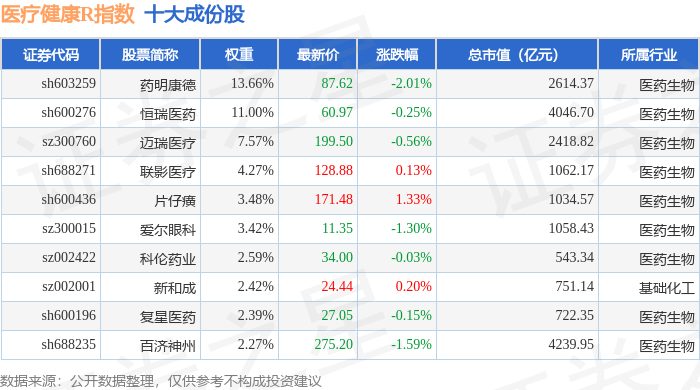
Core Points - The Medical Health R Index (480016) closed at 7284.72 points, down 0.42%, with a trading volume of 17.046 billion yuan and a turnover rate of 0.61% [1] - Among the index constituents, 23 stocks rose while 26 fell, with TeBao Bio leading the gainers at 2.85% and Renfu Pharmaceutical leading the decliners at 3.33% [1] Index Constituents Summary - The top ten constituents of the Medical Health R Index include: - WuXi AppTec (sh603259) with a weight of 13.66%, latest price at 87.62, down 2.01%, and a market cap of 261.437 billion yuan [1] - Hengrui Medicine (sh600276) with a weight of 11.00%, latest price at 60.97, down 0.25%, and a market cap of 404.670 billion yuan [1] - Mindray Medical (sz300760) with a weight of 7.57%, latest price at 199.50, down 0.56%, and a market cap of 241.882 billion yuan [1] - United Imaging Healthcare (sh688271) with a weight of 4.27%, latest price at 128.88, up 0.13%, and a market cap of 106.217 billion yuan [1] - Pianzai Shou (sh600436) with a weight of 3.48%, latest price at 171.48, up 1.33%, and a market cap of 103.457 billion yuan [1] - Aier Eye Hospital (sz300015) with a weight of 3.42%, latest price at 11.35, down 1.30%, and a market cap of 105.843 billion yuan [1] - Kelun Pharmaceutical (sz002422) with a weight of 2.59%, latest price at 34.00, down 0.03%, and a market cap of 54.334 billion yuan [1] - Xinhecheng (sz002001) with a weight of 2.42%, latest price at 24.44, up 0.20%, and a market cap of 75.114 billion yuan [1] - Fosun Pharma (sh600196) with a weight of 2.39%, latest price at 27.05, down 0.15%, and a market cap of 72.235 billion yuan [1] - Ziji Shenzhou (sh688235) with a weight of 2.27%, latest price at 275.20, down 1.59%, and a market cap of 423.995 billion yuan [1] Capital Flow Analysis - The Medical Health R Index constituents experienced a net outflow of 1.159 billion yuan from institutional investors, while retail investors saw a net inflow of 999 million yuan [1] - Detailed capital flow for specific stocks shows: - Health元 (600380) had a net inflow of 34.2431 million yuan from institutional investors [2] - Hengrui Medicine (600276) had a net inflow of 29.9909 million yuan from institutional investors [2] - Long Spring High-tech (000661) had a net inflow of 19.8154 million yuan from institutional investors [2] - The index constituents underwent adjustments, adding four new stocks and removing one [2]



DeepSeek发布新模型!创业板50ETF(159949)涨0.48%,机构持续看好AI产业链投资机会
Xin Lang Cai Jing· 2025-12-03 02:33
Core Viewpoint - The news highlights the performance of the ChiNext 50 ETF (159949), which has shown a slight increase of 0.48% to 1.467 CNY, amidst a broader market fluctuation, indicating ongoing investor interest and activity in the growth sector [1][6]. Market Performance - As of 10:20 AM on December 3, the ChiNext 50 ETF (159949) was trading at 1.467 CNY, with a trading volume of 4.22 billion CNY and a turnover rate of 1.66% [1][6]. - The ETF has experienced a cumulative trading amount of 323.05 billion CNY over the last 20 trading days, averaging 16.15 billion CNY per day, and a total of 3,205.79 billion CNY over 222 trading days this year, averaging 14.44 billion CNY per day [7][10]. Top Holdings - The top ten holdings of the ChiNext 50 ETF (159949) include leading companies such as CATL, Zhongji Xuchuang, Dongfang Caifu, Xinyi Technology, Sungrow Power, Shenghong Technology, Huichuan Technology, Mindray, Yiwei Lithium Energy, and Tonghuashun [3][8]. Industry Insights - Longcheng Securities reports that the continuous implementation of AI applications will drive the acceleration of computing infrastructure, particularly in the AIDC industry chain, which includes optical modules, PCBs, and main equipment manufacturers, indicating a strong demand release and potential for performance and valuation growth [10]. - The report suggests that the demand for edge computing modules will steadily increase as AI applications continue to develop, transitioning from traditional data transmission modules to intelligent and computing modules [10]. Investment Recommendations - The ChiNext 50 ETF (159949) is presented as a convenient and efficient investment tool for investors looking to capitalize on the long-term growth of China's technology sector, with recommendations for dollar-cost averaging or phased investment strategies to mitigate short-term volatility [10].







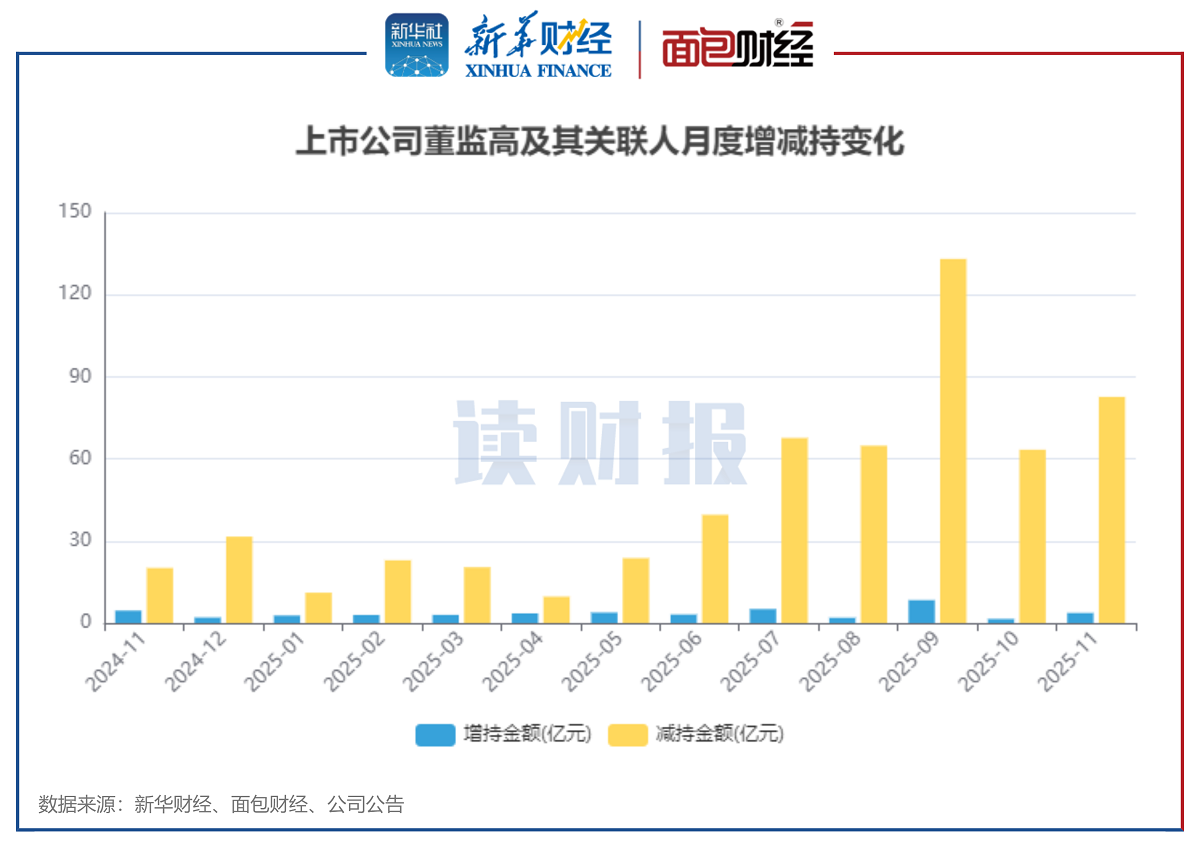
【读财报】11月董监高增减持动态:增持总额环比上升148% 公牛集团、圣邦股份减持金额居前
Xin Hua Cai Jing· 2025-12-02 23:22
Summary of Key Points Core Viewpoint - In November 2025, the total amount of stock reduction by executives and their related parties in the Shanghai and Shenzhen stock markets reached approximately 8.266 billion yuan, with a net reduction of 7.899 billion yuan after accounting for increases [1][3]. Group 1: Stock Reduction - The total reduction amount in November 2025 was approximately 8.266 billion yuan, involving 277 companies [1][3]. - The leading company in stock reduction was Bull Group, with a reduction amount of about 1.252 billion yuan [3][4]. - Other notable reductions included Shengbang Co. at approximately 333 million yuan and Anche Detection at about 322 million yuan [3][4]. - The light industry manufacturing sector had the highest reduction amount at around 1.405 billion yuan, followed by the computer industry at approximately 1.307 billion yuan [9]. Group 2: Stock Increase - The total amount of stock increase by executives and their related parties was approximately 368 million yuan, involving 67 companies [1][10]. - The top three companies for stock increases were Taoli Bread at about 158.7 million yuan, Zhejiang Fu Holdings at approximately 81.2 million yuan, and Mindray Medical at around 34 million yuan [10][11]. - The food and beverage industry led in stock increases with a total of about 161 million yuan, followed by the environmental protection industry at approximately 81 million yuan [15].





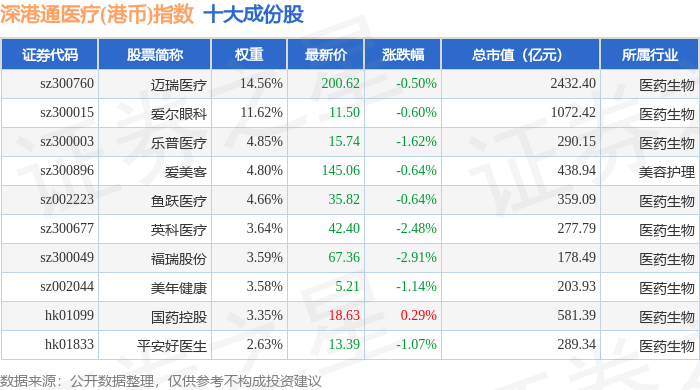
12月2日深港通医疗(港币)(983036)指数跌0.69%,成份股健康之路(02587)领跌
Sou Hu Cai Jing· 2025-12-02 11:35
Core Points - The Shenzhen-Hong Kong Stock Connect Medical Index (HKD) closed at 4433.77 points, down 0.69%, with a trading volume of 6.716 billion HKD and a turnover rate of 0.73% [1] - Among the index constituents, 18 stocks rose while 39 stocks fell, with Global Medical leading the gainers at 3.66% and Health Road leading the decliners at 6.35% [1] Index Constituents Summary - The top ten constituents of the Shenzhen-Hong Kong Stock Connect Medical Index include: - Mindray Medical (14.56% weight, latest price 200.62, market cap 243.24 billion) [1] - Yier Eye Hospital (11.62% weight, latest price 11.50, market cap 107.24 billion) [1] - Lejin Medical (4.85% weight, latest price 15.74, market cap 29.01 billion) [1] - Aimeike (4.80% weight, latest price 145.06, market cap 43.89 billion) [1] - Yuyue Medical (4.66% weight, latest price 35.82, market cap 35.91 billion) [1] - Yingke Medical (3.64% weight, latest price 42.40, market cap 27.78 billion) [1] - Furuide (3.59% weight, latest price 67.36, market cap 17.85 billion) [1] - Meinian Health (3.58% weight, latest price 5.21, market cap 20.39 billion) [1] - Sinopharm (3.35% weight, latest price 18.63, market cap 58.14 billion) [1] - Ping An Good Doctor (2.63% weight, latest price 13.39, market cap 28.93 billion) [1] Capital Flow Analysis - The net outflow of main funds from the index constituents totaled 83.77 million HKD, while retail investors saw a net inflow of 61.08 million HKD [1] - Specific stock capital flows include: - Mindray Medical: main fund net inflow of 37.11 million, retail net outflow of 4.23 million [2] - Yuyue Medical: main fund net inflow of 3.70 million, retail net inflow of 4.71 million [2] - Over the past 10 days, one stock was newly added to the index [2]



12月2日医疗健康R(480016)指数跌1.46%,成份股泰格医药(300347)领跌
Sou Hu Cai Jing· 2025-12-02 11:00
Core Viewpoint - The Medical Health R Index (480016) closed at 7315.52 points, down 1.46%, with a trading volume of 16.103 billion yuan and a turnover rate of 0.53% on December 2 [1]. Group 1: Index Performance - Among the index constituents, 4 stocks rose while 46 stocks fell, with Jichuan Pharmaceutical leading the gainers at 1.0% and Tigermed leading the decliners at 3.88% [1]. - The total net outflow of main funds from the index constituents was 1.447 billion yuan, while retail investors saw a net inflow of 1.043 billion yuan [1]. Group 2: Top Constituents - The top ten constituents of the Medical Health R Index are as follows: - WuXi AppTec (13.66% weight, latest price 89.42, market cap 266.808 billion yuan, down 3.12%) [1] - Hengrui Medicine (11.00% weight, latest price 61.12, market cap 405.666 billion yuan, down 1.32%) [1] - Mindray Medical (7.57% weight, latest price 200.62, market cap 243.240 billion yuan, down 0.50%) [1] - United Imaging Healthcare (4.27% weight, latest price 128.71, market cap 106.077 billion yuan, down 1.97%) [1] - Pianzi Shou (3.48% weight, latest price 169.23, market cap 102.099 billion yuan, down 1.60%) [1] - Yierfu Technology (3.42% weight, latest price 11.50, market cap 107.242 billion yuan, down 0.60%) [1] - Kelun Pharmaceutical (2.59% weight, latest price 34.01, market cap 54.350 billion yuan, down 1.13%) [1] - Xinhecheng (2.42% weight, latest price 24.39, market cap 74.961 billion yuan, down 1.22%) [1] - Fosun Pharma (2.39% weight, latest price 27.09, market cap 72.342 billion yuan, down 0.88%) [1] - Ziji Shenzhou (2.27% weight, latest price 279.66, market cap 430.866 billion yuan, down 2.90%) [1]. Group 3: Fund Flow Details - The detailed fund flow for the index constituents shows that: - Mindray Medical had a main fund net inflow of 37.107 million yuan, while retail saw a net outflow of 4.2266 million yuan [2]. - Huatai Medical experienced a main fund net inflow of 16.9225 million yuan, with retail seeing a net outflow of 1.6967 million yuan [2]. - The overall trend indicates a mixed sentiment among different investor types, with main funds generally withdrawing while retail investors were net buyers [2]. Group 4: Recent Adjustments - In the last 10 days, the Medical Health R Index constituents underwent adjustments, adding 4 new stocks and removing 1 stock [2].



迈瑞医疗多位高管接连增持,彰显未来发展信心
Sou Hu Wang· 2025-12-02 10:56
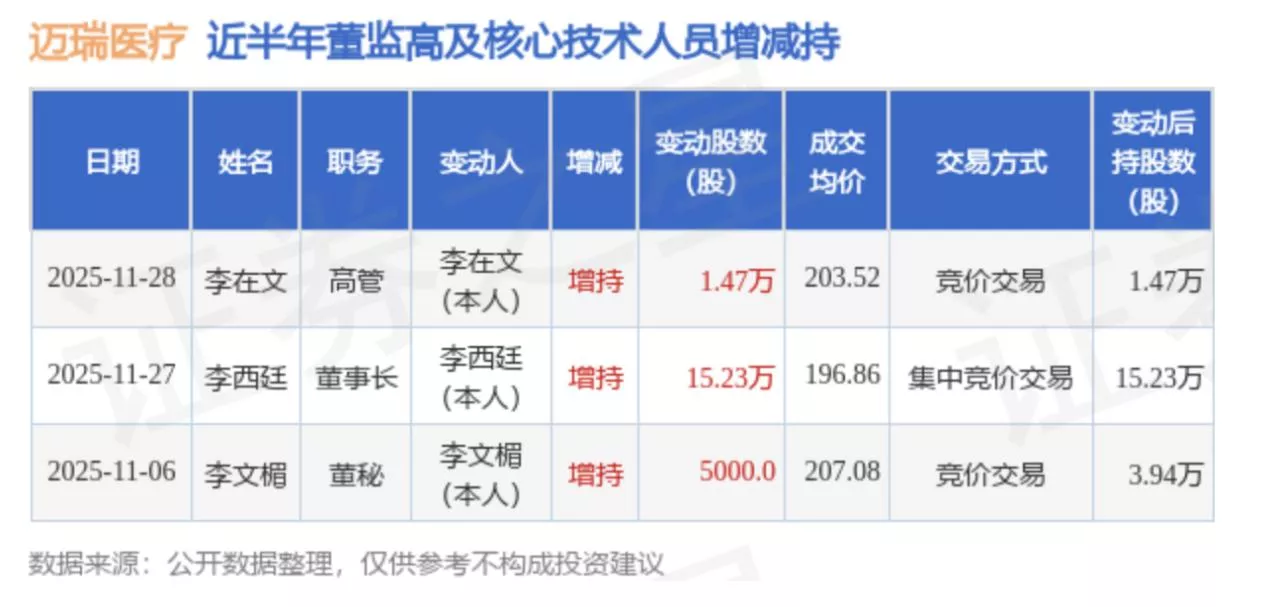
Core Viewpoint - The recent share buyback announcement by Mindray Medical (300760.SZ) has garnered significant attention in the capital market, signaling confidence from the company's management and potentially stabilizing the stock price [1][10]. Group 1: Share Buyback Details - On November 27, Chairman Li Xiting initiated a share buyback, purchasing 152,340 shares at an average price of 196.862 CNY per share, totaling approximately 29.99 million CNY [5]. - Li Xiting plans to continue buying shares over the next six months, with a total investment of 200 million CNY, funded by personal resources, without a fixed price range [5][6]. - Following the buyback, Li Xiting's direct shareholding increased, and he, along with his concerted parties, now controls 51.48% of the company's shares [5][6]. Group 2: Management Confidence - The buyback was followed by additional purchases from senior executives, including Senior Vice President Li Zaiwen, who bought 14,700 shares at an average price of 203.52 CNY per share on November 28 [4][6]. - The concentrated buying activity among the management team reflects a strong belief in the company's intrinsic value and future growth prospects [4][6]. Group 3: Market Reaction - Following the announcement, Mindray Medical's stock price rose by 3.93% to close at 204.01 CNY per share, with a trading volume of 2.378 billion CNY [13]. - The market response indicates that investors view the management's buyback as a positive signal, reinforcing their confidence in the company's long-term value [10][13]. Group 4: Company Performance - Mindray Medical is recognized as a leading domestic medical device company, with a projected revenue of 36.7 billion CNY in 2024 and a compound annual growth rate (CAGR) of over 18% from 2017 to 2024 [13]. - The company has maintained a net profit margin and return on equity (ROE) above 20%, highlighting its strong financial performance [13].

迈瑞医疗披露董事长计划增持2亿,引发市场广泛关注
Cai Jing Wang· 2025-12-02 09:45
Core Viewpoint - The recent share buyback announcement by Mindray Medical (300760.SZ) has attracted significant attention in the capital market, reflecting the confidence of the management team in the company's intrinsic value and future growth prospects [1][5]. Group 1: Buyback Details - On November 27, Chairman Li Xiting initiated a share buyback by purchasing 152,340 shares at an average price of 196.862 CNY per share, totaling approximately 29.99 million CNY [2]. - Li Xiting plans to continue buying back shares over the next six months, with a total investment of 200 million CNY, funded by personal resources, without a fixed price range [2]. - Following the buyback, Li Xiting's direct shareholding increased, and together with his concerted party, they control 51.48% of the company's shares [2]. Group 2: Management Confidence - The buyback activity is part of a broader trend, with multiple senior executives, including Senior Vice President Li Zaiwen and Secretary Li Wenmei, also increasing their holdings, indicating strong internal confidence in the company's future [3][4]. - Li Zaiwen bought 14,700 shares at an average price of 203.52 CNY per share on November 28, while Li Wenmei had previously purchased 5,000 shares at 207.08 CNY per share on November 6 [4]. Group 3: Market Reaction - The announcement of the buyback plan received a positive response from investors, with a notable increase in the stock price by 3.93% to 204.01 CNY per share on November 28, alongside a trading volume of 2.378 billion CNY [5]. - Investors view the buyback as a strong signal of confidence from the management, potentially stabilizing the stock price and providing reassurance to long-term investors [5]. Group 4: Company Performance - Mindray Medical is recognized as a leading domestic medical device company, ranking among the top 30 global medical device firms, with a projected revenue of 36.7 billion CNY in 2024 [5]. - The company has demonstrated robust growth, with a compound annual growth rate (CAGR) of over 18% in revenue and over 24% in net profit from 2017 to 2024, maintaining a return on equity (ROE) and net profit margin above 20% [5].
12月1日深港通医疗(983035)指数涨0.2%,成份股医渡科技(02158)领涨
Sou Hu Cai Jing· 2025-12-01 11:39
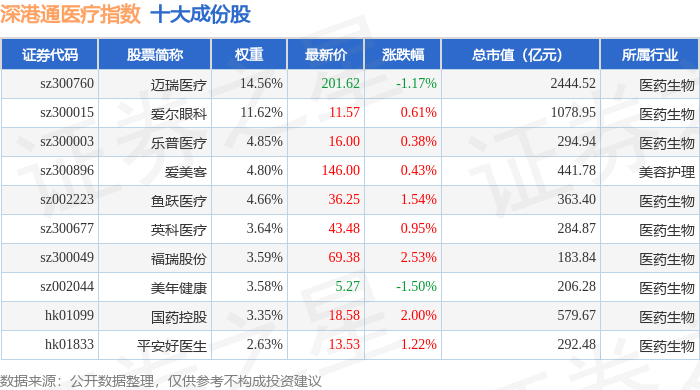
Core Points - The Shenzhen-Hong Kong Medical Index (983035) closed at 4554.17 points, up 0.2%, with a trading volume of 7.409 billion yuan and a turnover rate of 0.81% [1] - Among the index constituents, 38 stocks rose while 17 fell, with Yidu Technology leading the gainers at 3.5% and Mylab leading the decliners at 4.98% [1] Index Constituents Summary - The top ten constituents of the Shenzhen-Hong Kong Medical Index include: - Mindray Medical (sz300760) with a weight of 14.56% and a latest price of 201.62, down 1.17% [1] - Aier Eye Hospital (sz300015) with a weight of 11.62% and a latest price of 11.57, up 0.61% [1] - Lepu Medical (sz300003) with a weight of 4.85% and a latest price of 16.00, up 0.38% [1] - Aimeike (sz300896) with a weight of 4.80% and a latest price of 146.00, up 0.43% [1] - Yuyue Medical (sz002223) with a weight of 4.66% and a latest price of 36.25, up 1.54% [1] - Yingke Medical (sz300677) with a weight of 3.64% and a latest price of 43.48, up 0.95% [1] - Furuide (sz300049) with a weight of 3.59% and a latest price of 69.38, up 2.53% [1] - Meinian Health (sz002044) with a weight of 3.58% and a latest price of 5.27, down 1.50% [1] - Sinopharm (hk01099) with a weight of 3.35% and a latest price of 18.58, up 2.00% [1] - Ping An Good Doctor (hk01833) with a weight of 2.63% and a latest price of 13.53, up 1.22% [1] Capital Flow Analysis - The net outflow of main funds from the index constituents totaled 172 million yuan, while retail funds saw a net inflow of approximately 84.92 million yuan [3] - Notable capital flows include: - Sanbo Brain Science (301293) with a main fund net inflow of 26.77 million yuan [3] - Ruimait (301367) with a main fund net inflow of 16.21 million yuan [3] - Chutian Technology (300358) with a main fund net inflow of 11.20 million yuan [3] - The index constituents underwent an adjustment with one new stock added in the last ten days [3]

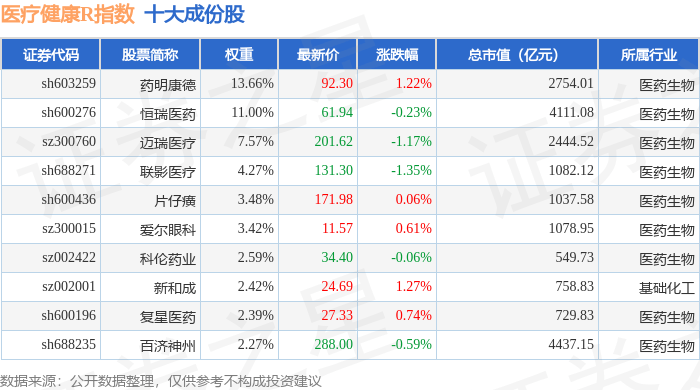
12月1日医疗健康R(480016)指数涨0.31%,成份股惠泰医疗(688617)领涨
Sou Hu Cai Jing· 2025-12-01 11:09
Core Insights - The Medical Health R Index (480016) closed at 7423.77 points, up 0.31%, with a trading volume of 18.443 billion yuan and a turnover rate of 0.67% [1] - Among the index constituents, 34 stocks rose while 16 fell, with Huatai Medical leading the gainers at 3.13% and Yirui Technology leading the decliners at 2.87% [1] Index Constituents Performance - The top ten constituents of the Medical Health R Index include: - WuXi AppTec (13.66% weight) at 92.30 yuan, up 1.22%, market cap of 275.401 billion yuan [1] - Hengrui Medicine (11.00% weight) at 61.94 yuan, down 0.23%, market cap of 411.108 billion yuan [1] - Mindray Medical (7.57% weight) at 201.62 yuan, down 1.17%, market cap of 244.452 billion yuan [1] - United Imaging Healthcare (4.27% weight) at 131.30 yuan, down 1.35%, market cap of 108.212 billion yuan [1] - Other notable constituents include Pianzai Shou, Aier Eye Hospital, Kelun Pharmaceutical, and Fosun Pharma, with varying performance [1] Capital Flow Analysis - The Medical Health R Index constituents experienced a net outflow of 261 million yuan from institutional investors, while retail investors saw a net inflow of 272 million yuan [1] - Detailed capital flow for specific stocks shows: - WuXi AppTec had a net inflow of 1.15 million yuan from institutional investors, but outflows from retail and speculative investors [2] - Other stocks like Jichuan Pharmaceutical and Lijun Group also showed mixed capital flows, with some experiencing significant outflows from retail investors [2] Recent Index Adjustments - In the last 10 days, the Medical Health R Index underwent adjustments, adding four new stocks and removing one [3] - New additions include: - Sanofi Guojian, Dize Pharmaceutical, Changshan Pharmaceutical, and Kanghong Pharmaceutical, all from the biopharmaceutical sector [3]