Mindray(300760)

Search documents
迈瑞官宣:手术机器人最新进展
Xin Lang Cai Jing· 2026-02-09 10:49
Core Insights - The company is exploring the surgical robot business through its minimally invasive surgery segment, which is expected to grow significantly, contributing positively to overall performance by Q3 2025 [1][4] - The company has completed its product layout for thoracic and abdominal minimally invasive surgery, achieving a competitive edge in the domestic market with over 10% market share in the endoscope system [1][4] - The market for high-value consumables in minimally invasive surgery exceeds 200 billion yuan, with core products like ultrasonic knives and endoscopic staplers having a combined market capacity of over 110 billion yuan, primarily dominated by two imported brands [5] Business Development - The company plans to enhance its sales team and channels for high-value consumables, aiming for accelerated business growth in 2025, which is seen as a pivotal year for the domestic market [5] - Prior to entering the surgical robot sector, the company has established foundational capabilities in endoscopy, energy platforms, and surgical instruments, setting the stage for successful commercialization [2][5] - The company aims to integrate its technological advancements across various fields to launch surgical robot products, enhancing high-end surgical applications and supporting the development of domestic surgical robots [2][5]


2月9日中证医疗(399989)指数涨0.6%,成份股三博脑科(301293)领涨
Sou Hu Cai Jing· 2026-02-09 10:30
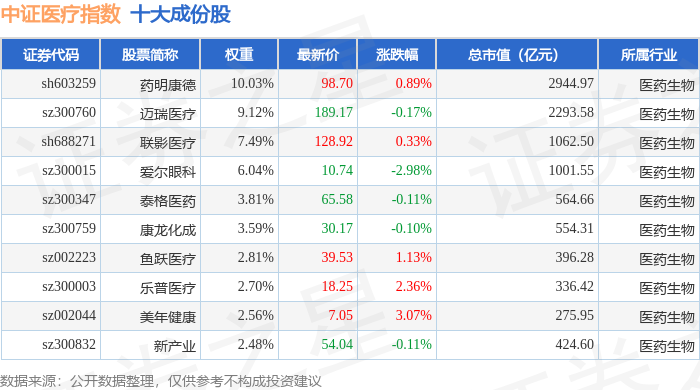
Core Viewpoint - The China Securities Medical Index (399989) closed at 7161.62 points, up 0.6%, with a trading volume of 19.192 billion yuan and a turnover rate of 1.97% on February 9 [1] Group 1: Index Performance - On the same day, 37 of the index's constituent stocks rose, with Sanbo Brain Science leading with a 5.32% increase, while 12 stocks declined, with Aier Eye Hospital falling by 2.98% [1] - The top ten constituent stocks of the China Securities Medical Index are primarily in the pharmaceutical and medical sectors, with WuXi AppTec holding the highest weight at 10.03% [1] Group 2: Stock Details - The top ten stocks include: - WuXi AppTec: Weight 10.03%, Latest Price 98.70, Market Cap 294.97 billion yuan [1] - Mindray Medical: Weight 9.12%, Latest Price 189.17, Market Cap 229.36 billion yuan [1] - United Imaging Healthcare: Weight 7.49%, Latest Price 128.92, Market Cap 106.25 billion yuan [1] - Aier Medical: Weight 6.04%, Latest Price 10.74, Market Cap 100.16 billion yuan [1] - Other notable stocks include Tigermed, Kanglong Chemical, and Yuyue Medical, all within the medical and pharmaceutical industry [1] Group 3: Capital Flow - The net outflow of main funds from the index's constituent stocks totaled 205 million yuan, while retail investors saw a net inflow of 1.51 billion yuan [1] - Detailed capital flow indicates that major stocks like WuXi AppTec and Mindray Medical experienced varying levels of net inflow and outflow from different investor categories [2]




迈瑞公布,手术机器人最新进展
Xin Lang Cai Jing· 2026-02-09 10:20
Group 1 - Mindray is actively developing its surgical robot business, integrating technologies from endoscopy, energy platforms, and surgical instruments [1][7][10] - The company has established a strong foundation in minimally invasive surgery, with a projected growth rate of over 25% for this segment by Q3 2025 [2][9] - Mindray's market share for its hard endoscope systems has surpassed 10%, positioning it just behind two major imported brands [2][9] Group 2 - The surgical robot industry is highly competitive, with major players like Medtronic and Intuitive Surgical making significant advancements [3][4] - Medtronic's Hugo™ robotic system has received FDA approval, marking its entry into the U.S. market [3] - Intuitive Surgical's da Vinci 5 system has been approved for specific cardiac surgeries, expanding its application range [4] Group 3 - The endoscopic surgical robot sector is gaining attention, with Olympus investing in Swan EndoSurgical to advance this technology [11] - Johnson & Johnson's MONARCH robot has been approved in China, allowing for natural orifice procedures without incisions [12] - Domestic companies are rapidly advancing in the surgical robot field, with several achieving initial commercialization in various specialties [12] Group 4 - The National Healthcare Security Administration has introduced guidelines for pricing surgical robots based on their participation and precision in surgeries [13][14] - The evolving regulatory framework is expected to facilitate the growth of the domestic surgical robot industry [14]
医药生物行业跨市场周报(20260209):政策推动中药工业提质升级,中长期利好行业集中度提升-20260209
EBSCN· 2026-02-09 02:12
Investment Rating - The report maintains a "Buy" rating for key companies in the pharmaceutical sector, including Innovent Biologics, Efang Biologics, Tianshili, WuXi AppTec, and Mindray Medical [4][28]. Core Insights - The policy-driven upgrade of traditional Chinese medicine (TCM) industry is expected to enhance industry concentration in the medium to long term, benefiting companies with strong quality control and innovative capabilities [2][24]. - The implementation plan for high-quality development of the TCM industry aims to establish a collaborative development system by 2030, focusing on raw material supply, innovation, production quality control, and internationalization [2][23]. - The investment strategy emphasizes the importance of clinical value in the pharmaceutical sector, recommending a focus on innovative drugs and high-end medical devices [3][26]. Summary by Sections Market Review - The A-share pharmaceutical index rose by 0.14%, outperforming the CSI 300 index by 1.47 percentage points [1][16]. - The Hong Kong Hang Seng Medical Health Index fell by 1.41%, but still outperformed the Hang Seng Index by 1.65 percentage points [1][16]. Policy Insights - The Ministry of Industry and Information Technology and other departments issued a plan to enhance the TCM industry, which includes fostering leading enterprises and establishing high-standard raw material production bases [2][24]. - The plan emphasizes digitalization and sustainability, aiming to raise compliance standards and accelerate the exit of smaller companies from the market [2][25]. Company Updates - Recent clinical progress includes the NDA submission for HRS-9531 by Heng Rui Medicine and the initiation of clinical trials for various drugs by other companies [1][31][32]. - Key companies such as Yunnan Baiyao, Baiyunshan, and Taiji Group are highlighted for their strong positions in raw material supply [2][25]. Financial Forecasts - The report provides earnings per share (EPS) forecasts for key companies, with Innovent Biologics projected to have an EPS of 0.49 in 2025 and WuXi AppTec expected to reach an EPS of 5.07 in the same year [4][28]. - The pharmaceutical manufacturing industry reported a revenue decline of 1.2% year-on-year for 2025, with total revenue reaching 2,487 billion yuan [51].



2月6日创业板医疗(970082)指数跌0.63%,成份股爱尔眼科(300015)领跌
Sou Hu Cai Jing· 2026-02-06 10:36
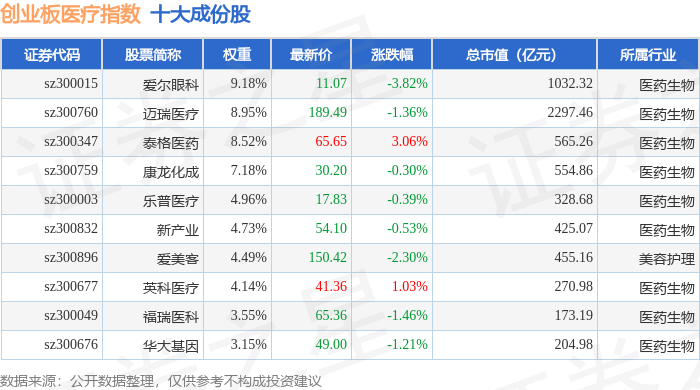
Core Viewpoint - The ChiNext Medical Index (970082) closed at 3882.75 points, down 0.63%, with a trading volume of 14.157 billion yuan and a turnover rate of 2.13% on February 6 [1] Group 1: Index Performance - Among the index constituents, 22 stocks rose while 28 stocks fell, with Tigermed leading the gainers at 3.06% and Aier Eye Hospital leading the decliners at 3.82% [1] - The top ten constituents of the ChiNext Medical Index include Aier Eye Hospital (9.18% weight, latest price 11.07, -3.82% change) and Tigermed (8.52% weight, latest price 65.65, +3.06% change) [1] Group 2: Market Capitalization - The total market capitalization of Aier Eye Hospital is approximately 103.232 billion yuan, while Tigermed's market capitalization is around 56.526 billion yuan [1] - Other notable companies include Mindray Medical (229.746 billion yuan) and Kanglong Chemical (55.486 billion yuan) [1] Group 3: Capital Flow - The net outflow of main funds from the ChiNext Medical Index constituents totaled 604 million yuan, while retail investors saw a net inflow of 412 million yuan [1] - The detailed capital flow shows that Tigermed had a net inflow of 14.716 million yuan from main funds, while retail investors experienced a net outflow of 1.41 million yuan [2]


医药生物行业双周报(2026、1、23-2026、2、5)-20260206
Dongguan Securities· 2026-02-06 05:14
Investment Rating - The report maintains a "Market Perform" rating for the pharmaceutical and biotechnology industry, indicating that the industry index is expected to perform within ±10% of the market index over the next six months [28][37]. Core Insights - The SW pharmaceutical and biotechnology industry underperformed the CSI 300 index, declining by 1.91% from January 23 to February 5, 2026, which is approximately 0.74 percentage points lower than the index [12]. - Most sub-sectors within the industry recorded negative returns during the same period, with offline pharmacies and vaccine sectors showing the best performance, increasing by 3.01% and 0.12% respectively, while other sectors like biological products and chemical preparations saw declines of 3.28% and 3.27% [13]. - Approximately 34% of stocks in the industry recorded positive returns, while 66% experienced negative returns during the reporting period [14]. - The overall price-to-earnings (PE) ratio for the SW pharmaceutical and biotechnology industry was approximately 51.00 times as of February 5, 2026, indicating a decrease in industry valuation [18]. Summary by Sections 1. Market Review - The SW pharmaceutical and biotechnology industry underperformed the CSI 300 index, with a decline of 1.91% from January 23 to February 5, 2026 [12]. - Most sub-sectors recorded negative returns, with offline pharmacies and vaccines performing relatively well [13]. - About 34% of stocks in the industry had positive returns, with significant variations in individual stock performance [14]. - The industry valuation has decreased, with a PE ratio of approximately 51.00 times [18]. 2. Industry News - The 11th batch of national procurement results is set to be implemented in February, with notifications already released by 17 provinces [26]. - The National Medical Insurance Administration has issued a notice to accelerate the cultivation and opening of application scenarios in the medical insurance field [25]. 3. Company Announcements - Jianyou Co., Ltd. announced that its subsidiary received FDA approval for its product, sodium selenite injection [27]. 4. Industry Outlook - The report suggests a focus on investment opportunities in the brain-computer interface sector as part of the 14th Five-Year Plan, with ongoing policy support [28]. - Recommended sectors for investment include medical devices, pharmaceutical commerce, aesthetic medicine, scientific services, hospital and diagnostic services, traditional Chinese medicine, innovative drugs, biological products, and CXO services [29].

深圳重磅!市值超19万亿元!
Zhong Guo Ji Jin Bao· 2026-02-06 02:57
Core Insights - Shenzhen has reached 600 listed companies with a total market capitalization exceeding 19 trillion yuan, showcasing its commitment to innovation and high-quality development [1] - The number of Shenzhen's domestic listed companies has grown by 35.03% during the 14th Five-Year Plan period, with a total market value of 12.59 trillion yuan as of October 2025, accounting for over 10% of the total market value of A-share listed companies [2] - Shenzhen's listed companies are leading in technological innovation, with over half of the companies on the ChiNext and Sci-Tech Innovation Board focusing on high-tech sectors [3] Group 1: Company Growth and Performance - Shenzhen's listed companies contributed over 20 billion yuan in taxes in the last five years and over 35 billion yuan in the last decade, supporting regional employment with over 4 million employees [2] - In the first three quarters of 2025, Shenzhen's listed companies achieved a total revenue of 5.20 trillion yuan and a net profit of 457.8 billion yuan, with revenue growth of 7.36% and net profit growth of 3.98%, surpassing the national average [2] - There are 20 companies in Shenzhen with a market value exceeding 100 billion yuan, with 8 of them forecasting positive earnings for 2025, totaling an expected profit of 253.9 billion yuan [2] Group 2: Technological Innovation - Shenzhen's listed companies are focusing on technological innovation, with 216 companies on the ChiNext and Sci-Tech Innovation Board, representing over half of the total, the highest among major cities in China [3] - The R&D intensity of 162 strategic emerging industry companies in Shenzhen is as high as 7%, with BYD leading with over 54 billion yuan in R&D investment [3] - Notable advancements include Hanon Medical's development of China's first ECMO system, which received EU MDR certification, and the successful R&D of key components for humanoid robots by Huichuan Technology [3][4] Group 3: Capital Market Innovations - Shenzhen companies are leveraging capital market innovations, with several becoming the first in their respective fields to list, such as Beixin Life, the first medical device company under the new Sci-Tech Innovation Board standards [6] - The city has seen a rise in "first stocks" in niche markets, contributing fresh capital to the market while meeting their financing needs [6] - Upcoming listings include Yingstone Innovation, expected to be the first global smart imaging company, and Youbixuan, a humanoid robot company, indicating a strong pipeline of innovative firms [6][7] Group 4: Future Prospects - Shenzhen has cultivated a robust pipeline of quality tech companies poised for future listings, with high-tech products like drones and 3D printers showing significant export growth [8][9] - The export of high-tech products from Shenzhen is projected to grow by 10.1% in 2025, driven by innovative products from companies like DJI and others [9]


中银晨会聚焦-20260206-20260206
Bank of China Securities· 2026-02-06 01:32
Core Insights - The report highlights the contradiction faced during the "14th Five-Year Plan" period, where carbon reduction pressures are increasing while the growth rate of new energy installations is slowing down. The introduction of a national capacity price policy is expected to open up space for new energy installations and support high-yield investment options for power companies during the "14th Five-Year Plan" investment intensity [5][6][9]. Group 1: Energy Storage Industry - The national capacity price policy, issued on January 30, 2026, aims to establish a mechanism that balances power supply stability, green energy transformation, and efficient resource allocation. This policy is expected to support the development of adjustable power sources and enhance the installation of new energy [7][9]. - The report estimates that the demand for energy storage will show a high growth trend, with new energy storage installations expected to reach 66.43 GW and 189.48 GWh in 2025, representing year-on-year increases of 52% and 73% respectively [8][9]. - The capacity price policy is seen as the final piece needed for energy storage development, potentially increasing project returns from approximately 6.5% to over 8% under current subsidy conditions. This is expected to stimulate investment interest from state-owned enterprises in new energy storage projects [8][9]. Group 2: Investment Recommendations - The report suggests prioritizing investments in leading companies involved in energy storage integration and upstream battery cells, recommending firms such as Sungrow Power Supply, Trina Solar, LONGi Green Energy, JinkoSolar, CATL, and Eve Energy. It also advises monitoring companies like Haisum, Sungrow Electric, Canadian Solar, and Penghui Energy [9].





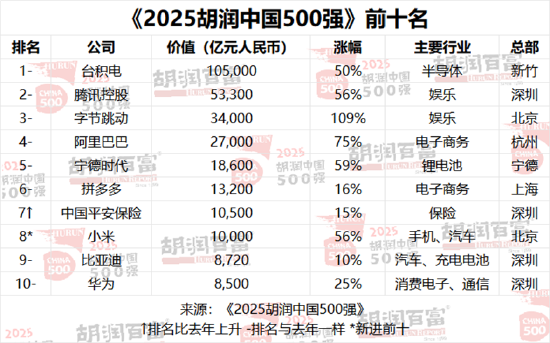
2025胡润中国500强发布:台积电、腾讯、字节跳动位列前三
Xin Lang Cai Jing· 2026-02-05 02:27
Core Insights - The 2025 Hurun China 500 list shows significant growth in company valuations, with TSMC leading as the highest valued private enterprise in China at 10.5 trillion RMB, followed by Tencent and ByteDance [1][9]. Company Performance - TSMC's value increased by 3.5 trillion RMB, driven by strong demand for artificial intelligence, advanced process technology, and a solid market position [3][11]. - Tencent's valuation rose by 1.9 trillion RMB, attributed to strong performance in gaming, advertising, and fintech [3][11]. - ByteDance's value grew by 1.8 trillion RMB, benefiting from advancements in AI [3][11]. - Alibaba's value increased by 1.2 trillion RMB, due to strategic investments in AI and cloud computing, alongside a recovery in traditional e-commerce [4][12]. - CATL's valuation rose by 690 billion RMB, supported by sustained demand in the electric vehicle market [4][12]. - Xiaomi entered the top ten with a valuation increase of 357 billion RMB, driven by growth in its automotive business and premium smartphone sales [4][12]. - Other notable companies include Cambricon, which saw a valuation increase of 370 billion RMB, and NetEase, which grew by 238 billion RMB due to strong gaming performance [4][12]. Industry Trends - The total value of the Hurun China 500 companies increased by 21 trillion RMB (38%) to reach 77 trillion RMB [2][10]. - The semiconductor industry experienced the most significant growth, surpassing the life sciences sector to become the second-largest industry in the list, while industrial products remained the largest [2][10]. - The real estate sector faced the largest decline, followed by retail [2][10]. - The average age of the top 500 companies is 29 years, indicating a relatively young corporate landscape [11]. Geographic Insights - Beijing, Shanghai, and Shenzhen are the top three cities with the most companies on the list, housing 59, 57, and 49 companies respectively [2][10]. - Suzhou emerged as the preferred manufacturing base with 68 companies, while Shanghai was the leading research and development hub with 101 companies [2][10]. New Entrants and Market Dynamics - A total of 95 companies (19%) made it to the list for the first time, with seven companies valued over 100 billion RMB [2][10]. - The threshold for entry into the 2025 Hurun China 500 increased by 7.5 billion RMB to 34 billion RMB, reflecting a 28% rise [2][10].




医药行业 2025Q4 公募基金持仓分析
GUOTAI HAITONG SECURITIES· 2026-02-04 13:40
Investment Rating - The report assigns an "Overweight" rating to the pharmaceutical industry, indicating a positive outlook based on ongoing technological innovation and demand growth [5][6]. Core Insights - The total market value of pharmaceutical stocks held by public funds decreased from 397.7 billion to 316.1 billion yuan, reflecting a decline of 2.58% from Q3 2025 to Q4 2025. The proportion of pharmaceutical stocks in all public fund holdings fell to 7.95%, down 2.58 percentage points from the previous quarter [6][9]. - The highest proportion of holdings in the pharmaceutical sector is in chemical preparations, other biological products, and medical research outsourcing, which accounted for 37.5%, 20.9%, and 16.4% of the total holdings, respectively [6][13]. - The top five pharmaceutical stocks by market value held by public funds in Q4 2025 were: Heng Rui Medicine (32 billion), WuXi AppTec (30.6 billion), Innovent Biologics (16.7 billion), Mindray Medical (15.2 billion), and CanSino Biologics (10.8 billion) [6][24]. Summary by Sections 1. Pharmaceutical Holdings Proportion - The proportion of pharmaceutical stocks held by public funds decreased to 7.95% in Q4 2025, down from Q3 2025, with a notable decline in non-pharmaceutical public fund holdings [9][10]. 2. Market Value of Pharmaceutical Sub-sectors - In Q4 2025, the market value of pharmaceutical sub-sectors held by public funds was as follows: 1. Chemical preparations: 118.6 billion yuan (37.5%) 2. Other biological products: 66 billion yuan (20.1%) 3. Medical research outsourcing: 51.7 billion yuan (16.4%) 4. Medical devices: 33.3 billion yuan (10.5%) 5. Medical consumables: 9.8 billion yuan (3.1%) [13][12]. 3. Public Fund Heavy Holdings - The number of public funds holding the top five pharmaceutical stocks in Q4 2025 was as follows: Heng Rui Medicine (507 funds), WuXi AppTec (448 funds), Mindray Medical (204 funds), Innovent Biologics (202 funds), and BeiGene (162 funds) [17][21]. - The market value growth of public fund heavy holdings in Q4 2025 saw significant increases for Heng Rui Medicine (+20.1 billion), WuXi AppTec (+5.7 billion), China National Pharmaceutical Group (+5 billion), Yingke Medical (+2.2 billion), and Yuyue Medical (+1.8 billion) [28].