
Mindray(300760)

Search documents
创业板50指数:龙头出海,链动全球
GF SECURITIES· 2026-02-04 09:09
Group 1 - The ChiNext 50 Index (399673.SZ) was launched on June 18, 2014, to reflect the overall performance of large-cap, liquid leading companies in the ChiNext market [3] - The index focuses on four key sectors: information technology, new energy, financial technology, and pharmaceuticals, with the top three industries being batteries (26.14%), communication equipment (23.46%), and photovoltaic equipment (7.26%), collectively accounting for 56.85% [14][24] - The index's constituent stocks are industry leaders with high representation, covering sectors such as new energy, optical modules, financial technology, PCB, and medical devices [14] Group 2 - The ChiNext 50 Index emphasizes international competitiveness and deep integration into the global industrial chain, promoting sectors with existing international competitiveness to grow stronger [18] - The index's constituent stocks have significant international operations, with overseas business income accounting for 35.17% of total revenue, higher than other major indices [25][28] - Leading companies in the index, such as CATL and Lens Technology, are key suppliers to international giants like Tesla and Apple, showcasing their strong global presence [24][26] Group 3 - The ChiNext 50 Index exhibits high elasticity and is particularly advantageous during phases of rising risk appetite, outperforming broader indices like the ChiNext Index and CSI 300 [32] - Over the past five years, the annualized return of the ChiNext 50 Index has been among the highest in its category, demonstrating its high-risk, high-reward characteristics [35] - The index is suitable for aggressive investment strategies during bull markets, aiming for higher excess returns [35] Group 4 - The valuation of the ChiNext 50 Index has returned to a reasonable range, with a current PE ratio of approximately 42, indicating a higher relative investment value [39] - The index has experienced a prolonged adjustment period, with its valuation significantly lagging behind fundamental declines, suggesting potential for future valuation and profit-driven resonance [41] - The index's constituent stocks have shown strong earnings growth, with a projected EPS compound growth rate significantly higher than other major indices [46] Group 5 - The lithium battery sector is experiencing a supply-demand resonance, driving both volume and price increases, with significant growth in demand from energy storage and new energy vehicles [55] - The communication equipment sector is benefiting from the AI data center construction, with a strong demand forecast for optical modules driven by major cloud providers [60] - The photovoltaic industry is transitioning towards high-quality development, with rising prices for raw materials like polysilicon, supported by government policies aimed at preventing "involution" in competition [67][68]






医疗器械板块2月4日涨0.9%,赛科希德领涨,主力资金净流出1.32亿元
Zheng Xing Xing Ye Ri Bao· 2026-02-04 08:56
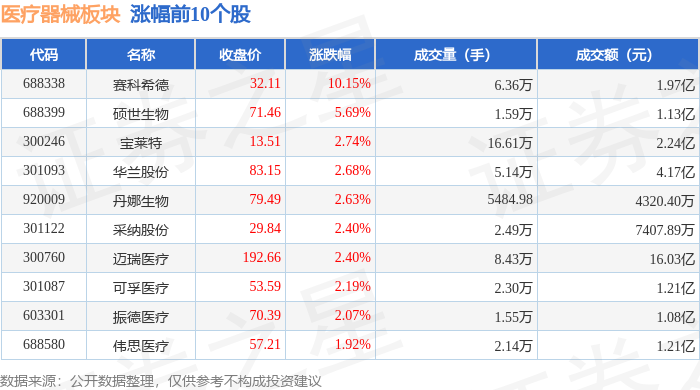
Market Overview - The medical device sector increased by 0.9% on February 4, with SAIKOSHI leading the gains [1] - The Shanghai Composite Index closed at 4102.2, up 0.85%, while the Shenzhen Component Index closed at 14156.27, up 0.21% [1] Top Performers - SAIKOSHI (688338) closed at 32.11, up 10.15% with a trading volume of 63,600 shares and a transaction value of 197 million [1] - SHUOSHI BIO (6638889) closed at 71.46, up 5.69% with a trading volume of 15,900 shares and a transaction value of 113 million [1] - BAOLAIT (300246) closed at 13.51, up 2.74% with a trading volume of 166,100 shares and a transaction value of 224 million [1] Underperformers - KANGZHONG MEDICAL (688607) closed at 57.80, down 4.26% with a trading volume of 46,300 shares [2] - SINO MEDICAL (688108) closed at 22.70, down 3.77% with a trading volume of 170,600 shares and a transaction value of 387 million [2] - SANYOU MEDICAL (688085) closed at 21.05, down 3.08% with a trading volume of 39,800 shares and a transaction value of 84 million [2] Capital Flow - The medical device sector experienced a net outflow of 132 million from institutional investors, while retail investors saw a net outflow of 191 million [2] - Speculative funds had a net inflow of 323 million into the sector [2] Individual Stock Capital Flow - MAIRUI MEDICAL (300760) had a net inflow of 86.91 million from institutional investors, while retail investors had a net outflow of 169 million [3] - LIANSHENG MEDICAL (688271) saw a net inflow of 44.32 million from institutional investors, with a net outflow of 76.86 million from retail investors [3] - HUAKANG CLEAN (301235) had a net inflow of 31.25 million from institutional investors, while retail investors experienced a net outflow of 52.92 million [3]




从设备招投标看2026年行业投资机遇:设备拐点向上趋势明确,医疗新科技蓬勃发展
Ping An Securities· 2026-02-04 08:50
Investment Rating - The report maintains an "Outperform" rating for the pharmaceutical and biotechnology industry [1] Core Insights - The medical device bidding market is expected to maintain high prosperity in 2025, driven by policy and demand resonance, with a projected market size of CNY 193.76 billion, representing a year-on-year growth of 24% [3][11] - The upward trend for medical device companies is clear for 2026, with multiple policies expected to support the continuous development of medical innovation [4][29] - The report emphasizes the importance of high-end product localization and innovation in driving growth for leading domestic companies [33][41] Summary by Sections Bidding Review - The medical device bidding market in 2025 is projected to reach CNY 193.76 billion, with a year-on-year increase of 24%, second only to the peak in 2022 [3][11] - Monthly bidding trends show sustained high levels, with procurement amounts from July to December ranging from CNY 134 billion to CNY 285 billion [3][11] - Key segments such as medical imaging equipment and radiation therapy devices are expected to see significant growth, with year-on-year increases of 35.37% and 36.34% respectively [3][16] 2026 Outlook - The report anticipates a clear upward turning point for medical device companies in 2026, supported by policies aimed at promoting medical innovation and equipment updates [4][29] - The implementation of large-scale equipment updates and consumer replacement policies is expected to further stimulate market demand [4][29] - The report highlights the potential for domestic companies to benefit from high-end product upgrades and the commercialization of brain-computer interface technologies [4][50] Investment Recommendations - The report suggests focusing on leading domestic companies that are enhancing their high-end and intelligent medical device offerings, such as Mindray, United Imaging, and KaiLi Medical [4][33] - It also recommends monitoring companies involved in brain-computer interfaces and domestic robotics, which are expected to see significant growth in the coming years [4][50]





迈瑞医疗涨2.10%,成交额11.36亿元,主力资金净流入3675.05万元
Xin Lang Zheng Quan· 2026-02-04 06:17
Core Viewpoint - Mindray Medical's stock price has shown fluctuations, with a recent increase of 2.10% to 192.11 CNY per share, while the company faces a decline in revenue and profit year-on-year [1][2]. Group 1: Stock Performance - As of February 4, Mindray Medical's stock price increased by 2.10%, reaching 192.11 CNY per share, with a trading volume of 1.136 billion CNY and a turnover rate of 0.50% [1]. - Year-to-date, the stock price has risen by 0.87%, with a 5-day increase of 2.15%, but a decline of 4.36% over the past 20 days and 7.64% over the past 60 days [1]. Group 2: Financial Performance - For the period from January to September 2025, Mindray Medical reported a revenue of 25.834 billion CNY, a year-on-year decrease of 12.38%, and a net profit attributable to shareholders of 7.570 billion CNY, down 28.83% year-on-year [2]. - Since its A-share listing, Mindray Medical has distributed a total of 35.336 billion CNY in dividends, with 25.025 billion CNY distributed over the last three years [3]. Group 3: Shareholder Information - As of September 30, 2025, the number of shareholders for Mindray Medical reached 108,800, an increase of 18.86% from the previous period, while the average number of circulating shares per person decreased by 15.87% to 11,139 shares [2]. - The top ten circulating shareholders include Hong Kong Central Clearing Limited, which holds 117 million shares, a decrease of 14.736 million shares from the previous period [3].
2月3日创业板医疗(970082)指数涨2.37%,成份股诺思格(301333)领涨
Sou Hu Cai Jing· 2026-02-03 10:53
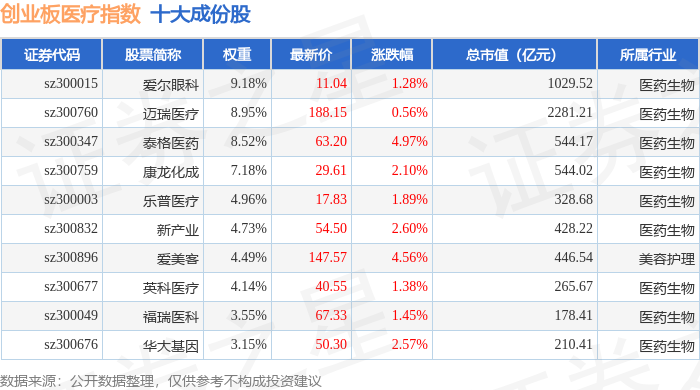
Core Viewpoint - The ChiNext Medical Index (970082) closed at 3876.07 points on February 3, with a gain of 2.37% and a trading volume of 13.236 billion yuan, indicating positive market sentiment in the medical sector [1]. Group 1: Index Performance - The ChiNext Medical Index saw 49 constituent stocks rise, with NuoSiGe leading the gains at 8.76% [1]. - The index's turnover rate was 1.71%, reflecting moderate trading activity [1]. Group 2: Top Constituents - The top ten constituents of the ChiNext Medical Index include: - YuanEr Eye Hospital (sz300015) with a weight of 9.18% and a latest price of 11.04 yuan, up 1.28% [1]. - MaiRui Medical (sz300760) with a weight of 8.95% and a latest price of 188.15 yuan, up 0.56% [1]. - TaiGe Medical (sz300347) with a weight of 8.52% and a latest price of 63.20 yuan, up 4.97% [1]. - KangLong HuaCheng (sz300759) with a weight of 7.18% and a latest price of 29.61 yuan, up 2.10% [1]. - LePu Medical (sz300003) with a weight of 4.96% and a latest price of 17.83 yuan, up 1.89% [1]. - New Industry (sz300832) with a weight of 4.73% and a latest price of 54.50 yuan, up 2.60% [1]. - AiMeiKe (sz300896) with a weight of 4.49% and a latest price of 147.57 yuan, up 4.56% [1]. - YingKe Medical (sz300677) with a weight of 4.14% and a latest price of 40.55 yuan, up 1.38% [1]. - FuRui Medical (sz300049) with a weight of 3.55% and a latest price of 67.33 yuan, up 1.45% [1]. - HuaDa Gene (sz300676) with a weight of 3.15% and a latest price of 50.30 yuan, up 2.57% [1]. Group 3: Capital Flow - The net inflow of main funds into the ChiNext Medical Index constituents totaled 145 million yuan, while retail investors experienced a net outflow of 106 million yuan [1]. - The detailed capital flow indicates that TaiGe Medical had a main fund net inflow of 10.514 million yuan, while retail investors had a net outflow of 18.28% [2].




创业50ETF(159682)跌0.07%,半日成交额2.23亿元
Xin Lang Cai Jing· 2026-02-03 03:39
Group 1 - The core viewpoint of the article highlights the performance of the 创业50ETF (159682), which experienced a slight decline of 0.07% to 1.499 yuan at midday, with a trading volume of 2.23 billion yuan [1] - Major holdings within the 创业50ETF include 宁德时代, which fell by 1.04%, 中际旭创 down by 1.06%, and 新易盛 decreasing by 4.13%, while 东方财富 increased by 0.27% and 天孚通信 surged by 9.14% [1] - The fund's performance benchmark is the 创业板50 index return, managed by 景顺长城基金管理有限公司, with a return of 49.56% since its establishment on December 23, 2022, and a 1.23% return over the past month [1]


医疗创新ETF(516820)连续12天净流入,政策持续助力医药产业发展
Xin Lang Cai Jing· 2026-02-03 03:27
Group 1 - The core viewpoint of the news highlights the positive performance of the medical innovation sector, with the CSI Medical and Medical Device Innovation Index showing mixed results among its constituent stocks, led by Aimeike with a 2.18% increase [1] - The Medical Innovation ETF has seen continuous net inflows over the past 12 days, with a peak single-day net inflow of 41.83 million yuan, totaling 234 million yuan, averaging 19.54 million yuan per day [1] - Policy support for the pharmaceutical industry is ongoing, with Shanghai accelerating the implementation of major industrial projects in fields such as integrated circuits, biomedicine, and artificial intelligence [1] Group 2 - The CSI Medical and Medical Device Innovation Index consists of 30 listed companies with good profitability, growth potential, and research innovation capabilities, reflecting the overall performance of profitable and growth-oriented pharmaceutical and medical device companies [2] - As of January 30, 2026, the top ten weighted stocks in the index include WuXi AppTec, Mindray Medical, and Heng Rui Medicine, accounting for 63.9% of the total index weight [2] - The success rate of Phase I clinical trials for dozens of AI-derived pipelines entering trials in 2025 is projected to be as high as 80%-90%, significantly exceeding traditional levels of 40%-65% [1]


迈瑞医疗2月2日获融资买入1.48亿元,融资余额42.87亿元
Xin Lang Cai Jing· 2026-02-03 01:33
Core Viewpoint - On February 2, Mindray Medical experienced a decline of 1.14% in stock price with a trading volume of 1.259 billion yuan, indicating a challenging market environment for the company [1]. Financing and Margin Trading - On February 2, Mindray Medical had a financing buy amount of 148 million yuan and a financing repayment of 165 million yuan, resulting in a net financing outflow of 16.78 million yuan [1]. - As of February 2, the total margin trading balance for Mindray Medical was 4.336 billion yuan, with a financing balance of 4.287 billion yuan, accounting for 1.89% of the circulating market value, which is above the 90th percentile level over the past year [1]. - In terms of securities lending, on February 2, Mindray Medical had 700 shares repaid and 4,800 shares sold short, with a selling amount of approximately 898,100 yuan, and a remaining short position of 259,100 shares valued at 48.48 million yuan, also above the 80th percentile level over the past year [1]. Company Overview - Mindray Medical, established on January 25, 1999, and listed on October 16, 2018, is located in Shenzhen, China, and specializes in the research, manufacturing, marketing, and service of medical devices [2]. - The company's revenue composition includes in vitro diagnostic products (38.37%), life information and support products (32.73%), medical imaging products (19.78%), electrophysiology and vascular intervention products (7.25%), and other products (1.56%) [2]. - As of September 30, the number of shareholders for Mindray Medical was 108,800, an increase of 18.86% from the previous period, while the average circulating shares per person decreased by 15.87% to 11,139 shares [2]. Financial Performance - For the period from January to September 2025, Mindray Medical reported a revenue of 25.834 billion yuan, a year-on-year decrease of 12.38%, and a net profit attributable to shareholders of 7.570 billion yuan, down 28.83% year-on-year [2]. Dividend Distribution - Since its A-share listing, Mindray Medical has distributed a total of 35.336 billion yuan in dividends, with 25.025 billion yuan distributed over the past three years [3]. Institutional Holdings - As of September 30, 2025, the top ten circulating shareholders of Mindray Medical included Hong Kong Central Clearing Limited as the third-largest shareholder with 117 million shares, a decrease of 14.736 million shares from the previous period [3]. - Other notable institutional shareholders include E Fund's ChiNext ETF and Huatai-PB's CSI 300 ETF, both of which have seen reductions in their holdings [3].
2月金股组合
Bank of China Securities· 2026-02-01 08:53
Strategy Overview - The core strategy indicates that Trump's nomination of Kevin Warsh as the next Federal Reserve Chairman suggests a hawkish policy stance, advocating for balance sheet reduction and cautious interest rate cuts, which may reverse market expectations for continued liquidity easing and strengthen the dollar, leading to a global tightening of dollar liquidity expectations and asset price reassessment [4][2] - In the short term, after a strong spring rally, the market may enter a rhythm adjustment period due to proactive policy guidance and increased overseas disturbances, presenting rotation opportunities for previously stagnant sectors [4][2] Real Estate Sector: Poly Real Estate Group - The company experienced a 48.1% year-on-year revenue growth in the first half of 2025, driven by increased project completions, with a settlement area of 814,000 square meters, up 20.8% year-on-year, and a settlement amount of 17.37 billion yuan, up 52.5% year-on-year [8] - Despite revenue growth, the net profit attributable to shareholders decreased by 44.3%, primarily due to a negative investment income of 950 million yuan and an increase in minority shareholder losses [8] - The company’s gross margin improved to 17.5%, up 3.2 percentage points year-on-year, while the net profit margin decreased to 1.3%, down 0.7 percentage points year-on-year [8][9] - The company’s debt structure improved, with interest-bearing debt down 8.6% year-on-year to 68.2 billion yuan, and the average financing cost decreased by 48 basis points to 2.90% [9] - The company’s sales ranking improved to 15th in the industry, with a sales amount of 29.5 billion yuan in the first seven months of 2025, despite a 13.5% year-on-year decline [10] Transportation Sector: CITIC Offshore Helicopter - CITIC Offshore Helicopter is a leading player in China's general aviation sector, operating the largest civil helicopter fleet in Asia with 84 advanced model helicopters [13] - The company has a strong revenue stream from offshore oil services, with nearly 70% of its revenue derived from this segment, and maintains a market share of over 60% in the offshore helicopter service market [14] - The general aviation market in China is expected to grow steadily, supported by policy guidance, with the number of general airports reaching 475 and the number of general aviation enterprises reaching 760 by 2024 [14] Transportation Sector: Air China - Air China is the only flag carrier in China, with passenger transport services accounting for nearly 91% of total revenue in 2024 [16] - The company reported a revenue of 166.7 billion yuan in 2024, up 18.14% year-on-year, with a sales gross margin of 5.11% [16] - The domestic passenger transport volume reached 730 million in 2024, a 17.86% increase year-on-year, marking a historical high [17] Chemical Sector: Zhejiang Longsheng - The company reported a 6.47% year-on-year decline in revenue to 6.505 billion yuan in the first half of 2025, with a gross margin of 29.80%, up 1.87 percentage points year-on-year [19][20] - The dye business saw a slight revenue decline of 3.17% to 3.632 billion yuan, but the gross margin improved by 4.40 percentage points to 34.17% [19] - The company is focusing on cost reduction and efficiency improvements to maintain stable development amid industry challenges [19] Chemical Sector: Yake Technology - The company achieved a revenue growth of 15.37% in the electronic materials segment, with a total revenue of 2.573 billion yuan in the first half of 2025 [24] - The company is actively developing new technologies and products in the LNG and electronic materials sectors, with a focus on semiconductor chemical materials [23] New Energy Sector: Foster - Foster is a leading player in the photovoltaic encapsulation materials market, maintaining a market share of around 50% [27] - The company is exploring new solutions for space environment applications, leveraging its existing technology in photovoltaic materials [28] Medical Sector: Mindray Medical - The company faced revenue pressure in the first half of 2025, with a 23.77% year-on-year decline in Q2 revenue to 8.506 billion yuan [29] - International business revenue increased by 5.39%, accounting for about 50% of total revenue, indicating a growing presence in the global market [30] - The company is focusing on building a digital healthcare ecosystem through the integration of devices, IT, and AI technologies [31] Food and Beverage Sector: Kweichow Moutai - The company is navigating a challenging environment in the liquor industry, focusing on quality and long-term value rather than short-term performance metrics [33] - In Q3 2025, the company reported a revenue of 39.06 billion yuan, a slight increase of 0.6% year-on-year, with a gross margin of 91.3% [34] Social Services Sector: Lingnan Holdings - The company achieved a revenue of 2.09 billion yuan in the first half of 2025, up 8.52% year-on-year, with a net profit of 50 million yuan, up 24.39% [36] - The company is expanding its travel agency and hotel management services, with a focus on enhancing its operational capabilities [38] Electronics Sector: Zhaoyi Innovation - The company expects a revenue of approximately 9.203 billion yuan in 2025, a 25% year-on-year increase, driven by demand from AI computing and the storage industry [39]





迈瑞医疗:公司已跻身全球顶尖医疗器械企业第23名
Zheng Quan Ri Bao Wang· 2026-01-29 13:45
证券日报网讯1月29日,迈瑞医疗(300760)在互动平台回答投资者提问时表示,迈瑞是全球领先、创 新驱动的世界级医疗器械企业及医疗数智化引领者。公司已跻身全球顶尖医疗器械企业第23名,并且排 名在不断上升,是全球前30大医疗器械企业中唯一上榜的中国企业,也是从成立到上榜最快的企业之 一。公司始终秉持"成为守护人类健康的核心力量"的愿景,将科技创新与人文关怀相结合,致力于让每 一位患者无论地域、经济条件如何,都能享受到安全、可及、可负担的优质医疗服务。公司坚信,科技 的最终价值不仅在于效率和成本的改善,更在于守护生命、提升健康水平和推动医疗公平。作为全球医 疗健康产业的重要参与者,公司把推动医疗资源均衡配置、缓解社会公共健康压力和提升全人类的健康 水平作为长期使命。未来,公司将继续以负责任的企业公民姿态,依托数智化创新,回应社会关切与临 床需求,让医疗创新真正服务于人类福祉。 ...