
Mindray(300760)

Search documents
迈瑞医疗(300760):25Q3营收同比转正,国际业务收入同比增速显著:——迈瑞医疗(300760.SZ)2025三季度报告点评
EBSCN· 2025-11-02 06:51
Investment Rating - The report maintains a "Buy" rating for the company, indicating a favorable outlook for investment over the next 6-12 months [4][6]. Core Insights - The company achieved a revenue of 25.834 billion yuan in the first three quarters of 2025, a year-on-year decrease of 12.38%. However, Q3 2025 saw a revenue increase of 1.53% year-on-year, with a net profit of 2.501 billion yuan, down 18.69% year-on-year [1][2]. - International business revenue grew significantly, with a year-on-year increase of 11.93% in Q3 2025, driven by the expansion of high-end overseas customer bases and improved localization capabilities [2][3]. - The company continues to invest in R&D, with expenses of 828 million yuan in Q3 2025, representing 9.11% of revenue, and has launched several innovative products across various medical fields [3][4]. Summary by Sections Financial Performance - For Q3 2025, the company reported a revenue of 9.091 billion yuan, a 1.53% increase year-on-year, while net profit decreased by 18.69% to 2.501 billion yuan [1][2]. - The company’s revenue for the first three quarters of 2025 was 25.834 billion yuan, down 12.38% year-on-year, with a net profit of 7.570 billion yuan, down 28.83% [1]. Business Segments - The in-vitro diagnostics segment generated 3.634 billion yuan in Q3 2025, a decrease of 2.81% year-on-year. The life information and support segment saw a revenue of 2.952 billion yuan, up 2.60% year-on-year, with minimally invasive surgery business growing over 25% [2]. - The medical imaging segment reported revenue of 1.689 billion yuan, remaining stable year-on-year [2]. R&D and Innovation - The company’s R&D expenses in Q3 2025 were 828 million yuan, a 1.37% increase year-on-year, highlighting a commitment to innovation [3]. - New product launches include advanced diagnostic kits and systems in various medical fields, enhancing the company's product portfolio [3]. Strategic Initiatives - The company is strengthening domestic and international collaborations, including partnerships for medical talent training and discussions for deeper cooperation with foreign officials [3][4]. - The report emphasizes the importance of these strategic initiatives in supporting the company's global expansion efforts [3].

迈瑞医疗
2025-11-01 12:41
Summary of the Conference Call for Mindray Medical (2025 Q3) Company Overview - **Company**: Mindray Medical - **Industry**: Medical Devices and Healthcare Solutions Key Points and Arguments Financial Performance - In Q3 2025, Mindray Medical achieved a revenue of **9.091 billion CNY**, representing a **1.53%** year-on-year growth [2] - The net profit attributable to shareholders was **2.501 billion CNY**, down **18.69%** year-on-year [2] - Operating cash flow reached **3.351 billion CNY**, up **30.02%** year-on-year [2] - The company has maintained a consistent dividend policy, with a total dividend payout of approximately **35.77 billion CNY** since its IPO, including a recent cash dividend of **1.637 billion CNY** [3] International Market Growth - International business grew by **12%** year-on-year in Q3, with Europe showing over **20%** growth [3][4] - The share of international business in total revenue exceeded **50%**, with in vitro diagnostics (IVD) contributing **28%** to international revenue [4] - The company is focusing on building a global supply chain and local production capabilities to support long-term growth in international markets [4] Domestic Market Recovery - Domestic equipment business began to recover in Q3 due to the resumption of medical device bidding activities [4] - The decline in revenue for the domestic market has narrowed significantly, with the company maintaining a leading market position in several product categories [5] Product Lines Performance - The IVD segment reported a revenue of **3.634 billion CNY**, down **2.81%** year-on-year, but international IVD revenue showed double-digit growth [5] - The Life Information and Support segment achieved a revenue of **2.952 billion CNY**, with a growth of **2.6%** year-on-year, and international revenue accounted for **70%** of this segment [7] - The Medical Imaging segment's revenue was **1.689 billion CNY**, remaining stable year-on-year, with international revenue contributing **61%** [9] R&D and Innovation - R&D investment for the first three quarters of 2025 was **2.686 billion CNY**, accounting for **10.40%** of revenue [11] - New product launches included high-sensitivity cardiac troponin T assays and other immunoassay kits, enhancing the IVD product portfolio [12][34] - The company is focusing on technological innovations in IVD, particularly in hormone detection, to achieve international leading standards [33][34] Strategic Initiatives - Mindray is enhancing its digital solutions and AI integration to improve hospital efficiency and patient care [17][18] - The company is actively pursuing international expansion, with a focus on local talent and supply chain development to mitigate geopolitical risks [21][22] - The upcoming Hong Kong IPO is seen as a strategic move to enhance brand recognition and support international market penetration [26][28] Challenges and Opportunities - The domestic IVD market faces challenges due to intense competition and ongoing healthcare reforms, but there is significant potential for market share growth [6][38] - The company aims to increase its market share in the IVD segment from **10%** to **20%** within three years, focusing on large-volume hospitals [37][39] Corporate Social Responsibility - Mindray is committed to public health initiatives, including training for emergency response and donations of medical equipment to support charitable causes [13][14] Conclusion - Mindray Medical is navigating a complex macroeconomic environment while demonstrating resilience through strategic growth in international markets and a focus on innovation. The company is well-positioned to capitalize on emerging opportunities in both domestic and international healthcare sectors.
医疗设备月度中标梳理-20251031
Tianfeng Securities· 2025-10-31 14:22
Investment Rating - The industry investment rating is maintained at "Outperform" [3][52]. Core Insights - In September 2025, the total bid amount for medical devices reached 15.534 billion yuan, showing a month-on-month increase of 18% but a year-on-year decrease of 3%. The total bid amount from January to September 2025 was 125.908 billion yuan, reflecting a year-on-year growth of 42% [4][9]. Summary by Sections Medical Device Procurement Overview - The total bid amount for medical devices in September 2025 was 15.534 billion yuan, with a month-on-month increase of 18% and a year-on-year decrease of 3%. The cumulative bid amount from January to September 2025 was 125.908 billion yuan, representing a year-on-year increase of 42% [4][9]. Domestic Brands - **United Imaging**: In September 2025, the total bid amount was 836 million yuan, a year-on-year increase of 23%. From January to September 2025, the total was 7.871 billion yuan, up 55% year-on-year [5][13]. - **Myray Medical**: The total bid amount in September 2025 was 999.2 million yuan, a year-on-year increase of 14% and a month-on-month increase of 18%. The cumulative amount from January to September was 6.898 billion yuan, reflecting a year-on-year growth of 43% [17][18]. - **Kaili Medical**: The total bid amount in September 2025 was 162 million yuan, a year-on-year increase of 65%. The cumulative amount from January to September was 1.067 billion yuan, up 94% year-on-year [25][26]. - **Wandong Medical**: The total bid amount in September 2025 was 130 million yuan, a year-on-year increase of 51%. The cumulative amount from January to September was 1.066 billion yuan, reflecting a year-on-year growth of 98% [33][34]. - **Shanwaishan**: The total bid amount in September 2025 was 66 million yuan, a year-on-year increase of 25%. The cumulative amount from January to September was 349 million yuan, up 134% year-on-year [29][30]. Imported Brands - **Philips**: The total bid amount in September 2025 was 980 million yuan, a year-on-year increase of 36%. The cumulative amount from January to September was 6.701 billion yuan, reflecting a year-on-year growth of 32% [36][37]. - **Siemens**: The total bid amount in September 2025 was 1.014 billion yuan, a year-on-year increase of 8%. The cumulative amount from January to September was 8.502 billion yuan, up 42% year-on-year [40][41]. - **GE Medical**: The total bid amount in September 2025 was 1.288 billion yuan, a year-on-year increase of 6%. The cumulative amount from January to September was 9.822 billion yuan, reflecting a year-on-year growth of 36% [44][45].




迈瑞医疗:第三季度营收同比上升1.5%至90.9亿元,拟每10股派息13.5元
Cai Jing Wang· 2025-10-31 12:27
Core Insights - The company reported a decline in revenue and net profit for the first three quarters of 2025, with total revenue at 25.83 billion yuan, down 12.4% year-on-year, and net profit attributable to shareholders at 7.57 billion yuan, down 28.8% [1] Financial Performance - For Q3 2025, the company achieved revenue of 9.09 billion yuan, an increase of 1.5% year-on-year, while net profit attributable to shareholders was 2.50 billion yuan, a decrease of 18.7% [1] - The company's net profit excluding non-recurring items for Q3 was 2.51 billion yuan, down 17.8% year-on-year [1] - The earnings per share (EPS) for Q3 was 2.063 yuan [1] Assets and Dividends - As of the end of Q3, the company's total assets amounted to 59.265 billion yuan, reflecting a growth of 4.6% compared to the end of the previous year [1] - The net assets attributable to shareholders were 39.298 billion yuan, up 9.6% year-on-year [1] - The company plans to distribute a cash dividend of 13.5 yuan (including tax) for every 10 shares, totaling approximately 1.637 billion yuan (including tax), indicating a commitment to shareholder returns while focusing on long-term business development and innovation [1]
迈瑞医疗全球化:加速掘金6万亿国际市场,AI布局冀望“直道超车”
Bei Jing Shang Bao· 2025-10-31 11:35
Core Insights - The "14th Five-Year Plan" emphasizes significant improvements in technological self-reliance and innovation, particularly in key sectors like medical devices, positioning China to compete globally [1][3] - The global medical device market is projected to exceed 6 trillion yuan by 2030, providing substantial growth opportunities for Chinese companies [1][3] Company Performance - Mindray Medical reported Q3 2025 revenue of 9.091 billion yuan, a year-on-year increase of 1.53%, with a quarter-on-quarter growth of 6.88% [2] - The company's net profit for the same period was 2.501 billion yuan, reflecting a quarter-on-quarter increase of 2.50% [2] - Mindray's contract liabilities reached 2.263 billion yuan by the end of Q3, a year-on-year increase of 31.45%, indicating strong future revenue potential [2] Innovation and R&D - Mindray's R&D investment for the first three quarters of 2025 was 2.686 billion yuan, accounting for 10.40% of its revenue, which is an increase from the previous year [4] - The company has applied for a total of 12,513 patents, with 9,034 being invention patents, showcasing its commitment to innovation [5][6] - Mindray's focus on digital transformation and high-end breakthroughs has positioned it favorably within the global value chain [2][7] Market Expansion - In the first eight months of 2025, China's medical device exports grew by 6.29%, with a trade surplus of 84.201 billion yuan, reflecting the industry's global rise [3] - Mindray's international business saw a year-on-year growth of 11.93% in Q3, with international revenue accounting for 50.6% of total revenue [3][11] - The company has successfully penetrated high-end markets, with significant growth in Europe and other regions [3][12] Strategic Initiatives - Mindray's digital ecosystem is evolving, with plans to launch a clinical application model for critical care, marking a significant milestone in AI and healthcare integration [9][10] - The company aims to enhance its global presence through innovative products and solutions, targeting both developed and developing markets [13][14] - Mindray's commitment to social responsibility is evident through its initiatives in emergency training and partnerships with international organizations for healthcare equity [15]
10月31日生物经济(970038)指数涨0.77%,成份股华兰疫苗(301207)领涨
Sou Hu Cai Jing· 2025-10-31 10:51
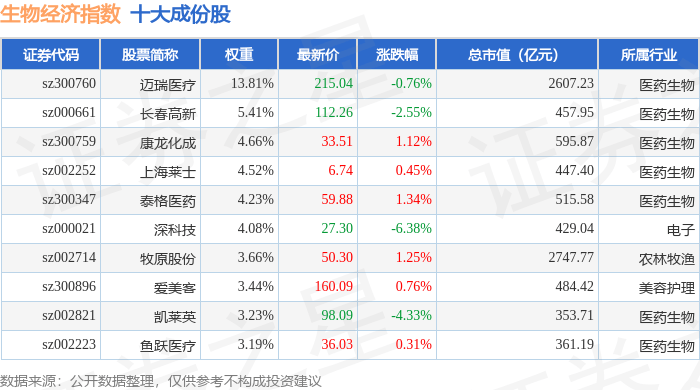
Core Insights - The Biotech Index (970038) closed at 2279.35 points, up 0.77%, with a trading volume of 28.709 billion yuan and a turnover rate of 1.85% [1] - Among the index constituents, 41 stocks rose, with Hualan Vaccine leading at a 17.88% increase, while 8 stocks fell, with Deep Technology leading the decline at 6.38% [1] Index Performance - The Biotech Index saw a net inflow of 140 million yuan from institutional investors, while retail investors contributed a net inflow of 210 million yuan, and there was a net outflow of 350 million yuan from speculative funds [1] Top Constituents - The top ten constituents of the Biotech Index include: - Mindray Medical (sz300760) with a weight of 13.81%, latest price at 215.04, and a decrease of 0.76% [1] - Changchun High-tech (sz000661) with a weight of 5.41%, latest price at 112.26, and a decrease of 2.55% [1] - Kanglong Chemical (sz300759) with a weight of 4.66%, latest price at 33.51, and an increase of 1.12% [1] - Other notable constituents include Muyuans (sz002714) and Aimeike (sz300896) with respective weights of 3.66% and 3.44% [1] Capital Flow Details - Detailed capital flow for key stocks includes: - Mindray Medical saw a net inflow of 26.2 million yuan from institutional investors [2] - Muyuans had a net inflow of 203 million yuan from institutional investors [2] - Hualan Vaccine experienced a net inflow of 74.8 million yuan from institutional investors [2]






10月31日医疗健康R(480016)指数涨1.68%,成份股泽璟制药(688266)领涨
Sou Hu Cai Jing· 2025-10-31 10:51
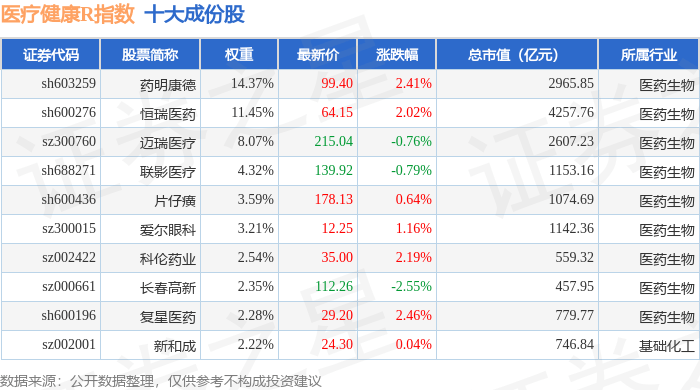
Core Points - The Medical Health R Index (480016) closed at 7755.61 points, up 1.68%, with a total transaction volume of 40.103 billion yuan and a turnover rate of 1.25% [1] - Among the index constituents, 43 stocks rose, with Zai Jian Pharmaceutical leading with a 16.14% increase, while 6 stocks fell, with Kailai Ying leading the decline at 4.33% [1] Index Constituents Summary - The top ten constituents of the Medical Health R Index include: - WuXi AppTec (603259) with a weight of 14.37%, latest price at 99.40 yuan, and a 2.41% increase, total market value of 296.585 billion yuan [1] - Hengrui Medicine (600276) with a weight of 11.45%, latest price at 64.15 yuan, and a 2.02% increase, total market value of 425.776 billion yuan [1] - Mindray Medical (300760) with a weight of 8.07%, latest price at 215.04 yuan, and a 0.76% decrease, total market value of 260.723 billion yuan [1] - United Imaging Healthcare (688271) with a weight of 4.32%, latest price at 139.92 yuan, and a 0.79% decrease, total market value of 115.316 billion yuan [1] - Pianzai Shou (600436) with a weight of 3.59%, latest price at 178.13 yuan, and a 0.64% increase, total market value of 107.469 billion yuan [1] - Aier Eye Hospital (300015) with a weight of 3.21%, latest price at 12.25 yuan, and a 1.16% increase, total market value of 114.236 billion yuan [1] - Kelun Pharmaceutical (002422) with a weight of 2.54%, latest price at 35.00 yuan, and a 2.19% increase, total market value of 55.932 billion yuan [1] - Changchun High-tech (000661) with a weight of 2.35%, latest price at 112.26 yuan, and a 2.55% decrease, total market value of 45.795 billion yuan [1] - Fosun Pharma (600196) with a weight of 2.28%, latest price at 29.20 yuan, and a 2.46% increase, total market value of 77.977 billion yuan [1] - New Hope Liuhe (002001) with a weight of 2.22%, latest price at 24.30 yuan, and a 0.04% increase, total market value of 74.684 billion yuan [1] Capital Flow Summary - The net inflow of main funds into the Medical Health R Index constituents totaled 406 million yuan, while speculative funds saw a net outflow of 644 million yuan, and retail investors had a net inflow of 237 million yuan [1] - Specific capital flow details for key stocks include: - Mindray Medical (300760) with a main fund net inflow of 262 million yuan and a speculative fund net outflow of 127 million yuan [2] - BeiGene (688235) with a main fund net inflow of 233 million yuan and a speculative fund net outflow of 225 million yuan [2] - Haizhi Pharmaceutical (002653) with a main fund net inflow of 92.778 million yuan and a retail net outflow of 95.916 million yuan [2] - New Hope Liuhe (002001) with a main fund net inflow of 90.378 million yuan and a speculative fund net outflow of 43.538 million yuan [2] - Renfu Pharmaceutical (600079) with a main fund net inflow of 71.683 million yuan and a speculative fund net outflow of 41.302 million yuan [2]




归母净利润降18%:迈瑞生物发布Q3财报
仪器信息网· 2025-10-31 09:39
Core Viewpoint - The article discusses the financial performance and strategic initiatives of Shenzhen Mindray Bio-Medical Electronics Co., Ltd. for the third quarter of 2025, highlighting both challenges and growth opportunities in various business segments. Financial Data Summary - The company's operating revenue for the third quarter of 2025 was CNY 9,090,902,689, representing a year-on-year increase of 1.53%. However, the total revenue for the first three quarters decreased by 12.38% to CNY 25,833,906,543 [2][13]. - The net profit attributable to shareholders for the third quarter was CNY 2,501,277,420, down 18.69% year-on-year, while the net profit for the first three quarters fell by 28.83% to CNY 7,570,044,518 [2][13]. - The basic earnings per share for the third quarter was CNY 2.0641, a decrease of 18.62% compared to the previous year [2][13]. - The company's total assets increased by 4.63% to CNY 59,265,123,962 compared to the end of the previous year [2][13]. Business Segment Performance - The international business segment saw a year-on-year growth of 11.93% in the third quarter, with significant contributions from the European market, which grew over 20% [13][14]. - The Life Information and Support segment generated CNY 29.52 billion in revenue for the third quarter, a growth of 2.60%, with minimally invasive surgery business growing over 25% [14][15]. - The Medical Imaging segment's revenue was CNY 16.89 billion, remaining stable year-on-year, while the In Vitro Diagnostics segment saw a decline of 2.81% to CNY 36.34 billion [14][15]. Research and Development - The company maintained a high level of R&D investment, amounting to CNY 268,642,960, which is 10.40% of its operating revenue for the first three quarters of 2025 [17]. - New product launches included high-sensitivity cardiac troponin T assay kits and various imaging systems, enhancing the product portfolio [17][18]. Sustainability Initiatives - Mindray has been active in promoting public emergency awareness, training 40,000 individuals in first aid, and successfully aiding 415 cardiac arrest patients with AEDs [19][20]. - The company partnered with Smile Train to provide free medical assistance for cleft lip and palate patients, conducting surgeries for 213 individuals [19][20]. Shareholder Returns - The company has consistently prioritized shareholder returns, distributing cash dividends totaling CNY 15.88 billion in 2025, with cumulative dividends since its IPO reaching approximately CNY 357 billion [22].

医疗器械板块10月31日涨1.13%,采纳股份领涨,主力资金净流入4.75亿元
Zheng Xing Xing Ye Ri Bao· 2025-10-31 08:42
Core Insights - The medical device sector experienced a rise of 1.13% on October 31, with Caina Co., Ltd. leading the gains [1] - The Shanghai Composite Index closed at 3954.79, down 0.81%, while the Shenzhen Component Index closed at 13378.21, down 1.14% [1] Medical Device Sector Performance - Caina Co., Ltd. (301122) saw a closing price of 30.38, with a significant increase of 19.98% and a trading volume of 91,000 shares, amounting to a transaction value of 259 million [1] - Spring Medical (688236) closed at 28.88, up 14.47%, with a trading volume of 84,200 shares and a transaction value of 235 million [1] - ZhenDe Medical (603301) closed at 95.00, increasing by 9.07% with a trading volume of 211,900 shares, resulting in a transaction value of 1.951 billion [1] - Other notable performers included TuoJing Life (300642) with an 8.81% increase, and Rejing Bio (688068) with an 8.70% increase [1] Capital Flow Analysis - The medical device sector saw a net inflow of 475 million from institutional investors, while retail investors experienced a net outflow of 108 million [2][3] - Major stocks like Mindray Medical (300760) had a net inflow of 262 million from institutional investors, but a net outflow of 1.27 billion from retail investors [3] - Other stocks such as Furuishi (300049) and Lepu Medical (300003) also showed significant net inflows from institutional investors, indicating strong institutional interest [3]



迈瑞医疗-2025 年第三季度营收符合预期但净利润不及预期;管理层态度边际转好;买入
2025-10-31 01:53
Summary of Mindray's 3Q25 Earnings Call Company Overview - **Company**: Mindray (300760.SZ) - **Industry**: Medical Technology (Medtech) Key Financial Results - **3Q25 Revenue**: Rmb 9,091 million, an increase of 1.5% year-over-year (yoy), in line with Goldman Sachs estimates (GSe) of Rmb 9,102 million [1] - **Net Profit**: Rmb 2,501 million, a decrease of 19% yoy, missing GSe of Rmb 3,043 million due to higher-than-expected operating expense ratio of 28.7% compared to GSe of 23.7% [1] Revenue Breakdown by Segment - **PMLS (Patient Monitoring and Life Support)**: - Revenue growth of +2.6% yoy - Domestic revenue decline narrowed to -25% in 3Q25 from -57% in 1H25 - Overseas sales grew +14% yoy, accounting for 70% of total PMLS revenue [2] - **Medical Imaging (MI)**: - Revenue growth of +1% yoy - Domestic sales declined -30% yoy while overseas revenue increased +7% yoy [2] - **IVD (In Vitro Diagnostics)**: - Revenue decline of -2.8% yoy - Domestic growth at -22% and overseas growth at +14% [2] Market Dynamics - **Destocking Phase**: The domestic PMLS business is in a destocking phase, with inventory normalization expected to persist into 4Q25, and revenue recovery anticipated in 2026 [2][9] - **IVD Market Challenges**: The domestic IVD market faces pressures from medical insurance reform, leading to declines in testing volume and pricing [2] - **Market Share**: Mindray's market share in chemiluminescence, biochemistry, and coagulation reagents is approximately 10%, indicating potential for growth [2] Management Guidance and Future Outlook - **Destocking Completion**: Management expects the destocking process to be completed by 4Q25, with channel inventory normalizing to around two months [9] - **Overseas Revenue Growth**: The company anticipates overseas revenue to continue outpacing domestic growth, with an increase in the overseas share of total revenue [9] - **Innovation Focus**: Plans to strengthen the product portfolio in surgical and electrophysiology segments, with long-term optimism about consumables for gastrointestinal and respiratory interventions [9] - **Surgical Robotics**: The surgical robotics business is in early stages, with commercialization expected to take several more years [9] Financial Estimates and Price Target - **Revised Estimates**: - 2025E Revenue: Rmb 33,442 million (down 1.1% from previous estimate) - 2026E Revenue: Rmb 36,966 million (down 1.7% from previous estimate) - 2025E Net Profit: Rmb 8,771 million (down 16.8% from previous estimate) [14] - **Price Target**: The 12-month target price is set at Rmb 285, down from Rmb 314, maintaining a Buy rating [13][16] Risks and Challenges - **Key Risks**: - Impact from Value-Based Procurement (VBP) on product pricing - Lower-than-expected penetration into top-tier hospitals in China - Challenges in entering North American and European markets - Patent-related lawsuit risks - Unexpected changes in trade policies [17] Conclusion - Mindray remains a leading medtech device manufacturer in China, with strong growth potential driven by healthcare infrastructure development and overseas expansion. Despite current challenges, the company is positioned for recovery and growth in the coming years, particularly in the context of its low market share and cost-effective product offerings [15]